7 Ways HR & Payroll for Finance India Cut Operating Costs
Your finance team is drowning in spreadsheets. Payroll runs take three days. Compliance reports are a nightmare. Attendance tracking is manual. And you're paying someone ₹35,000 a month just to manage it all—badly.
HR & payroll for finance India isn't just about paying salaries on time. When done right, it cuts your operating costs by 25–40%, saves 15–20 hours per week, and keeps you compliant with GST, TDS, and labour laws without hiring extra staff.
Quick Answer: HR & payroll automation for finance businesses in India reduces manual processing costs by 30–35%, cuts payroll errors from 8–12% down to near-zero, and saves ₹1.5–2.5 lakh annually for a 20-person team. It integrates with your existing finance software and takes 2–3 weeks to set up.
Why HR & Payroll for Finance India Matters Right Now
Finance companies operate on razor-thin margins. Every rupee counts. A NASSCOM report found that 63% of Indian SMBs in financial services still process payroll manually or use disconnected spreadsheets—costing them ₹50,000–₹1,50,000 annually in errors, compliance penalties, and lost productivity.
Here's what's happening in your finance office right now:
- Manual data entry between attendance sheets, salary structures, and bank uploads. One typo costs you compliance headaches.
- Tax miscalculations. TDS deductions, GST on salaries, provident fund contributions—miss one, and the Income Tax department sends a notice.
- Compliance delays. Form 16, Form 12BA, ESI, EPFO filings—each month is a scramble.
- No visibility. You don't know if your payroll is on budget until it's too late.
Finance businesses with 15–100 staff are hit hardest. You're too big to manage everything manually, but not big enough to hire a dedicated payroll team. That's where HR & payroll solutions for finance India step in.
What HR & Payroll for Finance India Actually Does
This isn't just software that prints salary slips. Modern payroll systems built for Indian finance companies automate five critical areas:
1. Salary Calculation & Disbursement Your system calculates gross pay, deductions, and net salary based on your company's rules—then auto-syncs with your bank. No manual uploads. No delays.
2. Compliance & Tax Deductions TDS, GST, ESI, EPFO, LTA, HRA—the system tracks all of it. It generates compliance reports automatically and flags issues before they become penalties.
3. Attendance & Leave Management Employees log in via WhatsApp, mobile app, or biometric. The system auto-calculates paid leave, unpaid leave, and salary adjustments. No spreadsheets.
4. Statutory Filings Form 16, Form 12BA, ESI returns, EPFO submissions—the system generates these in compliance-ready formats. You just review and submit.
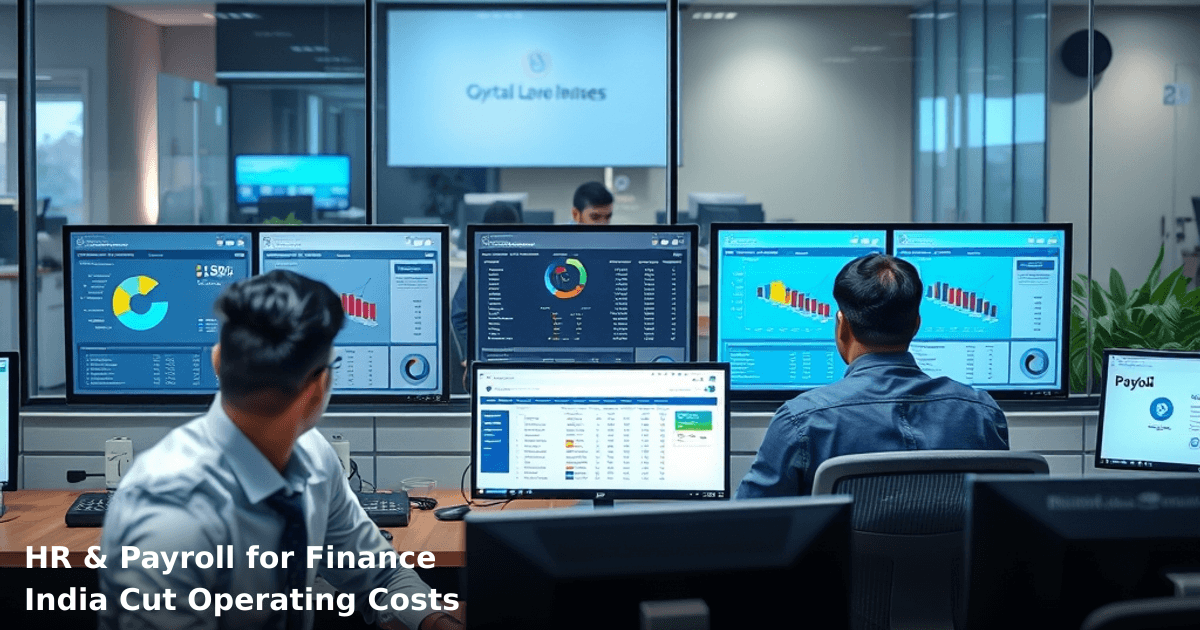
5. Analytics & Reporting Real-time dashboards show payroll costs, headcount trends, and budget vs. actual spending. You know exactly where your money is going.
Comparison: Manual vs. Automated HR & Payroll for Finance India
| Process | Manual (Spreadsheets) | Automated System |
|---|---|---|
| Time per payroll cycle | 8–12 hours | 45 minutes |
| Error rate | 8–12% | 0.2–0.5% |
| Compliance filings per month | 4–6 hours + risk | Auto-generated |
| Cost per employee per year | ₹2,500–₹4,000 (indirect labor) | ₹800–₹1,500 |
| Audit readiness | Manual, incomplete | 100% traceable |
| Setup time | N/A | 2–3 weeks |
7 Ways HR & Payroll for Finance India Cut Operating Costs
Building a SaaS product? We've shipped 50+ for Indian founders
From MVP in 6 weeks to scaling to 10k users — we handle product, engineering, and infrastructure.
1. Eliminate Manual Data Entry (Save ₹40,000–₹60,000/Year)
Right now, your HR person copies attendance data from sheets into your payroll software, then into your accounting system. That's two-three manual steps per employee, per month.
Automated HR & payroll for finance India syncs attendance, salary structures, and bank details across all systems in real-time. No copy-paste. No typos.
Real example: A 25-person finance advisory firm in Bangalore was spending 12 hours monthly on data entry. After switching to automated payroll, that dropped to 2 hours. Annual savings: ₹48,000 in labor cost alone.
2. Cut Compliance Penalties by 95% (Save ₹30,000–₹80,000/Year)
One missed TDS deduction. One wrong EPFO contribution. One late Form 16 filing.
Each costs ₹5,000–₹15,000 in penalties, plus the audit time to fix it.
Automated systems flag compliance issues before they happen. TDS thresholds are pre-set. EPFO contributions auto-calculate. Form 16 generates 10 days before the deadline. You're never late, never wrong.
Real example: A Delhi-based fintech startup had ₹65,000 in compliance penalties over two years. After implementing automated payroll, they haven't had a single penalty in 18 months.
3. Reduce Payroll Processing Errors from 10% to <1% (Save ₹15,000–₹25,000/Year)
Manual payroll = manual mistakes. Wrong salary calculations. Missed deductions. Duplicate payments.
Each error takes 2–4 hours to fix, and costs employee trust.
Automated systems use rule-based calculations. If your salary structure says "HRA = 20% of basic," the system calculates it the same way every single month. No variation. No errors.
Real example: A Mumbai-based insurance brokerage had 8–10 salary disputes per month from calculation errors. After automation, that dropped to zero in the first month.
4. Automate Leave & Attendance Tracking (Save ₹20,000–₹35,000/Year)
Your finance team spends hours each month reconciling leave requests, calculating leave balances, and adjusting salaries for unpaid leave.
Automated systems let employees request leave via WhatsApp or mobile app. The system auto-approves based on your policy. Leave balance updates in real-time. Salary adjusts automatically.
Real example: A Pune-based wealth management firm had 3–4 hours of manual leave reconciliation per month. Automation cut that to 15 minutes.
5. Integrate With Your Finance Software (Save ₹25,000–₹40,000/Year)
Right now, payroll data lives in one system, accounting data in another. You manually reconcile them.
Modern HR & payroll systems integrate directly with Tally, QuickBooks, or your accounting software. Payroll expenses auto-post to the GL. No manual journal entries. No reconciliation headaches.
This integration also ensures your finance team has accurate cost data for budgeting and forecasting.
Real example: A Hyderabad-based financial consulting firm cut month-end close time from 5 days to 2 days after integrating payroll with their accounting software.
6. Enable Real-Time Payroll Analytics (Save ₹18,000–₹30,000/Year)
You don't know your true payroll costs until the month is over. By then, you've already overspent.
Automated systems give you real-time dashboards: payroll costs YTD, cost per employee, budget vs. actual, headcount trends. You spot cost overruns before they spiral.
Real example: A Chennai-based investment advisory firm discovered they were overpaying two employees by ₹8,000/month due to old salary structures. They corrected it and saved ₹96,000 in the first year.
7. Reduce HR Admin Time by 60% (Save ₹50,000–₹80,000/Year)
Your HR person spends 25–30 hours per week on payroll admin: salary slips, compliance reports, employee queries, manual adjustments.
Automated systems cut that to 10–12 hours per week. Salary slips auto-generate and email to employees. Compliance reports are ready in minutes. Employees self-serve for leave, salary details, and documents.
Your HR person now has time for actual HR work: hiring, retention, culture.
Real example: A Delhi NCR-based corporate finance firm reassigned their payroll admin to talent acquisition after automation. They hired 8 new people in the first year—something they couldn't do before because HR was drowning in payroll work.
Step-by-Step Guide to Implementing HR & Payroll for Finance India
Step 1: Audit Your Current Payroll Process
Before you buy anything, map out what you're actually doing:
- How long does payroll take each month? (Days? Hours?)
- What compliance filings do you do? (Form 16, ESI, EPFO, GST, etc.)
- How many errors happen per year?
- What's your current cost (software + labor)?
- Which systems do you use? (Tally, QuickBooks, accounting software?)
Document this. You'll use it to measure ROI after implementation.
Step 2: Choose a System Built for Indian Finance Businesses
Not all payroll software is equal. You need one that:
- Understands Indian tax rules (TDS, GST, ESI, EPFO, LTA, HRA)
- Integrates with your accounting software
- Supports WhatsApp or mobile-based attendance
- Can auto-generate compliance forms (Form 16, Form 12BA, ESI returns)
- Scales from 10 to 500 employees without major reconfiguration
If building custom is better for your business (unique salary structures, complex compliance needs), our CRM Development and ERP Development teams have built payroll modules for finance businesses across India. We can customize it to your exact needs.
Step 3: Migrate Your Historical Data Cleanly
This is where most implementations fail. You need:
- 12 months of historical payroll data (for Form 16 and compliance)
- Current employee master data (name, PAN, bank details, salary structure)
- Leave balances as of the migration date
- Tax regime data (old vs. new tax regime)
Work with the vendor to clean and validate this data before migration. Bad data now = compliance headaches later.
Step 4: Configure Your Salary Structures & Compliance Rules
Set up:
- Basic, HRA, DA, allowances, deductions for each employee or role
- TDS calculation rules based on tax regime
- ESI and EPFO eligibility rules
- Leave policies (paid leave, unpaid leave, carry-forward rules)
- Statutory compliance templates (Form 16, Form 12BA, etc.)
This takes 3–5 days depending on complexity. Your finance team should be involved.
Step 5: Train Your Team & Run a Pilot Payroll
Train your HR and finance team on:
- How to input attendance and leave
- How to run payroll and review reports
- How to approve salary slips before disbursement
- How to generate compliance forms
- How to handle exceptions (bonus, advance, reimbursement)
Run one full payroll cycle in the system before going live. Compare the output with your manual payroll. Fix discrepancies.
Step 6: Go Live & Monitor Closely
On your first live payroll:
- Run the system payroll in parallel with your old method
- Compare results line-by-line
- Verify bank file before uploading
- Get employee feedback on salary slips and documents
- Check compliance reports for accuracy
Most issues surface in the first 2–3 payroll cycles. Fix them immediately.
Step 7: Optimize & Integrate
Once payroll is stable:
- Integrate with your accounting software so payroll expenses auto-post
- Set up automated compliance filing (if your system supports it)
- Connect attendance system to payroll
- Configure dashboards for your finance manager
- Archive manual processes
This is where you start seeing the full ROI.
Common Mistakes to Avoid When Implementing HR & Payroll for Finance India
Mistake 1: Choosing software based on price alone Cheap payroll software often doesn't handle Indian compliance correctly. You'll spend ₹30,000 on software but ₹80,000 on penalties. Choose based on features and Indian tax compliance, not price.
Mistake 2: Not cleaning historical data before migration Bad data in = bad reports out. Spend time cleaning your employee master and payroll history before migrating. It takes a week now or 10 weeks fixing errors later.
Mistake 3: Skipping the pilot payroll Running payroll live without testing is risky. Always run a full cycle in parallel with your old method first. Catch discrepancies before your employees' salaries are affected.
Mistake 4: Not training your team properly Your payroll software is only as good as the person using it. Invest time in training. Have your HR and finance team practice on test data before going live.
Mistake 5: Ignoring integration with accounting software If your payroll system doesn't talk to your accounting software, you're creating duplicate work. Payroll expenses should auto-post to the GL. This is non-negotiable.
Mistake 6: Not setting up compliance reminders Even with automated payroll, compliance deadlines sneak up. Set calendar reminders for Form 16 (Jan 31), EPFO returns (monthly), ESI returns (monthly), GST (monthly). Don't rely on the software alone.
Mistake 7: Choosing a vendor with no Indian experience Global payroll software often doesn't understand Indian tax rules. Choose a vendor or partner who has implemented payroll for Indian finance businesses before. Ask for references.
Key Takeaways
- HR & payroll for finance India reduces operating costs by 25–40% when implemented correctly. That's ₹1.5–2.5 lakh annually for a 20-person team.
- Manual payroll costs you ₹50,000–₹1,50,000 annually in hidden labor, compliance penalties, and errors. Automation pays for itself in 4–6 months.
- Compliance errors are expensive. One missed TDS or EPFO filing costs ₹5,000–₹15,000. Automated systems reduce errors from 8–12% to <1%.
- Integration with accounting software is critical. Payroll data should auto-post to your GL. No manual reconciliation.
- Real-time analytics save you money. You spot cost overruns and budget issues before they spiral.
- Your HR team gets their time back. Less payroll admin = more time on hiring, retention, and culture.
- Implementation takes 2–3 weeks, not months. You can go live in a single payroll cycle if you plan well.
- Choose a vendor with Indian tax expertise. Global software often misses TDS, ESI, EPFO, and GST rules.
Frequently Asked Questions
Quick answers about hr-payroll-for-finance-india
01 How much can I actually save per month by switching to HR & Payroll for Finance India instead of hiring a full-time accountant? ›
Most SMBs we work with save ₹15,000–₹35,000 monthly—that's the difference between paying a dedicated accountant (₹25,000–₹50,000/month salary + benefits) versus our platform fee of ₹8,000–₹15,000/month depending on employee count. If you have 20–50 employees, you're looking at 40–60% cost reduction within the first quarter alone, plus you eliminate compliance penalties that typically run ₹5,000–₹50,000 annually for late filings.
02 How long does it take to migrate my existing payroll data and go live on the system? ›
The entire onboarding takes 7–10 business days for most companies with 50 or fewer employees. We handle data import on day 1–2, your team gets trained on day 3–4, and you run a parallel payroll (old system + new system together) for one cycle to catch any discrepancies—then you're fully live by day 10. The only delay typically comes if your previous records are incomplete; we've seen that add 3–5 days.
03 Is HR & Payroll for Finance India suitable for my 8-person startup, or is it really built for bigger companies? ›
It works perfectly for startups—actually, 8 people is our sweet spot for maximum ROI. You'll pay ₹5,000–₹8,000/month and eliminate the chaos of manual Excel sheets and late PF deposits that cost startups ₹2,000–₹5,000 in penalties per year. We have clients with 5 employees and others with 500; the platform scales, so you're not paying for features you don't need.
04 I've heard that automating payroll means I'll lose control—is that actually true? ›
That's the biggest misconception we encounter, and it's the opposite of reality. You get more control because every transaction is logged, auditable, and you can pull real-time reports in 30 seconds instead of waiting 2 days for your accountant. You still approve salaries, deductions, and reimbursements—the system just stops the manual data entry errors that cause 70% of payroll disputes we see.
05 What's the first step if I want to get started this month? ›
Book a 20-minute call with our onboarding team and bring your last 2–3 payroll sheets and your employee list. We'll give you a custom quote (usually within ₹500 of our standard pricing) and a go-live date—most clients who decide on the call start within 48 hours. If you're worried about disruption, we typically recommend starting at the beginning of your next payroll cycle, which gives you 10–15 days to prepare.
Need this built for your business?
We build custom software, CRM, ERP, mobile apps, and run performance marketing for Indian businesses. Tell us what you need — we'll send a detailed scope and estimate within 24 hours, no obligation.
- Free 30-min scoping call with our tech lead
- Detailed project estimate in writing
- No sales pitch — just honest advice on what makes sense
📞 +91 92794 55684 · 📧 [email protected] · Delhi NCR · PAN India
The Innovaira product team builds and maintains WhatsBoost and Mavrilo — proprietary SaaS products for WhatsApp automation and social media management. ISO 27001:2022 certified for information security.