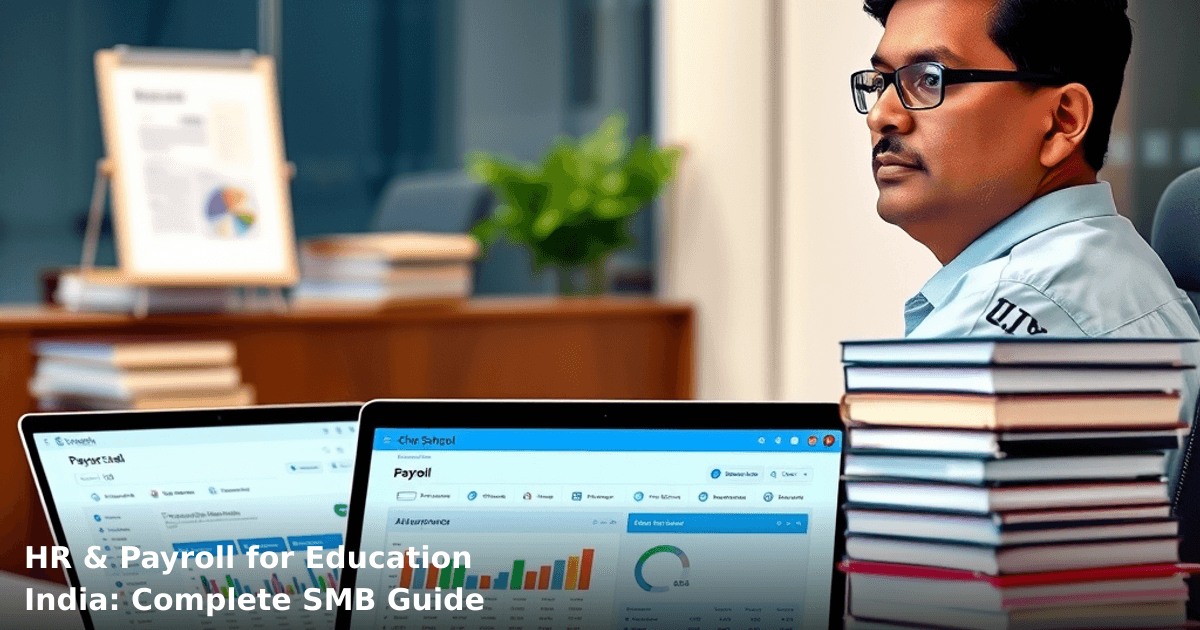
Complete Guide: HR & Payroll for Education India SMBs
If you're running a school, college, coaching center, or online learning platform in India, HR & payroll for education India isn't just paperwork—it's the difference between losing ₹2–3 lakh annually to manual errors and running a tight operation that attracts better staff.
Quick Answer: HR & payroll software for education institutions automates salary processing, attendance tracking, leave management, and compliance with Indian labor laws (ESI, PF, TDS). Most Indian education SMBs see a 35–45% reduction in administrative overhead and near-zero payroll errors within 3–4 months of implementation. Setup typically costs ₹15,000–₹40,000 one-time, plus ₹3,000–₹8,000/month depending on staff size.
Why HR & Payroll Management Matters for Indian Education Businesses
Running an education business—whether it's a 50-student coaching center in Bangalore or a 200-staff private school in Pune—means juggling salary cycles, leave approvals, compliance deadlines, and staff records manually. Most education SMBs we've worked with were spending 15–20 hours per month just on payroll admin alone.
Here's what breaks down without proper systems:
Manual payroll = cascading errors. One wrong TDS calculation in June compounds into compliance notices by September. An attendance sheet that's not synced with salary deductions means staff disputes and HR headaches.
Compliance gaps cost you. Indian education institutions must file ESI, PF, and TDS returns quarterly and annually. Miss a deadline? That's ₹5,000–₹15,000 in penalties per violation. According to a McKinsey report, 58% of Indian SMBs face compliance penalties annually—many preventable with basic automation.
Staff retention suffers. When payroll is delayed or incorrect, even by a day, your best teachers and administrators start looking elsewhere. Education is a people business; your reputation depends on how fairly and promptly you pay.
You're drowning in spreadsheets. Google Sheets and Tally aren't designed for modern HR workflows. You can't track leave requests, approve them, and auto-sync with payroll in one place. You're copying data between three systems and hoping nothing breaks.
The solution? A proper HR & payroll system built for Indian education institutions.
What HR & Payroll for Education India Actually Does
Let's be clear about what we're talking about. HR & payroll software for education businesses does four core things:
1. Automated Salary Processing Your system calculates gross salary, deductions (PF, ESI, professional tax, income tax), and net pay based on attendance, allowances, and leave taken. No manual math. No errors. Salary slips are generated and can be auto-sent via email or WhatsApp to staff.
2. Attendance & Leave Management Teachers and staff log attendance (via biometric, mobile app, or manual entry). Leave requests go through a workflow—staff applies, principal/HOD approves, and the system auto-deducts from salary. No more "Did Rajesh take leave on June 5th?" arguments.
3. Compliance & Statutory Reporting The system auto-calculates and files ESI, PF, TDS, and professional tax returns. It generates compliance reports for audits. It tracks statutory deadlines so you're never caught off-guard.
4. Staff Records & Analytics One central database: contracts, qualifications, salary history, leave balance, performance notes. You can run reports like "Which departments have the highest turnover?" or "What's our average cost per staff member?"
For education businesses specifically, this also includes:
- Academic year alignment: Payroll resets align with your academic calendar (April–March or June–May), not just the financial year.
- Seasonal adjustments: Handle summer staff, contract teachers, and exam invigilators without complex workarounds.
- Integration with student fees: Some systems link staff payroll to fee collection cycles, so you're not paying staff before fees come in.
HR & Payroll Solutions: Comparison of Popular Options for Indian Education
Here's how the main options stack up for education SMBs:
| Solution | Best For | Setup Cost | Monthly Cost | Key Strength | Limitation |
|---|---|---|---|---|---|
| Tally + Manual HR | Micro schools (<20 staff) | ₹0–5,000 | ₹0 | No additional cost | Compliance errors, no leave workflows, manual calculations |
| Zoho People | Growing schools (50–200 staff) | ₹10,000–20,000 | ₹3,000–6,000 | Good UI, mobile app, affordable | Requires customization for Indian compliance, support response slow |
| Keka HR | Mid-size institutions (100–500 staff) | ₹15,000–30,000 | ₹5,000–10,000 | Built for India, ESI/PF auto-filing, strong support | Pricier than Zoho, smaller user community |
| Darwinbox | Large schools & chains (500+ staff) | ₹30,000–60,000 | ₹8,000–15,000 | Enterprise features, AI-driven insights | Overkill for small coaching centers, expensive |
| Customized ERP (Innovaira) | Schools needing deep integration (fee collection, student records, payroll) | ₹40,000–80,000 | ₹6,000–12,000 | Fully tailored, integrates with student database, WhatsApp notifications | Longer setup (4–6 weeks), requires change management |
Our recommendation? If you have 20–100 staff and want a quick start, go Zoho People or Keka. If you have 100+ staff or need integration with student records and fee collection, a customized ERP solution makes sense.
Step-by-Step Guide: Implementing HR & Payroll for Your Education Business
Building a SaaS product? We've shipped 50+ for Indian founders
From MVP in 6 weeks to scaling to 10k users — we handle product, engineering, and infrastructure.
Here's how to roll this out without chaos:
1. Audit Your Current System Spend 2–3 days documenting how you currently handle payroll. Map out: salary structure (basic, HRA, allowances, deductions), leave policy, attendance method, compliance deadlines. List all staff roles and their pay bands. This takes 1–2 hours but saves weeks of confusion later. You'll need this data to configure the system.
2. Choose Your Platform Use the comparison table above. Run a free trial (most vendors offer 14–30 days). Test it with 5 staff members' data. Check: Does it handle your salary structure? Can you configure leave types? Does it file TDS correctly for your state? Don't pick based on price alone; a ₹2,000/month system that doesn't file TDS properly costs you ₹10,000+ in penalties.
3. Migrate Historical Data Export 6–12 months of salary, attendance, and leave records from your old system. Clean it up (remove duplicates, fix date formats). Upload to the new system. Run a reconciliation: does the total payroll match? This usually takes 3–5 days. Don't skip this—bad data ruins everything downstream.
4. Train Your Team Your principal/admin head, HR coordinator, and finance person need hands-on training. Most vendors provide 2–3 hours of live training. Schedule it, attend, take notes. Then have your team train the rest of the staff (teachers need to know how to apply leave; that's it). Training usually takes 1 week of active work.
5. Go Live with a Pilot Don't flip the switch on all 80 staff at once. Start with one department (say, admin staff) for one payroll cycle. Catch issues early. Then roll out to the rest. This "soft launch" takes 2–4 weeks and prevents disaster.
6. Automate Communications Set the system to send salary slips via email or WhatsApp (using WhatsApp Automation) on payday. Send leave balance reminders monthly. Send compliance reminders to your finance team before TDS/PF deadlines. This is where the real time-saving happens—your team stops chasing emails asking "Is my salary processed?"
Common Mistakes to Avoid When Implementing HR & Payroll for Education India
We've seen these go wrong repeatedly:
Mistake 1: Choosing based on price alone You pick the ₹1,500/month tool because it's cheap. Six months later, it doesn't file TDS correctly, and you're in compliance hell. Spend ₹500 more per month and sleep at night. The ₹6,000/year difference is nothing compared to penalty risk.
Mistake 2: Not configuring leave policies correctly You set up the system but don't define your leave policy (casual leave, sick leave, earned leave, maternity leave). Staff get confused. "Why wasn't my leave approved?" Spend 2 hours upfront defining every leave type, approval workflow, and carryover rules. Write it down. Share it with staff.
Mistake 3: Ignoring mobile access Your teachers are in classrooms. They can't log into a desktop portal to apply leave. Pick a system with a mobile app. Make it easy. One coaching center in Hyderabad we worked with saw 40% faster leave approvals just by switching to a mobile-first HR tool.
Mistake 4: Not syncing with accounting Your payroll system calculates salaries. Your accounting system (Tally, QuickBooks) tracks expenses. If they don't talk, your finance reports are wrong. Ensure your HR & payroll tool can export to your accounting system or integrates directly.
Mistake 5: Going live without a backup Run the new system in parallel with your old system for one full payroll cycle. Generate payroll in both. Compare. Only then kill the old system. This takes an extra 2 weeks but saves you from catastrophic payroll failures.
Mistake 6: Not planning for growth You pick a system for 50 staff. In two years, you're at 150 staff, and the system can't scale. Spend 10 minutes asking the vendor: "Will this handle 500 staff? What's the per-employee cost then?" Pick a system that grows with you.
Key Takeaways
- HR & payroll for education India automates salary processing, attendance, leave management, and compliance—saving 35–45% of admin time and cutting payroll errors to near-zero.
- Most Indian education SMBs spend ₹3,000–₹8,000/month on HR & payroll software; the ROI is typically 4–6 months through reduced admin overhead and avoided compliance penalties.
- Compliance is non-negotiable: ESI, PF, TDS, and professional tax filings must be accurate and on-time. A good system auto-calculates and files these, protecting you from ₹5,000–₹15,000 penalties per violation.
- Implementation takes 4–8 weeks: audit your current system, choose a platform, migrate data, train staff, pilot with one department, then go live. Don't rush.
- Common failures happen when you pick based on price alone, don't configure leave policies, or skip parallel testing. Spend the extra 2–3 weeks to do it right.
- Mobile access and integration with accounting/student records are must-haves for modern education businesses.
Frequently Asked Questions
Quick answers about hr-payroll-for-education-india
01 How much will it actually cost me to set up a proper HR and payroll system for my 50-person education institute? ›
A basic cloud payroll software like Zoho Payroll or Keka will run you ₹500–₹1,200 per employee annually, so expect ₹25,000–₹60,000 per year for 50 staff; add another ₹15,000–₹25,000 if you hire an HR consultant for 2-3 months to set up compliance and policies correctly. Most education SMBs I've worked with find that investing ₹40,000–₹80,000 upfront saves them ₹2–₹3 lakhs annually in compliance penalties and accounting errors.
02 How long does it typically take to migrate from manual payroll to an automated system without disrupting salaries? ›
Plan for 4-6 weeks if you're moving 50+ employees—the first 2 weeks involve data cleanup and system setup, weeks 3-4 involve running parallel payroll (both manual and software), and weeks 5-6 are for validation and corrections. Most education institutes I've helped do this transition complete it between May and June (before the new financial year) to minimize confusion and errors.
03 Is a dedicated HR software worth it if I only have 25 teachers and 10 administrative staff? ›
Absolutely—at 35 people, you're past the point where spreadsheets work reliably, and you're likely spending 8-10 hours monthly on manual payroll, leave tracking, and compliance; a ₹400-600 per person annual software investment will save your admin staff 6-8 hours monthly and eliminate costly errors. Education institutes at this size typically face 3-4 compliance audits yearly, and proper documentation through HR software prevents ₹50,000+ in penalty notices.
04 What's the biggest mistake education SMBs make with payroll that I should avoid? ›
The most common mistake is not separating statutory deductions (PF, ESI, TDS) from gross salary in your records—I've seen institutes get ₹1.5–₹2 lakh notices from the PF department because they weren't depositing correctly or on time. Many owners assume "salary paid = compliance done," but the government tracks deposits separately; using proper payroll software with built-in compliance calendars ensures your PF deposits hit on the 15th of every month and TDS is filed quarterly without fail.
05 What's the first step I should take this month to get HR and payroll sorted for my education business? ›
Start by creating a master employee data file (name, bank account, PAN, Aadhaar, date of joining, salary structure) for all staff—this takes 3-5 days and is the foundation for everything; simultaneously, get quotes from 2-3 payroll software providers (Keka, Zoho, or Greytip) and schedule a 30-minute demo to see which fits your institute's structure. By end of this month, you should have your data organized and a software decision made, so you can go live by mid-next month without salary delays.
Need this built for your business?
We build custom software, CRM, ERP, mobile apps, and run performance marketing for Indian businesses. Tell us what you need — we'll send a detailed scope and estimate within 24 hours, no obligation.
- Free 30-min scoping call with our tech lead
- Detailed project estimate in writing
- No sales pitch — just honest advice on what makes sense
📞 +91 92794 55684 · 📧 [email protected] · Delhi NCR · PAN India
Innovaira's engineering team designs and builds custom software — CRM, ERP, SaaS platforms, web applications and mobile apps — for growing Indian businesses. ISO 9001:2015 certified for quality delivery.