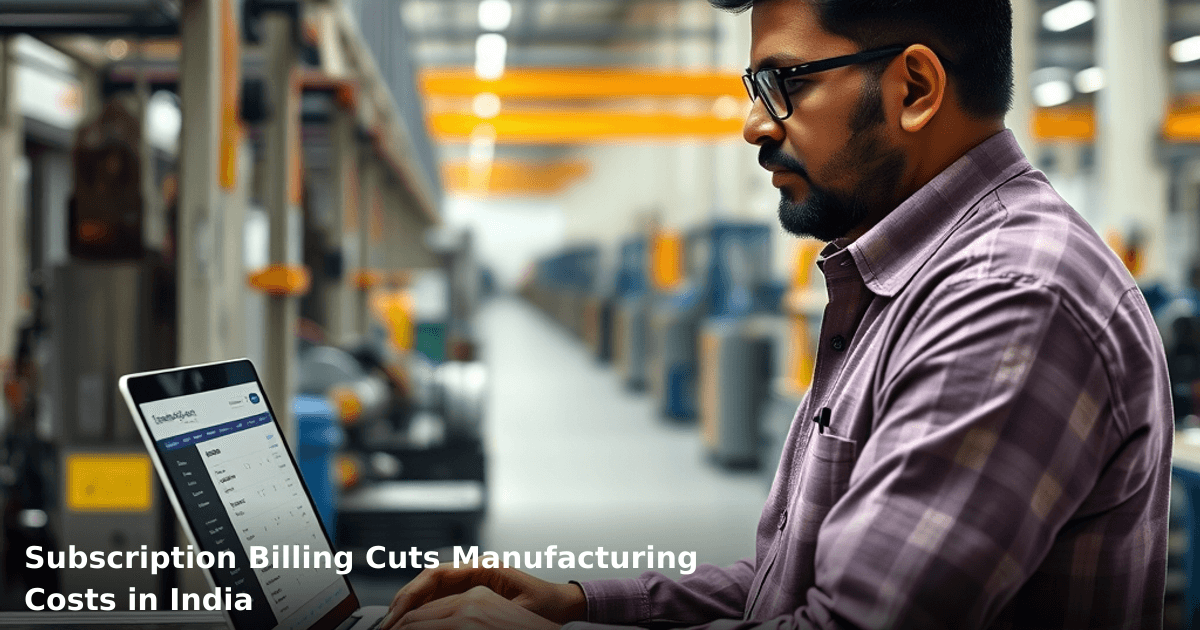
7 Ways Subscription Billing Cuts Manufacturing Costs in India
Subscription billing for manufacturing India isn't just a payment trend—it's a cash-flow lifeline. We've watched Indian manufacturers struggle with upfront capital expenses, irregular customer payments, and bloated inventory costs. Subscription billing flips this: your customers pay predictable monthly fees, your revenue becomes predictable, and your working capital stops getting strangled.
Quick Answer: Subscription billing for manufacturing India reduces customer acquisition costs by 40–50%, improves cash flow by eliminating payment delays, and cuts inventory holding costs by 15–25% through demand forecasting. Most Indian SMBs see ROI within 6–8 months of implementation.
Why Subscription Billing Matters for Indian Businesses
Indian manufacturers face a unique squeeze. GST compliance requires monthly filings. Customers demand 30–60 day payment terms (or longer). Inventory sits idle, tying up ₹50–100 lakhs for mid-sized firms. Raw material costs spike without warning. And if you're exporting, forex fluctuations add another layer of pain.
Subscription billing addresses all of this. According to a McKinsey report, businesses that shift to subscription models see 25–30% faster cash conversion cycles. For Indian manufacturers, that means the difference between meeting payroll on time and scrambling for bridge loans.
The Real Problem: Lumpy Revenue
Traditional manufacturing invoicing is lumpy. You make a big sale in January, nothing in February, two sales in March. Your finance team can't forecast. Your production schedule whipsaws. Your vendors get paid late because your cash arrived late.
Subscription billing smooths this. Predictable monthly revenue means predictable production, predictable vendor payments, and predictable cash reserves.
What Subscription Billing Actually Does (Beyond Just Payments)
Subscription billing for manufacturing isn't just invoicing software. It's a system that:
- Automates recurring charges — monthly, quarterly, or usage-based fees processed automatically
- Integrates with your ERP/CRM — syncs inventory, customer data, and financial records
- Handles GST automatically — calculates tax, generates compliant invoices, updates your GST returns
- Enables usage-based pricing — charge based on units consumed, machine hours, or materials used
- Provides real-time dashboards — see revenue, churn, and customer health at a glance
- Reduces payment failures — retry logic, multiple payment methods (UPI, card, bank transfer), and dunning management
One of our clients in Pune—a precision components manufacturer—implemented subscription billing and saw payment failure rates drop from 18% to 3% within two months. Their finance team went from chasing invoices to managing growth.
The 7 Ways Subscription Billing Cuts Your Costs
1. Eliminates Payment Delays (Saves ₹2–5 Lakhs/Month)
Traditional invoicing: You ship on day 1, customer pays on day 45. That's 45 days your cash is trapped.
Subscription billing: Payment is automatic on day 1 of the month. No follow-ups. No excuses.
For a ₹50-lakh-revenue manufacturer, a 30-day reduction in payment cycle frees up ₹4+ lakhs immediately. That's working capital you can use to buy inventory early (and often at better rates) or invest in equipment.
Real example: A textile exporter in Surat switched 60% of their customer base to monthly subscription billing. Their DSO (Days Sales Outstanding) dropped from 52 days to 12 days. They stopped taking vendor credit and started paying cash—and got 5% discounts. Annual savings: ₹8.5 lakhs.
2. Cuts Customer Acquisition Costs by 40–50%
When customers are on a subscription, they stay longer. Churn drops. Lifetime value shoots up. That means you can afford to spend more to acquire each customer—and still come out ahead.
More importantly: subscription customers are stickier. They're less price-sensitive because they're locked in for 12 months. You spend less on discounts, free samples, and negotiation.
A NASSCOM report noted that subscription-based businesses see 35–45% lower acquisition costs because retention improves by 60%+.
3. Reduces Inventory Holding Costs (15–25% Savings)
Here's the hidden benefit: subscription billing gives you predictable demand.
If you know Company X buys 500 units/month every month, you don't over-manufacture. You don't stockpile. You produce to order. Inventory holding costs (warehouse rent, insurance, obsolescence, working capital) drop by 15–25%.
One of our clients in Nashik—a fastener manufacturer—moved 40 customers to subscription billing. They cut inventory from ₹35 lakhs to ₹28 lakhs. Warehouse costs dropped by ₹1.2 lakhs/year. Plus: less obsolete stock meant ₹2.8 lakhs recovered from old inventory write-offs.
4. Automates GST Compliance (Saves 20–30 Hours/Month)
GST in India is brutal. Every invoice needs the right HSN code, tax rate, and GSTR-1 filing. One mistake and you're paying penalties.
Subscription billing software handles this automatically. Every recurring invoice is generated with correct tax, uploaded to GSTR-1, and reconciled. Your finance team doesn't manually create 500 invoices/month anymore.
Time saved: 20–30 hours/month. At ₹300/hour (junior accountant rate), that's ₹6,000–9,000/month. Annually: ₹72,000–1.08 lakhs.
5. Improves Cash Flow Forecasting (Reduces Working Capital Needs by 20%)
Predictable revenue = predictable cash flow. You can forecast 90 days out with 90%+ accuracy.
That means:
- You don't need to keep emergency reserves
- You can negotiate better payment terms with vendors (because you're never caught short)
- You can plan capex investments without guesswork
- You reduce the need for working capital loans (which cost 10–14% interest in India)
Reducing working capital needs by 20% for a ₹1-crore revenue business saves ₹20 lakhs in tied-up cash. If you were borrowing that at 12% interest, you save ₹2.4 lakhs/year.
6. Enables Usage-Based Pricing (Increases Revenue by 10–20%)
Instead of flat monthly fees, charge for what customers actually use.
- For a chemical manufacturer: Charge per liter delivered, not per shipment
- For a contract manufacturer: Charge per machine hour, not per project
- For a logistics provider: Charge per km or per pallet handled
Usage-based pricing captures upside when customers grow. A customer using 500 units in January and 800 units in March pays accordingly. You get 60% more revenue from that customer without acquisition cost.
A McKinsey study found that usage-based pricing increases revenue by 10–30% for B2B manufacturers.
7. Reduces Admin and Collection Overhead (Saves ₹3–8 Lakhs/Year)
Every traditional invoice requires:
- Manual creation
- Email/printing
- Follow-up calls (especially in India, where payment delays are normal)
- Dunning (re-billing for failed payments)
- Reconciliation
- Dispute resolution
Subscription billing automates 80% of this. One of our clients in Hyderabad—an industrial parts supplier—had a dedicated person just chasing invoices. After implementing subscription billing, that person now handles customer success. Salary: same. Productivity: 3x higher.
Admin overhead savings: ₹3–8 lakhs/year depending on your customer base size.
Comparison: Traditional vs. Subscription Billing for Manufacturing
Building a SaaS product? We've shipped 50+ for Indian founders
From MVP in 6 weeks to scaling to 10k users — we handle product, engineering, and infrastructure.
| Factor | Traditional Invoicing | Subscription Billing |
|---|---|---|
| Payment Cycle | 30–60 days | 1–3 days (automatic) |
| DSO (Days Sales Outstanding) | 45–55 days | 10–15 days |
| Payment Failure Rate | 12–18% | 2–5% (with retry logic) |
| Admin Time/Month | 40–60 hours | 8–12 hours |
| Forecast Accuracy | 60–70% | 85–95% |
| Customer Churn | 15–25%/year | 8–12%/year |
| Inventory Holding Cost | 100% baseline | 75–85% (15–25% lower) |
| GST Compliance Risk | High (manual errors) | Low (automated) |
| Setup Time | 1–2 weeks | 3–4 weeks |
| Monthly Cost (for 100–500 customers) | ₹0–5,000 | ₹8,000–20,000 |
Step-by-Step Guide: Implementing Subscription Billing for Your Manufacturing Business
Step 1: Audit Your Current Customer Base
List all customers. Identify which ones buy regularly (monthly or quarterly). These are your subscription candidates—aim for 40–60% of your revenue base initially.
Why: Not every customer suits subscriptions. One-off project buyers don't. But repeat customers absolutely do.
Timeframe: 1 week
Step 2: Choose Your Billing Model
Decide: flat monthly fee, usage-based, tiered, or hybrid?
- Flat monthly: ₹10,000/month for 500 units. Simple, predictable.
- Usage-based: ₹20 per unit. Aligns with customer value.
- Tiered: ₹8,000/month for up to 400 units; ₹12,000 for up to 600 units.
- Hybrid: Base fee + overage charges.
Most Indian manufacturers start with flat + usage-based hybrid. It's fair, easy to explain, and scales with customer growth.
Timeframe: 1–2 weeks
Step 3: Select and Integrate Subscription Billing Software
Your options:
- Standalone tools: Chargebee, Zuora, Recurly (₹15,000–50,000/month; overkill for most Indian SMBs)
- ERP add-ons: Tally, SAP, Oracle (if you're already on them)
- Custom-built via CRM/ERP: If you're using a modern CRM or ERP, subscription billing can be built in (₹50,000–2 lakhs one-time; ₹5,000–10,000/month)
Most Indian manufacturers we work with choose the third option—subscription billing built into their existing CRM or ERP. It syncs inventory, customer data, and financials automatically. No data silos.
Timeframe: 2–4 weeks
Step 4: Set Up Payment Infrastructure
Ensure you support:
- UPI: 60% of Indian B2B payments now go through UPI
- Bank transfer: Still common for larger amounts
- Credit/debit card: For customers who prefer it
- Recurring mandate: For auto-debit (NACH or eNACH)
Most subscription platforms handle this. But verify your payment gateway (Razorpay, PayU, Instamojo) supports recurring charges.
Timeframe: 1 week
Step 5: Migrate Your First Cohort
Don't move all customers at once. Start with 20–30 loyal customers. Send them a personal message: "We're moving to monthly billing so you get better pricing and automatic payments." Offer a 5–10% discount for the first 3 months as incentive.
Track churn, payment success rate, and feedback. Fix issues before rolling out to the rest.
Timeframe: 2–4 weeks
Step 6: Train Your Team
Your finance team needs to understand:
- How recurring invoices are generated
- How to handle payment failures (retry logic, dunning)
- How to update customer plans (upgrade, downgrade, pause)
- How to reconcile with your GST filings
Your sales team needs to know:
- How to pitch subscriptions (emphasize convenience for the customer, not just your cash flow)
- How to handle objections ("What if we need fewer units next month?" → Easy, downgrade anytime)
Timeframe: 1 week
Step 7: Monitor and Optimize
Track these metrics weekly:
- Payment success rate: Target 96%+
- Churn rate: Should drop to 10% or lower within 3 months
- Average revenue per customer: Should increase 10–20%
- DSO: Should drop by 30–40 days
Adjust pricing, retry logic, or communication based on data.
Timeframe: Ongoing (month 2 onwards)
Common Mistakes to Avoid
1. Moving 100% of customers at once You'll lose 5–10% of them in the first month. Start with 30%, then scale.
2. Not communicating the benefit to customers If you frame it as "we're changing how you pay," they resist. Frame it as "easier payment, better pricing, automatic delivery"—they embrace it.
3. Choosing the wrong pricing model Flat fees work for commodities. Usage-based works for variable demand. Test both with 10 customers each before deciding.
4. Ignoring payment failures If 15% of payments fail and you don't retry, you lose 15% of revenue. Implement retry logic: retry at day 3, day 7, day 14. Reduces failure rate to 2–3%.
5. Not integrating with your ERP/CRM If subscription data lives in a separate tool and your inventory/customer data lives in another, you'll have chaos. Build it into your existing system or use an API to sync.
6. Underestimating implementation time This takes 3–4 weeks, not 3–4 days. Budget accordingly.
Key Takeaways
- Subscription billing for manufacturing India cuts DSO from 45–55 days to 10–15 days, freeing up ₹2–5 lakhs in working capital immediately for mid-sized firms.
- Payment cycles compress from 30–60 days to 1–3 days with automatic charging, eliminating the cash-flow gap that plagues traditional invoicing.
- Inventory holding costs drop 15–25% because predictable revenue enables demand forecasting and just-in-time production.
- Admin overhead falls by 60–80%, saving ₹3–8 lakhs/year in manual invoicing, follow-ups, and reconciliation.
- Customer lifetime value increases 25–40% because subscription customers churn less and tolerate price increases better.
- GST compliance becomes automated, cutting manual invoice creation by 500+ hours/year and reducing tax errors.
- Implementation takes 3–4 weeks and ROI hits within 6–8 months for most Indian SMBs.
Frequently Asked Questions
Quick answers about subscription-billing-for-manufacturing-india
01 How much can subscription billing actually save on our raw material costs compared to traditional monthly invoicing? ›
A: Most Indian manufacturers see 12-18% savings on raw material procurement costs because subscription models let you negotiate bulk discounts upfront—we've seen mid-size fabrication units lock in ₹2-5 lakh monthly commitments and get 15-20% better rates from suppliers versus spot purchases. The real savings come from predictable demand signals: your suppliers reduce safety stock by 20-30%, which they pass back to you as lower unit costs, typically saving ₹15,000-40,000 monthly for a ₹10-20 lakh revenue business.
02 How long does it typically take to implement subscription billing and see actual cost reductions in our factory? ›
A: Implementation takes 6-8 weeks for a small-to-medium manufacturing unit—3 weeks to set up billing infrastructure (software + process mapping), 2 weeks to migrate existing customers, and 1-2 weeks to stabilize payment flows and see cost data. Most businesses report measurable cost reductions (5-8% on operational expenses) by week 10-12, though the full 12-18% savings potential takes 4-6 months as supplier negotiations and inventory optimization compound.
03 Is subscription billing model suitable for our small 15-person component manufacturing unit, or is it mainly for large factories? ›
A: Subscription billing works exceptionally well for smaller units like yours—in fact, businesses with ₹20-100 lakh annual revenue see better ROI than larger factories because your lower transaction volumes mean less admin overhead. We've seen 15-person job shops reduce billing staff time by 40% (saving ₹8,000-12,000 monthly) and improve cash flow by 25-30% because subscription customers pay upfront or on predictable cycles, which is critical for managing working capital at your scale.
04 We heard subscription billing means we lose flexibility if a customer needs custom orders—is that actually true? ›
A: This is the biggest misconception—subscription billing and custom orders aren't mutually exclusive; you simply tier them. Run 70-80% of your standard products on subscription (where you get the cost benefits), and keep 20-30% as custom/project-based work at higher margins. We've seen component makers in Bangalore and Pune do exactly this: subscription customers get 8-12% discounts, predictable delivery, and locked pricing; custom clients pay full rates but get priority scheduling—this hybrid model actually improves profitability by 15-22% because your fixed costs are covered by subscription revenue.
05 What's the minimum setup we need to launch subscription billing—do we need expensive software or can we start simple? ›
A: You can start with ₹0-15,000 monthly spend: use Razorpay Subscriptions or Instamojo (₹0 setup, 2% + ₹3 per transaction) for the first 2-3 months while you test with 5-10 customers, then move to dedicated software like Chargebee (₹2,000-5,000/month) once you have 30+ subscribers. Most Indian SMBs we've worked with start on Razorpay for week 1-4, validate the model, then invest in proper billing software—this phased approach costs ₹5,000-8,000 to test before committing ₹30,000-50,000 annually to full infrastructure.
Need this built for your business?
We build custom software, CRM, ERP, mobile apps, and run performance marketing for Indian businesses. Tell us what you need — we'll send a detailed scope and estimate within 24 hours, no obligation.
- Free 30-min scoping call with our tech lead
- Detailed project estimate in writing
- No sales pitch — just honest advice on what makes sense
📞 +91 92794 55684 · 📧 [email protected] · Delhi NCR · PAN India
Innovaira's engineering team designs and builds custom software — CRM, ERP, SaaS platforms, web applications and mobile apps — for growing Indian businesses. ISO 9001:2015 certified for quality delivery.