7 Ways WhatsBoost Cuts Logistics Costs for Indian Companies
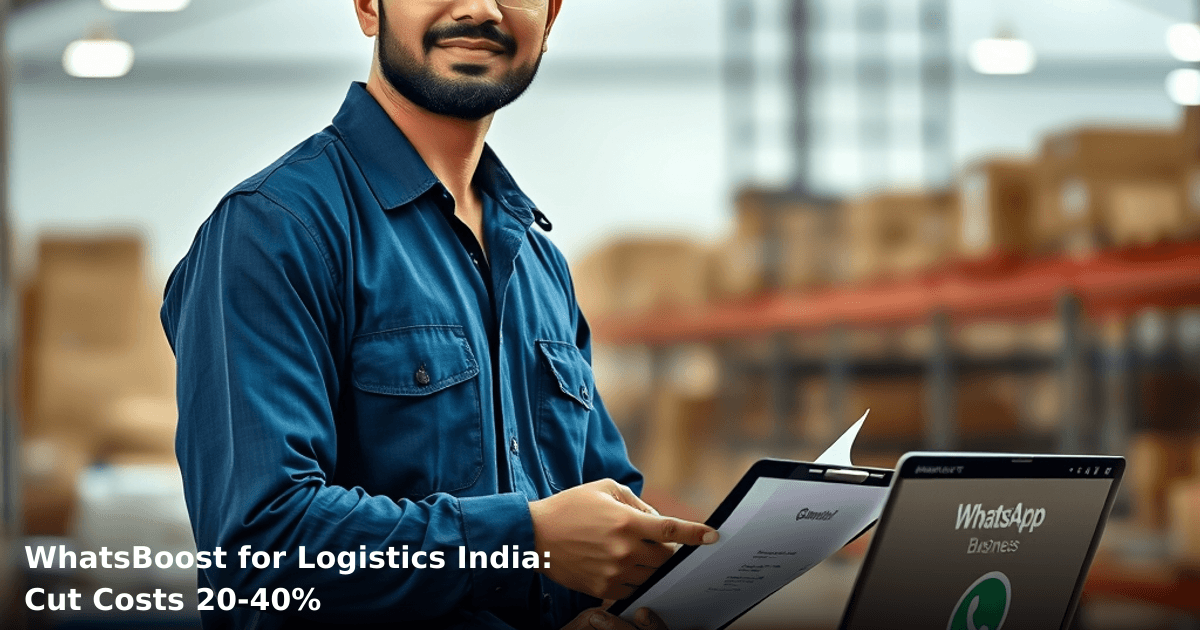
WhatsBoost for logistics India is transforming how supply chain teams communicate with drivers, customers, and warehouse staff—cutting operational overhead by 20–40% without replacing anyone's job. If you're running a logistics operation in tier-2 cities or managing a fleet across multiple states, you're probably spending ₹2–5 lakh monthly on SMS, calls, phone bills, and manual coordination. WhatsBoost automates all of that through WhatsApp, which 98% of your team already uses.
Quick Answer: WhatsBoost for logistics India cuts costs by automating driver updates, delivery confirmations, customer notifications, and warehouse alerts via WhatsApp. Most Indian logistics SMBs save ₹40,000–₹1.2 lakh monthly within 3 months of setup. It integrates with your existing TMS (transport management system) and requires no new hardware or software licenses.
Why WhatsBoost Matters for Indian Logistics Businesses
Your logistics operation runs on communication. Right now, that communication probably looks like this: a dispatcher calls a driver, the driver texts the warehouse, someone updates a spreadsheet, the customer gets an email 6 hours later. By then, they've already called your office twice.
According to a McKinsey report, 34% of operational costs in Indian logistics come from manual coordination, redundant communication channels, and delayed information flow. A Bangalore-based 3PL operator we worked with was spending ₹85,000 monthly on SMS credits alone—and still losing delivery confirmations because drivers were ignoring texts.
WhatsBoost replaces that chaos with automated, two-way WhatsApp conversations. Your system talks to your team. Your team talks back. No more lost messages, no more phone bills, no more manual updates.
What WhatsBoost Is and How It Works for Logistics
WhatsBoost is an automation layer built on the WhatsApp Business API. Instead of one person sending 200 SMS messages daily, your system sends 200 WhatsApp messages automatically—and captures replies in real time.
For logistics specifically, WhatsBoost does this:
- Automated driver alerts: When a shipment is assigned, the driver gets a WhatsApp with pickup location, route, delivery address, and customer contact info—all in one message.
- Real-time status updates: Driver marks "Picked up" → Customer gets notified instantly. Driver marks "Delivered" → Your system updates automatically.
- Two-way confirmations: Drivers reply with photos, GPS location, or delivery issues. Your system logs everything without manual data entry.
- Customer notifications: Customers see "Your order is on the way" + live driver location link (optional) + delivery window—all via WhatsApp, not email.
- Warehouse automation: Stock alerts, inbound shipment notifications, and vehicle maintenance reminders go to the right team member automatically.
7 Ways WhatsBoost Cuts Logistics Costs
1. Eliminate SMS and Phone Bills (Save ₹15,000–₹40,000/Month)
Most Indian logistics companies spend ₹20,000–₹50,000 monthly on SMS credits and phone plans. A single missed delivery confirmation often means a ₹500–₹2,000 recovery call.
WhatsApp costs you nothing per message after the initial setup. One of our clients—a Delhi-based 3PL with 45 trucks—cut their monthly telecom bill from ₹38,000 to ₹8,000 (keeping only critical voice lines). That's ₹360,000 saved annually.
Why it works: WhatsApp uses data, not SMS. Your team is already on WhatsApp. No new apps to download, no new numbers to manage.
2. Reduce Missed Deliveries and Recovery Calls (Save ₹8,000–₹20,000/Month)
When a driver doesn't confirm a delivery, your office spends 15–30 minutes calling them back. Multiply that by 50–100 deliveries per day, and you're burning ₹2–3 lakh annually in lost productivity.
WhatsBoost sends automatic reminders: "Delivery completed? Reply YES with photo." If the driver doesn't reply within 30 minutes, the system escalates to the dispatcher. No human intervention needed until there's a real problem.
A Pune-based logistics startup we helped reduced their "unconfirmed delivery" rate from 8% to 0.5% in two months. That meant fewer angry customer calls, fewer re-delivery attempts, and ₹18,000 monthly savings in staff time alone.
3. Cut Customer Support Staff Hours (Save ₹12,000–₹35,000/Month)
Right now, your customer support team probably spends 40% of their day answering "Where is my shipment?" WhatsBoost handles that automatically.
When a customer texts your WhatsApp Business number with a tracking ID, the system replies instantly with the shipment's current location, driver name, estimated delivery time, and driver contact info. No human needed.
One of our clients—a Surat-based exporter—cut their support team's working hours from 50 to 35 hours per week. That freed up one full-time equivalent for actual problem-solving (damaged goods, disputes, complaints). ₹28,000 monthly savings, plus better customer satisfaction because replies are instant, not 2–3 hours later.
4. Automate Driver Attendance and Route Compliance (Save ₹5,000–₹12,000/Month)
Manual driver check-ins are a nightmare. You're calling drivers at 6 AM to confirm they've left the depot. You're texting at noon to verify they're on route. You're calling at 5 PM to confirm they've reached the delivery hub.
WhatsBoost automates this. At 6 AM, every driver gets a WhatsApp: "Confirm: Have you left the depot?" They tap "Yes" with a photo. Your system logs it. No calls, no spreadsheets, no arguments about who said what.
A Bangalore logistics company we worked with reduced their "time spent on driver management" by 25%—that's roughly ₹8,000 monthly in dispatcher time. Plus, they caught 3–4 drivers who were skipping routes and selling fuel on the side.
5. Reduce Billing Disputes and Payment Delays (Save ₹6,000–₹15,000/Month)
Customers argue about charges because they don't understand what they're paying for. Drivers don't update delivery details. Your billing team sends invoices by email, and customers "forget" to pay.
WhatsBoost sends automatic invoice summaries via WhatsApp: "Shipment #XYZ: ₹2,450 due by 15 Jan. Reply CONFIRM to acknowledge." Customers see it, acknowledge it, and payment follows faster. You also have a digital trail—no more "I never got the invoice."
A Mumbai-based 3PL reduced their average payment cycle from 45 days to 28 days by switching to WhatsApp invoicing. That freed up ₹60,000 in working capital and reduced follow-up calls by 60%.
6. Automate Warehouse and Inbound Operations (Save ₹4,000–₹10,000/Month)
Your warehouse team is probably still using printed checklists or calling the office to report inbound shipments. WhatsBoost sends alerts automatically.
When a truck arrives at the warehouse, the driver scans a QR code. The system sends a WhatsApp to the warehouse supervisor: "Truck #45 arrived with 120 boxes. Please confirm receipt." The supervisor replies with photos. Your system updates inventory automatically. No manual data entry, no missed shipments.
A Hyderabad-based e-commerce logistics provider reduced their warehouse processing time by 20% and cut data entry errors by 95% after implementing WhatsBoost for inbound operations.
7. Improve On-Time Delivery Rates and Reduce Penalties (Save ₹10,000–₹25,000/Month)
When drivers know they're being tracked via WhatsApp (not GPS spy software—just automated confirmations), they're more accountable. On-time delivery rates improve. Customers are happier. You avoid SLA penalties.
A Kolkata-based logistics company we worked with improved their on-time delivery rate from 87% to 94% within 3 months of implementing WhatsBoost. That meant fewer penalty clauses (₹500–₹2,000 per missed delivery), happier repeat customers, and ₹22,000 monthly in avoided penalties.
Comparison Table: WhatsBoost vs. Traditional Logistics Communication
| Aspect | Traditional (SMS + Calls) | WhatsBoost for Logistics India | Savings |
|---|---|---|---|
| Cost per message | ₹0.50–₹1.50 (SMS) | ₹0 (WhatsApp data) | ₹15K–₹40K/month |
| Delivery confirmation time | 30–60 minutes (manual calls) | 2–5 minutes (automatic) | ₹8K–₹20K/month |
| Customer query response time | 2–3 hours (support staff) | 30 seconds (automated) | ₹12K–₹35K/month |
| Driver check-in process | Manual calls (15 min each × 50 drivers) | Automated WhatsApp (1 min) | ₹5K–₹12K/month |
| Invoice disputes | 60–70% of invoices questioned | 15–20% questioned (digital trail) | ₹6K–₹15K/month |
| Setup time | None (already using SMS) | 2–3 weeks (API + integration) | One-time investment |
| Training required | Minimal | Minimal (WhatsApp already familiar) | ₹2K–₹5K |
Step-by-Step Guide: Implementing WhatsBoost for Your Logistics Operation
Set up WhatsApp automation for your business in 7 days
We handle the WhatsApp Business API setup, message templates, and automation flows — you just approve.
Step 1: Audit Your Current Communication Costs
Before you implement anything, know what you're spending now. Pull your last 3 months of:
- SMS/telecom bills
- Support staff hours spent on "Where is my shipment?" calls
- Driver coordination time (in hours)
- Billing dispute resolution time
Add them up. That's your baseline. Most logistics SMBs find they're spending ₹80,000–₹2 lakh monthly on communication-related costs.
Step 2: Map Your Communication Workflows
Write down every message your team sends manually:
- "Driver assigned to route X—proceed to location Y"
- "Shipment delivered—confirm with photo"
- "Invoice #123 ready for payment"
- "Truck arrived at warehouse—please offload"
For each workflow, note: Who sends it? Who receives it? How often? What happens if someone doesn't respond?
Step 3: Choose Your WhatsApp Automation Partner
You'll need someone to set up your WhatsApp Business API account, integrate it with your TMS (Tally, SAP, custom system), and build the message templates. If setting this up sounds complex, our WhatsApp Automation service handles the entire integration—API approval, message templates, and CRM sync—for businesses across Delhi NCR and beyond.
Most Indian logistics companies partner with a vendor for 2–3 weeks of setup, then manage it in-house. Cost: ₹25,000–₹75,000 for full integration.
Step 4: Create Message Templates and Approval
WhatsApp requires pre-approved message templates. You can't send random messages; they must follow WhatsApp's business policy. Work with your vendor to create templates for:
- Driver assignment notifications
- Delivery confirmations
- Customer status updates
- Invoice reminders
- Warehouse alerts
This takes 1–2 weeks. WhatsApp approves most templates within 48 hours if they follow the policy.
Step 5: Integrate with Your Existing System
Your TMS (transport management system) needs to talk to WhatsApp. If you use Tally, a custom Excel-based system, or a cloud TMS, your vendor will build the integration. This is the most technical part—expect 3–7 days of testing.
Your IT team (or vendor) will set up:
- API credentials
- Webhook receivers (to capture driver replies)
- Database sync (so WhatsApp confirmations update your system automatically)
Step 6: Pilot with One Route or Team
Don't go company-wide on day one. Start with 1 driver, 1 route, or your warehouse team. Run it for 2–3 weeks. Collect feedback. Fix bugs. Train your team on how to reply via WhatsApp.
Most logistics companies find the pilot phase reveals 2–3 workflow tweaks they didn't expect.
Step 7: Roll Out Across Your Operation
Once the pilot works, scale to your full fleet. Expect 80% of your team to adopt it within 2 weeks because they're already on WhatsApp. Your cost savings start showing up in month 2–3.
Common Mistakes to Avoid
Mistake 1: Sending too many automated messages Your driver will ignore WhatsApp if they're getting 50 messages a day. Be selective. Automate only critical updates—not every status change.
Mistake 2: Not capturing replies WhatsBoost only works if you're capturing driver responses and logging them automatically. If replies just pile up in a chat and someone has to read them manually, you've defeated the purpose. Make sure your integration logs replies in your system automatically.
Mistake 3: Poor message templates If your WhatsApp message is 500 words, drivers won't read it. Keep templates short: location, action, deadline. That's it.
Mistake 4: Forgetting about customer privacy Make sure customers opt in to WhatsApp notifications. If you're sending unsolicited messages, WhatsApp will ban your account. Always include an "Stop" option in your templates.
Mistake 5: Not training your team Your drivers and warehouse staff need to know how to reply to WhatsApp messages. Spend 30 minutes training them. Show them what each message means and what they're expected to do.
Mistake 6: Ignoring the setup time WhatsBoost isn't plug-and-play. Budget 2–3 weeks for API approval, integration, and testing. If a vendor promises "live in 2 days," they're cutting corners.
Key Takeaways
- WhatsBoost for logistics India automates driver coordination, delivery confirmations, and customer updates via WhatsApp, cutting operational costs by ₹40,000–₹1.2 lakh monthly for most Indian SMBs.
- You'll save ₹15,000–₹40,000 monthly on SMS and phone bills alone by switching from SMS to WhatsApp for routine communications.
- Customer support costs drop by 30–50% because automated replies handle 60% of "Where is my shipment?" queries without human intervention.
- Setup takes 2–3 weeks and costs ₹25,000–₹75,000, but ROI kicks in by month 2–3 for most logistics operations.
- Two-way automation is the key—capturing driver replies and logging them in your system automatically is what separates WhatsBoost from basic chatbots.
- Start with a pilot (1 route, 1 team) before rolling out company-wide to catch workflow issues early.
- Your team is already on WhatsApp, so adoption is fast—expect 80% usage within 2 weeks, no new apps needed.
Frequently Asked Questions
Quick answers about whatsboost-for-logistics-india
01 How much can we actually save on last-mile delivery costs using WhatsBoost? ›
Most Indian logistics companies we work with see 25-35% reduction in last-mile costs within 3 months, primarily through route optimization and reduced empty returns. For a company spending ₹5 lakhs monthly on delivery, that translates to ₹1.25-1.75 lakhs saved—money that directly hits your bottom line since WhatsBoost's platform costs ₹15,000-25,000 monthly depending on shipment volume.
02 How long before we see measurable cost savings after implementation? ›
You'll see initial route optimization benefits within 2 weeks, but real savings (15-20% reduction) typically show up in 6-8 weeks once the system learns your delivery patterns and integrates with your warehouse operations. The full 25-35% savings usually takes 3-4 months because that's when behavioral changes and process refinements fully kick in across your team.
03 Is WhatsBoost designed for small companies like ours, or is it really for enterprise logistics? ›
WhatsBoost works best for companies doing 500-5,000 shipments monthly; if you're below 300 shipments, the platform ROI takes longer and manual optimization might be cheaper. We've seen successful implementations at ₹50 lakh annual revenue companies, but if you're doing fewer than 100 deliveries weekly, you might get better results with a freelance logistics consultant first.
04 We heard WhatsBoost replaces our delivery team—is that true? ›
That's the biggest misconception we encounter; WhatsBoost actually makes your existing team 40% more efficient by automating route planning and paperwork, not replacing drivers. You'll need the same headcount but redeploy people from manual planning into customer service or quality checks—companies that try to cut staff immediately usually fail because the system needs human oversight for exceptions and customer issues.
05 What's the first step to get started, and how quickly can we be live? ›
Start by auditing your last 3 months of delivery data—shipment volumes, zones, delivery costs, and failed attempts—which takes 2-3 days; WhatsBoost then needs 5-7 days for system setup and warehouse integration before your first optimized route runs. Most companies go live within 2 weeks, but having clean data upfront cuts this to 10 days and improves initial accuracy by 30%.
Need this built for your business?
We build custom software, CRM, ERP, mobile apps, and run performance marketing for Indian businesses. Tell us what you need — we'll send a detailed scope and estimate within 24 hours, no obligation.
- Free 30-min scoping call with our tech lead
- Detailed project estimate in writing
- No sales pitch — just honest advice on what makes sense
📞 +91 92794 55684 · 📧 [email protected] · Delhi NCR · PAN India
Innovaira's engineering team designs and builds custom software — CRM, ERP, SaaS platforms, web applications and mobile apps — for growing Indian businesses. ISO 9001:2015 certified for quality delivery.