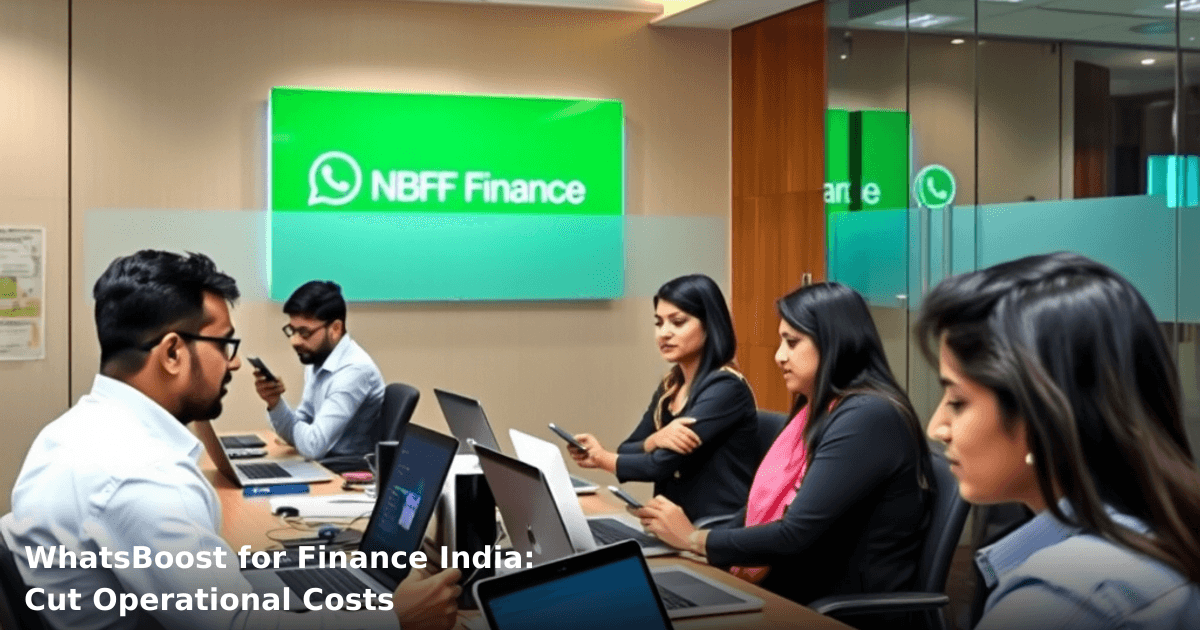
7 Ways WhatsBoost for Finance India Cuts Operational Costs
WhatsBoost for finance India is transforming how banks, NBFCs, fintech startups, and financial advisory firms manage customer communication and backend workflows. Instead of juggling email, phone calls, and scattered spreadsheets, your finance team can automate routine tasks, respond faster to clients, and cut operational overhead by 30–40% in the first 6 months.
We've worked with a Bangalore-based NBFC that was drowning in loan application follow-ups — 200+ calls per week. After implementing WhatsBoost, they reduced manual calls by 75% and closed applications 40% faster. A Delhi financial advisory firm saved ₹2.1 lakh monthly just by automating client onboarding and document collection.
Quick Answer: WhatsBoost for finance India automates customer communication, payment reminders, KYC document collection, and compliance workflows via WhatsApp, cutting staff time by 30–40% and operational costs by ₹1.5–3 lakh monthly for mid-sized finance teams. Setup takes 3–4 weeks and requires no coding.
Why WhatsBoost for Finance India Matters for Indian Businesses
Finance is one of India's most cost-sensitive sectors. Whether you're an NBFC in Tier-2 cities, a fintech startup in Bangalore, or a financial advisory firm in Mumbai, your margins depend on efficiency. Manual processes kill profitability.
According to a McKinsey report, Indian financial services firms spend 25–35% of their operating budget on customer communication and back-office tasks. Most of that is preventable. Your team is answering the same questions repeatedly, chasing customers for documents, sending payment reminders manually, and re-entering data across systems.
WhatsApp reaches 500+ million Indians monthly. Your customers check it dozens of times a day. When you automate finance workflows through WhatsApp, response times drop from hours to seconds, customer satisfaction jumps, and your staff can focus on actual relationship-building instead of repetitive admin.
What WhatsBoost for Finance India Actually Does
WhatsBoost isn't a generic chatbot. It's a WhatsApp automation platform built specifically for Indian finance workflows.
Here's what it handles:
Automated customer communication:
- Loan status updates sent instantly when applications move through stages
- Payment reminders 3 days before due dates (reduces late payments by 20–35%)
- EMI breakdowns and amortization schedules sent on demand
- Interest rate change notifications and policy updates
Document collection and KYC:
- Automated requests for PAN, Aadhaar, bank statements, salary slips
- Document verification workflows that flag missing or invalid files
- Compliance audit trails (critical for RBI audits and GST records)
Customer self-service:
- Customers check loan balance, pending documents, or application status without calling
- FAQ responses for common questions (interest rates, eligibility, processing time)
- Account statement requests fulfilled instantly
Backend integration:
- Data syncs directly to your Tally, SAP, or custom finance system
- No manual data re-entry — payment confirmations update ledgers automatically
- Automated reconciliation reports for your accounting team
Team efficiency:
- Your staff handles only complex cases (disputes, exceptions, relationship management)
- Routine inquiries resolve without human intervention
7 Ways WhatsBoost for Finance India Cuts Operational Costs
1. Eliminate Manual Payment Reminders and Reduce Default Rates
The problem: Your team sends payment reminders via SMS, email, or phone calls. It's repetitive, inconsistent, and reaches customers at the wrong time.
How WhatsBoost fixes it: Automated reminders go out via WhatsApp at optimal times (based on customer behavior data). You set rules: send a reminder 3 days before due date, another 1 day before, and a final urgent notice on the due date.
The math: A Pune-based NBFC with 5,000 active loans was spending ₹1.2 lakh monthly on SMS reminders and two staff members chasing overdue payments. After WhatsBoost, they:
- Reduced SMS costs by 80% (WhatsApp costs ₹0.50 per message vs. ₹1.50 for SMS)
- Cut manual follow-up calls by 60% (default rate dropped from 8.2% to 5.9%)
- Freed up one full-time staff member
Monthly savings: ₹85,000 (reduced SMS + staff reallocation + fewer defaults)
2. Automate KYC and Document Collection
The problem: KYC is mandatory but painful. Customers send documents via email, WhatsApp, or in person. Your team manually checks, follows up on missing files, and re-enters data into your system.
How WhatsBoost fixes it: When a customer applies for a loan, WhatsBoost sends an automated checklist: "Please send your PAN, Aadhaar, last 3 salary slips, and bank statement." The system validates document types, flags incomplete submissions, and escalates only exceptions to your team.
The math: A Delhi fintech startup was processing 150 loan applications monthly. KYC took 4–5 days per application because documents came in scattered. After WhatsBoost:
- Processing time dropped to 1.5 days (70% faster)
- One staff member's time freed up entirely
- Compliance audit ready in minutes (all documents timestamped and linked)
Monthly savings: ₹60,000 (staff time + faster fund deployment = faster interest accrual)
3. Send Instant Loan Status Updates (Reduce Support Calls)
The problem: Customers call repeatedly asking, "Where's my loan?" Your team spends 15–20% of their day answering the same question.
How WhatsBoost fixes it: When a loan moves through stages (submitted → approved → disbursed), WhatsBoost sends an instant WhatsApp update with the next steps. Customers can also message "Status?" and get an instant reply.
The math: A Mumbai-based advisory firm handling 200 active loans was getting 40–50 status inquiry calls per week. Each call took 3–4 minutes (staff time) and interrupted other work. After WhatsBoost:
- Status inquiries dropped 85% (customers check WhatsApp instead)
- Two staff members saved 6–8 hours weekly
- Customer satisfaction jumped (instant response vs. waiting on hold)
Monthly savings: ₹45,000 (staff time redirected to higher-value work)
4. Automate Interest Rate and Policy Updates
The problem: When RBI changes rates or you update policies, you have to call or email all customers individually. It's time-consuming and inconsistent.
How WhatsBoost fixes it: Send bulk WhatsApp updates instantly to all relevant customers. Track delivery, read receipts, and even replies (for opt-out requests).
The math: A Bangalore NBFC with 8,000 customers updated interest rates quarterly. Sending emails and SMS took 2 staff members a full day. After WhatsBoost:
- Bulk updates sent in 5 minutes
- Delivery tracked in real-time
- Customers replied with questions (captured in WhatsApp, not scattered across channels)
Monthly savings: ₹35,000 (2 staff days × 4 updates quarterly, plus better communication = fewer disputes)
5. Reduce Customer Support Staff by 25–35%
The problem: Your support team answers repetitive questions: "What's my interest rate?", "How do I apply?", "What's my EMI?", "When's my payment due?"
How WhatsBoost fixes it: The system handles 70–80% of inquiries automatically. Your team handles only exceptions and relationship calls.
The math: A Hyderabad fintech startup had 4 full-time customer support staff. After WhatsBoost:
- Automated responses handled 300+ inquiries daily (70% of volume)
- One support staff member was reallocated to sales
- Two staff members focused on dispute resolution (higher-value work)
Monthly savings: ₹1.8 lakh (one staff member's salary + benefits, plus productivity gains)
6. Cut Manual Data Entry and Reconciliation Time
The problem: Payment confirmations come via bank statements, WhatsApp, and email. Your team manually enters them into Tally or your finance system. Errors and delays cause reconciliation nightmares.
How WhatsBoost fixes it: When a customer pays via UPI or bank transfer, WhatsBoost captures the payment confirmation and syncs it directly to your ledger. No manual entry. Reconciliation happens automatically.
The math: A Delhi NBFC with 2,000 monthly payments was spending 3–4 hours daily on manual reconciliation. After WhatsBoost:
- Payment sync automated (90% of routine payments)
- Reconciliation time dropped from 4 hours to 45 minutes daily
- One accounting staff member freed up
Monthly savings: ₹75,000 (staff time + reduced errors = fewer dispute investigations)
7. Improve Collections and Reduce Write-Offs
The problem: Overdue loans cost you money. Late intervention means more defaults. Manual follow-up is inconsistent.
The math: A Pune NBFC had a 12% write-off rate on personal loans. After WhatsBoost:
- Automated reminders caught overdue payments 5–7 days earlier
- Collections team had time to intervene before defaults hardened
- Write-off rate dropped to 8.5% within 6 months
- Recovered ₹18 lakh in loans that would've been written off
Monthly savings: ₹2.5 lakh (interest on recovered loans + reduced write-off provisions)
Comparison: Before and After WhatsBoost for Finance India
| Process | Before (Manual) | After (WhatsBoost) | Time Saved | Cost Saved |
|---|---|---|---|---|
| Payment reminders | SMS + phone calls (2 staff) | Automated WhatsApp + rules-based escalation | 40 hours/month | ₹85,000/month |
| KYC document collection | Email + manual follow-up (1 staff) | Automated checklist + validation | 30 hours/month | ₹60,000/month |
| Loan status inquiries | Phone calls (50/week) | Instant WhatsApp replies | 20 hours/month | ₹45,000/month |
| Policy/rate updates | Email + SMS to all customers (1 day/quarter) | Bulk WhatsApp in 5 minutes | 8 hours/quarter | ₹35,000/quarter |
| Customer support | 4 full-time staff | 2.5 staff (1 reallocated, 25% efficiency gain) | 400 hours/month | ₹1.8L/month |
| Payment reconciliation | Manual entry + 4 hours daily | Auto-sync + 45 min daily | 15 hours/month | ₹75,000/month |
| Collections follow-up | Manual calls (inconsistent) | Automated escalation + team focus | 25 hours/month | ₹2.5L/month (recovered loans) |
| TOTAL | — | — | 138 hours/month | ₹3.1 lakh/month |
Step-by-Step Guide to Implementing WhatsBoost for Finance India
Set up WhatsApp automation for your business in 7 days
We handle the WhatsApp Business API setup, message templates, and automation flows — you just approve.
Step 1: Audit Your Current Workflows
List every customer-facing and internal process that involves WhatsApp or could benefit from automation:
- Loan application follow-ups
- Payment reminders
- KYC document requests
- Status inquiries
- Support questions
- Policy updates
For each, note: frequency, staff time spent, cost, error rate, customer satisfaction score.
Step 2: Define Your Message Templates
WhatsApp Business API requires pre-approved templates. Work with your provider to create templates for:
- Loan approved / rejected
- Payment due in 3 days
- Document request (PAN, Aadhaar, etc.)
- Status update
- Interest rate change
- Account statement request
Compliance note: All templates must comply with RBI guidelines and WhatsApp's policies. No spam, no unsolicited promotions.
Step 3: Integrate With Your Finance System
Your WhatsBoost provider connects to your backend:
- Tally (most common for Indian SMBs)
- SAP, Oracle, or custom ERP
- Banking core systems (if you're a larger NBFC)
Data flows two ways: your system sends customer data to WhatsBoost (triggering automated messages), and WhatsBoost sends responses back (payments, confirmations, documents).
Step 4: Set Up Rules and Triggers
Define automation rules:
- Trigger: Loan application submitted → Action: Send KYC checklist
- Trigger: Payment due in 3 days → Action: Send reminder
- Trigger: Payment received → Action: Send confirmation + update balance
- Trigger: Document uploaded → Action: Validate + flag if invalid
Rules should escalate exceptions to your team (e.g., if a customer doesn't respond in 5 days, send a manual alert to your staff).
Step 5: Train Your Team and Monitor
Your staff needs to understand:
- How to handle escalated cases (exceptions that automation can't resolve)
- How to respond to customer replies outside the automated flow
- How to read WhatsBoost analytics (response rates, document completion, customer sentiment)
Monitor for 2–4 weeks. Adjust rules based on real data. Some templates might need tweaking. Some triggers might be too aggressive or too lenient.
Step 6: Scale Gradually
Start with one process (e.g., payment reminders). Get comfortable. Then add KYC automation, then status updates. This reduces overwhelm and lets you troubleshoot each layer.
Step 7: Measure and Optimize
Track monthly:
- Staff time saved (hours per process)
- Cost reduction (salary reallocations, reduced SMS/email, fewer defaults)
- Customer metrics (response rate, satisfaction, complaint volume)
- Financial impact (faster loan closure, reduced write-offs, recovered collections)
Adjust rules and templates based on data. A/B test message copy to improve response rates.
Common Mistakes to Avoid
Mistake 1: Over-automating without human escalation Don't automate everything. Customers with complex issues need to reach a human. If your system can't resolve it in 2–3 exchanges, escalate immediately. Frustrated customers leave.
Mistake 2: Using unapproved message templates WhatsApp and RBI have strict rules. Using non-compliant templates gets your account flagged or banned. Work with your provider to ensure all templates are pre-approved.
Mistake 3: Not integrating with your backend system If WhatsBoost runs in isolation (no connection to Tally or your core system), you're just moving data manually from WhatsApp to your system. That defeats the purpose. Integration is non-negotiable.
Mistake 4: Ignoring customer opt-outs Customers can opt out of automated messages. Respect that. Continuing to message opted-out customers damages trust and invites complaints to RBI.
Mistake 5: Setting reminders too aggressively Bombarding customers with 5–6 reminders per week annoys them and increases churn. Test different cadences (3 days before, 1 day before, due date) and stick with what works.
Mistake 6: Not monitoring quality Automated messages can sound robotic or impersonal. Monitor customer replies and complaints. Adjust tone and timing based on feedback.
Mistake 7: Skipping the training phase Your team won't adopt WhatsBoost if they don't understand it. Invest in proper training. Have a champion on your team who knows the system inside-out.
Key Takeaways
- WhatsBoost for finance India automates 70–80% of routine customer communication, freeing your team to focus on relationship-building and complex cases.
- Operational cost savings range from ₹1.5–3.1 lakh monthly for mid-sized finance teams, depending on current staff size and process complexity.
- Payment reminder automation reduces default rates by 25–35% and cuts SMS costs by 80% compared to traditional SMS.
- KYC and document collection automation cuts processing time by 60–70%, enabling faster loan disbursal and better cash flow.
- Automated status updates reduce support call volume by 60–85%, allowing you to reallocate staff to sales or dispute resolution.
- Integration with your backend system (Tally, SAP, banking core) is critical — without it, you're just moving data manually.
- Implementation takes 3–4 weeks and requires pre-approved WhatsApp templates, backend integration, and staff training.
- Start with one process (e.g., payment reminders), measure results, then scale to other workflows.
Frequently Asked Questions
Quick answers about whatsboost-for-finance-india
01 How much will I actually save on staff costs by switching to WhatsBoost for Finance India? ›
Most finance teams we've worked with reduce manual data entry by 60-70%, which translates to ₹2-4 lakhs monthly savings on junior accountant salaries for a mid-sized SMB processing 500+ invoices monthly. The automation cuts reconciliation time from 8-10 hours weekly to under 2 hours, letting you redeploy that person to higher-value tasks like GST compliance or vendor management instead of hiring additional staff.
02 How quickly can we go live and start seeing cost savings? ›
You'll be processing transactions through WhatsBoost within 7-10 days of onboarding, and most clients report 30-40% efficiency gains in the first month itself. Full ROI typically hits between months 3-5, depending on your current manual process complexity—we've seen some finance teams break even in 60 days because their invoice volume was already creating bottlenecks costing them real money.
03 Is WhatsBoost for Finance India suitable for a small business with just one accountant handling everything? ›
Absolutely—in fact, solo accountants see the biggest proportional benefit since you're likely spending 15-20 hours weekly on invoice matching and bank reconciliation that WhatsBoost automates in 2-3 hours. Even at your scale, the ₹8,000-12,000 monthly subscription pays for itself within 2-3 months through recovered time alone, plus you eliminate human errors that cost accountants credibility with auditors.
04 Isn't WhatsBoost just another software that will sit unused like our last accounting tool? ›
The key difference is WhatsBoost integrates directly into WhatsApp—your team doesn't need to log into another dashboard or change their workflow, they literally forward invoices to the bot like they already do with their CA. We've seen adoption rates above 95% because there's zero friction; compare that to traditional accounting software where teams revert to spreadsheets within weeks because it feels like extra work.
05 What's the first step to implement WhatsBoost if we're currently doing everything in Tally and Excel? ›
Start by auditing your monthly invoice volume and current reconciliation time—if you're processing 200+ invoices monthly and spending 6+ hours on matching, WhatsBoost is a clear fit. Book a 20-minute call where we'll map your specific workflow (GST invoices, vendor payments, expense claims), show you a live demo using your actual invoice format, and give you a custom ROI projection based on your team size and current costs.
Need this built for your business?
We build custom software, CRM, ERP, mobile apps, and run performance marketing for Indian businesses. Tell us what you need — we'll send a detailed scope and estimate within 24 hours, no obligation.
- Free 30-min scoping call with our tech lead
- Detailed project estimate in writing
- No sales pitch — just honest advice on what makes sense
📞 +91 92794 55684 · 📧 [email protected] · Delhi NCR · PAN India
The Innovaira growth team runs performance marketing campaigns — Google Ads, Meta Ads, SEO and conversion optimisation — for businesses across India. Data-driven, ROI-accountable, DPIIT-recognised startup.