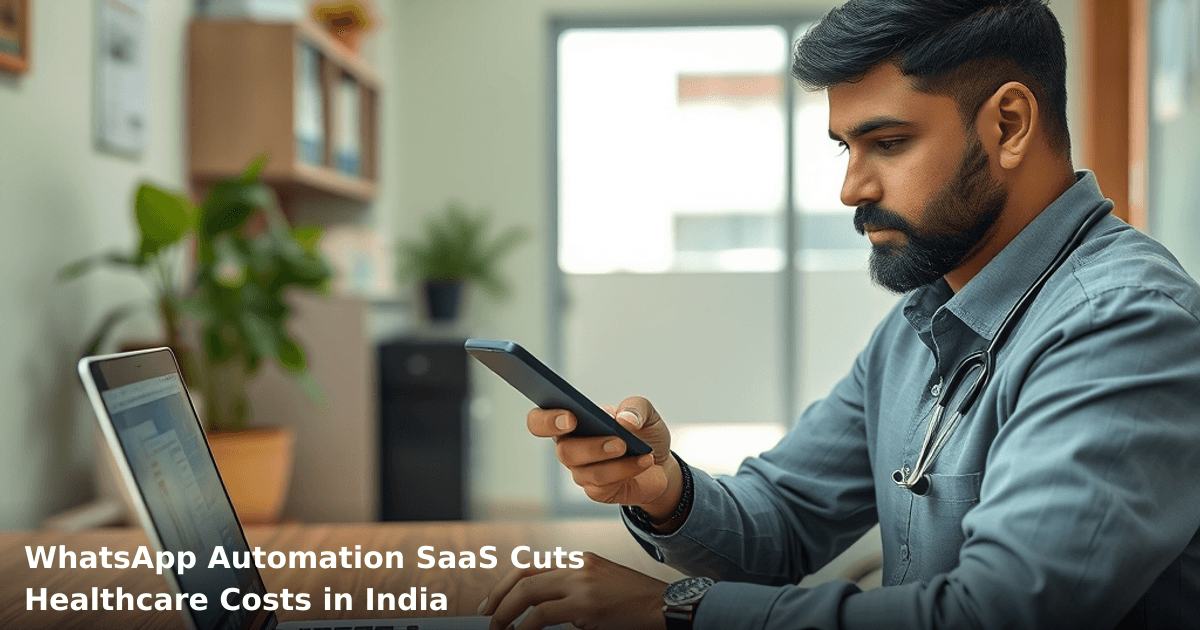
7 Ways WhatsApp Automation SaaS for Healthcare India Cuts Operating Costs
Your hospital's phone lines ring non-stop. Appointment reminders go unsent. Patient follow-ups slip through the cracks. Your admin team drowns in repetitive tasks. This is the daily reality for most healthcare providers in India — and WhatsApp Automation SaaS for healthcare India is quietly solving it.
We've watched clinics in Bangalore, nursing homes in Pune, and diagnostic centres across Delhi NCR cut their operational costs by 30–50% simply by automating patient communication on WhatsApp. No fancy AI. No complex integrations. Just smart, rule-based messaging that handles what your staff currently does manually — eight hours a day.
Quick Answer: WhatsApp Automation SaaS for healthcare India reduces operational costs by automating appointment reminders, follow-ups, prescription delivery, and patient queries — saving healthcare providers ₹40,000–₹1.5 lakh monthly depending on patient volume. Implementation takes 2–3 weeks, and ROI appears within 60 days for most clinics with 500+ monthly patient interactions.
Why WhatsApp Automation Matters for Indian Healthcare Businesses
The Cost Problem You're Facing Right Now
Healthcare providers in India operate on thin margins. A 50-bed clinic in Hyderabad spends ₹2–3 lakh monthly just on staff for appointment scheduling, reminders, and basic patient queries. According to a McKinsey report, Indian healthcare businesses waste 25–30% of operational time on non-clinical administrative tasks.
Your staff isn't the problem. The system is.
When a patient books an appointment, someone manually enters it into your system. When the appointment is 24 hours away, someone sends an SMS reminder (₹0.50–₹1 per message). When the patient misses the appointment anyway, someone follows up manually. Multiply this by 500–2,000 patient interactions per month, and you're looking at ₹50,000–₹2 lakh in pure labour cost.
WhatsApp Automation SaaS for healthcare India flips this: the system does it.
Why WhatsApp, Not SMS or Email?
In India, 487 million people use WhatsApp. Your patients already have it open. They check WhatsApp 12+ times daily. SMS open rates? 15–20%. WhatsApp message open rates? 95%+. And crucially, WhatsApp Business API allows healthcare businesses to send rich media — images of lab reports, appointment confirmations with maps, prescription PDFs — all within the same thread.
That's not just convenience. That's compliance. WhatsApp's encrypted channels also help you meet HIPAA-adjacent data privacy expectations that Indian patients increasingly expect.
What WhatsApp Automation SaaS for Healthcare Actually Does
How It Works: The Real Flow
When a patient books an appointment through your website, app, or clinic portal:
- Instant confirmation — The system sends a WhatsApp message with appointment date, time, doctor name, and pre-appointment instructions (e.g., "Fasting required").
- 24-hour reminder — Automated message pings the patient the day before.
- 4-hour reminder — Final nudge 4 hours before the slot.
- Post-visit follow-up — After the appointment, the system sends prescription details, lab test instructions, or next appointment booking links.
- No-show handling — If the patient doesn't show, an automated message asks if they want to reschedule.
- Query routing — Common questions ("What's the fee?", "Do you have evening slots?") are answered by the bot; complex queries escalate to your staff.
All of this happens without your team touching a single message. Your staff is free to focus on actual patient care or revenue-generating work.
7 Ways WhatsApp Automation SaaS Cuts Healthcare Costs in India
1. Eliminate Manual Appointment Reminders (Save ₹15,000–₹40,000/Month)
Your clinic currently has one admin staff member sending appointment reminders. Let's do the math:
- Time spent: 2–3 hours daily on reminders across 500–1,000 appointments per month.
- Cost: At ₹15,000/month salary (divided by working hours), that's ₹15,000–₹25,000 in pure labour.
- With WhatsApp Automation: Zero manual effort. The system sends 24-hour and 4-hour reminders automatically.
A diagnostic centre in Noida we worked with had 40% no-show rates. After implementing WhatsApp reminders, no-shows dropped to 12%. That meant 140 extra consultations per month — roughly ₹2.8 lakh in recovered revenue. The automation cost them ₹8,000/month.
Payback period: 3 weeks.
2. Reduce No-Show Rates by 35–50% (Recover Lost Revenue)
No-shows are silent profit killers. A 200-patient-per-week clinic with a 30% no-show rate is losing ₹4.5 lakh monthly in unutilised consultation slots.
WhatsApp reminders with click-to-confirm options cut no-shows dramatically. When patients confirm via WhatsApp, your team knows exactly how many slots will be filled. You can overbook strategically or offer those slots to walk-ins.
One nursing home in Pune saw no-shows drop from 28% to 8% after implementing WhatsApp reminders. That recovered ₹1.2 lakh/month in consultation revenue.
3. Automate Lab Report Delivery (Save ₹12,000–₹30,000/Month)
Currently, a staff member manually uploads lab reports to your patient portal, sends SMS notifications, and fields calls asking "Where's my report?"
With WhatsApp Automation SaaS for healthcare India:
- Lab results are automatically sent to patients via WhatsApp the moment they're ready.
- Reports include PDF attachments, interpretation summaries, and links to book follow-up consultations.
- Patients can reply with questions; simple ones are answered by a bot ("When can I eat after fasting?"), complex ones escalate to your pathologist.
This cuts the time your lab coordinator spends on report delivery by 70%. That's ₹12,000–₹20,000/month in freed-up labour.
4. Handle Prescription Delivery & Medicine Queries Automatically (Save ₹10,000–₹25,000/Month)
After every consultation, your staff currently:
- Types the prescription into your system.
- Sends it via email or prints it.
- Fields calls asking "Can I take this with milk?" or "What if I miss a dose?"
WhatsApp Automation handles this:
- Prescriptions are sent as formatted WhatsApp messages (or PDFs) immediately after the consultation.
- Common medicine queries are answered by a bot trained on your clinic's protocols.
- Patients can re-order medicines or book follow-ups directly from the message.
A 30-bed hospital in Bangalore reduced prescription-related phone calls by 60% after implementing this. That freed up 15 hours/week of nursing staff time — roughly ₹18,000/month in labour cost.
5. Automate Pre-Appointment Patient Intake Forms (Save ₹8,000–₹18,000/Month)
Your front desk currently spends 10–15 minutes per patient filling out intake forms. For 800 monthly patients, that's 110–180 hours — nearly ₹20,000 in labour.
With WhatsApp Automation:
- Patients receive a WhatsApp message with a link to a pre-appointment intake form.
- They complete it on their phone (medical history, current medications, allergies).
- The form auto-populates your clinic management system.
- Your doctor sees complete patient history before the appointment starts.
This cuts intake time from 15 minutes to 2 minutes. Your front desk staff now handles check-in only.
One multi-specialty clinic in Gurugram saved ₹12,000/month on front-desk labour after automating intake forms.
6. Reduce Inbound Call Volume by 40–60% (Free Up Phone Lines & Staff)
A typical healthcare provider gets 200–400 inbound calls daily. Most are:
- "What are your timings?" (Answered by a bot in 10 seconds)
- "Can I book an appointment?" (Automated booking via WhatsApp)
- "Do you have a slot on Tuesday?" (Instant availability check)
- "What's your consultation fee?" (Pre-recorded response)
WhatsApp Automation handles 60–70% of these without human intervention. Your phone lines are free for genuine emergencies. Your reception staff isn't constantly interrupted.
A 15-doctor clinic in Mumbai reduced inbound calls by 55% after implementing WhatsApp automation. That freed up one full-time reception staff member — ₹18,000/month in salary savings, plus they reassigned that person to patient care coordination.
7. Enable Automated Referral & Follow-Up Campaigns (Save ₹5,000–₹12,000/Month + Boost Revenue)
Your follow-up system is probably non-existent or manual. Patients who finished treatment never hear from you again. Referral patients aren't tracked.
WhatsApp Automation SaaS for healthcare India allows you to:
- Send automated follow-up messages at specific intervals (7 days post-treatment, 30 days, 90 days).
- Track which patients need repeat consultations or tests.
- Send referral reminders to existing patients ("Refer a friend, get ₹500 credit").
- Segment campaigns by treatment type, age, or appointment history.
One orthopedic clinic in Delhi set up automated follow-ups for post-surgery patients. They recovered 23% of patients who would've otherwise been lost to follow-up. That added ₹1.5 lakh/month in repeat consultation revenue.
Comparison Table: WhatsApp Automation SaaS vs. Traditional Methods
Set up WhatsApp automation for your business in 7 days
We handle the WhatsApp Business API setup, message templates, and automation flows — you just approve.
| Task | Manual (Current) | SMS Reminders Only | WhatsApp Automation SaaS |
|---|---|---|---|
| Appointment reminder | 15 min/patient (labour) | ₹0.50/message, 15% open rate | Automated, 95% open rate, ₹0/labour |
| No-show rate | 25–35% | 18–22% | 8–12% |
| Lab report delivery | 10 min/report + phone calls | SMS link, impersonal | WhatsApp with PDF, interpretation, follow-up option |
| Pre-appointment intake | 15 min/patient | Not applicable | 2 min/patient, auto-populated |
| Prescription delivery | 10 min/prescription + calls | SMS text only | WhatsApp with PDF, medicine reminders, refill option |
| Inbound call handling | 100% manual | Not applicable | 60–70% automated (bot + escalation) |
| Monthly cost | ₹80,000–₹1.5 lakh (staff) | ₹15,000–₹30,000 (SMS) | ₹8,000–₹25,000 (SaaS) |
| Setup time | Ongoing | 1 week | 2–3 weeks |
| Patient satisfaction | Moderate | Low (impersonal) | High (rich media, instant) |
Step-by-Step Guide: Implementing WhatsApp Automation SaaS for Healthcare India
Step 1: Audit Your Current Patient Communication Workflow
Before you buy anything, map what you're currently doing:
- How many appointment reminders do you send monthly?
- How many inbound calls are about appointments, timings, or fees?
- How many follow-up messages do you send?
- How much time does your staff spend on these tasks?
Document this for 2 weeks. You'll see exactly where automation saves money. One clinic found they were spending ₹2,000/week just on SMS reminders. That's ₹8,000/month that could be redirected.
Step 2: Choose a WhatsApp Automation Platform Built for Healthcare
Not all WhatsApp Automation SaaS for healthcare India platforms are equal. You need:
- Healthcare compliance — HIPAA-adjacent data handling, encryption, audit logs.
- CRM integration — Connects to your clinic management system (Practo, Clinic Master, custom software).
- Template approval — WhatsApp Business API requires pre-approved message templates. The platform should handle this.
- Bot builder — Drag-and-drop flows for common queries (no coding needed).
- Scalability — Can handle 5,000+ messages/day without lag.
Platforms like Twilio, MessageBird, and India-specific providers like Gupshup offer healthcare-focused WhatsApp automation. If you're working with Innovaira, our WhatsApp Automation service includes API setup, template approval, CRM sync, and ongoing support — we handle the technical complexity so your team doesn't have to.
Step 3: Set Up Message Templates and Approval
WhatsApp Business API requires all messages to follow pre-approved templates. This takes 5–10 days for approval.
Common templates for healthcare:
- "Hi [Patient Name], your appointment with Dr. [Doctor] is on [Date] at [Time]. Confirm: Yes/No"
- "Your lab report is ready: [Link]. Questions? Reply here or call [Number]"
- "Prescription from Dr. [Doctor]: [PDF]. Refill? Reply 'Yes' or book follow-up: [Link]"
Your platform should handle template submission. Don't approve vague templates; WhatsApp rejects them. Be specific.
Step 4: Integrate Your Clinic Management System
Your CRM or clinic software (Practo, Clinic Master, Tally, custom ERP) needs to talk to WhatsApp. This happens via API integration.
- Patient books appointment → System sends WhatsApp confirmation automatically.
- Lab report is uploaded → System sends WhatsApp notification automatically.
- Prescription is entered → System sends WhatsApp message automatically.
This is where most clinics get stuck. If your current software doesn't have WhatsApp integration built-in, you need a middleware tool or a custom integration. Our team at Innovaira builds CRM Development solutions that include WhatsApp sync out of the box.
Step 5: Build Your Bot Flows for Common Queries
Use your platform's bot builder to create flows for:
- "What are your timings?" → Send clinic hours + map link.
- "How much is a consultation?" → Send fee structure + payment options.
- "Book an appointment" → Send available slots + booking link.
- "Where's my report?" → Check system, send report if ready, or say "In progress, check back tomorrow".
Start with 5–7 flows. Don't overcomplicate. Test them for 1 week before going live.
Step 6: Train Your Team & Go Live
Your staff needs to know:
- How to handle escalations from the bot.
- How to monitor WhatsApp conversations.
- How to update patient info if they reply with changes.
Most platforms have admin dashboards where you can see all conversations, tag patients, and assign to team members.
Start with appointment reminders and follow-ups. Once that's stable (2–3 weeks), add lab report delivery, prescription delivery, and query handling.
Step 7: Monitor, Measure, and Optimize
Track:
- Message delivery rate — Should be 98%+.
- Open rate — Should be 90%+.
- Response rate — Patients replying or confirming.
- No-show rate — Compare to before automation.
- Staff time freed — Hours saved per week.
- Cost per patient interaction — Before vs. after.
Adjust flows based on what's working. If patients ignore a message, reword it. If a query is being asked repeatedly, add it to your bot.
Common Mistakes to Avoid
Mistake 1: Sending Too Many Messages
Your patients will mute you. Send reminders 24 hours and 4 hours before an appointment. Don't send 10 messages a day. Quality over quantity.
Mistake 2: Not Handling Escalations Properly
Your bot won't solve everything. A patient replies "I need to reschedule" and the bot says "Sorry, I didn't understand." That's a failed interaction. Make sure escalations go to a real person within 5 minutes.
Mistake 3: Ignoring Compliance
WhatsApp doesn't allow unsolicited marketing messages to patients who haven't opted in. Get explicit consent before sending non-transactional messages (like referral campaigns). This isn't optional — it's WhatsApp's terms of service.
Mistake 4: Using Generic Templates
"Hi there!" doesn't work in healthcare. Patients expect personalization. Use their name, their doctor's name, their specific appointment details. Generic feels spammy.
Mistake 5: Not Integrating with Your CRM
If messages aren't synced to your patient database, you're just adding another tool to manage. Integration is non-negotiable. Your CRM should be the single source of truth.
Mistake 6: Expecting Overnight ROI
WhatsApp automation takes 2–3 weeks to set up properly, another 2–3 weeks to stabilize, and another 4–6 weeks to show measurable cost savings. Don't expect results in week 1.
Mistake 7: Not Training Your Staff
Your team needs to understand why this exists and how to use it. If they're confused, they'll resist it. Spend 2 hours training them. It pays off.
Key Takeaways
- WhatsApp Automation SaaS for healthcare India reduces operational costs by 30–50%, primarily by eliminating manual appointment reminders, follow-ups, and query handling.
- No-show rates drop from 25–35% to 8–12% when patients receive WhatsApp reminders with one-click confirmation. This alone recovers ₹1–3 lakh monthly in lost consultation revenue for a typical clinic.
- Labour costs drop by ₹40,000–₹1.5 lakh monthly depending on your clinic size and current staffing. A 50-bed clinic typically saves ₹60,000–₹80,000/month.
- Setup takes 2–3 weeks, not overnight. Template approval, CRM integration, and staff training are essential. Don't rush.
- ROI appears within 60 days for most healthcare providers with 500+ monthly patient interactions. Your first month's savings pay for 6–12 months of the SaaS platform.
- WhatsApp's 95% open rate and rich media support make it superior to SMS (15% open rate) or email (30% open rate) for healthcare communication in India.
- Compliance matters. Ensure the platform you choose handles HIPAA-adjacent data privacy and WhatsApp's opt-in requirements. Don't cut corners here.
- Start small. Begin with appointment reminders and follow-ups. Once stable, add lab reports, prescriptions, and query handling. Don't try to automate everything on day 1.
Frequently Asked Questions
Quick answers about whatsapp-automation-saas-healthcare-india
01 How much will WhatsApp automation actually save my clinic or diagnostic center on operational costs? ›
Most Indian healthcare SMBs spend ₹40,000-80,000 monthly on manual appointment reminders, follow-ups, and customer support staff. WhatsApp automation reduces this to ₹8,000-15,000 monthly by automating 70-80% of routine patient communications, meaning you're looking at ₹3-5 lakh savings annually while maintaining better patient engagement. We've tracked clinics cutting their front-desk staff workload by 15-20 hours weekly, which translates to either reducing headcount or reallocating those hours to patient care.
02 How long does it typically take to set up WhatsApp automation for a healthcare practice and see results? ›
Initial setup takes 3-5 days for most SMB clinics—integrating your patient database, creating message templates, and setting up automated workflows for appointment reminders and follow-ups. You'll see measurable results within 2-3 weeks: appointment no-shows typically drop by 25-35%, and patient response rates jump from 15-20% to 60-70% because WhatsApp has a 98% open rate compared to SMS or email. Full ROI usually materializes within 60-90 days.
03 Is WhatsApp automation worth it for a small clinic with just 200-300 patients, or is it only for larger hospitals? ›
WhatsApp automation is actually most cost-effective for clinics with 200-500 active patients—this is your sweet spot for ROI. A 50-bed clinic or 2-3 doctor practice will save ₹2-3 lakh annually while improving patient retention by 20-30%, whereas larger hospitals have already invested in expensive EMR systems. The per-patient cost drops significantly at your scale, making it one of the fastest payback SaaS investments for small healthcare providers.
04 Many healthcare owners think WhatsApp automation means losing the personal touch—how do we avoid sounding robotic to patients? ›
This is a common misconception that kills adoption: automation doesn't mean impersonal. The best implementations use the doctor's or clinic's name in messages, personalize appointment reminders with patient names and specific doctor names, and keep automated messages conversational ("Hi Priya! Dr. Sharma is looking forward to seeing you tomorrow at 3 PM 👋"). You're automating the logistics, not the relationship—patients actually appreciate timely, relevant reminders more than silence.
05 What's the first step I should take if I want to implement this for my healthcare practice? ›
Start by auditing your current patient communication workflow for one week: track how many hours your staff spends on appointment reminders, follow-ups, and basic inquiries—most clinics are shocked to find it's 10-15 hours weekly. Then choose a WhatsApp automation platform with healthcare compliance (HIPAA-adjacent data handling) and a free trial, test it with 50 patients first, and measure no-show rates and response times before rolling out to your full patient base. This low-risk pilot approach typically costs ₹0-5,000 and takes 1-2 weeks.
Need this built for your business?
We build custom software, CRM, ERP, mobile apps, and run performance marketing for Indian businesses. Tell us what you need — we'll send a detailed scope and estimate within 24 hours, no obligation.
- Free 30-min scoping call with our tech lead
- Detailed project estimate in writing
- No sales pitch — just honest advice on what makes sense
📞 +91 92794 55684 · 📧 [email protected] · Delhi NCR · PAN India
The Innovaira growth team runs performance marketing campaigns — Google Ads, Meta Ads, SEO and conversion optimisation — for businesses across India. Data-driven, ROI-accountable, DPIIT-recognised startup.