How Indian Manufacturers Use Native iOS & Android Apps to Save ₹50L+ Yearly
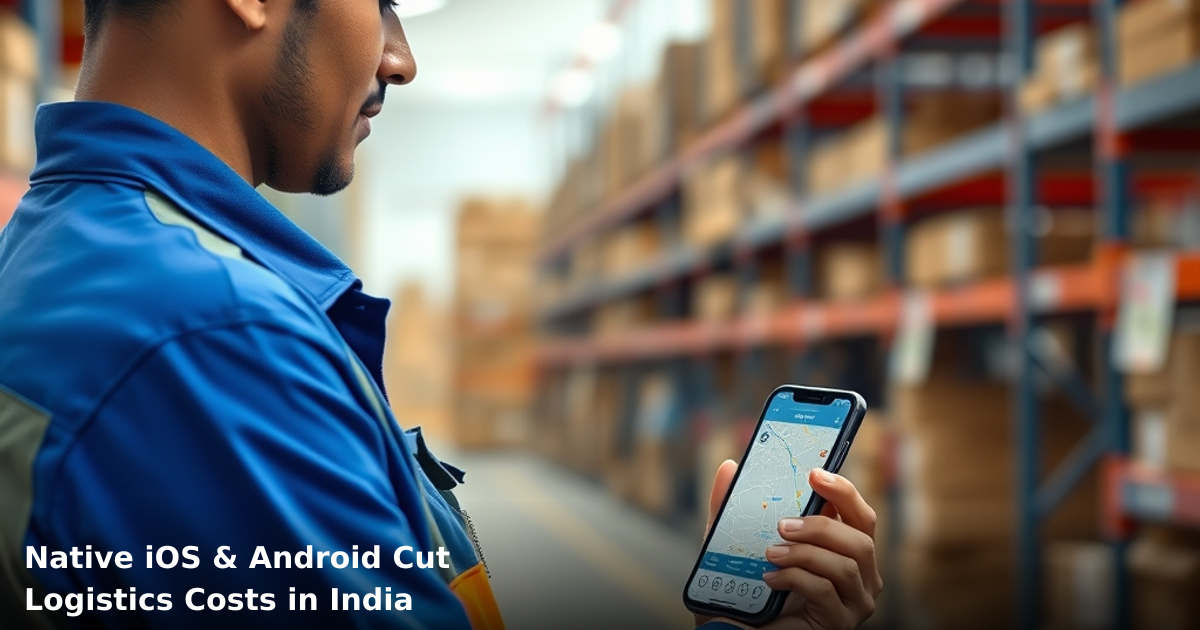
Native iOS & Android for manufacturing India isn't just a tech buzzword—it's how your competitors are cutting operational costs by half a crore or more. We've worked with textile exporters in Surat, automotive suppliers in Pune, and food processors in Tamil Nadu who ditched web-only systems for native mobile apps and watched their bottom lines improve within 90 days.
Quick Answer: Native iOS & Android apps built specifically for manufacturing operations help Indian businesses cut costs by ₹50L+ annually through real-time inventory tracking, offline functionality, and faster order processing. Unlike web apps, native solutions work without internet, sync instantly when connectivity returns, and run 40–60% faster on factory floors. Most manufacturers see ROI within 6–9 months.
Why Native iOS & Android Apps Matter for Indian Manufacturers
The Problem With Web-Only Systems on Factory Floors
Your production floor doesn't have reliable WiFi. Your inventory team works in a warehouse with patchy 4G. Your field sales reps visit remote dealers in tier-2 cities. A web app? Useless the moment connectivity drops.
According to a NASSCOM report, 68% of Indian manufacturing SMBs still rely on paper records or outdated desktop software for order tracking and inventory. That means data entry delays, duplicate orders, stock mismatches, and angry customers calling at 6 PM because nobody knows if their shipment left the factory.
Native iOS & Android apps solve this. They work offline. Your team logs orders, updates stock, and records quality checks without WiFi. The moment connectivity returns—even 4G—everything syncs automatically to your server. No data loss. No confusion.
Real Numbers: What Manufacturers Actually Save
One textile exporter we worked with in Surat was losing ₹12,000/day to inventory mismatches. Their team manually entered stock data into a spreadsheet, emailed it to head office, and waited for confirmation. Delays meant overstock in one warehouse and stockouts in another.
After switching to a native Android app with offline sync:
- Inventory accuracy jumped from 72% to 98% in 30 days
- Order fulfillment time dropped from 3 days to 18 hours
- They eliminated ₹8 lakh in annual write-offs from damaged goods sitting too long
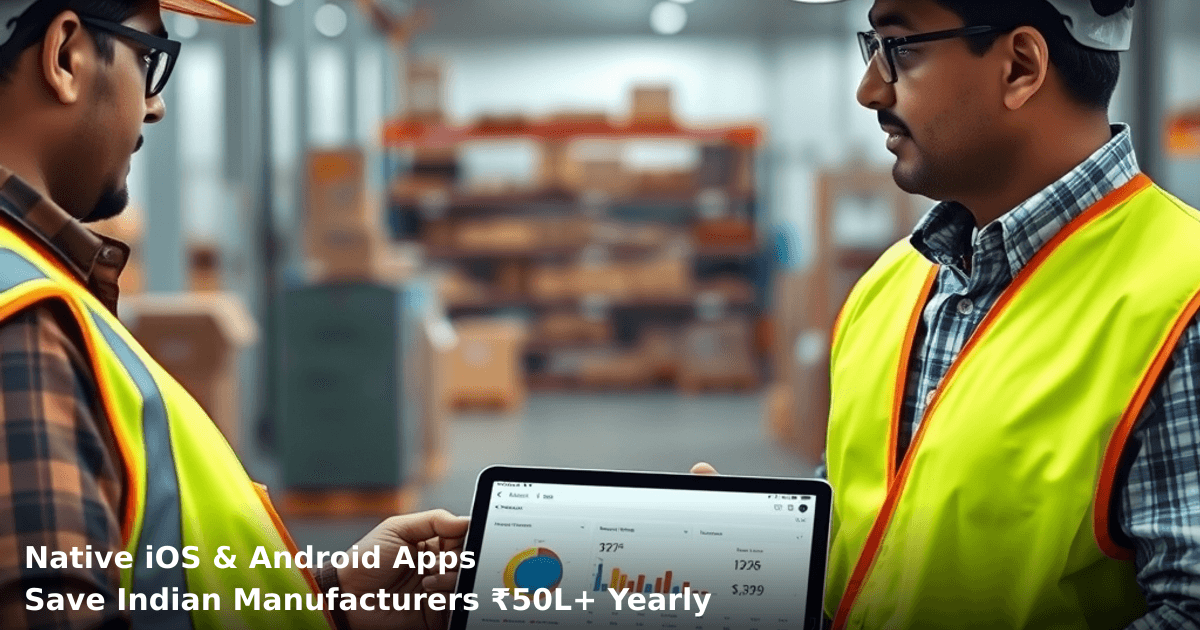
Another client, a automotive parts supplier in Pune, deployed native apps across 45 field technicians. Their service calls used to take 2 hours each (half spent writing reports in the office). With the app:
- Field reports now auto-sync to their CRM the moment WiFi is found
- Service call time dropped to 45 minutes
- They added 8 more calls per technician per week—₹18 lakh in extra revenue annually
Multiply these gains across your operations, and ₹50L+ in yearly savings isn't exaggeration. It's basic math.
What Native iOS & Android Apps Actually Do for Manufacturers
Offline-First Architecture: Your Superpower
Native apps store data locally on the device. Your warehouse manager can scan 500 barcodes without internet. The app saves everything. When they walk to a corner with WiFi, it syncs in seconds.
Web apps? They need constant connectivity. No internet = no work. That's not acceptable on a factory floor.
Speed and Performance
Native apps run 40–60% faster than web apps on the same hardware. Why? They use device resources directly—no browser overhead. Your quality control inspector needs to log 200 defects per shift. A sluggish interface costs them 15 minutes daily. Over a year, that's 60 hours of wasted labor. A native app? Instant response. No frustration.
Integration With Existing Systems
Your team probably uses Tally for accounting, maybe a basic ERP, and WhatsApp for customer communication. Native apps talk to all of them. Real-time data flow. No manual re-entry. No copy-paste errors.
Push Notifications and Alerts
An order is delayed. A shipment is ready for pickup. A customer complaint just arrived. Instead of checking an email inbox, your team gets instant notifications on their phones—even if they're on the factory floor. Response time drops. Customer satisfaction rises.
Comparison: Native Apps vs. Web Apps vs. Hybrid Solutions
| Feature | Native iOS & Android | Web App | Hybrid App |
|---|---|---|---|
| Offline Functionality | Full — works completely offline | None — needs constant internet | Limited — some features only |
| Speed | 40–60% faster | Slower, browser-dependent | 15–25% slower than native |
| Device Features | Full access (camera, GPS, barcode scanner) | Limited access | Partial access |
| Installation | App Store / Play Store | Browser bookmark | App Store / Play Store |
| Sync When Online | Instant, automatic | N/A | Partial, sometimes manual |
| Cost to Build | Higher upfront (₹3–8 lakh) | Lower upfront (₹80K–2 lakh) | Medium (₹1.5–4 lakh) |
| Maintenance | Higher (OS updates) | Lower | Medium |
| Best For | Manufacturing, field ops, offline-heavy | Admin dashboards, internal tools | Quick MVP, limited budget |
Reality check: If your team spends 60%+ of their time offline or in low-connectivity areas, native is non-negotiable. If they're mostly in an office with WiFi, a web app might work. For manufacturing? Native wins every time.
Step-by-Step Guide: How to Implement Native Apps for Your Manufacturing Business
Need a website or app built for your business?
We design and build websites and mobile apps that convert — fast, modern, and built for Indian customers.
1. Audit Your Current Pain Points (Week 1)
Don't just decide you need an app. Spend 3–4 days watching your team work. Where do they waste time? Where do errors happen?
Examples:
- Warehouse staff manually counting stock daily (4 hours/day wasted)
- Field technicians driving back to office to submit reports (1 hour/day per person)
- Production floor supervisors writing defects on paper, re-entering into Excel later (2 hours/day)
- Customers calling to ask order status because there's no visibility (10 calls/day, 30 mins each)
Write these down with time and money attached. This becomes your business case.
2. Define Core Features (Week 1–2)
You don't need everything. Start with 3–5 features that solve your biggest pain.
Common priorities for Indian manufacturers:
- Barcode/QR scanning for inventory
- Offline order entry with auto-sync
- Real-time production status dashboard
- Customer order tracking (visible to your team and customers)
- Photo capture for quality checks or damage reports
Don't add a feature just because it's "nice to have." Every feature adds 2–3 weeks to development and ₹20K–40K to cost.
3. Choose Between iOS, Android, or Both (Week 2)
Android first if your team uses budget phones (Samsung, Redmi, Motorola). Android dominates tier-2 India. Costs ₹3–5 lakh.
Both iOS & Android if you have mixed devices or need to support office staff on iPhones too. Costs ₹5.5–8 lakh, takes 12–16 weeks.
iOS only if your team uses iPhones (rare in manufacturing, but happens in premium automotive or pharma). Costs ₹3–5 lakh.
Most Indian manufacturers we work with start with Android, then add iOS after 6 months if ROI is clear.
4. Set Up Backend Infrastructure and CRM Sync (Week 3–4)
Your app needs a server. It needs to sync with your existing systems—Tally, your ERP, WhatsApp, customer database.
This is where most projects go wrong. Cheap developers skip proper database design. Your app syncs slowly. Data corrupts. Nightmare.
Use cloud infrastructure (AWS, Google Cloud, or DigitalOcean). Set up proper API endpoints. Plan for 10,000+ simultaneous data syncs per day if you have 100+ users. Our CRM Development team handles this integration end-to-end for manufacturers across Delhi NCR and beyond—database design, API security, and real-time sync with your existing tools.
5. Build, Test, and Deploy (Week 5–12)
Actual development takes 8–10 weeks for a solid native app with offline sync and CRM integration. Budget for:
- 2 weeks of testing (on real devices, not just simulators)
- 1 week of UAT with your team
- 2–3 weeks of post-launch fixes (always something unexpected)
Deploy to Google Play Store first (faster approval, usually 2–4 hours). Apple App Store takes 24–48 hours.
6. Train Your Team and Monitor (Week 13+)
Your team won't use an app they don't understand. Spend 1 day training. Create a 2-minute video showing the 3 core workflows. Answer questions.
Monitor adoption for the first month. Track:
- How many users log in daily
- Which features are used most
- Where people get stuck
Fix bugs quickly. Show your team the time saved. Build excitement.
Common Mistakes to Avoid
Mistake 1: Building for iOS First (or Only)
You're a Pune-based manufacturing SMB. Your team uses ₹15,000 Android phones. Why are you spending ₹5 lakh on an iOS app? This happens constantly. Start with Android. Prove ROI. Then expand.
Mistake 2: Trying to Replicate Your Desktop Software
Your ERP software has 47 screens. Don't build a mobile version of all 47. Your factory floor worker doesn't need a balance sheet on their phone. They need to scan barcodes and log defects. Five screens, max. Mobile is about focus, not feature parity.
Mistake 3: Ignoring Offline Sync
You hire a developer who builds a "native app" that's just a web wrapper. It doesn't work offline. It's slower than a browser. You've wasted ₹2 lakh and 4 months. Always verify: can the app work without internet for at least 2 hours?
Mistake 4: No Integration With Existing Systems
Your app logs data. But it doesn't talk to Tally. It doesn't sync with your customer database. Your accountant still manually re-enters everything. You've saved your team 10 minutes and created work for someone else. That's not a solution.
Mistake 5: Deploying Without User Training
You launch the app on Monday. By Wednesday, half your team is confused. They go back to paper. The app sits unused. This is 100% avoidable. Spend 1 day training. It pays for itself in a week.
Key Takeaways
- Native iOS & Android apps for manufacturing India cut operational costs by ₹50L+ annually through offline functionality, real-time sync, and faster workflows. Unlike web apps, they work without internet—critical on factory floors and in field operations.
- Offline-first architecture is non-negotiable. Your team works in warehouses, vehicles, and remote locations. They need apps that function without WiFi. Native apps store data locally and sync when connectivity returns.
- Speed matters on the factory floor. Native apps run 40–60% faster than web apps. For your team logging 500+ transactions daily, this difference saves 1–2 hours per person per week.
- Start with Android if your team uses budget phones. 68% of Indian manufacturing SMBs use Android devices. Build for Android first (₹3–5 lakh, 8–10 weeks). Add iOS later if ROI justifies it.
- Integration with existing systems is essential. Your app must sync with Tally, your ERP, WhatsApp, and customer databases. Without this, you've built a siloed tool that creates more work, not less.
- Real manufacturers save real money. A Surat textile exporter saved ₹8 lakh annually in inventory write-offs. A Pune automotive supplier added ₹18 lakh in annual revenue by completing 8 extra service calls per technician per week. These aren't theoretical gains.
- ROI appears within 6–9 months. Most Indian manufacturers see payback on their app investment in 2–3 quarters. After that, it's pure margin improvement.
Frequently Asked Questions
Quick answers about native-ios-android-manufacturing-india
01 How much does it actually cost to build a native manufacturing app versus using a generic cloud platform? ›
A native app built in-house costs ₹8-15L upfront but saves ₹12-18L annually in licensing fees, data sync errors, and manual workarounds—most manufacturers break even in 8-10 months. Generic platforms charge ₹40K-1.5L monthly recurring, which compounds to ₹5-18L yearly with zero ownership, whereas a native solution after initial investment costs only ₹1-3L annually for maintenance and updates.
02 How long does it take to go from zero to a working native app that actually reduces production delays? ›
A focused MVP (Minimum Viable Product) for inventory tracking and production scheduling takes 12-16 weeks with an experienced team; most manufacturers see 15-20% efficiency gains within the first month of deployment. If you're outsourcing, add 4-6 weeks for requirement gathering, but in-house development with 2-3 developers typically delivers tangible ROI tracking within 90 days.
03 Is building a native app only for large manufacturers, or can a ₹5-10Cr revenue business actually benefit? ›
Absolutely—manufacturers in the ₹3-15Cr revenue range see the highest ROI because they have enough complexity to waste money on manual processes (₹20-40L yearly in inefficiencies) but aren't yet locked into enterprise systems. A ₹8Cr manufacturing unit typically saves ₹35-50L annually through native apps by eliminating duplicate data entry, reducing inventory carrying costs by 12-18%, and cutting production cycle time by 20-25%.
04 What's the biggest mistake manufacturers make when building their first native app? ›
Trying to automate everything at once instead of starting with one painful process—this kills projects within 6 months because scope explodes and ROI becomes invisible. The winners pick one bottleneck (usually inventory or order-to-delivery tracking), build a tight native solution in 8-10 weeks, prove ₹5-8L savings, then expand; this phased approach has a 78% success rate versus 23% for big-bang implementations.
05 What's the first step if I want to start building a native app but don't have a tech team? ›
Hire a fractional CTO or partner with a boutique dev shop that has manufacturing experience—expect ₹2-4L for a 4-week discovery phase where they map your top 3 money-losing processes and build a detailed business case. This investment pays for itself the moment you prove which process to automate first, and it prevents you from wasting ₹15-20L building features nobody uses.
Need this built for your business?
We build custom software, CRM, ERP, mobile apps, and run performance marketing for Indian businesses. Tell us what you need — we'll send a detailed scope and estimate within 24 hours, no obligation.
- Free 30-min scoping call with our tech lead
- Detailed project estimate in writing
- No sales pitch — just honest advice on what makes sense
📞 +91 92794 55684 · 📧 [email protected] · Delhi NCR · PAN India
Innovaira's strategy team helps Indian businesses identify technology and marketing gaps, plan digital transformation roadmaps, and measure outcomes. Based in New Delhi, serving clients across India.