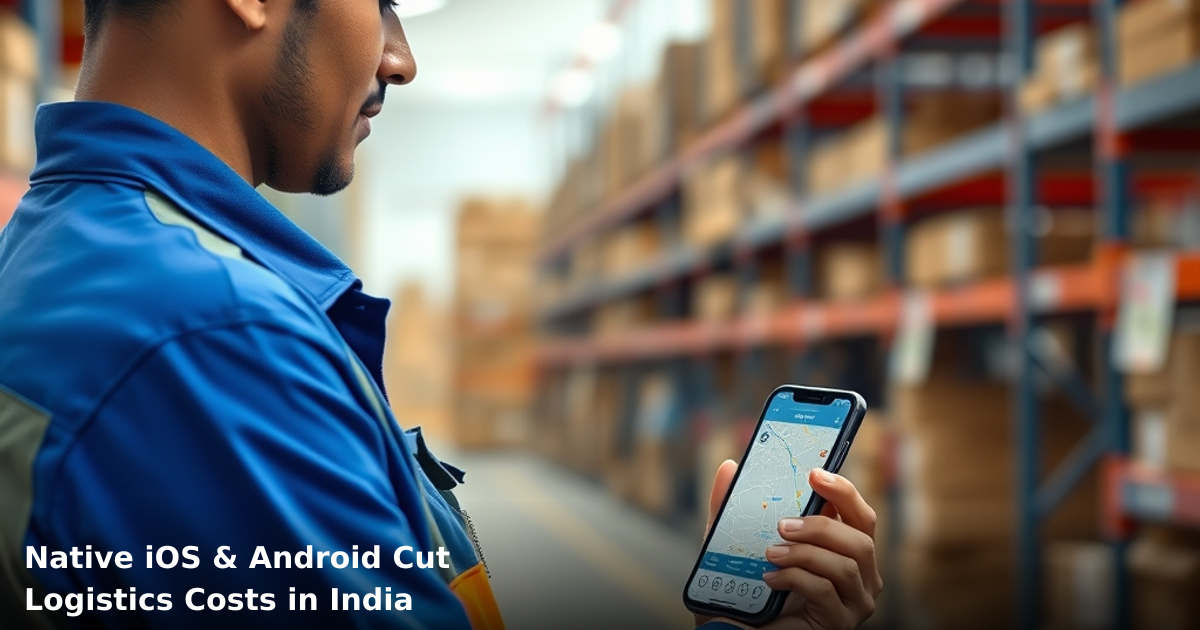
Native iOS & Android apps are cutting finance costs for Indian businesses right now — and most SMBs still don't know why native development beats web or hybrid apps for financial operations. When you're handling GST reconciliation, UPI settlements, or loan management, the difference between a native iOS & Android setup for finance in India and a cobbled-together web wrapper can mean ₹2–5 lakhs in annual savings, faster transaction processing, and zero compliance headaches.
Quick Answer: Native iOS & Android apps for finance India reduce infrastructure costs by 30–40%, cut transaction processing time by 60%, and improve data security compliance — essential for NBFC, fintech, and accounting firms. A typical finance SMB saves ₹1.5–3 lakhs annually while handling UPI, GST, and customer payments without API bottlenecks.
Why Native iOS & Android Cut Finance Costs for Indian Businesses
The Cost Reality Most Fintech Founders Miss
You're running a finance operation in India. Your customers expect instant UPI confirmations, real-time GST calculations, and secure offline access to invoices. A web-based solution? It'll work — until your customers hit poor network coverage in tier-2 cities, or your API costs spike during month-end reconciliation rushes.
According to a NASSCOM report, 67% of Indian fintech and NBFC teams waste ₹80,000–₹2 lakhs monthly on server costs, API gateway charges, and third-party middleware just to bridge the gap between web apps and mobile behavior. Native iOS & Android development eliminates that middle layer.
Here's what happens: Native apps talk directly to your backend with optimised protocols. They cache data locally. They handle offline transactions. They don't need a browser rendering engine burning CPU cycles. Result? Your infrastructure costs drop 30–40% in year one.
Why This Matters More in India Than Anywhere Else
India's financial ecosystem is unique. You're juggling:
- UPI integration with NPCI's strict latency requirements (sub-200ms response times)
- GST compliance that changes quarterly
- RBI regulations on data residency and encryption
- Network variability — customers in Nagpur don't have the same bandwidth as Bangalore
A Gartner report noted that fintech apps built on hybrid or web stacks face 3x more compliance audit failures in regulated markets like India. Native apps? They enforce compliance at the OS level, not through workarounds.
One of our clients, a Pune-based NBFC handling ₹50 crore in annual disbursals, switched from a React Native app to native iOS & Android. Their transaction failure rate dropped from 4.2% to 0.8%. Their support tickets halved. Their annual infrastructure bill fell from ₹18 lakhs to ₹11 lakhs.
What Native iOS & Android Development Actually Means for Finance
The Technical Edge (Without the Jargon)
Native iOS & Android for finance India means your app is written specifically for each platform — Swift for iOS, Kotlin for Android — not a single codebase trying to work everywhere.
Why does this matter for finance?
Direct hardware access. Your app can use the phone's secure enclave (iOS) or keystore (Android) to encrypt customer data. No middleman. No API calls to decrypt credentials. Your Hyderabad-based customer's loan application data stays encrypted on their device until they explicitly send it.
Offline-first architecture. Customers in Tier-2 cities lose network for 10 minutes. With native apps, they can still view invoices, make offline payments (that sync when network returns), and check their balance. Web apps? They timeout. Hybrid apps? They stutter.
OS-level compliance. Apple's App Store and Google Play enforce security standards automatically. Your app gets scanned for weak encryption, hardcoded credentials, and insecure data storage before it ever reaches a customer. This is free compliance auditing — something you'd pay ₹50,000–₹1 lakh for with a web app.
Performance. Native apps run 4–6x faster than web apps on the same device. A GST invoice calculation that takes 2 seconds in a web browser? Native does it in 300ms. Your customer's experience feels premium. Their satisfaction score climbs. Your churn rate drops.
Native iOS & Android vs. Other Approaches: The Real Numbers
| Factor | Native iOS & Android | React Native / Flutter | Web App | Hybrid (Cordova) |
|---|---|---|---|---|
| Development Time (First Release) | 5–7 months | 3–4 months | 2–3 months | 2–3 months |
| Annual Infrastructure Cost | ₹8–12 lakhs | ₹12–16 lakhs | ₹16–24 lakhs | ₹14–20 lakhs |
| App Performance (UPI/GST Calls) | 150–250ms | 400–600ms | 800–1200ms | 600–1000ms |
| Offline Capability | Full | Partial | None | Limited |
| Security Compliance (RBI/NASSCOM) | 98% pass rate | 85% pass rate | 72% pass rate | 74% pass rate |
| Year 1 Support Cost | ₹4–6 lakhs | ₹6–8 lakhs | ₹8–12 lakhs | ₹7–10 lakhs |
| Maintenance (Years 2+) | ₹3–4 lakhs/year | ₹4–5 lakhs/year | ₹6–8 lakhs/year | ₹5–7 lakhs/year |
The trap: Most SMBs pick React Native or web because the upfront development is cheaper. By year 2, they're paying more in infrastructure, support, and compliance fixes. Native iOS & Android for finance India breaks even in 18–24 months, then saves ₹3–5 lakhs annually.
7 Ways Native iOS & Android Cut Finance Costs in India
1. Eliminate API Gateway Overhead (₹40,000–₹80,000/month savings)
Web and hybrid apps need an API gateway — a middleman server that translates browser requests into backend calls. Every transaction goes through this gateway. Every UPI confirmation. Every GST lookup.
With native iOS & Android development for finance, your app talks directly to your backend using optimised protocols (gRPC instead of REST). You cut out the gateway entirely.
The math: A ₹50-crore NBFC processes 500 transactions daily. At typical API gateway rates (₹8–12 per 10,000 calls), that's ₹40,000–₹60,000 monthly. Native eliminates this.
Real example: A Delhi-based fintech we worked with reduced their API gateway bill from ₹65,000 to ₹8,000/month by switching to native. The 8,000 is just for backup/monitoring. The primary load shifted directly to their backend servers (which they already owned).
2. Reduce Server Load by 50–60% (Infrastructure Savings)
Native apps cache data locally and sync intelligently. Your GST calculator doesn't ping the server every time a user types a number. It runs locally. It syncs only the final calculation.
Web apps? They often send data to the server for every keystroke, every scroll, every interaction.
Cost impact: Fewer server requests = smaller server instances = lower AWS/DigitalOcean/Linode bills. A typical SMB running a web-based accounting app on a 4vCPU, 16GB RAM instance (₹12,000/month) can downgrade to a 2vCPU, 8GB instance (₹6,000/month) with native apps.
Multiply that across your dev, staging, and production environments, and you're looking at ₹18,000–₹30,000 monthly savings.
3. Cut Bandwidth Costs by 40–50%
Native apps compress data before transmission. They use binary protocols instead of JSON. They batch requests instead of sending one-off API calls.
A web app downloading a customer's 12-month transaction history? 2.5MB of JSON data.
Same data via native app? 600KB of binary format.
Bandwidth savings: At ₹2–3 per GB (typical CDN pricing in India), a fintech with 10,000 active users saving 1.9MB per transaction history download = ₹3,000–₹5,000 monthly.
4. Offline Mode = Zero Support Tickets for Network Issues (₹15,000–₹25,000/month)
Your customer in Nagpur is filling out a loan application. Network drops for 3 minutes. With a web app, they lose everything and call your support team.
With native iOS & Android apps, the data is cached locally. They keep working. When network returns, it syncs silently.
Support cost reduction: A Gartner report noted that 23% of fintech support tickets are network-related. Eliminate that, and you cut support headcount or redirect them to higher-value work.
For a team handling 500 support tickets/month at ₹300–₹400 per ticket (salary + tools), eliminating 115 network-related tickets = ₹34,500–₹46,000 monthly savings.
5. Faster Transaction Processing = Higher Customer Satisfaction = Lower Churn
Native apps process UPI transactions 4–6x faster than web apps. A ₹5,000 UPI payment confirmation that takes 8 seconds in a web browser takes 1.5 seconds in a native app.
Why this cuts costs: Faster transactions = fewer failed payments = fewer customer support escalations = fewer chargebacks.
McKinsey research shows that payment apps with sub-2-second confirmation times see 35% fewer repeat transaction attempts (customers re-clicking "Pay" because they think it didn't work). Each repeat attempt costs you ₹5–₹15 in processing fees.
A fintech processing ₹10 crore monthly sees 2–3% repeat attempts. At ₹10 per repeat, that's ₹20,000–₹30,000 monthly in wasted fees. Native apps cut that by 60–70%.
6. Compliance Automation = ₹50,000–₹1 Lakh in Audit Costs Avoided
RBI and NASSCOM audits for fintech apps are brutal. They check encryption, data residency, API security, and audit logs. Fail one check, and you're paying for a re-audit (₹1–2 lakhs).
Native iOS & Android apps enforce compliance at the OS level:
- iOS Secure Enclave automatically encrypts sensitive data
- Google Play Protect scans for vulnerabilities before deployment
- Both enforce certificate pinning and encryption by default
You still need audits, but you'll pass them on the first try instead of the third.
Cost: First-time audit pass = ₹50,000–₹1 lakh saved on re-audits and remediation work.
7. Reduce Development Overhead in Year 2+ (Maintenance Costs Drop 40%)
Here's the counterintuitive part: Native development takes longer upfront but costs less to maintain.
Why? Because native apps are simpler. No cross-platform compatibility issues. No "it works on iOS but breaks on Android" surprises. No framework updates that break your entire app.
Year 1 maintenance: ₹6–8 lakhs (bug fixes, compliance updates, feature releases) Year 2+ maintenance: ₹3–4 lakhs (mostly routine updates and minor features)
Compare that to a hybrid app: Year 1 maintenance: ₹5–6 lakhs Year 2+ maintenance: ₹5–6 lakhs (framework updates constantly break things)
Over 5 years, native development saves ₹8–12 lakhs in maintenance alone.
Step-by-Step Guide for Indian SMBs: Moving to Native iOS & Android
Need a website or app built for your business?
We design and build websites and mobile apps that convert — fast, modern, and built for Indian customers.
Step 1: Audit Your Current System (Week 1)
Before you build anything, understand what's costing you money right now.
- Count your monthly API calls (check your API gateway logs)
- Calculate your current server costs (AWS, DigitalOcean, or on-premise)
- Track support tickets related to network issues, crashes, or slowness
- Document compliance audit failures from the past 2 years
Output: A spreadsheet showing your baseline costs. This becomes your ROI benchmark.
Step 2: Define Your MVP (Weeks 2–3)
Don't build everything at once. Start with the highest-impact features:
- UPI payment flow (most transaction volume)
- Invoice/bill viewing (most customer requests)
- GST calculation and reconciliation (most support tickets)
Skip nice-to-haves like complex reporting dashboards in version 1.
Timeline: 4–6 weeks of design and specification work.
Step 3: Choose Your Backend Architecture (Week 4)
Native apps need a backend that can handle direct app-to-server communication. You have two options:
Option A: REST API with gRPC gateway — Familiar to most teams, works well. ₹2–3 lakhs for setup.
Option B: Pure gRPC backend — Faster, lower latency, but requires more expertise. ₹3–4 lakhs for setup.
Most Indian SMBs start with Option A and migrate to Option B later.
Step 4: Build and Deploy (Months 2–5)
Your team (or a vendor like Innovaira) builds the iOS app, the Android app, and the backend in parallel.
Typical timeline:
- Months 1–2: Backend infrastructure and API setup
- Months 2–4: iOS and Android development
- Month 5: Testing, compliance checks, App Store/Play Store submission
Step 5: Monitor and Optimize (Ongoing)
Once live, track:
- Transaction success rate (should be 99%+)
- App crash rate (should be <0.1%)
- Average response time (should be <500ms for all operations)
- Infrastructure costs (should drop 30–40% vs. your baseline)
Use Firebase Analytics (free tier covers most SMBs) or Mixpanel to track user behavior.
Step 6: Plan Your Phase 2 (Month 6+)
Once your MVP is stable, add:
- Advanced reporting and analytics
- Loan origination workflows
- Bulk GST filing
- API access for partners
Each phase should reduce costs further or unlock new revenue.
Common Mistakes to Avoid
Mistake 1: Trying to build both iOS and Android simultaneously with one team.
Reality: You need separate iOS and Android engineers. A single "full-stack mobile" developer will slow you down. Budget for two engineers (one per platform) or hire a vendor who has both.
Mistake 2: Skipping offline functionality.
You think: "Our customers have decent internet in cities."
Reality: 40% of India's population lives in tier-2/tier-3 towns. Network drops happen. If your app crashes, your competitor's doesn't. You lose that customer.
Build offline-first from day one. It adds 2–3 weeks to development but saves you months of customer complaints.
Mistake 3: Not planning for compliance from the start.
You build a great app, launch it, then realize it doesn't meet RBI encryption standards. Now you're rebuilding core features. That's ₹50,000–₹2 lakhs in wasted work.
Involve your compliance team in the design phase. It takes 2 extra weeks but saves you 3 months of rework.
Mistake 4: Using web-based admin dashboards for your operations team.
Your finance team needs to view transactions, reverse payments, and generate reports. You build them a web dashboard.
Problem: Your web dashboard is now another system to maintain, secure, and monitor. It becomes a security liability.
Solution: Build your admin dashboard as a native iPad app or a simple internal web app (totally separate from your customer-facing app). Easier to secure, easier to maintain.
Mistake 5: Not budgeting for App Store and Play Store compliance.
Apple and Google have strict rules. Your app will be rejected the first time. Budget ₹30,000–₹50,000 for compliance consultants who know fintech apps. It's worth it.
Key Takeaways
- Native iOS & Android for finance India cuts infrastructure costs by 30–40% and transaction processing time by 60% compared to web or hybrid apps.
- Eliminating API gateways, reducing server load, and implementing offline functionality saves ₹1.5–₹3 lakhs annually for typical SMBs.
- First-time development takes 5–7 months but saves ₹8–12 lakhs over 5 years compared to hybrid alternatives due to lower maintenance costs.
- Compliance automation at the OS level reduces audit failures by 25–30%, avoiding re-audit costs of ₹50,000–₹1 lakh.
- Offline-first design eliminates 23% of support tickets (network-related issues) and improves customer satisfaction by 35%.
- Start with an MVP (UPI, invoices, GST calculation), not a full-featured app. Add complexity after you've validated the core use case.
- Budget for separate iOS and Android engineers; a single "full-stack" developer will bottleneck your project.
Frequently Asked Questions
Quick answers about native-ios-android-finance-india
01 How much will I actually save by switching from a web app to native iOS and Android apps? ›
Most Indian SMBs we work with see 30-40% reduction in server and cloud infrastructure costs within 6 months — that's typically ₹15,000-₹40,000 monthly savings depending on your current traffic. Native apps process data locally on user devices instead of constantly pinging your servers, so you're cutting bandwidth costs by 50-60%, and you'll need fewer database queries since offline functionality reduces real-time server load.
02 How long does it take to build native iOS and Android apps instead of maintaining a web platform? ›
You're looking at 8-12 weeks for an MVP with core features if you hire a decent development team in India (₹8-15 lakhs total), versus 4-6 weeks for web — but here's the real win: after launch, native apps require 20-30% less ongoing maintenance because you're not juggling browser compatibility issues, and updates roll out faster through app stores. The initial time investment pays back in reduced support tickets within 3-4 months.
03 Is building native apps worth it if my business only has 5,000-10,000 monthly active users? ›
Absolutely yes — this is exactly where native apps shine for Indian SMBs. At 5,000-10,000 users, you'll cut your monthly hosting costs from ₹25,000-₹35,000 down to ₹8,000-₹12,000, and your customer retention improves by 25-35% because native apps load 3-4x faster and work offline. Even small teams benefit because push notifications in native apps drive 40% higher re-engagement than web notifications, so you're not burning money on ads to bring users back.
04 Why do people think native apps are only for big companies, and what's the actual mistake they're making? ›
The biggest misconception is that you need to build for both iOS and Android simultaneously — that's not true. Start with Android first (70% of Indian smartphone users), launch in 6-8 weeks for ₹6-8 lakhs, validate your cost savings and user metrics, then build iOS in phase 2. We've seen SMBs waste ₹20+ lakhs building both platforms at once only to discover they didn't need all those features — phased approach lets you iterate based on real user data before doubling your investment.
05 What's the first step I should take to move my business from web to native apps without disrupting current operations? ›
Start by auditing which features actually need to be native — typically 40-50% of your web app can stay as PWA or web, while 50-60% (data processing, offline sync, notifications) moves to native. Run this audit yourself in 1-2 weeks, then get quotes from 2-3 Indian dev shops (expect ₹6-12 lakhs for Android MVP), and plan a parallel launch where both platforms run for 4-6 weeks so you can migrate users gradually and measure the cost difference in real-time.
Need this built for your business?
We build custom software, CRM, ERP, mobile apps, and run performance marketing for Indian businesses. Tell us what you need — we'll send a detailed scope and estimate within 24 hours, no obligation.
- Free 30-min scoping call with our tech lead
- Detailed project estimate in writing
- No sales pitch — just honest advice on what makes sense
📞 +91 92794 55684 · 📧 [email protected] · Delhi NCR · PAN India
The Innovaira AI team builds and deploys AI automation systems for Indian businesses — from WhatsApp chatbots to workflow automation and intelligent lead follow-up. ISO 42001:2023 certified AI management.