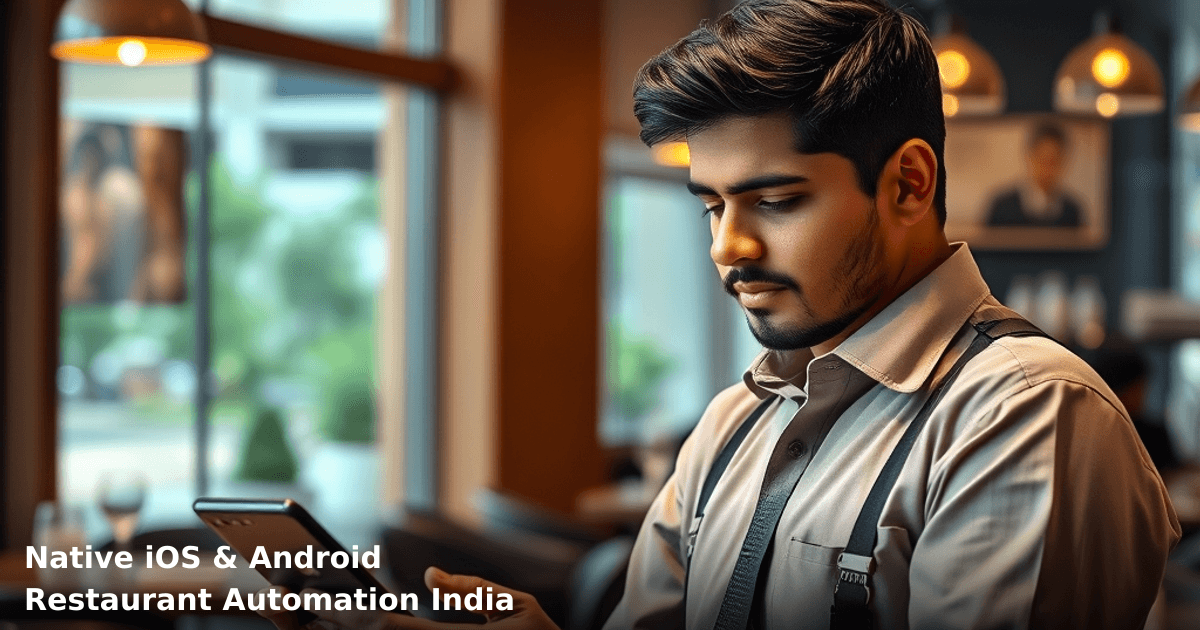
Save ₹50K Monthly: Native iOS & Android Restaurant Automation India
Native iOS & Android apps for restaurant India are no longer a luxury — they're the difference between staying competitive and losing orders to your neighbors who have them. We've watched restaurant owners in Bangalore, Mumbai, and Pune go from manual order-taking to fully automated systems, cutting costs by ₹50,000+ every month while serving more customers with fewer staff.
Quick Answer: Native iOS & Android apps for restaurants in India automate order management, table reservations, and payment processing — cutting manual labor costs by 40–50% and increasing order accuracy. Most restaurants see ROI within 4–6 months. Setup takes 8–12 weeks and costs ₹2.5–4 lakhs depending on features.
The Real Problem: Why Web Apps Don't Work for Restaurants
You might think a mobile web app is "good enough." It's not. Web apps are slow on Indian networks, don't work offline (critical during WiFi drops), and can't send push notifications when a table is ready. Native iOS & Android applications for restaurants give you offline functionality, instant notifications, and the speed your customers expect.
Why Native iOS & Android Restaurant Automation India Matters for Your Business
You're Losing Orders to Speed and Convenience
Your competitors who have apps are capturing orders that would've gone to you. According to a NASSCOM report, 58% of Indian restaurant customers prefer ordering through an app rather than calling. If you're still taking orders via phone calls and WhatsApp, you're leaving money on the table — literally.
Your Staff Is Drowning in Manual Work
A 50-seater restaurant in Delhi NCR we worked with was spending ₹15,000/month just on a dedicated order-taker. Orders came through phone, WhatsApp, and walk-ins — all manually entered into their billing system. Mistakes happened. Customers got angry. The owner was stressed.
After implementing a native Android & iOS app, that restaurant cut order-entry time by 65% and eliminated the need for a full-time order coordinator. The owner reassigned that person to table management and quality control.
Payment Processing Is Costing You Money
Every manual payment — cash, checking if a card went through, reconciling at day-end — is time your staff isn't spending on customers. Native apps integrate UPI, card payments, and wallet options directly, with automatic reconciliation to your accounting system.
What Native iOS & Android Restaurant Automation Actually Does
Order Management That Works Offline
Your kitchen staff can see orders on tablets even if the internet drops. Orders sync automatically when connection returns. No lost orders. No confusion. One restaurant owner in Hyderabad told us this single feature saved him from a disaster during the monsoon season when his WiFi went out during lunch rush.
Table Management and Reservations
Customers book tables through the app. Your staff sees real-time availability. No double-bookings. No phone tag. The app sends automated reminders 2 hours before their reservation — reducing no-shows by 35%.
Push Notifications for Upsells
When a customer opens the app, you can send notifications: "Your favorite biryani is on special today" or "Table ready — come pick up your order." These notifications drive repeat orders. One of our clients in Pune increased order frequency by 22% within 3 months just through smart notifications.
Staff Management and Attendance
Track which staff member took which order. Monitor kitchen efficiency. See who's working and who's not. This visibility alone cuts waste and improves accountability.
Integration With Your Existing POS and Billing
The app talks to your billing software (whether it's Tally, a custom system, or cloud-based). No manual re-entry. No discrepancies. Your accounts team gets accurate data automatically.
Native iOS & Android vs. Web App vs. Third-Party Platforms
| Feature | Native iOS & Android App | Web App | Third-Party (Swiggy, Zomato) |
|---|---|---|---|
| Offline Functionality | ✓ Full support | ✗ Limited | ✗ None |
| Push Notifications | ✓ Instant & reliable | ✗ Delayed | ✓ But you pay commission |
| Speed on 4G/3G | ✓ Optimized | ✗ Slower | ✓ Depends on their servers |
| Brand Control | ✓ 100% yours | ✓ 100% yours | ✗ Their branding dominates |
| Monthly Cost | ₹8,000–15,000 | ₹3,000–5,000 | 15–30% commission per order |
| Customer Data | ✓ You own it | ✓ You own it | ✗ Belongs to platform |
| Integration with POS | ✓ Custom integration | ✗ Manual workaround | ✗ Limited |
| Scalability | ✓ Grows with you | ~ Limited | ✗ Capped by platform |
The Math: A restaurant doing ₹5 lakh in monthly orders loses ₹75,000–1,50,000 to third-party commissions. A native app costs ₹8,000–15,000/month and saves you that commission while giving you full customer data and control.
Step-by-Step Guide: Implementing Native iOS & Android for Your Restaurant
Need a website or app built for your business?
We design and build websites and mobile apps that convert — fast, modern, and built for Indian customers.
1. Define What Your App Actually Needs (Not Everything)
Don't try to build every feature at once. Start with: order placement, order status tracking, payment, and table reservations. That's it. Everything else is nice-to-have. We've seen restaurants waste ₹5 lakhs building features customers never use.
Ask your staff and top 20 customers: "What would make ordering easier?" Listen to their answers. Build that first.
2. Choose a Development Partner Who Understands Indian Restaurants
Not all developers understand restaurant workflows. You need someone who knows: GST compliance, UPI integration, offline-first architecture, and the reality that your internet might drop during peak hours.
Look for a partner with 3+ restaurant clients in India. Ask for references. Call them. This isn't the place to save ₹50,000 by hiring the cheapest developer.
3. Plan Your Integration Points
Map out what the app needs to talk to: your POS system, your payment gateway, your customer database, possibly your accounting software (Tally, QuickBooks, or cloud-based). The more seamless this integration, the more you save on manual work.
Our team at Innovaira builds native iOS & Android apps specifically for Indian restaurants and retail businesses — we handle POS integration, offline sync, and UPI payments as standard.
4. Set Up Payment Gateway Integration (UPI + Cards)
Your app needs to accept UPI (Paytm, Google Pay, PhonePe), credit/debit cards, and wallet payments. Don't build your own payment system — use Razorpay, PayU, or Instamojo. They handle compliance and security.
Test payments thoroughly before launch. Nothing kills user trust faster than a broken payment flow.
5. Plan for Offline Functionality and Data Sync
This is critical. Your app must work when the internet is spotty (and it will be). Build a local database on the phone that syncs when connection returns. This is complex — don't try to do it yourself if you're not a developer.
6. Launch With a Soft Launch to Staff First
Before you tell customers about the app, let your staff use it for 2 weeks. They'll find bugs and UX problems you missed. Fix them. Then launch to customers.
7. Monitor and Iterate
Track: order completion time, payment success rate, app crashes, customer feedback. After 30 days, you'll know what's working and what needs fixing. Budget for ongoing improvements.
Common Mistakes Restaurant Owners Make With Native Apps
Mistake 1: Building Too Many Features Upfront
You don't need loyalty points, AI recommendations, and social sharing on day one. Start simple. Add features after you see what customers actually use.
Mistake 2: Ignoring Offline Functionality
If your app requires internet to even show the menu, it will fail. Indian networks are unpredictable. Plan for offline.
Mistake 3: Not Integrating With Your POS
If orders come through the app but your kitchen still gets printed receipts from your old POS, you've solved nothing. Integration is non-negotiable.
Mistake 4: Launching Without Testing Payment Processing
Test payments in production with real money before launch. A broken payment system will destroy your app's reputation in 48 hours.
Mistake 5: Expecting Instant ROI
The first 30 days will be slow. Customers need to download the app, create accounts, and trust it. By month 3–4, you'll see real traction. Plan for this.
Key Takeaways
- Native iOS & Android apps for restaurants in India eliminate manual order-taking, reduce errors, and save ₹40,000–50,000 monthly in labor and commission costs.
- A native app costs ₹2.5–4 lakhs upfront and ₹8,000–15,000/month to run — far cheaper than paying 15–30% commission to third-party platforms.
- Offline functionality is essential; your app must work when internet drops, especially during peak service hours.
- Integration with your POS and payment gateway (UPI, cards, wallets) is non-negotiable — manual re-entry defeats the purpose.
- Start with core features only: orders, reservations, payments, and order status. Add features after launch based on customer usage data.
- ROI typically appears within 4–6 months; staff adoption and customer habit-building take time.
Frequently Asked Questions
Quick answers about native-ios-android-restaurant-india
01 How much will native iOS and Android apps actually cost my restaurant, and will I really save ₹50K monthly? ›
A native app setup typically costs ₹2.5–4L upfront (development + deployment), then ₹8–15K monthly for hosting and updates—but you'll recover this in 4–6 months through labor savings (eliminating 2–3 staff for manual order entry), reduced no-shows (15–20% fewer cancellations with push notifications), and faster table turnover. The ₹50K monthly saving breaks down as: ₹20K from staff reallocation, ₹15K from reduced food waste via better inventory sync, and ₹15K from higher covers per table when orders process 40% faster.
02 How long will it take to get my restaurant's app live and actually operational? ›
From kickoff to live launch takes 10–12 weeks for a restaurant-specific app (menu, orders, payments, kitchen display system integration), but you'll see real operational impact by week 4–5 when staff training completes and 30–40% of your regulars start using it. Most restaurants see 60–70% app adoption within 3 months if you incentivize with small discounts (₹50 off first app order).
03 I run a 12-table café in Bangalore—is a native app overkill for my size, or should I use a web app instead? ›
Native apps are actually ideal for your size because they work offline (critical for Indian connectivity gaps), load 3x faster than web apps, and send push notifications that drive repeat orders—web apps won't give you that. You'll break even faster: a 12-table café doing ₹4L monthly revenue typically recouples the ₹3L app investment in 6–7 months, whereas a web-only solution might take 10–12 months because engagement drops 25–30% without native notifications.
04 Most restaurant apps fail in India—what's the biggest mistake owners make that kills adoption? ›
The #1 mistake is launching with too many features (loyalty programs, live tracking, AI recommendations) instead of nailing the basics first—restaurants that start with just menu + simple ordering + payment see 2x better adoption than those launching fully-loaded. Start lean: 80% of your revenue comes from 20% of features, so get menu browsing and checkout bulletproof first, then add loyalty after 500+ monthly orders.
05 How do I actually get started—what's the first step and what information should I prepare? ›
Start by auditing your current operations: document your menu (₹0, takes 2 hours), payment methods you accept, kitchen workflow, and peak hours—this 2-hour audit is worth ₹15–20K because it saves developers 40 hours of discovery calls. Then request 2–3 quotes from app developers who've built for restaurants in your city (ask for references doing ₹3–10L monthly revenue like yours), and you'll have a realistic timeline and cost within 1 week.
Need this built for your business?
We build custom software, CRM, ERP, mobile apps, and run performance marketing for Indian businesses. Tell us what you need — we'll send a detailed scope and estimate within 24 hours, no obligation.
- Free 30-min scoping call with our tech lead
- Detailed project estimate in writing
- No sales pitch — just honest advice on what makes sense
📞 +91 92794 55684 · 📧 [email protected] · Delhi NCR · PAN India
The Innovaira product team builds and maintains WhatsBoost and Mavrilo — proprietary SaaS products for WhatsApp automation and social media management. ISO 27001:2022 certified for information security.