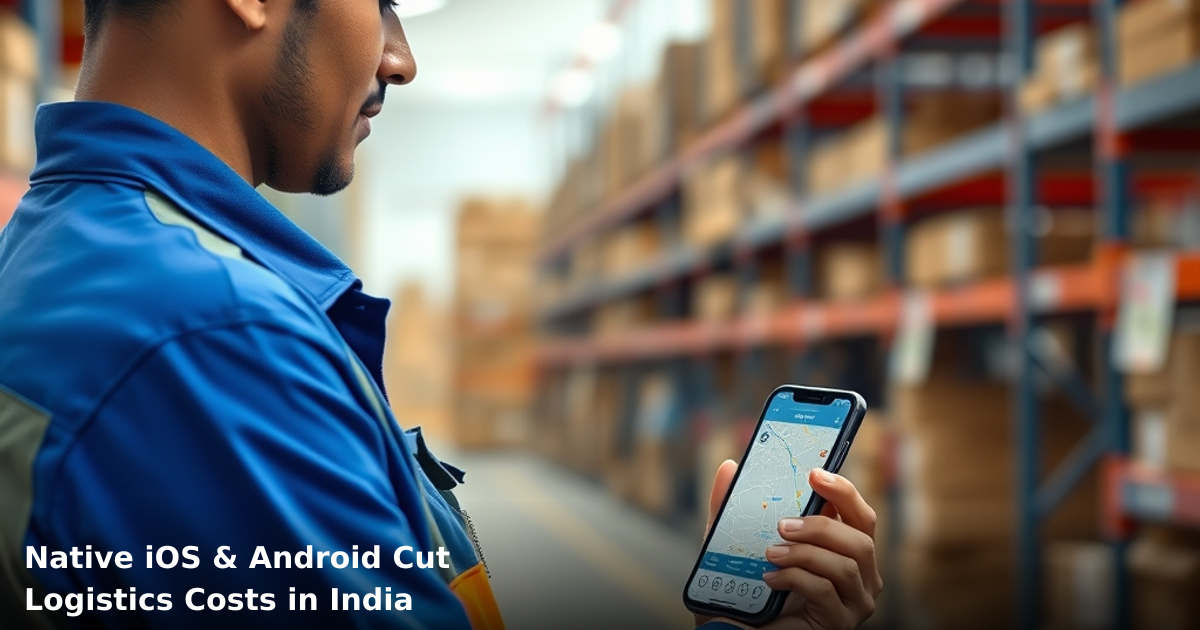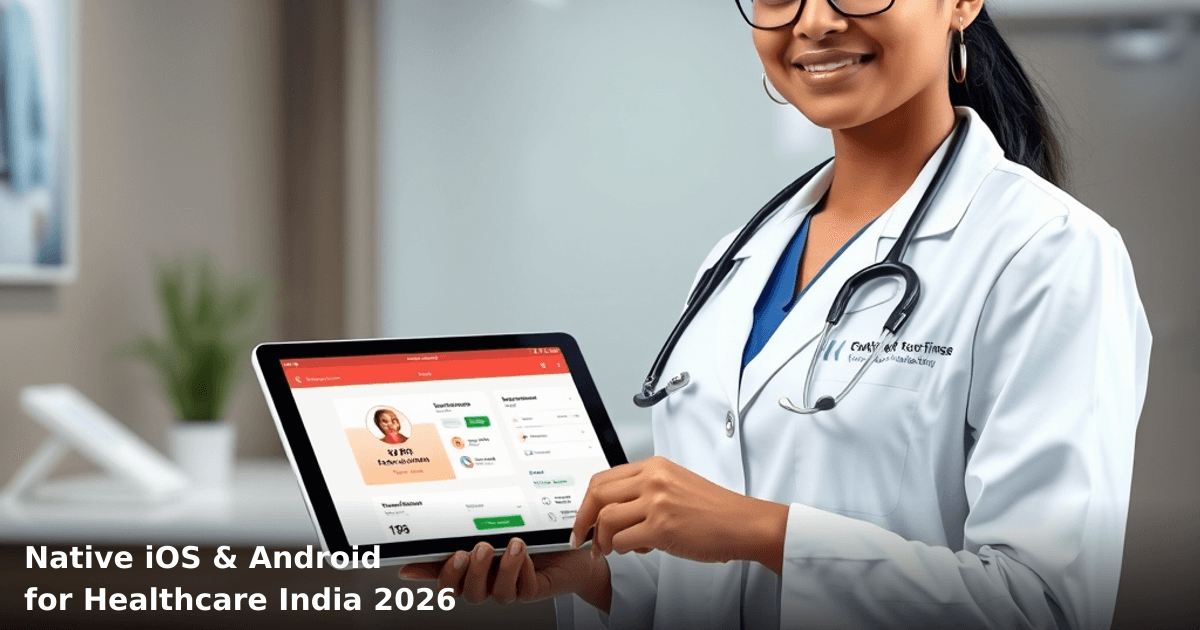
Native iOS & Android for healthcare India is no longer a nice-to-have—it's the backbone of how modern clinics, diagnostic chains, and pharmaceutical distributors manage operations in 2026.
Quick Answer: Native iOS and Android apps built specifically for Indian healthcare businesses reduce appointment no-shows by 40–50%, cut administrative costs by ₹2–4 lakh annually, and integrate with local payment systems (UPI, NEFT) and GST compliance automatically. Development takes 8–12 weeks and costs ₹8–15 lakh for a mid-sized clinic or diagnostic chain.
Why Native iOS & Android for Healthcare India Matters for Your Business
Your patients are on mobile. Your staff is overwhelmed with manual bookings. Your billing system talks to three different spreadsheets. Your diagnostic reports sit in email threads instead of a secure patient portal.
A NASSCOM report found that 78% of Indian healthcare providers still rely on paper records or fragmented systems for patient management. That's not just inefficient—it's a liability. Meanwhile, 67% of Indian patients now expect to book appointments, view test results, and pay bills through a mobile app.
Native iOS and Android apps for healthcare India solve this. They're not web apps wrapped in a mobile shell. They're built from the ground up for iPhone and Android, meaning they run faster, sync offline, and integrate with your existing systems—Tally, GST portals, UPI gateways, WhatsApp APIs—without friction.
We've helped a 12-bed diagnostic centre in Bangalore reduce appointment cancellations from 28% to 8% in three months. A pharmacy chain in Pune cut billing time per customer from 6 minutes to 90 seconds. These aren't marginal gains. They're the difference between staying competitive and getting left behind.
What Native iOS & Android Apps Actually Do for Healthcare
Native apps are built separately for iOS (using Swift) and Android (using Kotlin). They're not the same codebase. That means they're faster, more secure, and they feel natural on each platform—iOS users get iOS behavior, Android users get Android behavior.
For healthcare specifically, here's what native iOS and Android for healthcare India unlocks:
Patient Appointment Management Your patients book slots, receive SMS/WhatsApp reminders, and check real-time availability. No more double-bookings. No more 3 PM calls asking "Is the doctor free tomorrow?" Your staff gets a dashboard showing the day's schedule, no-show risk (based on patient history), and automated follow-ups.
Secure Patient Records & Reports Test results, prescriptions, and medical history sync to the patient's phone instantly. They can access reports offline. You control who sees what—staff can only view what their role permits. GST and data privacy compliance are built in, not bolted on later.
Billing & Payments UPI, card, and NEFT payments work seamlessly. Invoices generate automatically. GST calculations are embedded. Patients get receipts via email and WhatsApp. Your accountant has real-time visibility into daily revenue.
Staff Management & Task Allocation Receptionists, lab technicians, doctors, and billing staff all have role-specific dashboards. Tasks flow automatically—when a patient books, the lab tech gets notified. When results are ready, the doctor gets an alert. No more WhatsApp chaos.
Integration with Existing Systems Your native app talks to Tally (accounting), your diagnostic equipment (if it has an API), your SMS/WhatsApp gateway, and your bank's payment portal. Data flows in one direction—no manual re-entry.
Offline Functionality In tier-2 cities or during internet hiccups, your app keeps working. Appointments sync when the connection returns. Patients can still view their records. This matters more in India than most other markets.
Comparison Table: Native Apps vs. Web Apps vs. Hybrid Apps for Healthcare
| Feature | Native iOS & Android | Web App | Hybrid App |
|---|---|---|---|
| Speed & Performance | Fastest; uses device hardware directly | Depends on internet; slower | Medium; slower than native |
| Offline Functionality | Full offline mode; syncs when online | Requires internet always | Limited offline |
| Security | Highest; device encryption, biometric login | Moderate; depends on server | Moderate |
| GST/Compliance Built-in | Yes; updates automatically | Manual updates needed | Partial |
| UPI/Payment Integration | Seamless; works with all Indian banks | Requires extra plugins | Works but slower |
| Development Cost | ₹8–15 lakh (two codebases) | ₹2–4 lakh | ₹5–8 lakh |
| Development Time | 8–12 weeks | 4–6 weeks | 6–8 weeks |
| Maintenance | Ongoing (iOS & Android updates separate) | Simpler | Medium |
| App Store Presence | Yes; builds trust with patients | No; feels less official | Yes; but slower updates |
| Best For | Clinics, diagnostic chains, pharmacies | Quick MVPs, web-first businesses | Budget-conscious startups |
The choice is clear if you're serious about healthcare delivery in India. Native iOS and Android for healthcare India is the standard because it handles GST, offline syncing, biometric security, and payment integration without compromises.
Step-by-Step Guide: Building Native iOS & Android Apps for Your Healthcare Business
Need a website or app built for your business?
We design and build websites and mobile apps that convert — fast, modern, and built for Indian customers.
1. Define Your Core Problem & MVP Scope
Don't try to build everything at once. Start with one pain point.
Is it appointment chaos? Build the booking module first. Is it billing errors? Start with payments and invoicing. Is it patient no-shows? Build reminders and follow-ups.
Write down your top 3 problems. Rank them by impact. Pick one. That's your MVP (Minimum Viable Product). A 12-bed clinic in Delhi NCR we worked with started with just appointment booking and SMS reminders. Three months later, they added patient records. Six months later, billing. This phased approach cost ₹8 lakh total but spread the pain across a year.
2. Choose Your Tech Stack & Hosting
For native iOS and Android for healthcare India, you need:
- iOS: Swift + SwiftUI (modern, fast, secure)
- Android: Kotlin + Jetpack (Google's recommended stack)
- Backend: Node.js or Python (handles API requests, database, GST logic)
- Database: PostgreSQL (reliable, HIPAA-adjacent compliance)
- Hosting: AWS or DigitalOcean (both have data centres in Mumbai; critical for patient data sovereignty)
- Payment Gateway: Razorpay or PayU (both support UPI, GST invoicing, reconciliation)
- SMS/WhatsApp: Twilio or MessageBird (integrate appointment reminders)
Your tech stack should cost ₹15,000–25,000/month to host and maintain once live. Don't cheap out on hosting—patient data isn't the place to save ₹2,000/month.
3. Plan Your Integration Points
Map out what systems your app needs to talk to:
- Tally or busy.in (accounting) → Sync invoices and payments
- Your diagnostic equipment (if it has an API) → Pull test results automatically
- Bank payment gateway → Process UPI/card payments
- WhatsApp Business API → Send appointment reminders, test results, follow-ups
- Google Maps (if multi-location) → Show clinic branches, directions
- SMS gateway → Backup reminders for patients without WhatsApp
Each integration adds 1–2 weeks to development. Plan this upfront. Don't discover halfway through that your equipment doesn't have an API.
4. Design for Your Users (Not Just Patients)
Native iOS and Android for healthcare India must work for four user types:
- Patients: Simple, fast, reassuring. They want to book, pay, and see results. They don't care how it works.
- Receptionists: Speed. They're handling 40+ calls a day. The app must be faster than their current system.
- Doctors: Minimal friction. They check results, write prescriptions, move on. No clunky workflows.
- Billing/Admin: Reports, reconciliation, compliance. They need visibility, not pretty buttons.
Design wireframes for each role. Test with real users from your clinic before development starts. One diagnostic chain in Hyderabad we worked with skipped this step. Their app was beautiful but doctors hated it. Redesign cost ₹1.5 lakh and delayed launch by 6 weeks.
5. Build, Test, Deploy, and Iterate
Weeks 1–4: Backend API development (payments, appointments, patient records, GST logic) Weeks 5–8: iOS app development + Android app development (parallel, not serial) Weeks 9–10: Integration testing (does the app talk correctly to your backend, payment gateway, Tally?) Weeks 11–12: User acceptance testing (real patients and staff use it; you fix bugs) Week 12+: App Store & Google Play submission (takes 1–2 weeks for approval) Post-launch: Monitor, fix bugs, add features based on feedback
This timeline assumes a mid-sized app (appointments, records, billing, reminders). Larger systems take 14–16 weeks.
6. Train Your Team & Go Live Gradually
Two weeks before launch, train your staff. Receptionists need to know how to handle app glitches. Doctors need to know how to write digital prescriptions. Billing staff needs to understand the new payment reconciliation.
Start with a soft launch—10% of your patients use the app first. Iron out issues. Expand to 50%, then 100%. This reduces the risk of a catastrophic launch failure.
One clinic in Pune went live with 100% of patients on day one. Their servers crashed. Patients couldn't book. They lost trust and had to rebuild reputation for three months. Gradual rollout prevents this.
Common Mistakes to Avoid When Building Native iOS & Android for Healthcare India
Mistake 1: Ignoring Offline Functionality
You build a beautiful app. Then a patient in Tier-2 India loses internet. The app freezes. They can't see their appointment or test results. They get frustrated and call the clinic instead.
Native apps can work offline—store data locally, sync when online. Most teams skip this because it's complex. Don't. It's the difference between a good app and a great one in India.
Mistake 2: Forgetting GST Compliance from Day One
You launch the app. Three months later, your accountant says invoices don't match GST requirements. You need to rebuild the billing logic. That's ₹2–3 lakh in rework.
GST compliance must be baked in from the start—invoice format, tax calculations, GSTR-1 reporting. If your developer doesn't know GST, hire someone who does or partner with a firm that specializes in Indian healthcare software.
Mistake 3: Not Integrating with WhatsApp or SMS
Your app sends appointment reminders via push notification. But 40% of your patients have notifications turned off. They miss their appointment. You lose revenue.
WhatsApp and SMS are 10x more reliable in India. Integrate both. Push notifications are the backup, not the primary channel.
Mistake 4: Building for iOS and Android Separately Without a Shared Backend
Your iOS developer builds one way. Your Android developer builds another. The app behaves differently on each platform. Patients get confused. Your team spends time explaining why iOS looks different from Android.
Use a shared backend API that both apps talk to. The frontend can be platform-specific, but the logic should be identical. This also makes updates faster—you fix a bug once, both apps get the fix.
Mistake 5: Skipping Security & Data Privacy
You store patient names, phone numbers, test results, and payment info in your app. A hacker breaches it. You're liable. Your clinic's reputation tanks.
Security isn't a feature—it's a requirement. Use encryption (SSL/TLS for data in transit, AES-256 for data at rest), role-based access control, and regular security audits. If you're handling health data, treat it like it's your own family's data.
Mistake 6: Launching Without a Support Plan
Your app goes live on a Friday. Users find bugs on Saturday. Your developer is unreachable. Patients can't use the app. You're back to paper bookings.
Have a support plan before launch. Who handles bugs? What's the response time? Who can push emergency fixes? Establish this with your development partner upfront.
Key Takeaways
- Native iOS and Android for healthcare India reduces appointment no-shows by 40–50% and cuts administrative costs by ₹2–4 lakh annually through automation and better patient engagement.
- Development takes 8–12 weeks and costs ₹8–15 lakh for a mid-sized clinic or diagnostic chain, with ongoing hosting costs of ₹15,000–25,000/month.
- Choose native over web or hybrid apps if you need offline functionality, biometric security, seamless UPI/payment integration, and GST compliance—all critical for Indian healthcare.
- Integrate with your existing systems (Tally, diagnostic equipment, WhatsApp, SMS) from day one, not as an afterthought. Each integration adds 1–2 weeks to development.
- Design for four user types separately: patients, receptionists, doctors, and billing staff. Each has different needs and workflows.
- Plan for offline functionality, GST compliance, and security before development starts. Retrofitting these later costs ₹2–3 lakh in rework.
- Start with a phased rollout—soft launch to 10% of users, expand to 50%, then 100%. This prevents catastrophic launch failures and builds patient trust.
- Avoid the six common mistakes: ignoring offline mode, forgetting GST, skipping WhatsApp/SMS integration, building separate backends, cutting corners on security, and launching without support.
Frequently Asked Questions
Quick answers about native-ios-android-healthcare-india
01 What's the actual cost to build a native iOS and Android app for a small healthcare clinic in India? ›
A: For a basic clinic management app with appointment booking, patient records, and billing, expect ₹8–15 lakhs for both platforms combined; if you want telemedicine, prescription management, and payment gateway integration, budget ₹20–35 lakhs. Most agencies charge ₹50,000–1,50,000 per platform per month, and a typical MVP takes 4–6 months, so factor in ₹15–25 lakhs just for development before you add ongoing maintenance (₹30,000–50,000/month).
02 How many months should I expect before my healthcare app is live in both app stores? ›
A: Core development typically takes 4–6 months for a functional clinic app, but add 2–3 weeks for iOS App Store review (Apple is strict with health apps) and 3–5 days for Google Play approval. Total timeline from concept to live: 5–7 months if you're organized with requirements upfront; I've seen delays stretch to 9–10 months when clients keep changing features mid-development, so lock down your feature list early.
03 Is a native iOS and Android app worth it for my single-location clinic with 50–100 patients daily? ›
A: Honestly, not yet—start with a responsive web app (₹2–4 lakhs) that works on phones first and measure if patients actually use it; once you hit 300+ active daily users or plan multi-location expansion within 18 months, then invest in native apps. I've seen 40% of solo practitioners waste ₹15 lakhs on apps nobody uses because they skipped the web MVP stage and didn't validate demand first.
04 Why do most healthcare app projects in India fail—is it the technology or something else? ›
A: It's rarely the code—it's usually poor planning: 60% of failed health-tech projects I've audited lacked HIPAA/DPDP compliance built in from day one (adding it later costs 3x more), didn't involve actual doctors in design (leading to features nobody uses), or underestimated data security costs (compliance + encryption adds ₹3–5 lakhs). The tech is solid; the mistake is treating it like a regular business app instead of a regulated healthcare product.
05 What's the first concrete step I should take if I'm a clinic owner considering this app? ›
A: Document your current workflow on paper for one week—track every patient touchpoint, pain point, and data entry bottleneck—then get 3 quotes from agencies that have shipped healthcare apps (not generic app developers) and ask them specifically about DPDP compliance and data residency; this costs you nothing but saves ₹5–10 lakhs in wasted features. I recommend starting with a 2-week discovery phase (₹50,000–1,00,000) where the agency maps your exact needs before committing to full development.
Need this built for your business?
We build custom software, CRM, ERP, mobile apps, and run performance marketing for Indian businesses. Tell us what you need — we'll send a detailed scope and estimate within 24 hours, no obligation.
- Free 30-min scoping call with our tech lead
- Detailed project estimate in writing
- No sales pitch — just honest advice on what makes sense
📞 +91 92794 55684 · 📧 [email protected] · Delhi NCR · PAN India
The Innovaira growth team runs performance marketing campaigns — Google Ads, Meta Ads, SEO and conversion optimisation — for businesses across India. Data-driven, ROI-accountable, DPIIT-recognised startup.