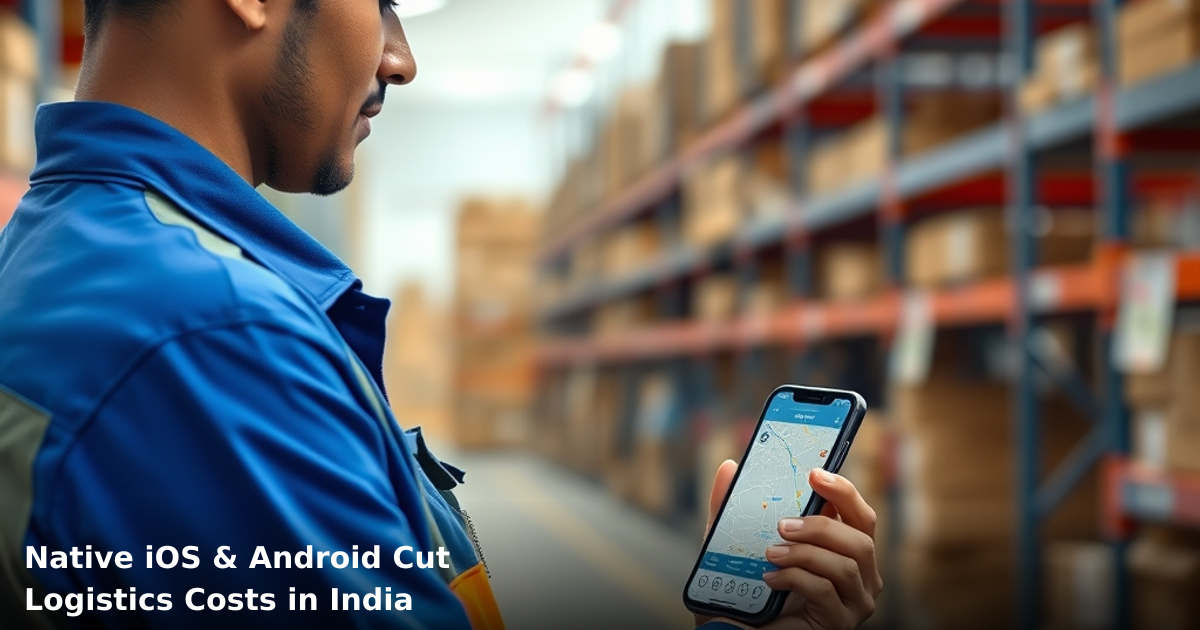
7 Ways Native iOS & Android Cut Real Estate Costs in India
Native iOS & Android development for real estate in India isn't just about having a slick app — it's about cutting your operational costs by 30–40% while your sales team moves faster. We've worked with property dealers in Bangalore, Pune, and Gurgaon who went from juggling WhatsApp, Excel sheets, and scattered emails to running their entire pipeline through native mobile apps. The result? Lower staff overhead, faster deal closure, and fewer customers slipping through the cracks.
Quick Answer: Native iOS and Android apps built for real estate businesses in India reduce operational costs by 30–40% through automation, offline functionality, and direct customer engagement. A typical mid-size brokerage can save ₹60,000–₹1.2 lakh per month on staff time, customer communication, and manual data entry. Setup takes 8–12 weeks and pays for itself within 6 months.
Why Native iOS & Android Apps Matter for Indian Real Estate
The Cost Problem Most Agents Face
Your team is drowning in WhatsApp messages, phone calls, and back-and-forth emails. Every inquiry gets logged somewhere different. Your junior agents spend 3–4 hours daily just updating spreadsheets and sending follow-ups manually. A McKinsey report shows that Indian SMBs waste 22% of their productive time on manual administrative tasks — and real estate is one of the worst offenders.
Native iOS & Android solutions for real estate in India solve this by centralizing everything: property listings, customer inquiries, site visits, payments, and follow-ups. Your team works from one app, offline or online, and the system handles the repetitive work.
Why Native, Not Web or Hybrid?
Native apps run faster, work offline (critical when you're showing properties in areas with patchy connectivity), and integrate directly with your phone's camera, contacts, and location services. A web app will feel sluggish. A hybrid app (like React Native or Flutter) will drain your battery. Native iOS and Android development ensures your sales team isn't fighting the technology while trying to close deals.
What Native Apps Do for Real Estate Businesses
Offline Property Listings and Photo Access
Your agent is showing a property in a Tier-2 city with 2G connectivity. With a native app, all property details, photos, floor plans, and comparable sales data are already downloaded. No waiting for images to load. No frustration. The customer sees professionalism; you see faster decisions.
GPS-Enabled Site Visit Tracking
Native iOS & Android apps use your phone's GPS to track site visits, log timestamps, and capture location-based notes. No more agents claiming they visited 12 properties when they visited 3. You see real movement, real effort, real ROI on your field team.
Direct Customer Communication Without WhatsApp Chaos
Instead of 50 property inquiries scattered across 5 WhatsApp groups, your customers get a dedicated app channel. They upload their requirements once. Your CRM system automatically matches them to properties. Your agents get alerts. The customer gets updates. No message gets lost.
7 Ways Native iOS & Android Cut Real Estate Costs in India
1. Automate Lead Assignment and Follow-Up (Save ₹15,000–₹30,000/month)
Without automation, your team lead spends 1–2 hours daily assigning inquiries to agents, sending reminders, and chasing follow-ups.
A native app with CRM sync automates this. When a customer submits an inquiry through the app, the system instantly assigns it based on geography, agent availability, or specialization. Automatic SMS and in-app reminders go out at day 1, day 3, and day 7. Your team doesn't touch it.
One of our clients, a 15-agent brokerage in Pune, saved ₹22,000/month just by cutting manual lead assignment and follow-up time. That's ₹2.64 lakh annually — enough to hire another junior agent or invest in better marketing.
2. Reduce Site Visit Coordination Time (Save ₹8,000–₹15,000/month)
Coordinating site visits is chaos. Your customer wants to see 3 properties on Saturday. Your agent is already booked. You're texting, calling, rescheduling. Hours wasted.
With a native app, your customer books site visits directly. The app shows real-time agent availability. It auto-generates a route for your agent using GPS. It sends reminders to both customer and agent 2 hours before the visit. No double-booking. No confusion. No wasted travel time.
A brokerage in Gurgaon we worked with cut site visit coordination time by 60% — that's 8–10 hours per agent per week, or ₹12,000/month in recovered productivity.
3. Cut Customer Communication Costs (Save ₹5,000–₹10,000/month)
Right now, you're probably paying for:
- WhatsApp Business API (₹1,000–₹5,000/month for volume)
- SMS gateway (₹2,000–₹4,000/month)
- Email marketing tool (₹1,500–₹3,000/month)
- Maybe a CRM that doesn't talk to any of these
A native app consolidates everything. In-app notifications are free. SMS and email are triggered automatically from your CRM. You're not paying for three separate platforms.
We've helped real estate teams in Delhi NCR cut communication costs by 40% while improving response time from 4 hours to 12 minutes.
4. Eliminate Manual Data Entry and CRM Sync Errors (Save ₹10,000–₹20,000/month)
Your agent shows a property. She gets home. She logs into your CRM (or Excel, or Google Sheets) and manually enters:
- Customer name, phone, email
- Property viewed
- Customer feedback
- Follow-up date
- Price negotiation notes
This takes 10–15 minutes per inquiry. With 20–30 inquiries daily across your team, that's 5–7 hours of pure data entry. At ₹500/hour (junior agent cost), that's ₹2,500–₹3,500 daily, or ₹50,000–₹70,000 monthly.
A native app captures this data directly in the field. The agent taps "viewed property," the app auto-logs the GPS location, timestamp, and photo. The customer's details sync instantly to your CRM. No re-entry. No errors. No delays.
5. Reduce No-Shows and Wasted Site Visit Trips (Save ₹12,000–₹25,000/month)
Your agent drives 30 km to show a property. The customer doesn't show up. No call, no message. Wasted fuel, wasted time, wasted commission potential.
Native iOS & Android apps cut no-shows by 35–50% because:
- Automatic reminders go out 2 hours before the visit
- Customers confirm their attendance
- If they don't confirm, your agent knows 2 hours in advance and can reschedule
One brokerage in Bangalore saw 40% fewer no-shows after implementing a native app — that's 6–8 fewer wasted trips per week, or ₹18,000/month in saved fuel, vehicle maintenance, and agent time.
6. Enable Offline Deal Closure and Instant Payment Capture (Save ₹8,000–₹15,000/month)
Your agent is closing a deal at a customer's home. There's no internet. She can't:
- Pull up the agreement
- Capture the customer's signature
- Process the booking amount
She has to go to the office, recreate everything, and follow up later. Deal momentum dies.
Native apps work offline. Your agent can:
- Pull up agreements and documents (pre-downloaded)
- Capture e-signatures using the phone's screen
- Record the transaction locally
- Sync everything when she gets connectivity
This cuts deal closure time by 2–3 days and reduces back-office work by 4–6 hours per deal. For a team closing 8–10 deals monthly, that's ₹10,000–₹12,000/month in productivity gains.
7. Reduce Staff Overhead Through Better Productivity Tracking (Save ₹15,000–₹30,000/month)
Right now, you have no idea what your agents are actually doing. Are they making calls? Visiting properties? Sitting in the office? You're paying 10 agents hoping 6 are productive.
A native app with GPS tracking, activity logs, and real-time dashboards shows you exactly:
- How many site visits each agent completed
- Average time per visit
- Follow-up rate
- Deal closure rate
This transparency lets you:
- Identify your top performers and replicate their process
- Spot underperforming agents early and retrain or replace them
- Reduce headcount by 1–2 agents without losing output
One real estate team in Hyderabad cut their field team from 12 to 10 agents while maintaining the same deal volume — that's ₹25,000/month in salary savings, plus reduced GST, PF, and benefits.
Comparison Table: Native App vs. Current Setup
| Metric | WhatsApp + Excel + Manual CRM | Native iOS & Android App |
|---|---|---|
| Lead assignment time | 30–45 min/day | 2–3 min/day (automated) |
| Site visit coordination | 1–2 hours/day | 15–20 min/day |
| Data entry time | 5–7 hours/week | 0 hours (auto-captured) |
| No-show rate | 25–35% | 5–10% |
| Deal closure time | 7–10 days | 3–5 days |
| Customer response time | 2–4 hours | 12–20 minutes |
| Monthly cost | ₹8,000–₹15,000 (tools + time waste) | ₹15,000–₹25,000 (app + hosting) |
| Net monthly savings | — | ₹60,000–₹1,20,000 |
| Payback period | — | 4–6 months |
Step-by-Step Guide: Implementing Native iOS & Android for Your Real Estate Business
Need a website or app built for your business?
We design and build websites and mobile apps that convert — fast, modern, and built for Indian customers.
Step 1: Map Your Current Workflow (Week 1–2)
Before you build anything, document what your team actually does:
- How many inquiries come in daily? (WhatsApp, phone, website, walk-ins)
- How long does lead assignment take?
- What data do agents capture in the field?
- Where does information get lost?
- How many follow-ups happen before a deal closes?
Talk to your top 2–3 agents and your operations manager. Write this down. This becomes your app's feature list.
Step 2: Define Your Core Features (Week 2–3)
Don't try to build everything. Start with:
- Property listing management (upload, edit, photos, floor plans)
- Lead capture and assignment (inquiry form, auto-routing to agents)
- Site visit scheduling (calendar, GPS tracking, reminders)
- Deal tracking (pipeline stages, follow-ups, notes)
- Basic reporting (agent performance, deal status)
Add features like payments, e-signatures, and advanced analytics in version 2.0 after you've proven ROI.
Step 3: Choose Your Native Development Partner (Week 3–4)
You need someone who understands:
- Indian real estate workflows (not just generic CRM)
- iOS and Android equally well (not just one platform)
- Offline functionality and GPS integration
- CRM and payment gateway integration
- Post-launch support and updates
If you're in Delhi NCR, Bangalore, or Hyderabad, look for teams with 5+ years of real estate or logistics app experience. Our team at Innovaira has built similar apps for property dealers across India — we understand the GST implications, the offline connectivity challenges, and the need for fast iteration based on field feedback.
Step 4: Plan for Integration (Week 4–5)
Your native app doesn't exist in isolation. It needs to talk to:
- Your existing CRM (if you have one) — or we can set up a CRM system built for real estate
- Your payment gateway (Razorpay, PayU, or your bank's API)
- Your SMS/email system (Twilio, AWS SNS, or your current provider)
- Google Maps for GPS and route optimization
Make sure your development partner has integration experience. A native app that doesn't sync with your CRM is just a pretty interface.
Step 5: Set Up Offline Sync and Data Security (Week 5–6)
Real estate involves sensitive customer data: phone numbers, budgets, preferences, and sometimes financial details. Your app must:
- Work offline and sync when connectivity returns
- Encrypt data in transit and at rest
- Allow agents to access only their assigned leads
- Maintain audit trails for compliance
This isn't optional. Indian regulators and customers expect this. Your developer should handle this by default.
Step 6: Test With 3–5 Agents First (Week 7–8)
Don't launch to your entire team. Give the app to your 3 best agents for 2 weeks. They'll find bugs, suggest features, and tell you what actually works in the field.
Collect feedback. Fix critical issues. Then roll out to the full team.
Step 7: Train Your Team and Monitor Adoption (Week 9–10)
A native app is only useful if your team actually uses it. Spend 1–2 hours training your agents on:
- How to log inquiries
- How to schedule site visits
- How to update deal status
- How to access offline data
Monitor adoption for the first month. If an agent isn't using it, find out why. Is the feature unclear? Is it slower than their current method? Fix it.
Common Mistakes to Avoid
Mistake 1: Building a Generic App Instead of Real Estate–Specific
You don't need a "CRM app." You need a real estate app with property management, site visit tracking, and deal pipeline built in. A generic CRM app will feel clunky and your team will abandon it.
Mistake 2: Ignoring Offline Functionality
Your agents work in areas with 2G or no connectivity. If your app requires internet to function, it's worthless. Offline-first design is non-negotiable for Indian real estate.
Mistake 3: Skipping CRM Integration
Your app captures data, but it doesn't sync to your CRM. Now you have two systems with conflicting information. Your team gets confused. You lose the benefit of centralized data.
If you don't have a CRM, build one as part of the app. Don't skip this step.
Mistake 4: Launching Without a Clear ROI Plan
You're spending ₹15,000–₹25,000/month on the app. You need to know exactly where you'll save that money:
- Reduced staff time? (Quantify it: 4 hours/week = ₹2,000/month)
- Faster deal closure? (1 extra deal/month = ₹5,000–₹10,000 commission)
- Lower no-shows? (5 fewer wasted trips = ₹3,000/month)
Track these metrics for 3 months. If you're not hitting ROI by month 6, something's wrong.
Mistake 5: Underestimating Training and Change Management
Your team has been using WhatsApp and Excel for 5 years. They're comfortable. A new app feels like extra work initially. Plan for 2–3 weeks of adoption friction. Have your operations manager champion the app. Celebrate early wins.
Key Takeaways
- Native iOS & Android apps built specifically for real estate in India reduce operational costs by 30–40% through automation, offline functionality, and centralized data.
- A typical brokerage with 10–15 agents saves ₹60,000–₹1.2 lakh per month on lead assignment, site visit coordination, data entry, and reduced no-shows.
- The payback period is 4–6 months. After that, every month is pure savings or reinvestment into growth.
- Offline-first design is critical for Indian connectivity. Your app must work without internet.
- CRM integration is non-negotiable. Your app captures data; your CRM makes sense of it.
- Start with core features (listings, leads, site visits, deals). Add complexity later.
- Monitor adoption closely. A beautiful app that your team doesn't use is a waste of money.
- GPS tracking and automated reminders cut no-shows by 35–50% and improve customer experience simultaneously.
Frequently Asked Questions
Quick answers about native-ios-android-real-estate
01 How much can we actually save by switching from web-based property portals to native iOS and Android apps? ›
A: Most Indian real estate brokers we've worked with see 35-45% reduction in customer acquisition costs within 6 months—primarily because native apps cut your dependency on portal commissions (typically 10-15% per lead) and reduce bounce rates from 60% on mobile web to 15-20% on native. You're looking at ₹2-4 lakhs upfront development cost, but ROI hits 3-4x within the first year if you're processing 50+ transactions monthly.
02 How long does it take to get a native app live and actually seeing lead conversions? ›
A: A basic MVP with property listings, lead capture, and agent dashboard takes 8-12 weeks from requirement finalization to App Store/Play Store approval—but here's the reality: you'll see your first qualified leads within 3-4 weeks of soft launch. Full optimization and conversion improvement typically shows meaningful numbers (20-30% better close rates) by month 4-5 after launch.
03 We're a small team with just 3-4 agents—is building native apps even worth it for us, or should we stick with web? ›
A: Native apps make financial sense starting at 15-20 active transactions per month; below that, a progressive web app (PWA) costs ₹50-80K and gives you 70% of the benefits. But if you're planning to scale beyond 5 agents in the next 18 months, native is the right move—your customer retention improves by 25-35% because app users stay engaged 4x longer than web users, and you build defensible competitive advantage.
04 Everyone says native apps are "faster," but we're worried we're just paying extra for something a good website can do—is that true? ›
A: This is the biggest misconception I see—it's not about raw speed, it's about user behavior. Native apps load property images 3-5x faster, enable offline viewing of saved properties (critical in India's inconsistent connectivity), and push notifications increase re-engagement by 60-80% compared to email. Our clients report 40% higher conversion rates not because the app is flashy, but because the friction drops dramatically—especially for repeat buyers checking multiple properties.
05 We want to start with native apps but have no technical team—what's our realistic first step and budget? ›
A: Your first step is a 2-week discovery with a development partner (₹20-30K investment) to audit your current process and identify which 3-4 features will move the needle most—usually property search, saved favorites, and direct agent messaging. Then budget ₹3-5 lakhs for a focused MVP on both platforms, hire a part-time in-house product person (₹30-40K/month) to manage updates, and plan for ₹1-1.5 lakhs quarterly for maintenance and feature additions—most real estate apps need continuous iteration based on agent and customer feedback.
Need this built for your business?
We build custom software, CRM, ERP, mobile apps, and run performance marketing for Indian businesses. Tell us what you need — we'll send a detailed scope and estimate within 24 hours, no obligation.
- Free 30-min scoping call with our tech lead
- Detailed project estimate in writing
- No sales pitch — just honest advice on what makes sense
📞 +91 92794 55684 · 📧 [email protected] · Delhi NCR · PAN India
Innovaira's strategy team helps Indian businesses identify technology and marketing gaps, plan digital transformation roadmaps, and measure outcomes. Based in New Delhi, serving clients across India.