7 Ways Mobile Apps for Manufacturing India Cut Costs — And Why Your Factory Needs One Now
Mobile apps for manufacturing India aren't a luxury anymore. They're the difference between a factory running on paper, spreadsheets, and WhatsApp chaos — versus one that knows exactly what's happening on the shop floor, in real time.
We've watched this shift happen across Pune, Surat, Ahmedabad, and Bengaluru. A textile exporter in Surat cut inventory waste by ₹3.2 lakh monthly after switching to a mobile-first production app. A precision engineering firm in Pune reduced downtime from 6 hours/week to 1.5 hours/week. These aren't outliers. They're the baseline now.
Quick Answer: Mobile apps for manufacturing in India reduce operational costs by automating shop floor tracking, inventory management, and worker communication. Most Indian manufacturers see ₹1.5–₹5 lakh/month in savings within 3–4 months of deployment, with ROI hitting 18–24 months depending on factory size and current processes.
Why Mobile Apps for Manufacturing India Matter for Your Business
Your factory probably runs like this: production managers walk the floor with clipboards, supervisors text updates to the plant head, inventory gets checked manually once a week, and when a machine breaks down, someone has to physically run to the maintenance team.
That's not just slow. It's expensive.
According to a NASSCOM report, 64% of Indian manufacturing SMBs still rely on manual or semi-automated processes. That inefficiency costs you in three ways:
- Labor overhead: People spending 15–20% of their time on data entry instead of actual work.
- Downtime: Machines sitting idle because spare parts weren't ordered on time, or maintenance teams didn't know about the breakdown fast enough.
- Waste: Overproduction, duplicate orders, or expired raw materials because nobody had real-time visibility.
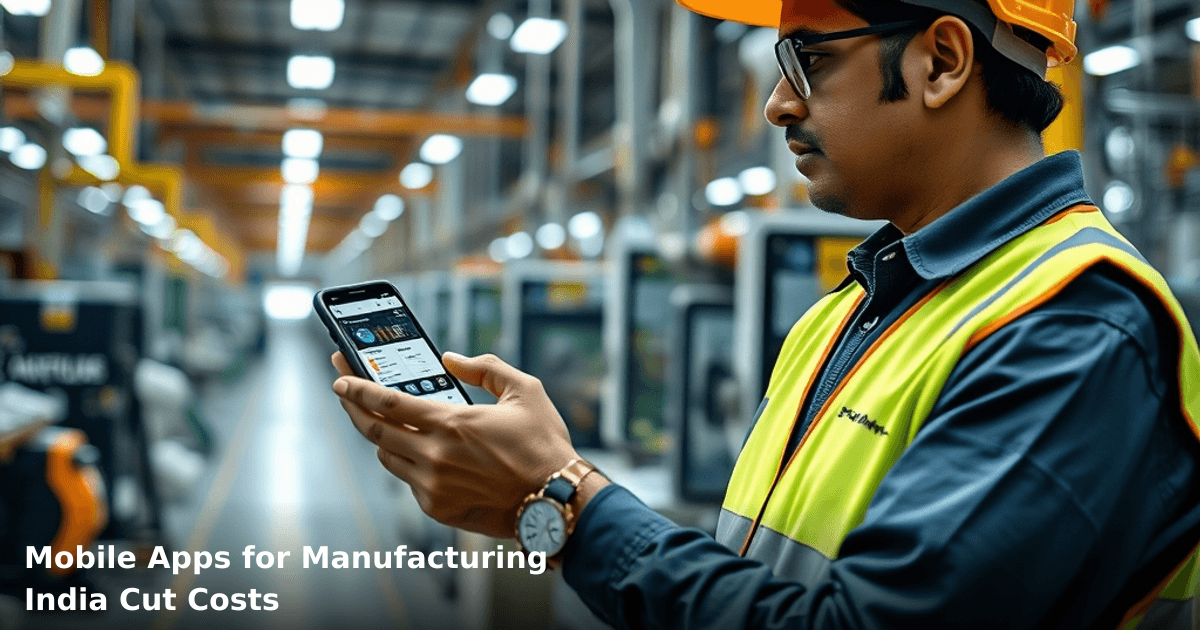
Mobile apps for manufacturing India solve this by putting the entire factory operation in your workers' pockets. Not as a gimmick — as a system that tracks, alerts, and automates the decisions that drain your margins.
7 Ways Mobile Apps Cut Manufacturing Costs in India
1. Real-Time Shop Floor Tracking Cuts Downtime by 40–60%
When a lathe breaks down at 2 PM, how long before your maintenance team knows? If it's via phone call or WhatsApp message, you've already lost 30 minutes. If they're checking a log at day-end, you've lost hours.
A mobile app sends an instant alert the moment a machine stops. Your maintenance team gets a notification with the machine ID, the last recorded error, and the spare parts in stock. They're at the machine within 5 minutes instead of 45.
Real example: One of our clients, a hydraulics manufacturer in Pune, reduced average downtime from 4.2 hours to 1.8 hours per incident. With 3–4 incidents/week, that's 7–8 hours of recovered production time weekly. At ₹8,000/hour of lost production, that's ₹56,000–₹64,000/week back in your pocket.
2. Inventory Management Apps Stop ₹2–₹4 Lakh in Waste Monthly
Manual inventory is a guess wrapped in a spreadsheet. You order too much because you're not sure what's in the warehouse. You order too little because the last count was three weeks ago. Raw materials expire. Finished goods pile up.
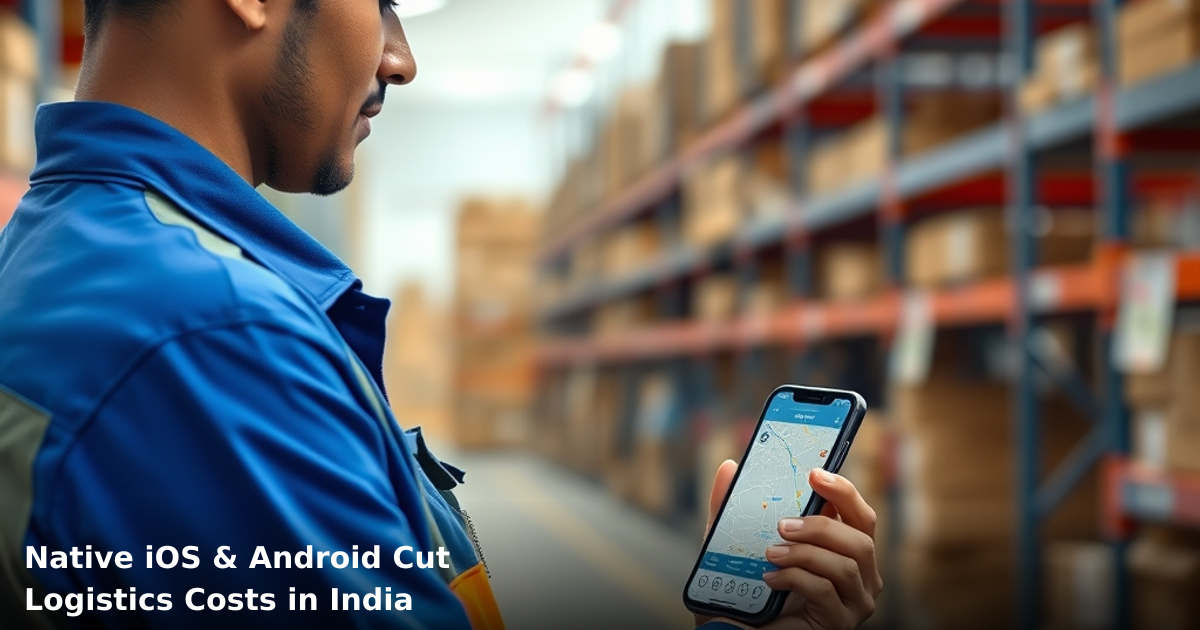
A mobile app connected to your warehouse lets any worker scan a barcode and update stock in real-time. The system flags when stock hits reorder point. It alerts you to slow-moving inventory before it becomes scrap.
Real numbers: A textile exporter in Surat was carrying ₹18 lakh in excess raw material inventory. After implementing a mobile inventory app, they cut that to ₹12 lakh within 8 weeks. That freed up ₹6 lakh in working capital — money that went straight back into operations.
3. Reduce Quality Defects by 25–35% with Mobile Inspection Checklists
Quality checks are currently done by one person, once per shift, walking the line with a clipboard. They miss things. They get tired. They sometimes skip steps because they're rushing.
A mobile app gives every worker an inspection checklist tied to their station. They scan the batch, answer 8–10 quick questions about dimensions, surface finish, or packaging, and the system flags defects instantly. No more "we found the problem after shipping."
Cost impact: If you're currently shipping 2–3% defective units and catching them at customer site (returns, rework, lost repeat business), even a 25% reduction in defects saves ₹1–₹1.5 lakh/month for a mid-sized factory.
4. Automate Labor Allocation — Save ₹80,000–₹1.2 Lakh Monthly
Right now, your production manager decides who works where based on habit, experience, and gut feeling. Sometimes the best welder is assigned to a job that doesn't need expertise. Sometimes workers stand idle because nobody checked capacity.
A mobile app tracks worker skills, current workload, and job requirements. It suggests optimal task allocation. Over time, it learns which workers are fastest at which jobs. You stop paying for wasted labor hours.
Real scenario: A precision engineering firm in Bengaluru had workers averaging 6.5 productive hours in an 8-hour shift (the rest was waiting for instructions, moving between stations, or rework). After implementing a mobile task-management app, that jumped to 7.2 hours. With 45 workers, that's 31.5 extra productive hours/week — equivalent to ₹1.1 lakh/month in recovered capacity.
5. Cut Raw Material Costs by 12–18% with Supplier Coordination
Your suppliers don't know your actual needs in real-time. So you either over-order (tying up cash) or under-order (causing delays). You end up buying emergency stock at 20–30% premium from local dealers.
A mobile app lets you share production forecasts with suppliers via a simple dashboard. They see your 4-week production plan and can schedule deliveries accordingly. You order less frequently, in optimized quantities, and rarely need emergency purchases.
Numbers: A mid-sized automotive parts manufacturer in Pune reduced raw material costs by 14% in the first 6 months by optimizing supplier orders through a mobile coordination app. For a ₹50 lakh/month material budget, that's ₹7 lakh/month in savings.
6. Eliminate Duplicate Orders and Rework — Save ₹50,000–₹2 Lakh Monthly
Without real-time visibility, your sales team sometimes takes orders that the production team can't fulfill on time. Production starts the job twice because communication broke down. Orders get lost in email chains.
A mobile app syncs sales orders, production schedule, and inventory in one place. Every team member sees the same truth. Duplicate orders are impossible. Rework drops because production knows exactly what was promised.
Impact: An electronics assembly firm in Bengaluru had 8–12% of production rework due to miscommunication. After implementing a mobile order-management system, rework fell to 2%. At ₹40 lakh/month revenue, that's ₹2.4 lakh/month in recovered capacity.
7. Predictive Maintenance Cuts Equipment Repair Costs by 30–40%
Your machines break down, you fix them. That's reactive. It's also expensive — emergency repairs cost 2–3x more than planned maintenance.
A mobile app collects sensor data from machines (if they have IoT sensors) or manual readings from workers. It spots patterns: "This pump usually fails 2 weeks after the temperature hits 65°C." You schedule maintenance before the failure. You buy parts in bulk, not in panic.
Real impact: A food processing plant in Pune implemented predictive maintenance via a mobile app connected to their key equipment. They cut unplanned downtime by 35% and maintenance costs by ₹1.8 lakh/year.
Comparison Table: Mobile App Approaches for Indian Manufacturers
| Approach | Setup Time | Monthly Cost | Best For | ROI Timeline |
|---|---|---|---|---|
| Custom Native App (iOS + Android) | 8–12 weeks | ₹15,000–₹35,000 | Large factories (100+ workers); complex workflows | 12–18 months |
| Cross-Platform App (React Native/Flutter) | 6–9 weeks | ₹10,000–₹25,000 | Mid-sized factories (30–100 workers); standard processes | 14–20 months |
| Mobile-First Web App | 4–6 weeks | ₹5,000–₹12,000 | Small factories (10–30 workers); basic tracking | 6–10 months |
| WhatsApp + Automation | 2–3 weeks | ₹3,000–₹8,000 | Very small operations; order & alert only | 2–4 months |
Step-by-Step Guide: How to Implement Mobile Apps for Manufacturing India
Need a website or app built for your business?
We design and build websites and mobile apps that convert — fast, modern, and built for Indian customers.
Step 1: Audit Your Current Processes (Week 1)
Walk your factory with a notepad. Where do you lose the most time? Where do errors happen most? Where is communication breaking down?
Common pain points:
- Production floor to manager: 20–30 minutes delay
- Inventory checks: manual, once/week
- Quality defects caught post-shipping: 2–3% of output
- Machine downtime: 3–5 hours average recovery time
Document these. Get numbers. This becomes your baseline for measuring ROI.
Step 2: Define Your Core Workflow (Week 1–2)
You don't need to automate everything on day one. Start with the biggest cost drain.
For most factories, that's one of these:
- Production tracking: What's being made, by whom, how long it takes
- Inventory management: Real-time stock visibility
- Quality control: Defect detection and logging
- Maintenance alerts: Machine downtime and repair requests
Pick one. Build the app around that workflow first. Add other modules later.
Step 3: Choose Your App Type (Week 2)
- Native iOS & Android app: Fastest, most reliable, works offline. Best if you have 50+ workers and budget of ₹20,000+/month. Native iOS & Android apps for manufacturing can cut costs significantly for larger operations.
- Cross-platform app: Good balance of cost and speed. 30–100 workers, ₹12,000–₹18,000/month.
- Mobile web app: Cheapest, easiest to update, but slower. Under 30 workers, ₹5,000–₹8,000/month.
If you're already using WhatsApp for worker communication, WhatsApp Automation can integrate alerts and order confirmations without building a full app — faster and cheaper to start.
Step 4: Plan Your Integration Points (Week 2–3)
Your app doesn't live alone. It needs to talk to:
- Tally or your accounting software: So inventory updates sync with GST records
- Your existing CRM or ERP: If you have one
- Supplier systems: For order coordination
- Machine sensors: If available (optional, but valuable)
This integration planning is where most projects slow down. Don't skip it.
Step 5: Pilot with One Department or Shift (Week 4–6)
Don't roll out to 100 workers on day one. Start with one production line or one shift. Let them use it for 2 weeks. Collect feedback. Fix bugs. Then expand.
You'll find issues you didn't anticipate: "The QR code scanner doesn't work in direct sunlight." "Workers need the app to work offline." "We need to export data to Excel for the auditor."
Piloting catches these before they become factory-wide problems.
Step 6: Train Your Team (Week 5–7)
Your workers won't use an app they don't understand. Plan for:
- 30-minute group training on the core workflow
- One "app champion" per shift — someone who troubleshoots and answers questions
- Written guide in Hindi/local language, not just English
- Ongoing support: A phone number or email they can reach your vendor at
Most app failures aren't technical. They're because workers didn't understand why they should change their habit.
Step 7: Measure and Optimize (Week 8 onwards)
After 4 weeks of full use, pull your data:
- Downtime incidents: how many, how long to resolve?
- Inventory accuracy: how close is your app count to physical count?
- Defect rate: did it drop?
- Labor hours: are workers more productive?
Compare to your baseline from Step 1. If you're not seeing 15–20% improvement in your chosen metric by month 3, something's wrong. Adjust.
Common Mistakes to Avoid
Mistake 1: Building an app for everything at once You end up with a bloated app that's slow, confusing, and takes 6 months to build. Start with one workflow. Expand after month 3.
Mistake 2: Not training workers properly You deploy the app, then wonder why nobody uses it. Workers need to see the benefit in their own work — less rework, fewer mistakes, easier job — not just "the boss wants this."
Mistake 3: Choosing the wrong app type for your size A 15-person workshop doesn't need a ₹25,000/month native app. A WhatsApp automation system or mobile web app saves them ₹15,000/month and does the job.
Mistake 4: Ignoring offline functionality If your factory has spotty WiFi (common in tier-2 cities), your app needs to work offline and sync when connection returns. This doubles development cost but is non-negotiable.
Mistake 5: Not integrating with existing systems Your app collects data, but it stays siloed. It doesn't talk to Tally, so your accountant still manually enters inventory. You've just added a new tool instead of replacing an old one.
Mistake 6: Underestimating change resistance Your production manager has run the floor for 10 years without an app. He sees it as a threat, not a help. Involve him early. Show him how it makes his job easier, not just visible.
Key Takeaways
- Mobile apps for manufacturing India reduce operational costs by ₹1.5–₹5 lakh/month for most mid-sized factories, with payback in 14–20 months.
- The biggest wins come from real-time shop floor tracking (40–60% downtime reduction), inventory optimization (₹2–₹4 lakh/month waste prevention), and labor allocation automation (₹80,000–₹1.2 lakh/month savings).
- Start with one core workflow (production tracking, inventory, or quality control), not everything at once.
- Choose your app type based on factory size: native for 50+ workers, cross-platform for 30–100, web app for under 30.
- Pilot with one department first. Train workers in their language. Measure against a clear baseline. Adjust monthly.
- Integration with Tally, CRM, and supplier systems is non-negotiable — don't build an isolated app.
Frequently Asked Questions
Quick answers about mobile-apps-for-manufacturing-india
01 How much will a manufacturing app actually cost my factory, and will it pay for itself? ›
A: A basic inventory + production tracking app runs ₹15,000–₹40,000/month as SaaS, while a custom build costs ₹3–8 lakhs upfront; most factories see 20–30% reduction in raw material waste within 6 months, which recovers costs if you're processing ₹50+ lakhs monthly. If you're running ₹20 lakh/month revenue, the ROI typically hits 8–12 months through reduced downtime and scrap alone.
02 How long does it take to actually get a manufacturing app running in my factory? ›
A: Cloud-based off-the-shelf apps go live in 2–4 weeks with basic setup and staff training, while a custom-built solution takes 3–5 months from requirement gathering to full deployment; the real timeline killer is getting your team to stop using Excel—expect another 4–6 weeks of resistance before adoption hits 80%.
03 Is a manufacturing app overkill for my 15-person factory, or should I wait until I'm bigger? ›
A: Start now—factories with 10–25 workers see the fastest payback because you still have manual chaos but enough volume to matter; at your size, a ₹20,000/month app catches ₹3–5 lakhs in annual losses from duplicate orders, forgotten jobs, and material shrinkage that bigger factories have already systematized.
04 Everyone says apps reduce downtime, but I'm skeptical—what's the actual catch I'm missing? ›
A: The real mistake is buying an app without fixing your shop floor data first; if your machine maintenance logs, material batches, and job cards are already a mess, the app just digitizes garbage and you'll blame the software. Spend 2–3 weeks cleaning up your records first, then the app typically cuts unplanned downtime by 15–25% because you actually know when machines need servicing.
05 What's the smartest first step if I want to try this without blowing my budget? ›
A: Start with a ₹8,000–₹12,000/month inventory + production app (like Deskera or Tally's manufacturing module) for 30 days on a free trial, track one production line only, and measure scrap/rework costs before and after; if you see even 10% improvement, you've proven ROI and can confidently expand to full factory coverage or a custom build.
Need this built for your business?
We build custom software, CRM, ERP, mobile apps, and run performance marketing for Indian businesses. Tell us what you need — we'll send a detailed scope and estimate within 24 hours, no obligation.
- Free 30-min scoping call with our tech lead
- Detailed project estimate in writing
- No sales pitch — just honest advice on what makes sense
📞 +91 92794 55684 · 📧 [email protected] · Delhi NCR · PAN India
Innovaira's engineering team designs and builds custom software — CRM, ERP, SaaS platforms, web applications and mobile apps — for growing Indian businesses. ISO 9001:2015 certified for quality delivery.