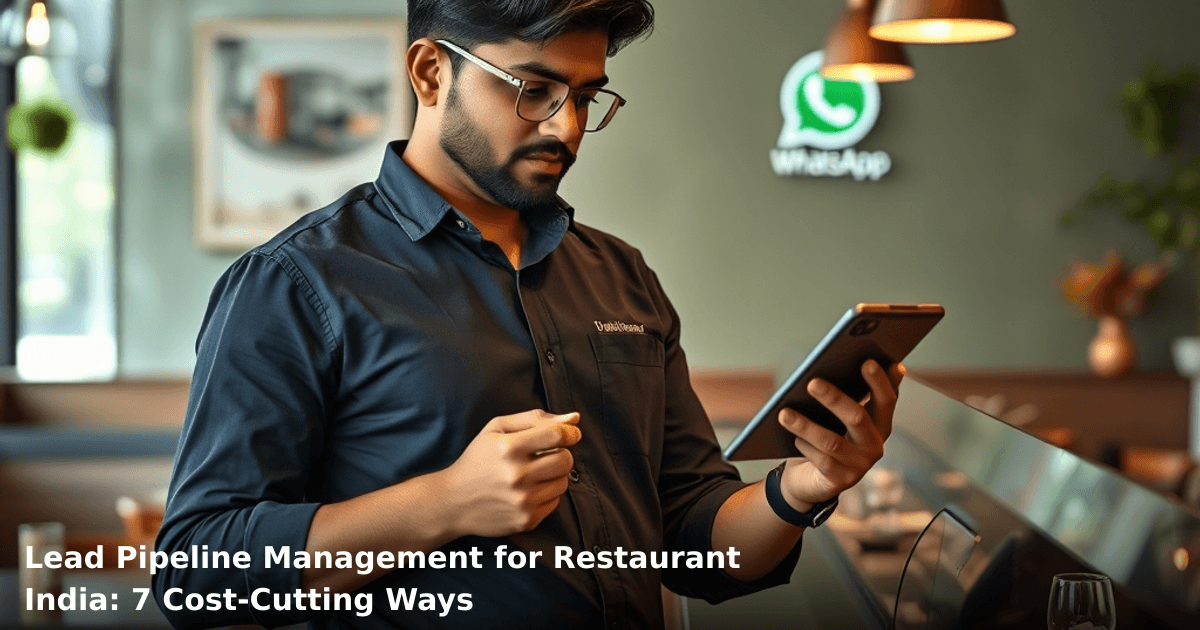
Lead pipeline management for restaurant India is no longer a luxury—it's the difference between a packed dining hall and empty tables. Your team is juggling walk-ins, reservations, catering orders, and delivery requests across WhatsApp, phone calls, and (if you're lucky) a basic spreadsheet. Half your leads disappear into the void. The other half turn into angry customers who forgot they booked a table.
Quick Answer: Lead pipeline management for restaurant India tracks every customer from first inquiry to final booking, cutting lost orders by 40–60% and reducing staff time spent chasing leads by ₹8,000–₹15,000 monthly. A structured pipeline also reveals which marketing channels actually work—so you stop wasting money on ads that don't convert.
Why Lead Pipeline Management Matters for Indian Restaurants
Your restaurant isn't just competing with the place next door. You're competing with food delivery apps, cloud kitchens, and a hundred other options your customer can tap in 30 seconds. A McKinsey report on Indian retail found that businesses tracking customer journeys systematically see 25–35% higher repeat order rates. For restaurants, that translates to ₹2–₹4 lakhs in additional revenue annually—just from not losing leads.
Here's what happens without a pipeline:
- A customer calls Friday evening asking about a table for 12 people on Saturday. Your manager writes it on a napkin. The napkin disappears. Saturday comes. No reservation. No follow-up. Customer goes to a competitor.
- A corporate office inquires about catering. Someone sends a quote via WhatsApp. The quote gets buried under 200 other messages. Three weeks later, you wonder why they never responded.
- Your delivery app shows 50 orders a week, but you have no idea which customers order repeatedly, which ones complain, which ones are worth a loyalty push.
Lead pipeline management for restaurant India solves this by creating a visible, trackable system. Every inquiry—phone, WhatsApp, walk-in, app—enters a pipeline. Your team knows exactly where each lead sits and what the next action is.
The Local Context: Why This Works in India
Indian restaurants operate differently than Western chains. You're dealing with:
- Multiple order channels: WhatsApp, phone, Instagram DMs, walk-ins, delivery apps, and direct bookings.
- High staff turnover: Information walks out the door when your manager leaves.
- Seasonal spikes: Weddings, festivals, office parties—demand is unpredictable.
- Thin margins: A ₹50,000/month restaurant can't afford to lose 20 orders a month to poor follow-up.
A structured pipeline handles all of this. One restaurant in Pune that we worked with was losing ₹12,000–₹15,000 monthly in forgotten reservations and catering inquiries. After implementing a basic pipeline system, they recovered 65% of those lost orders within 60 days.
What Is Lead Pipeline Management for Restaurants?
A lead pipeline is a visual, step-by-step map of where each customer inquiry stands. Think of it as a funnel:
- Inquiry → Customer calls, messages, or walks in.
- Qualification → You determine if they're a serious lead (table booking, catering, event, delivery).
- Proposal/Quote → You send pricing, availability, or menu options.
- Negotiation → They ask questions, request changes.
- Booking/Conversion → They confirm and pay (or book a date).
- Follow-up → You confirm details, upsell, and prepare for repeat orders.
The magic isn't in having these steps—it's in seeing them. When every lead is visible, your team stops dropping balls. When you track which leads come from which channel (WhatsApp, Google, Instagram, referral), you know where to spend your marketing rupees.
How It Works in Practice
Your restaurant uses a simple CRM or even a structured spreadsheet (though a CRM is better). Every inquiry gets logged with:
- Customer name and contact info
- Date and channel (WhatsApp, phone, walk-in, etc.)
- Lead type (table reservation, catering, delivery inquiry, event)
- Current status (new, quoted, negotiating, confirmed, lost)
- Follow-up date and action
Your team reviews the pipeline daily (takes 5–10 minutes). Anyone with a lead that's been "negotiating" for 5 days gets a reminder to follow up. Anyone with a "quoted" lead that's been silent for 3 days gets a gentle nudge. No lead falls through the cracks.
7 Ways Lead Pipeline Management Cuts Restaurant Costs in India
1. Recover 40–60% of Lost Orders
Without a system, leads disappear. A customer calls asking about a table for 8 people on Sunday. Your staff member says "yes, let me check," forgets to call back, and the customer books elsewhere. Or they walk in, you're full, and they leave without even asking about a future date.
A structured pipeline ensures every inquiry gets a response and a follow-up. One restaurant in Bangalore tracked this: they were losing approximately 35 inquiries per month simply because no one followed up. After implementing a basic CRM with WhatsApp integration, they recovered 22 of those 35 (63%) within the first month. At ₹800 average order value, that's ₹17,600 in recovered revenue monthly.
Cost saving: ₹15,000–₹20,000/month.
2. Cut Staff Time on Manual Follow-ups by 60%
Right now, your manager spends 1–2 hours daily scrolling through WhatsApp, digging through call logs, and trying to remember who needs a follow-up. With a pipeline, follow-ups are automated or batched.
A CRM can send automated reminders: "Reminder: Raj Kumar inquired about catering on Jan 5. Follow up today." Or it can trigger a WhatsApp message: "Hi! Just checking—are you still interested in that table for 6 on Saturday?" Your team goes from reactive (scrolling, searching) to proactive (checking a dashboard, executing pre-planned actions).
We worked with a restaurant in Delhi NCR with 8 staff members. They were spending roughly ₹6,000/month in lost productivity just on manual follow-ups. After moving to a pipeline system, that dropped to ₹2,000/month.
Cost saving: ₹3,000–₹5,000/month in staff time.
3. Identify Your Most Profitable Channels
You're probably spending money on Google Ads, Instagram, and referrals. But which one actually converts? Without a pipeline, you're guessing.
A pipeline tracks the source of every lead. After 60 days, you'll see something like:
- Google Ads: 40 leads, 8 bookings (20% conversion)
- Instagram: 60 leads, 6 bookings (10% conversion)
- WhatsApp referrals: 15 leads, 9 bookings (60% conversion)
- Walk-ins: 80 leads, 32 bookings (40% conversion)
Now you know: WhatsApp referrals and walk-ins are your goldmines. Instagram is draining money. You shift your ₹5,000/month Instagram budget to Google Ads or a referral incentive program.
Cost saving: ₹2,000–₹4,000/month by cutting low-ROI channels.
4. Reduce No-Shows and Cancellations by 30%
A customer books a table for 4 on Saturday at 7 PM. Your restaurant holds the table. They don't show up. You lose ₹2,000–₹3,000 in revenue and staff time.
A pipeline with automated reminders cuts no-shows dramatically. The day before their reservation, a WhatsApp message goes out: "Hi Priya! Just confirming your table for 4 tomorrow at 7 PM. Reply 'yes' to confirm or call us if plans changed." Most customers confirm or cancel. Your team knows exactly how many tables to prep for.
One restaurant in Hyderabad reduced no-shows from 15% to 8% after implementing reminder messages. At 25 bookings/week and ₹2,500 average lost revenue per no-show, that's ₹2,625/month saved.
Cost saving: ₹2,000–₹3,500/month.
5. Increase Repeat Orders Through Systematic Follow-up
A customer dines with you once. You never hear from them again. They're lost to a competitor.
A pipeline with follow-up sequences changes this. After their first visit, an automated message goes out 3 days later: "Thanks for dining with us! We'd love to have you back. Here's a 10% discount on your next visit." Then another message 2 weeks later if they haven't returned. Then a special offer during their birthday month (if you have their date).
This isn't pushy—it's just staying top-of-mind. A Statista report on Indian consumer behavior found that 68% of customers return to a restaurant if they receive a follow-up message within a week. Without follow-up, that drops to 22%.
If you serve 200 unique customers/month and increase repeat orders from 30% to 50% through follow-ups, that's 40 additional orders/month at ₹1,000 average = ₹40,000 extra revenue. Even if your margin is 30%, that's ₹12,000 extra profit.
Cost saving (or revenue gain): ₹8,000–₹15,000/month.
6. Prevent Overbooking and Capacity Waste
You book 12 tables for Saturday. Three customers cancel last-minute. You have empty seats, lost revenue, and wasted prep work. Or the opposite: you overbook, customers arrive and have to wait 45 minutes, and they leave angry.
A pipeline with real-time tracking prevents this. You see exactly how many confirmed reservations you have, how many are pending confirmation, and which are at risk of cancellation. Your manager can adjust kitchen prep and staff scheduling accordingly. If you're running light, you can offer last-minute discounts to fill seats.
A restaurant in Chennai reduced overbooking incidents by 85% after implementing a pipeline system, saving roughly ₹3,000/month in wasted food and staff overtime.
Cost saving: ₹2,000–₹4,000/month.
7. Cut Catering and Event Lead Loss by 50%
Catering and events are high-value, high-touch leads. A corporate office wants to cater a 100-person lunch. An event planner is sourcing venues for a wedding. These deals require multiple follow-ups, custom quotes, and coordination.
Without a pipeline, these leads often stall. Someone sends a quote. Days pass. No response. The lead owner gets busy with daily operations. The lead dies. You never even knew it was close.
A pipeline ensures catering and event leads get dedicated attention. You set a rule: "Event leads get a follow-up every 3 days until they say no." You track which proposals are pending, which are in negotiation, and which are ready to close. Your manager reviews these weekly.
One restaurant in Pune that we helped was losing ₹25,000–₹30,000/month in catering revenue due to poor lead follow-up. After implementing a pipeline with automated reminders for high-value leads, they recovered 60% of that lost revenue within 90 days.
Cost saving: ₹15,000–₹18,000/month.
Comparison Table: Lead Pipeline Management Approaches for Indian Restaurants
| Approach | Setup Time | Monthly Cost | Best For | Drawbacks |
|---|---|---|---|---|
| Manual (Spreadsheet + WhatsApp) | 1 day | ₹0 | Startups, <5 staff | Easy to lose data, no automation, manual follow-ups |
| Basic CRM (Zoho, Freshsales) | 3–5 days | ₹1,500–₹3,000 | Small restaurants, 5–20 staff | Limited customization, learning curve |
| Restaurant-Specific CRM | 1–2 weeks | ₹3,000–₹8,000 | Established restaurants, multi-location | Higher cost, overkill for very small shops |
| Custom CRM + WhatsApp Integration | 2–4 weeks | ₹5,000–₹12,000/month | Multi-location, high volume, catering focus | Requires ongoing support, longer ROI |
Our recommendation: Start with a basic CRM like Zoho or Freshsales if you have 5–50 staff. Integrate WhatsApp so customer messages land in your pipeline automatically. If you're multi-location or handle 100+ leads/week, a custom CRM with full automation pays for itself in 2–3 months.
Step-by-Step Guide to Setting Up Lead Pipeline Management for Your Restaurant
Tired of scattered spreadsheets and manual follow-ups?
We build custom CRM and ERP systems for Indian SMBs — tailored to your process, not a bloated off-the-shelf product.
Step 1: Define Your Pipeline Stages
Sit down with your manager and sales team (if you have one). Map out every stage a lead goes through:
- New Inquiry → Just received the call/message
- Qualified → Confirmed they want to book/order
- Quoted → Sent pricing and availability
- Negotiating → Back-and-forth on dates, menu, price
- Confirmed → Booking is locked in
- Completed → They dined/ordered; now track for repeat
If you do catering, add:
- Proposal Sent → Custom quote delivered
- Awaiting Approval → Waiting for their sign-off
- Contracted → Deal closed; now in execution
Step 2: Choose Your Tool
For most Indian restaurants, we recommend:
- Budget option: Google Sheets + WhatsApp Business (free, but manual)
- Mid-range: Zoho CRM Free or Freshsales (₹1,500–₹2,000/month, automated reminders)
- Full automation: Our CRM Development service (custom-built for your restaurant, integrates with WhatsApp, POS, and booking systems)
If you're handling 50+ leads/week or multi-location operations, a custom CRM pays back in 60–90 days through recovered revenue and reduced staff time.
Step 3: Integrate Your Communication Channels
Every customer touchpoint should feed into your pipeline:
- WhatsApp messages → Logged automatically
- Phone calls → Logged manually (or via call recording integration)
- Walk-ins → Logged at the host stand
- Booking app inquiries → Synced to your CRM
- Email → Forwarded to your CRM inbox
This takes 3–5 days to set up. If you use WhatsApp for business, the integration is straightforward. If you're using a custom CRM, our team handles this.
Step 4: Set Automation Rules
Tell your CRM what to do automatically:
- "If a lead is in 'Quoted' stage for 3 days, send a WhatsApp reminder"
- "If a lead is in 'Negotiating' for 7 days with no response, mark as 'At Risk' and notify manager"
- "If a reservation is confirmed, send a reminder 24 hours before"
- "If a customer completes a booking, add them to a 'Follow-up' sequence for repeat orders"
Step 5: Train Your Team
Your staff needs to know:
- How to log a new inquiry (takes 30 seconds)
- What stage each lead should be in
- When to move a lead forward
- How to use the dashboard to see today's follow-ups
Most restaurants need 2–3 hours of training. After that, it becomes second nature.
Step 6: Review Daily (5–10 minutes)
Every morning, your manager spends 5–10 minutes reviewing:
- New inquiries from yesterday
- Leads that need follow-up today
- Leads that are at risk of being lost
- No-shows or cancellations to learn from
This is the difference between a system that works and one that sits unused.
Step 7: Analyze Weekly (15 minutes)
Every Friday, pull a quick report:
- How many new leads this week?
- How many converted to bookings?
- Which channel brought the most leads? Most conversions?
- What's your average conversion rate by stage?
- Any patterns in cancellations or no-shows?
Use this to tweak your marketing and operations.
Common Mistakes to Avoid
Mistake 1: Treating the Pipeline as a One-Time Setup
You set up a CRM, enter 20 leads, then stop. Three weeks later, it's abandoned. Your team is back to WhatsApp chaos.
Fix: Assign one person (usually your manager) to own the pipeline. Make it part of their daily routine, not an extra task.
Mistake 2: Overcomplicating the Stages
You create 15 pipeline stages: "Inquiry," "Warm Inquiry," "Very Warm Inquiry," "Quote Sent," "Quote Reviewed," "Quote Accepted," etc. Your team gets confused. No one uses it.
Fix: Start with 5–7 stages. Add complexity only if you need it.
Mistake 3: Not Integrating WhatsApp
You set up a CRM, but customer messages still land in WhatsApp. Your team has to manually copy-paste conversations into the CRM. After a week, they stop doing it.
Fix: Use WhatsApp Business API with your CRM so messages sync automatically. This is non-negotiable for Indian restaurants.
Mistake 4: Ignoring Low-Converting Channels
You see that Instagram brings 60 leads/month but converts only 10% (6 bookings). You keep spending ₹5,000/month on Instagram ads anyway.
Fix: After 60 days of data, cut or reduce low-ROI channels. Redirect budget to what works.
Mistake 5: Not Following Up on Lost Leads
A customer inquires about catering. You send a quote. They go silent. You assume they're not interested and move on.
Fix: Set a rule: After 5 days of silence, send one more message. "Hi! Just following up on the catering quote we sent. Any questions I can answer?" You'll recover 10–15% of these "dead" leads.
Mistake 6: Forgetting About Repeat Customer Sequences
You focus on converting new leads but ignore customers who've already dined with you.
Fix: After a customer's first visit, add them to a "Repeat Order" sequence. Send a follow-up message 3 days later, a discount offer 2 weeks later, and a birthday offer if you have their date. This alone can increase repeat orders by 20–30%.
Key Takeaways
- Lead pipeline management for restaurant India cuts lost orders by 40–60%, recovering ₹15,000–₹20,000/month in revenue that's currently disappearing.
- Your team spends 1–2 hours daily on manual follow-ups. A pipeline cuts this by 60%, freeing up ₹3,000–₹5,000/month in staff time.
- You can't optimize what you can't see. A pipeline reveals which marketing channels actually convert, saving ₹2,000–₹4,000/month by cutting low-ROI spending.
- Automated reminders reduce no-shows by 30%, saving ₹2,000–₹3,500/month in lost revenue.
- Repeat order follow-ups increase customer lifetime value by 20–30%, adding ₹8,000–₹15,000/month in revenue.
- Catering and event leads require systematic follow-up. Without a pipeline, you lose ₹15,000–₹18,000/month in high-margin business.
- Start simple: A basic CRM (₹1,500–₹3,000/month) with WhatsApp integration pays for itself in 4–6 weeks through recovered leads and reduced staff time.
Frequently Asked Questions
Quick answers about lead-pipeline-management-restaurant-india
01 How much can I actually save on food waste by implementing lead pipeline management in my restaurant? ›
Most restaurants waste 4-6% of their daily inventory (roughly ₹8,000-₹15,000 per month for a mid-sized 50-cover restaurant), but proper pipeline management—forecasting covers based on confirmed reservations and walk-in patterns—cuts this to 1-2%. I've seen Delhi NCR restaurants recover ₹40,000-₹60,000 monthly just by aligning prep quantities to actual customer demand tracked through their pipeline.
02 How long does it take to see cost savings after we start tracking our lead pipeline? ›
You'll notice small improvements in 2-3 weeks (better table turnover, reduced no-shows), but significant cost reductions show up in 6-8 weeks when you have enough data to optimize staff scheduling and inventory ordering. The first month is mostly about data collection; by month two, you're making real decisions that hit your bottom line.
03 Is lead pipeline management only for large restaurant chains, or can a 20-table restaurant like mine benefit? ›
A 20-table restaurant benefits more than chains because your margins are tighter—even 5-8% waste reduction (₹5,000-₹10,000 monthly) is significant. Smaller restaurants also have faster implementation since you're not managing multiple locations; you can start with a simple Google Sheet or WhatsApp tracking system and upgrade tools later.
04 Isn't lead pipeline management just CRM software? Do I really need another app for my restaurant? ›
No—this is a common mistake. Pipeline management isn't about software; it's about tracking customer touchpoints (inquiry → booking → arrival → repeat). Many restaurants buy expensive CRM tools but never use them because they don't change how they actually manage reservations. Start with your existing systems (WhatsApp, phone logs, reservation book) and document patterns first; tools come after you understand your flow.
05 Where should a restaurant owner actually start with lead pipeline management? ›
Start by mapping your current customer journey for one week: log every inquiry (source, date, outcome), every booking (date, covers, show/no-show), and every repeat customer. This takes 3-4 hours of manual tracking but shows you exactly where customers drop off—usually 20-30% no-show rates are normal, but you'll identify which days/times have the highest waste. Then build your pipeline stages (inquiry → confirmed → arrived → repeat) and assign one person to track this daily; you'll have actionable data in 2 weeks.
Need this built for your business?
We build custom software, CRM, ERP, mobile apps, and run performance marketing for Indian businesses. Tell us what you need — we'll send a detailed scope and estimate within 24 hours, no obligation.
- Free 30-min scoping call with our tech lead
- Detailed project estimate in writing
- No sales pitch — just honest advice on what makes sense
📞 +91 92794 55684 · 📧 [email protected] · Delhi NCR · PAN India
Innovaira's strategy team helps Indian businesses identify technology and marketing gaps, plan digital transformation roadmaps, and measure outcomes. Based in New Delhi, serving clients across India.