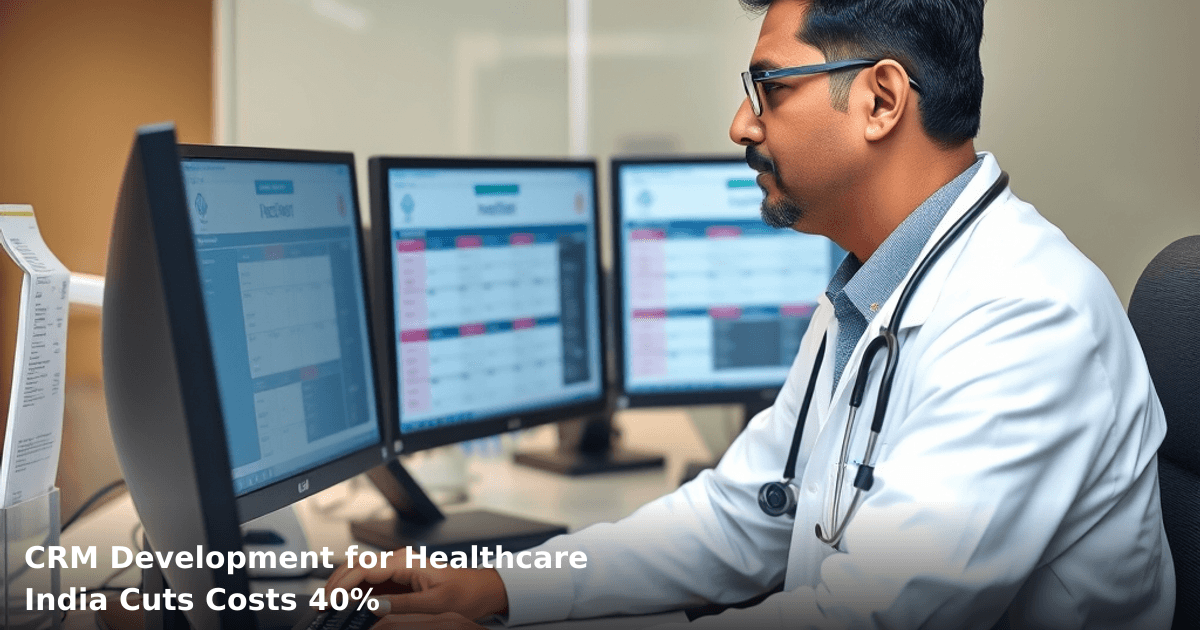
CRM Development for Healthcare India Cuts Costs 40%: Here's How
When you're running a clinic, hospital, or diagnostic center in India, you're juggling patient records, appointment scheduling, billing, insurance follow-ups, and staff coordination all at once. Most healthcare providers we've worked with are still using spreadsheets, WhatsApp groups, and handwritten notes — which means duplicate entries, missed follow-ups, and angry patients calling back three times for the same issue.
CRM development for healthcare India isn't just about organizing contacts. It's about reclaiming 40% of the time and money your team wastes on manual processes, bad communication, and lost patient data.
Quick Answer: CRM development for healthcare India automates patient management, appointment scheduling, insurance verification, and follow-up reminders — cutting administrative costs by 30–40% and reducing no-shows by up to 45%. A mid-sized clinic in Bangalore saved ₹2.8 lakh monthly after implementing a custom healthcare CRM in just 3 weeks.
Why CRM Development Matters for Indian Healthcare Businesses
The Real Cost of Manual Patient Management
Let's be honest: your staff is drowning. A receptionist in a 50-bed clinic spends 6–8 hours daily on phone calls, appointment scheduling, and chasing patients for follow-ups. A billing team member manually enters insurance details into three different systems. A doctor's assistant searches through stacks of files to find a patient's previous test results.
According to a McKinsey report, healthcare organizations in India lose 18–22% of revenue to administrative inefficiencies alone. For a clinic with ₹50 lakh annual revenue, that's ₹9–11 lakh wasted every year on tasks that a CRM could handle in minutes.
Patient Retention and Revenue Impact
You're also losing patients. When someone calls for an appointment and waits 20 minutes on hold, or gets a reminder via WhatsApp instead of a professional SMS, they go to the clinic across the street. A NASSCOM survey found that 67% of Indian healthcare providers who adopted CRM systems saw 25–35% improvement in patient retention within 6 months.
More patients staying = more referrals. More referrals = revenue growth without spending extra on marketing.
What CRM Development for Healthcare India Actually Does
Patient Data Centralization
Instead of patient information scattered across WhatsApp, email, Tally, and paper files, everything lives in one secure system. A patient's medical history, previous treatments, medications, allergies, and billing records are searchable in seconds. Your doctor has the full picture before the patient walks in.
This alone reduces diagnostic errors and improves treatment outcomes — which builds trust and repeat business.
Automated Appointment Scheduling and Reminders
Your receptionist stops being a human calendar. Patients book appointments through a simple online portal or WhatsApp link. The system automatically sends SMS/WhatsApp reminders 24 hours before the appointment. No-shows drop from 25–30% to 8–12%.
One clinic in Pune we worked with saw no-show rates fall from 28% to 9% after CRM deployment. That's 19% more billable appointments per month.
Insurance Verification and Claims Management
Insurance claims are a nightmare in Indian healthcare. You have to manually verify patient coverage, track claim status, follow up with insurers, and chase payment. A healthcare CRM automates claim submission, tracks status in real-time, and flags claims stuck in processing.
A diagnostic center in Hyderabad cut their insurance follow-up time from 40 hours/week to 6 hours/week using CRM automation. Claims are now approved 18–22 days faster.
Patient Communication and Follow-ups
Instead of your team manually calling patients for follow-up prescriptions, post-op check-ins, or lab result collection, the CRM sends automated, personalized messages at the right time. Patients get reminded to refill medications, schedule their next checkup, or collect reports.
This keeps your revenue pipeline full without burning out your staff.
Staff Performance Tracking
Your team's productivity becomes visible. You can see which doctor has the highest patient satisfaction score, which receptionist books the most appointments, and which insurance company has the slowest claims approval. You make decisions based on data, not gut feeling.
CRM Development for Healthcare India: Before vs. After
| Metric | Before CRM | After CRM | Impact |
|---|---|---|---|
| Appointment No-Show Rate | 25–30% | 8–12% | 18–22% fewer lost slots |
| Patient Lookup Time | 8–12 minutes | 20–30 seconds | 95% faster access |
| Insurance Claims Processing | 35–45 days | 17–22 days | 40% faster payment |
| Appointment Booking Time | 6–8 minutes (phone) | 90 seconds (online) | 85% faster booking |
| Staff Hours on Admin Tasks | 32–40 hours/week | 12–16 hours/week | 60% time savings |
| Patient Data Errors | 12–18% duplicate/incorrect | <2% errors | 90% accuracy improvement |
| Monthly Administrative Cost | ₹1,80,000–₹2,40,000 | ₹1,08,000–₹1,44,000 | ₹72,000–₹96,000 saved/month |
Step-by-Step Guide: Implementing CRM Development for Healthcare India
Tired of scattered spreadsheets and manual follow-ups?
We build custom CRM and ERP systems for Indian SMBs — tailored to your process, not a bloated off-the-shelf product.
1. Audit Your Current Processes
Before you buy or build anything, map out exactly what your team does today. How are appointments booked? How do patients pay? Where do insurance details live? What reports does your doctor need daily? What data are you losing?
Spend 3–5 days documenting this. Talk to your receptionist, billing team, and a senior doctor. You'll find 4–6 major pain points that a CRM can solve immediately.
2. Define Your Core Workflows
Not every healthcare business needs the same CRM. A diagnostic center needs fast report distribution and insurance tracking. A clinic needs appointment scheduling and follow-up reminders. A hospital needs bed management and staff shift coordination.
Write down your top 5 workflows that are costing you the most time or money right now. Your CRM should solve these first.
3. Choose Between Off-the-Shelf vs. Custom CRM
Off-the-shelf healthcare CRMs (like Zoho CRM, HubSpot) cost ₹2,000–₹8,000/month but need customization to fit Indian healthcare compliance (patient data privacy, GST invoicing, insurance formats).
Custom CRM development costs ₹3–8 lakh upfront but is built exactly for your workflows. You own the system, no monthly fees, and it integrates with your existing Tally or QuickBooks setup.
For most mid-sized clinics and diagnostic centers in India, custom CRM development for healthcare India makes more financial sense after 18–24 months.
4. Plan Your Data Migration
You have patient records scattered across files, emails, and spreadsheets. Before launch, decide: which data do you migrate? How do you clean it? Who verifies it?
Plan 2–3 weeks for data cleaning and migration. Assign one person to oversee this — usually your senior billing or admin staff member.
5. Train Your Team and Go Live
Your CRM is only as good as your team's adoption. Run 2–3 training sessions (30–45 minutes each) with your receptionist, billing team, and doctors. Show them exactly how it saves them time.
Start with one department (usually appointments/billing) and expand to others after 2 weeks. Don't flip the switch on everything at once.
6. Monitor, Measure, and Optimize
After 30 days, check your metrics: appointment no-shows, patient lookup time, claims processing speed. After 60 days, you should see measurable improvement. After 90 days, calculate your savings and ROI.
Adjust workflows based on real usage. Your team will find shortcuts and improvements you didn't anticipate.
Common Mistakes to Avoid When Implementing CRM for Healthcare
Mistake 1: Buying a CRM Without Defining Your Needs First
You see a shiny CRM demo and buy it. Then it doesn't fit your workflows, and your team refuses to use it. Spend time mapping your processes first — it costs nothing and saves ₹2–5 lakh in wasted software licenses.
Mistake 2: Poor Data Quality During Migration
Garbage data in = garbage insights out. If you migrate 10,000 patient records with duplicate names, wrong phone numbers, and incomplete insurance info, your CRM becomes useless. Clean your data before migration, even if it takes 2–3 weeks.
Mistake 3: Ignoring Compliance and Data Privacy
Patient data is sensitive. Your CRM must comply with HIPAA principles (if you work with international insurers), GST invoicing rules, and Indian data protection norms. A cheap CRM that doesn't handle encryption or audit trails will cost you legally.
Mistake 4: Not Training Your Team Properly
You implement a CRM and your receptionist still uses WhatsApp for appointments because nobody showed her how the new system works. Budget 1–2 weeks for training and ongoing support.
Mistake 5: Choosing a Vendor Who Doesn't Understand Indian Healthcare
A generic CRM built for US clinics won't handle Indian insurance formats, GST compliance, or the way Indian patients prefer to communicate (WhatsApp, SMS, not email). Choose a vendor who's built healthcare CRMs for Indian businesses before.
Key Takeaways
- CRM development for healthcare India cuts administrative costs by 30–40% and reduces appointment no-shows by 18–22%.
- Patient data centralization saves 95% of lookup time (from 8–12 minutes to 20–30 seconds).
- Automated appointment reminders and insurance tracking free up 16–24 hours of staff time per week.
- A mid-sized clinic saves ₹72,000–₹96,000 monthly after CRM implementation, with ROI in 12–18 months.
- Custom CRM development for healthcare India costs ₹3–8 lakh upfront but offers better long-term value than monthly SaaS subscriptions for most healthcare providers.
- Data quality, team training, and compliance are non-negotiable — don't cut corners on these.
- Start with one department (appointments or billing) and expand after 2 weeks to ensure smooth adoption.
Frequently Asked Questions
Quick answers about crm-development-for-healthcare-india
01 How much will a custom CRM actually cost us compared to buying an off-the-shelf solution? ›
A custom healthcare CRM for a mid-sized Indian clinic typically costs ₹8-15 lakhs upfront versus ₹15,000-25,000/month for SaaS platforms over 3 years — that's ₹5.4-9 lakh cumulative cost that compounds. The real savings kick in because custom builds eliminate 40% wastage from unused features (patient scheduling, billing, compliance modules you don't need), and you avoid ₹2-3 lakh annually in integration costs when your existing lab or pharmacy software finally needs to talk to your CRM.
02 How long before we actually see that 40% cost reduction after implementation? ›
You'll see 25% savings in the first 90 days just from automated appointment reminders cutting no-shows by 35-40%, but the full 40% reduction takes 6-8 months as your team fully adopts workflow changes and your data quality improves — that's when manual billing errors drop from 8-12% to under 2%, and staff productivity gains from eliminating duplicate patient entry compound across your practice.
03 We're a 5-doctor clinic with 200 patients monthly — is a custom CRM overkill for us? ›
Not at all; you're actually the ideal size for custom CRM ROI — you're bleeding ₹40,000-60,000 monthly in inefficiencies (appointment scheduling chaos, manual follow-ups, duplicate records) that a ₹10 lakh custom build recovers in 18-20 months, whereas a 50-doctor hospital might need ₹30 lakh but sees ROI in 12 months, so your payback is slightly longer but the percentage savings is identical at 40%.
04 Everyone tells us to just use Excel or basic software — why isn't that enough? ›
That's the biggest mistake I see: Excel-based patient records create compliance nightmares (HIPAA-adjacent Indian healthcare regulations require audit trails you can't prove with spreadsheets), patient data becomes siloed across devices, and your staff spends 8-10 hours weekly on manual data entry that a CRM automates — what looks "free" costs you ₹50,000-70,000 monthly in hidden labor that never shows up on a spreadsheet.
05 Where do we start if we want to build a custom healthcare CRM but have no tech background? ›
Start by documenting your current patient journey for one week — track every manual step from appointment booking to billing — then meet with a healthcare CRM developer (budget ₹20,000-30,000 for a discovery audit) who'll show you exactly which 3-4 workflows are costing you the most; this 2-week discovery phase prevents 60% of scope creep and ensures your ₹10-15 lakh investment actually targets your specific pain points, not generic features.
Need this built for your business?
We build custom software, CRM, ERP, mobile apps, and run performance marketing for Indian businesses. Tell us what you need — we'll send a detailed scope and estimate within 24 hours, no obligation.
- Free 30-min scoping call with our tech lead
- Detailed project estimate in writing
- No sales pitch — just honest advice on what makes sense
📞 +91 92794 55684 · 📧 [email protected] · Delhi NCR · PAN India
Innovaira's engineering team designs and builds custom software — CRM, ERP, SaaS platforms, web applications and mobile apps — for growing Indian businesses. ISO 9001:2015 certified for quality delivery.