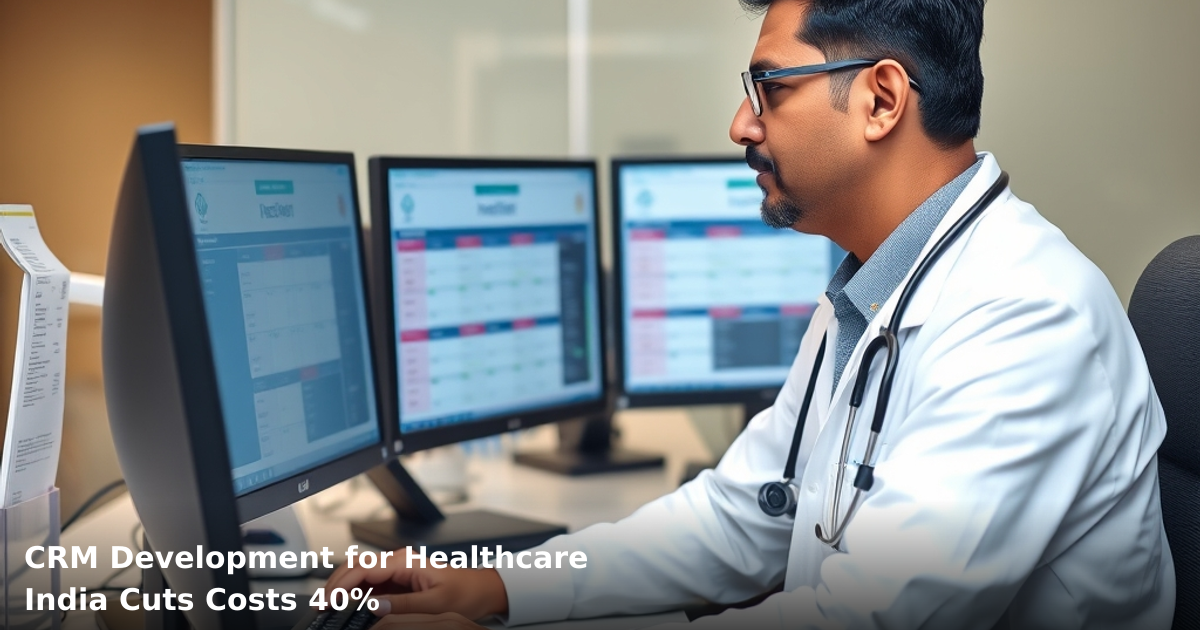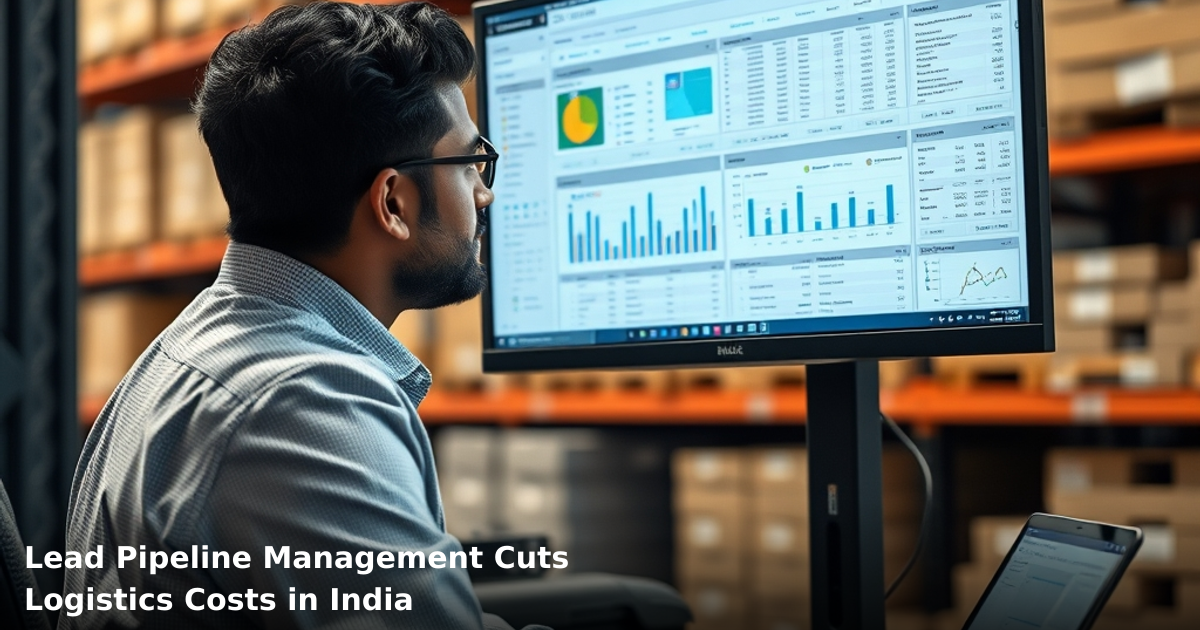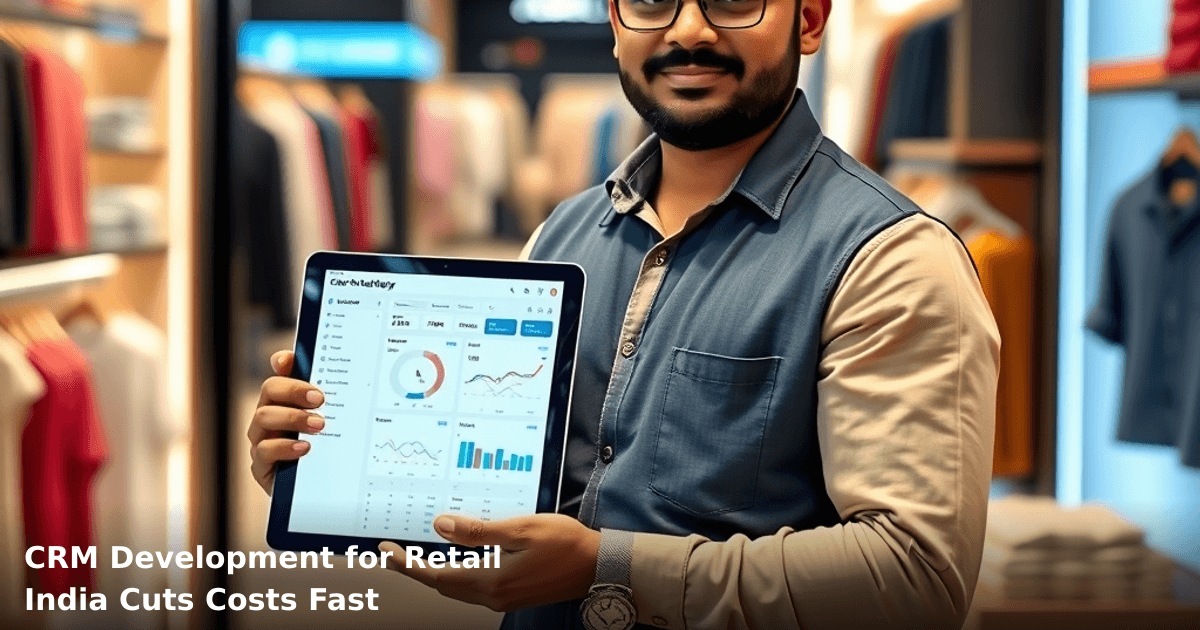
7 Ways CRM Development for Retail India Cuts Costs Fast
CRM development for retail India isn't just about storing customer data in a fancy system. It's about cutting the waste that's bleeding your margins dry — duplicate entries, lost follow-ups, inventory mismatches, and staff chasing information instead of selling.
Quick Answer: CRM development for retail businesses in India reduces operational costs by 20–35% through automated follow-ups, inventory sync, and real-time dashboards. A typical retail chain saves ₹40,000–₹1,20,000 per month within the first 90 days of implementation, depending on store count and team size.
We've worked with apparel shops in Bangalore, quick-commerce stores in Mumbai, and hyperlocal retail chains in Pune. Every single one had the same problem: their teams were drowning in spreadsheets, customers weren't getting follow-ups, and nobody knew which products were actually moving.
This post walks you through exactly how CRM systems cut costs for Indian retail, with real numbers and no fluff.
Why CRM Development Matters for Indian Retail Right Now
Your retail business runs on three things: inventory, staff, and customers. Mess up any one, and your profit margin takes a hit.
According to a NASSCOM report, 68% of Indian SMBs in retail still rely on manual processes for customer data and inventory tracking. That means lost sales, duplicate orders, and staff spending 10–15 hours a week just hunting for information.
The Retail Cost Bleeding You're Not Seeing
- Duplicate customer entries across multiple staff members, leading to confused follow-ups and lost repeat sales.
- Inventory mismatches between what your system says you have and what's actually on the shelf.
- No visibility into which staff member closed which sale, so you can't replicate success or identify training gaps.
- Customers slipping through the cracks because follow-ups happen on Post-its, not in a system.
A CRM system for retail stops this bleeding. Here's how.
What CRM Development for Retail India Actually Does
A CRM built for retail isn't generic software. It's built to handle your specific workflows: walk-in customers, repeat buyers, seasonal stock, and team targets.
The Core Features That Cut Costs
Customer 360 View: Every time a customer walks in or messages you, your staff sees their full history — past purchases, preferences, pending follow-ups. No more asking "Have we spoken before?" and losing the sale.
Automated Follow-ups: Set rules. If a customer bought a winter coat in November, they get a message in March about spring arrivals. No manual SMS or WhatsApp blasts. No forgotten reminders.
Real-Time Inventory Sync: Your CRM talks to your stock. Staff knows what's available right now, not yesterday. Returns are logged instantly. Stock transfers between stores happen in the system, not on paper.
Sales Pipeline & Targets: See which staff member is on track to hit their monthly target, who needs help, and where the bottlenecks are. One retail client in Surat cut their target-miss rate from 22% to 8% in 4 months just by having this visibility.
Automated Billing & Receipts: Fewer manual invoices means fewer GST errors and faster reconciliation with your accountant.
7 Ways CRM Development for Retail India Cuts Costs Fast
1. Eliminate Duplicate Customer Records (Save ₹8,000–₹15,000/month)
Without a CRM, your staff creates new customer profiles every time someone walks in without their phone number handy. One client in Delhi had 2,400 customer records for a store that actually had 800 unique customers.
What happens: You send the same discount offer to the same person under three different names. Your follow-up messages go to duplicate numbers. Your "top customer" list is inflated garbage.
With a CRM: Duplicate detection happens automatically. The system flags matches by phone, email, or purchase history. Your follow-up campaigns hit real people, not phantom records.
The math: If you're wasting 30% of your marketing budget on duplicates, and your monthly marketing spend is ₹50,000, that's ₹15,000 straight in the bin. A CRM recovers that immediately.
2. Automate Follow-Ups and Reduce Lost Sales (Save ₹25,000–₹60,000/month)
Most retail stores don't follow up. A customer browses, leaves, and never hears from you again.
What happens: You lose 40–50% of potential repeat sales because nobody remembers to call or message.
With a CRM: Set it and forget it. Customer bought a shirt? Trigger a message 30 days later suggesting complementary items. Customer hasn't visited in 60 days? Auto-trigger a "We miss you" offer. No manual work. No forgotten reminders.
One of our clients, a fashion retail chain in Pune with 3 stores, implemented automated follow-ups and saw repeat purchase rate jump from 18% to 31% in 3 months. That's an extra ₹45,000 in monthly revenue with zero extra staff.
The cost saving: Fewer lost sales + fewer staff hours chasing follow-ups = real money back in your pocket.
3. Sync Inventory Across Stores (Save ₹12,000–₹35,000/month)
If you have multiple locations, inventory chaos is your default state.
What happens: Store A has 50 units in stock but doesn't know. Store B orders 30 units from the distributor. You end up overstocked in one location, understocked in another. Cash gets stuck in dead inventory. Customers can't find what they want.
With a CRM: Real-time inventory visibility across all stores. When a customer asks for a size, your staff knows which store has it right now. You can offer to ship from another location instead of losing the sale.
A retail chain in Bangalore with 5 stores was holding ₹8 lakhs in excess inventory because stores weren't talking to each other. After CRM implementation, they freed up ₹2.5 lakhs within 60 days by redistributing stock smartly.
4. Cut Staff Time Spent on Manual Data Entry (Save ₹18,000–₹40,000/month)
Your staff spends 8–12 hours a week entering customer data into multiple systems — the billing machine, WhatsApp, a notebook, maybe an old Excel sheet.
What happens: Data entry errors. Typos in phone numbers. Customer information that's out of sync across systems. Staff burnout.
With a CRM: One entry point. Everything syncs automatically. Billing, inventory, customer profile, follow-up triggers — all connected.
The time math: If one staff member spends 10 hours a week on manual data entry at ₹200/hour, that's ₹2,000/week or ₹8,000/month in wasted labor. A CRM cuts that by 70–80%.
5. Track Staff Performance and Hit Targets (Save ₹20,000–₹50,000/month via better sales)
Without visibility, you don't know if Rajesh is closing 30% of his leads or 60%. You don't know if the afternoon shift is underperforming. You can't identify what's working.
With a CRM: Real-time dashboards show which staff member closed how many sales, average transaction value, conversion rate, follow-up completion rate. You spot problems before they cost you money.
One retail client in Hyderabad discovered that their evening shift had a 15% lower close rate than the morning shift. They added one senior staff member to evenings, and sales jumped 22% in 6 weeks. That dashboard visibility saved them ₹35,000/month in lost sales.
6. Reduce Returns and Refund Disputes (Save ₹10,000–₹25,000/month)
Returns are a nightmare in retail. No documentation. Customers claiming they never bought something. Staff not remembering the transaction.
With a CRM: Every transaction is logged with details — what was sold, when, to whom, at what price. Return reasons are recorded. Patterns emerge. You spot if one product has a 40% return rate and pull it from shelves.
A quick-commerce store in Noida was losing ₹18,000/month to disputed returns and refunds. After CRM implementation, they had full transaction history and cut disputed returns by 65%.
7. Optimize Promotions and Reduce Wasted Marketing Spend (Save ₹15,000–₹40,000/month)
Most retail businesses blast the same offer to everyone. "30% off everything!" That's not marketing. That's a fire sale.
With a CRM: You segment customers. High-value buyers get exclusive early access to new stock. Price-sensitive customers get percentage discounts. Seasonal shoppers get timely reminders. You send the right offer to the right person at the right time.
A clothing store in Gurgaon was spending ₹60,000/month on blanket SMS campaigns. After CRM segmentation, they cut that to ₹35,000/month, improved response rates by 40%, and actually increased revenue. That's ₹25,000 saved plus better results.
CRM Development for Retail: Before and After Comparison
| Metric | Before CRM | After CRM (3 months) | Cost Saving |
|---|---|---|---|
| Duplicate customer records | 2,400 for 800 unique | 820 clean records | ₹12,000/month |
| Repeat purchase rate | 18% | 31% | ₹45,000/month extra revenue |
| Staff time on data entry | 40 hours/week | 8 hours/week | ₹6,400/month |
| Inventory holding cost | ₹8,00,000 excess | ₹5,50,000 excess | ₹2,50,000 freed up |
| Marketing spend efficiency | 40% wasted | 15% wasted | ₹18,000/month saved |
| Target achievement rate | 72% | 89% | ₹35,000/month extra sales |
| Return/refund disputes | 65 disputes/month | 22 disputes/month | ₹8,000/month |
Step-by-Step Guide: How to Implement CRM Development for Your Retail Business
Tired of scattered spreadsheets and manual follow-ups?
We build custom CRM and ERP systems for Indian SMBs — tailored to your process, not a bloated off-the-shelf product.
Step 1: Map Your Current Workflows (Week 1)
Before you buy anything, document how your business actually works right now. How do customers come in? How do you track them? What systems do you use? Where are the pain points?
Spend 2–3 hours with your team. Write it down. This is your baseline.
Step 2: Define What You Need (Week 1–2)
Not every CRM feature matters to you. A hyperlocal retail store doesn't need the same features as a chain with 10 locations.
Ask yourself:
- Do I need multi-store inventory sync?
- Do I need automated follow-ups via WhatsApp or SMS?
- Do I need staff performance dashboards?
- Do I need integration with my existing billing system?
Step 3: Choose Between Off-the-Shelf or Custom CRM (Week 2)
Off-the-shelf CRM (Zoho CRM, HubSpot, Salesforce): Cheaper upfront (₹3,000–₹15,000/month), faster to set up (2–4 weeks), but may not fit your exact workflow.
Custom CRM (built specifically for your business): Higher upfront cost (₹2–₹8 lakhs), takes 6–8 weeks, but fits your workflow perfectly. Our CRM development service builds custom systems for Indian retail businesses that need specific features like WhatsApp integration, Tally sync, or multi-location inventory.
For most Indian retail businesses with 2–5 locations, a custom CRM pays for itself in 4–5 months.
Step 4: Integrate Your Existing Systems (Week 3–4)
Your CRM needs to talk to your billing software, inventory system, and accounting tools. Bad integration means duplicate data entry (defeating the purpose).
If you're using Tally, your CRM should pull inventory and sync customer data automatically. If you're using WhatsApp Business API, follow-ups should trigger automatically.
Step 5: Set Up Automation Rules (Week 4–5)
This is where the real cost savings happen. Define your rules:
- When a customer makes a purchase, log it automatically.
- When a customer hasn't visited in 60 days, send a reminder.
- When inventory drops below 10 units, alert the manager.
- When a staff member closes 5 sales, log a bonus alert.
These rules run 24/7 with zero manual work.
Step 6: Train Your Team (Week 5–6)
A CRM is only as good as your staff's adoption. Spend 2–3 hours training your team on:
- How to log a customer
- How to view customer history
- How to process a return
- How to check inventory
Make it simple. Create a one-page cheat sheet. Run a practice session.
Step 7: Monitor and Optimize (Week 6 onwards)
First month: Track adoption. Are staff using it? Are there bugs? Fix them.
Second month: Look at the data. Which automation rules are working? Which aren't?
Third month: Optimize. Adjust follow-up timing, segment customers better, refine your automation.
Common Mistakes to Avoid When Implementing CRM in Retail
Mistake 1: Choosing a CRM without understanding your workflow first
You see a shiny CRM and buy it. Then you realize it doesn't integrate with your billing system. Now you're entering data twice. You've just made your problem worse.
Fix: Map your workflows first. Then choose a CRM that fits, not the other way around.
Mistake 2: Not training your staff
Your team doesn't know how to use it, so they ignore it and go back to spreadsheets. The CRM sits unused.
Fix: Invest 3–4 hours in hands-on training. Make it mandatory. Celebrate early wins.
Mistake 3: Setting it up but not automating
You have a CRM, but you're still manually sending follow-ups and entering data. You've just added another system to manage.
Fix: Automate everything. Follow-ups, inventory alerts, customer segmentation, billing. That's where the cost savings come from.
Mistake 4: Not integrating with your existing systems
Your CRM is separate from your billing, inventory, and accounting. Data doesn't sync. You're back to manual work.
Fix: Ensure your CRM integrates with Tally, your POS system, WhatsApp Business API, and your accounting software.
Mistake 5: Ignoring data quality
Garbage in, garbage out. If your customer data is messy, your reports will be useless.
Fix: Before you go live, clean your data. Remove duplicates, standardize phone numbers, fill in missing fields.
Key Takeaways
- CRM development for retail India cuts costs by 20–35% through automation, inventory sync, and better targeting. A typical retail business saves ₹40,000–₹1,20,000/month.
- Eliminate duplicates first: Duplicate customer records waste 30% of your marketing budget. A CRM catches these automatically.
- Automate follow-ups: Set rules once. Follow-ups run 24/7 with zero manual work. Repeat purchase rates typically jump from 18% to 30%+.
- Sync inventory across stores: Real-time visibility prevents overstocking, understocking, and lost sales. Free up ₹1–₹3 lakhs in trapped inventory.
- Cut staff time on data entry: One entry point instead of five. Save ₹6,000–₹8,000/month in labor costs.
- Track performance and hit targets: Dashboards show which staff member is closing sales, which shifts are underperforming. Spot problems before they cost you money.
- Reduce returns and refund disputes: Full transaction history eliminates "he said, she said" disputes. Cut disputed returns by 50–65%.
- Optimize promotions: Segment customers, send the right offer to the right person, reduce wasted marketing spend by ₹15,000–₹40,000/month.
- Implementation takes 6–8 weeks for a custom CRM, 2–4 weeks for off-the-shelf. ROI typically hits in 4–5 months.
Frequently Asked Questions
Quick answers about crm-development-for-retail-india
01 How much will a custom CRM system actually cost my retail store, and what's the typical payback period? ›
A custom CRM for a single retail location typically costs ₹2.5–5 lakhs for basic inventory + customer tracking, with implementation taking 6–8 weeks; mid-market chains (10–50 stores) spend ₹8–15 lakhs but recover costs in 8–12 months through reduced stockouts (which cost Indian retailers 15–20% in lost sales) and repeat customer increases of 25–30%. Most retail owners see positive ROI by month 10 because automation cuts manual billing time by 40% and reduces staff hours per store by 2–3 hours daily.
02 How long before my team can actually start using the CRM and seeing results? ›
Your team can begin basic operations (customer capture, sales logging) within 2–3 weeks of go-live, but the real efficiency gains—automated reorder alerts, customer segment reports, staff performance dashboards—take 6–8 weeks as data accumulates and your team learns to run queries; I've seen retailers cut their monthly stocktake time from 3 days to 4 hours by week 12, which is when the system starts paying dividends.
03 I only have 2 retail outlets with 8 staff total—is a custom CRM overkill for me, or should I consider it? ›
Not overkill if you're doing ₹15+ lakhs monthly turnover across both stores; a scaled-down CRM (₹1.5–2.5 lakhs) tracking just customer repeat visits and inventory alerts will cut your dead stock by 30–40% and increase average transaction value by 12–18% through targeted upsells—but if you're under ₹10 lakhs monthly, start with a ₹15,000–30,000/year cloud solution like Zoho CRM or a point-of-sale system with basic CRM features first.
04 Isn't CRM just a fancy database that will sit unused like our old software? ›
The biggest mistake I see is treating CRM as a tool instead of a process—most Indian retailers buy it, dump data in, and abandon it because they don't assign someone (even part-time) to run weekly customer reports or clean data; the retailers who actually cut costs 35–45% are those who assign one staff member 5 hours weekly to segment customers, flag low-stock items, and send targeted SMS offers—CRM fails when nobody owns it, not when the software is bad.
05 What's the first step I should take to implement this without disrupting my daily sales? ›
Start by auditing your current customer data—how many repeat customers do you actually track, and what inventory information is scattered across notebooks or Excel sheets (this audit takes 1–2 weeks and costs nothing but time); then run a 2–3 week pilot with one store location, loading 3–6 months of historical sales data, training 2–3 staff on the basics, and measuring if you spot 2–3 quick wins (like identifying your top 20% customers or reducing stockouts in one category) before rolling out to all locations—this staged approach costs ₹20,000–50,000 extra in consulting but prevents the 60% failure rate I see with big-bang rollouts.
Need this built for your business?
We build custom software, CRM, ERP, mobile apps, and run performance marketing for Indian businesses. Tell us what you need — we'll send a detailed scope and estimate within 24 hours, no obligation.
- Free 30-min scoping call with our tech lead
- Detailed project estimate in writing
- No sales pitch — just honest advice on what makes sense
📞 +91 92794 55684 · 📧 [email protected] · Delhi NCR · PAN India
The Innovaira product team builds and maintains WhatsBoost and Mavrilo — proprietary SaaS products for WhatsApp automation and social media management. ISO 27001:2022 certified for information security.