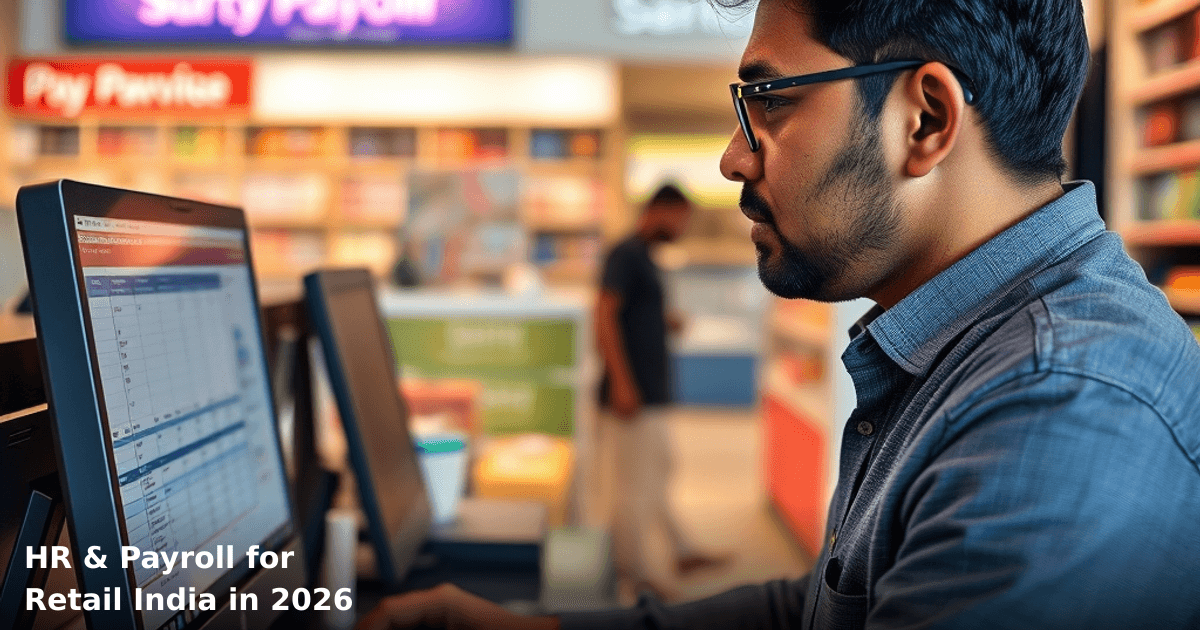
Complete Guide to HR & Payroll for Retail India in 2026
HR & payroll for retail India has become non-negotiable for any shop owner, franchise manager, or chain operator who wants to stop drowning in spreadsheets and actually know what their staff costs are. You're running a retail business—whether it's a single store in Bangalore or a 15-outlet chain across Tier-2 cities—and every rupee counts. Manual payroll processing, attendance tracking via WhatsApp groups, and tax compliance nightmares aren't just inefficient; they're costing you money you don't realise you're losing.
Quick Answer: HR & payroll for retail India means automating employee records, attendance, salary calculations, PF/ESI deductions, and tax filing—saving retail businesses ₹40,000–₹1,20,000 per year in admin costs alone. Modern cloud-based systems sync with your POS, track shift-based pay, and handle GST/TDS compliance automatically. Setup takes 2–3 weeks, and most systems cost ₹3,000–₹8,000/month for teams under 50 staff.
Why HR & Payroll Matters for Indian Retail Businesses
Your retail team isn't sitting in one office. Store managers are in Pune, shift staff rotate daily, and you're managing attendance across multiple locations. A NASSCOM report highlighted that 67% of Indian SMBs still manage payroll manually or via outdated software—leading to 15–20 hours of admin work per month and compliance errors that invite GST/Labour Department penalties.
Retail is also one of India's fastest-growing sectors, but margins are razor-thin. According to Statista data, Indian retail operates on 8–12% profit margins. Every inefficiency—a missed PF deduction, a delayed salary run, a labour audit penalty—directly eats into what you keep.
The Real Cost of Manual Payroll in Retail
When you manage HR & payroll for retail India manually:
- Attendance chaos: Staff mark themselves present via messages; you have no audit trail.
- Salary calculation errors: Different pay rates for different shifts, missed overtime, manual deductions—mistakes happen. One wrong calculation can trigger a wage dispute.
- Compliance headaches: PF, ESI, TDS, GST—missing deadlines costs ₹10,000–₹50,000 in penalties per violation.
- Staff turnover: Employees don't trust payroll systems they can't track. High turnover in retail already costs 30–50% of an employee's annual salary to replace.
One of our clients, a 12-store fashion retail chain in Delhi NCR, was spending ₹2.5 lakhs per year on a part-time HR person just to manage payroll spreadsheets. After implementing an automated HR & payroll system for retail India, they cut that to ₹45,000/year in software costs and freed up 40 hours/month for actual HR work.
What HR & Payroll for Retail India Actually Does
HR & payroll software for retail isn't just salary processing. It's an integrated system that connects your POS, attendance, leave management, and compliance into one dashboard.
Core Features You Need
Attendance & Shift Management Retail runs on shifts. Your system should auto-sync with biometric machines or mobile apps so you know exactly who worked when. Shift differentials (night shift pays 20% more, for example) should calculate automatically.
Salary Processing Fixed salary + variable components (commission, bonus, shift allowance). The system calculates gross salary, applies GST/TDS rules for India, deducts PF (12% employee + 3.67% employer), ESI (0.75% employee + 3.25% employer), and generates payslips within minutes.
Leave & Attendance Tracking Casual leave, sick leave, earned leave—track accruals, apply company policy automatically, and prevent overpayment. Retail staff often take unplanned leave; your system should calculate pay deductions instantly.
Compliance & Tax Filing PF returns (monthly), ESI returns, TDS reconciliation, and labour law compliance (Factory Act, Shops & Establishments Act). The system generates ready-to-file reports so you don't miss deadlines.
Multi-Location Management Running stores across Bangalore, Hyderabad, and Pune? Centralized payroll with location-level reporting. You see store-wise labour costs instantly.
Integration with POS Retail-specific: sync shift data from your POS, flag attendance mismatches, and cross-verify commission calculations against actual sales.
Comparison Table: HR & Payroll Solutions for Indian Retail
| Feature | Manual Spreadsheets | Tally + Excel Add-ons | Cloud HR & Payroll Software | Innovaira Custom Solution |
|---|---|---|---|---|
| Setup Time | Instant (but error-prone) | 1–2 weeks | 2–3 weeks | 3–4 weeks |
| Monthly Cost | ₹0 (hidden labour: ₹15,000–₹25,000) | ₹2,000–₹5,000 | ₹3,000–₹8,000 | ₹6,000–₹15,000 |
| Compliance Updates | Manual (you miss deadlines) | Quarterly updates | Real-time, automatic | Real-time + dedicated support |
| Multi-Location Support | Difficult | Limited | Full | Full + custom workflows |
| POS Integration | No | No | Limited | Yes, full sync |
| Scalability | Breaks at 30+ staff | Breaks at 50+ staff | Handles 500+ staff | Handles unlimited, custom rules |
| Support | None | Email only | Chat/email | Dedicated account manager |
Step-by-Step Guide to Setting Up HR & Payroll for Retail India
We build this automation for your business
Our team maps your current workflow, identifies automation opportunities, and delivers a working system in 2–3 weeks.
1. Audit Your Current Payroll Process
Before you buy anything, document what you're doing now. How many staff? How many locations? What's your pay structure (fixed + variable)? Do you have PF/ESI obligations (yes, if you have 20+ staff)? What compliance deadlines do you currently miss?
Write this down. It takes 2 hours but saves you from buying a system that doesn't fit.
2. Choose Your System Based on Team Size and Complexity
- 5–20 staff, single location, simple pay: Cloud HR software like Keka or Zoho People. Cost: ₹3,000–₹4,000/month.
- 20–50 staff, 2–5 locations, variable pay/commissions: Mid-tier software like Darwinbox or Workday. Cost: ₹5,000–₹8,000/month.
- 50+ staff, complex multi-location retail chain: Custom ERP with HR module. Cost: ₹15,000–₹50,000/month + setup.
Our team at Innovaira builds custom HR & payroll solutions for retail chains that need POS sync, shift-based pay, and real-time compliance reporting. We've done this for a 20-store apparel chain in Pune and a quick-service restaurant franchise across NCR.
3. Integrate with Your Attendance System
Most retail stores have biometric machines. Your HR software should sync directly with them (or via an API). If you're using mobile-based attendance, ensure the app connects to your payroll system automatically.
Manual data entry = errors. Automation = accuracy.
4. Set Up Your Pay Structure and Policies
Define your salary components: basic, DA, HRA, shift allowance, commission, bonus. Define your leave policy: how many casual/sick/earned leave days? What's the encashment rule? Does earned leave carry forward?
Enter these into your system once. The software then applies these rules to every payroll run.
5. Run a Pilot Payroll (Dry Run)
Don't go live with 50 employees on day one. Pick 5–10 staff and run a test payroll. Check:
- Are salaries calculated correctly?
- Are PF/ESI deductions accurate?
- Do payslips look professional?
- Can you generate compliance reports?
Fix issues in the pilot. Then roll out to everyone.
6. Train Your Team and Automate Compliance
Your store managers, shift supervisors, and HR person need 2–3 hours of training. Show them how to mark attendance, approve leave, and run payroll. Then set up automatic alerts: "PF return due on 15th", "ESI filing deadline: 21st".
Common Mistakes to Avoid When Implementing HR & Payroll for Retail India
Mistake 1: Ignoring Multi-Location Complexity You have 3 stores in different states. Each state has different labour laws (Kerala's minimum wage ≠ Haryana's). A one-size-fits-all system will break. Ensure your software handles state-level compliance rules.
Mistake 2: Not Syncing Attendance with Payroll You manually enter attendance into payroll. Result: mismatches, disputes, and audit failures. Always auto-sync from your biometric/POS system.
Mistake 3: Skipping the Pilot Live payroll on day one with 40 staff = chaos. A 2-week pilot with 5 staff catches 90% of issues before they become expensive problems.
Mistake 4: Choosing Software Based on Price Alone ₹999/month sounds great until compliance deadlines pass and you get a ₹50,000 penalty. Cheap software often lacks PF/ESI automation. Spend ₹5,000–₹8,000/month on something reliable.
Mistake 5: Not Training Your Team You buy the software, but your store manager doesn't know how to use it. Adoption stalls. Invest in 2–3 hours of training and create a simple SOP document.
Mistake 6: Forgetting About Statutory Compliance HR & payroll for retail India means you're handling PF (if 20+ staff), ESI (if 10+ staff), TDS, and GST. Many retail owners skip this because they think "small business = no compliance". Wrong. Labour Department audits happen, and penalties are steep. Your software must automate these filings.
Key Takeaways
- Manual payroll costs retail businesses ₹40,000–₹1,20,000/year in hidden labour and compliance penalties. Automation pays for itself in 3–4 months.
- HR & payroll for retail India must handle multi-location complexity, shift-based pay, PF/ESI compliance, and POS integration. Generic HR software doesn't cut it.
- Choose your system based on team size and pay complexity, not just price. A ₹5,000/month system beats a ₹999/month one that breaks at 30 staff.
- Run a pilot payroll with 5–10 staff before going live. Catches errors early.
- Automate compliance deadlines: PF (15th), ESI (21st), TDS (7th of next month). Missing these costs ₹10,000–₹50,000 per violation.
- Train your team. Software adoption fails when staff don't know how to use it.
- Sync attendance automatically from biometric/POS systems. Manual entry = disputes and audit failures.
Frequently Asked Questions
Quick answers about hr-payroll-retail-india
01 How much should I budget for implementing a payroll system for my 50-person retail store? ›
You're looking at ₹15,000–₹40,000 upfront for decent payroll software (Zoho Payroll, Keka, or Greytip), plus ₹2,000–₹5,000 monthly recurring costs depending on employee count and features. If you hire an external payroll consultant to set it up and handle compliance, add another ₹20,000–₹50,000 one-time, but this saves you from costly PF/ESI/TDS errors that can cost 5–10% of your annual payroll in penalties.
02 How long does it typically take to get compliant with all labor laws when starting fresh? ›
Plan for 4–6 weeks to get fully compliant if you're starting from scratch—you need to register with ESIC (₹500–₹1,000, 5–7 days), EPF (₹1,000–₹2,000, 3–5 days), file Form 12A for TDS (2–3 days), and set up your internal attendance and wage register systems (1–2 weeks). Most retail owners underestimate this and rush, leading to rejection of EPF applications or PF deduction errors that take another 3–4 weeks to rectify.
03 At what employee count does it become mandatory for me to hire a dedicated HR person versus managing it myself? ›
Once you cross 30–40 employees, a part-time HR person (₹15,000–₹25,000/month) becomes cost-effective; at 50+ employees, it's almost mandatory to avoid compliance gaps that regulators catch during inspections—the average fine for missing attendance records or incorrect wage slips is ₹10,000–₹50,000 per violation. Before 30 employees, a good payroll software (₹3,000–₹5,000/month) and a quarterly compliance audit (₹5,000–₹10,000) is sufficient.
04 Is it a mistake to use WhatsApp or Excel for attendance and payroll tracking? ›
Yes—this is the #1 compliance risk I see in retail stores; during labor department audits, they specifically check for digitally maintained attendance records, and handwritten or WhatsApp-based records are rejected, often resulting in ₹25,000–₹100,000 fines plus wage recovery demands. Excel is slightly better but still risky because one formula error affects 20+ employees' salaries, and you have zero audit trail for compliance proof—invest in even a basic ₹1,500/month software like Zoho People or BambooHR to protect yourself.
05 What's the first step I should take to set up HR and payroll in my retail business? ›
Start by registering with ESIC and EPF (if you have 10+ employees or payroll exceeds ₹21,000/month per employee)—this is non-negotiable and takes 1–2 weeks; simultaneously, choose a payroll software (spend 1 week evaluating options like Keka, Greytip, or Zoho based on your store size and budget), then create a basic wage structure document showing basic salary, allowances, and deductions for each role. Once these three pieces are in place (3–4 weeks total), you can run your first compliant payroll cycle and avoid the chaos I see in stores that rush this.
Need this built for your business?
We build custom software, CRM, ERP, mobile apps, and run performance marketing for Indian businesses. Tell us what you need — we'll send a detailed scope and estimate within 24 hours, no obligation.
- Free 30-min scoping call with our tech lead
- Detailed project estimate in writing
- No sales pitch — just honest advice on what makes sense
📞 +91 92794 55684 · 📧 [email protected] · Delhi NCR · PAN India
Innovaira's engineering team designs and builds custom software — CRM, ERP, SaaS platforms, web applications and mobile apps — for growing Indian businesses. ISO 9001:2015 certified for quality delivery.