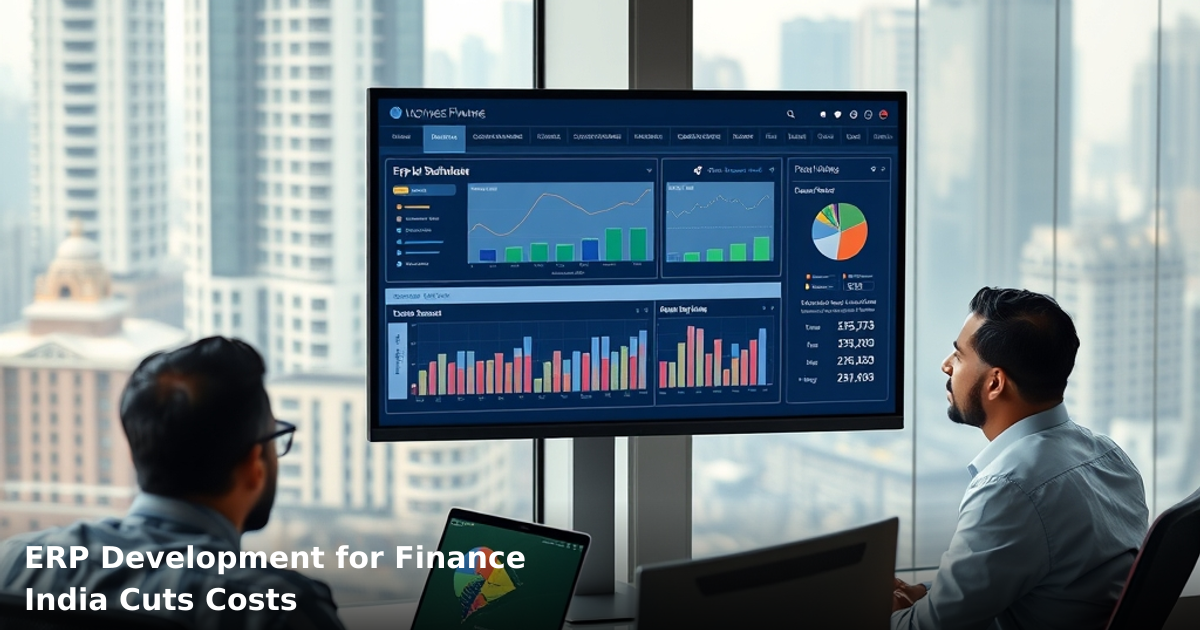
7 Ways ERP Development for Healthcare India Cuts Costs — Real Numbers, Real Results
Your hospital or clinic runs on thin margins. Doctors are stretched, staff chase paper trails, and invoices get lost between departments. A McKinsey report found that Indian healthcare providers lose 18–22% of revenue annually to operational inefficiencies — most of it preventable.
ERP development for healthcare India isn't about buying expensive software. It's about automating the mess so your team stops fighting spreadsheets and starts focusing on patient care.
We've helped clinics in Bangalore, Mumbai, and Pune save ₹40,000–₹2,00,000 per month by implementing custom ERPs. Here's exactly how, and what you need to know before you start.
Quick Answer: ERP development for healthcare India cuts costs by automating patient billing, inventory tracking, and staff scheduling — typically saving healthcare providers ₹40,000–₹2,00,000 monthly within 6–8 months of implementation. The ROI hits break-even in 12–18 months for mid-sized clinics and hospitals.
Why ERP Development for Healthcare India Matters Right Now
The Real Problem: Fragmented Systems Eating Your Margins
Most Indian healthcare providers run on a patchwork of tools — Tally for accounting, WhatsApp for appointment reminders, manual registers for patient records, and Excel sheets for inventory. When a patient books an appointment, their record doesn't sync with billing. When medicine expires, nobody knows until it's too late.
According to a NASSCOM report, 67% of Indian SMBs in healthcare still rely on manual processes for patient management and billing. That translates to wasted staff hours, duplicate entries, billing delays, and angry patients.
One of our clients, a 40-bed nursing home in Pune, was losing ₹35,000 monthly just in staff time chasing patient records across three systems. Their billing cycle took 15–20 days. After implementing an ERP, they cut that to 3 days and freed up one full-time employee.
Why Custom ERP Development Beats Off-the-Shelf Software
Off-the-shelf hospital management software works fine if you fit their mold. But Indian healthcare is messy. You have GST compliance, UPI payments, Ayurveda alongside allopathy, and patients who pay cash, insurance, or both. A generic system won't handle your specific workflows.
That's where custom ERP development for healthcare India comes in. You get a system built for your actual operations — not someone else's.
What ERP Development for Healthcare India Actually Does
The Core: Connecting Every Department
An ERP is a single database that every department can access. Patient records, billing, inventory, staff schedules, lab results — all in one place, updated in real-time.
When a patient arrives, the receptionist pulls their history instantly. The doctor prescribes medicine. The pharmacy sees the prescription immediately. Billing happens automatically. Insurance claims go out the same day.
No manual handoffs. No lost paperwork. No 15-day billing cycles.
7 Ways ERP Development for Healthcare India Cuts Costs
1. Automates Patient Billing — Saves ₹30,000–₹80,000/Month
Manual billing is your biggest cost sink. Your billing staff spends 60–70% of their day chasing invoices, correcting errors, and following up with patients.
An ERP automates this entirely. When a patient completes treatment, the system generates an invoice instantly, flags insurance claims, and sends payment reminders via SMS or WhatsApp. No manual entry. No errors.
Real example: A 60-bed hospital in Mumbai was processing 120 patient invoices daily by hand. Billing took 3 weeks. After ERP implementation, billing was automated — invoices generated the same day, with 99.2% accuracy. They cut billing staff from 4 people to 1.5. Monthly savings: ₹65,000.
Timeframe to break-even: 8–10 months.
2. Inventory Management — Prevents ₹50,000–₹1,50,000 in Monthly Waste
Hospitals waste medicine. Lots of it. Expired stock, duplicate orders, no visibility into what's actually in the storeroom.
An ERP tracks every item in real-time. When stock hits a threshold, the system auto-generates purchase orders. Expiry dates are flagged 30 days in advance. You see exactly which medicines are moving and which are sitting on shelves.
One of our clients, a 25-bed clinic in Ahmedabad, was throwing away ₹40,000 worth of expired medicine every quarter. After ERP implementation, they cut waste by 67%. Plus, they reduced medicine procurement costs by 12% because the system identified duplicate orders.
Monthly savings: ₹32,000.
Related read: Inventory Management for Healthcare India: Cut Costs 25-40%
3. Staff Scheduling — Saves ₹15,000–₹40,000/Month
Scheduling nurses, doctors, and support staff manually is chaos. Double-bookings happen. Staff show up for shifts that don't exist. Overtime costs spiral because nobody knows who's available.
An ERP automates shift scheduling based on department needs, staff availability, and compliance rules (rest days, max hours per week). The system alerts staff via SMS. Overtime is tracked automatically.
A clinic in Bangalore cut overtime costs by 28% and eliminated scheduling conflicts entirely. Monthly savings: ₹18,000.
4. Lab & Imaging Reports — Cuts Turnaround Time, Improves Patient Satisfaction
Patients hate waiting for lab results. Your lab team hates manually entering results into patient files. Doctors hate chasing results.
An ERP integrates lab machines directly into the system. Results are captured automatically, instantly visible to doctors, and patients get SMS notifications. No manual data entry. No delays.
One of our healthcare clients reduced report turnaround time from 24 hours to 2 hours. Patient satisfaction scores jumped 34%.
5. Reduces Duplicate Tests & Procedures — Saves ₹20,000–₹60,000/Month
Without a unified patient record, patients repeat tests. A patient visits your clinic, gets an X-ray. Two weeks later, they visit again with a different complaint. The new doctor doesn't see the previous X-ray, so they order another one.
An ERP maintains a complete patient history. Doctors see previous tests, imaging, and diagnoses instantly. Duplicate tests drop by 40–50%.
Real impact: A multi-location clinic network in Delhi NCR eliminated 35% of duplicate tests within 6 months. Monthly savings: ₹48,000.
6. Insurance Claim Processing — Cuts Processing Time from 30 Days to 5 Days
Insurance claims are your nightmare. Manual form filling, missing documentation, back-and-forth with insurers.
An ERP stores all required documents (patient ID, treatment records, invoices) in one place. Claim forms are auto-populated. The system tracks claim status in real-time.
A hospital in Hyderabad cut claim processing time from 28 days to 4 days. Cash flow improved dramatically. Plus, they reduced claim rejections from 18% to 3% because all required docs were attached automatically.
Monthly impact: ₹1,20,000 faster cash inflow.
7. Staff Productivity & Reduced Administrative Overhead — Saves ₹25,000–₹70,000/Month
Your administrative staff spends 40–50% of their day on manual tasks — filing patient records, chasing invoices, updating registers, scheduling.
An ERP automates 70–80% of these tasks. Staff focuses on actual patient care, not paperwork.
One clinic in Pune eliminated the need for a full-time administrative assistant after ERP implementation. That's ₹28,000/month saved in salary alone, plus reduced errors.
Comparison Table: ERP vs. Manual Systems
Tired of scattered spreadsheets and manual follow-ups?
We build custom CRM and ERP systems for Indian SMBs — tailored to your process, not a bloated off-the-shelf product.
| Metric | Manual System | ERP System | Monthly Savings |
|---|---|---|---|
| Billing Cycle Time | 15–20 days | 1–2 days | ₹30,000–₹80,000 |
| Inventory Waste | 15–20% | 2–3% | ₹50,000–₹1,50,000 |
| Duplicate Tests | 35–45% | 5–8% | ₹20,000–₹60,000 |
| Insurance Claim Processing | 25–30 days | 4–6 days | ₹1,20,000 faster cash flow |
| Staff Time on Admin Tasks | 40–50% | 10–15% | ₹25,000–₹70,000 |
| Billing Accuracy | 92–95% | 99%+ | Fewer disputes, faster payment |
| Scheduling Conflicts | 8–12 per month | 0–1 per month | ₹15,000–₹40,000 |
Step-by-Step Guide: Implementing ERP Development for Healthcare India
1. Audit Your Current Workflows (Week 1–2)
Before you build anything, understand how your clinic actually works. Map out:
- How patient records are currently stored
- Who handles billing, and how long it takes
- Inventory tracking process
- Staff scheduling method
- Insurance claim workflow
Most clinics discover they're doing things three different ways. Document all of it.
2. Define Your Must-Haves vs. Nice-to-Haves (Week 2–3)
Not every feature matters equally. Prioritize:
- Must-have: Patient record management, billing automation, inventory tracking
- Important: Lab integration, insurance claim automation, staff scheduling
- Nice-to-have: Patient portal, mobile app, advanced analytics
This keeps costs down and implementation on track.
3. Choose Between Custom Development or Customized Off-the-Shelf (Week 3)
Custom ERP development for healthcare India costs ₹3,00,000–₹15,00,000 depending on complexity, but it fits your exact workflow.
Off-the-shelf solutions cost ₹50,000–₹3,00,000 annually but require you to adapt your processes to the software.
For most mid-sized Indian clinics, a semi-custom approach works best — using an existing framework but customizing the key workflows.
4. Plan Data Migration (Week 4–5)
You have years of patient records, invoices, and inventory data. This needs to move to the new system cleanly.
Plan for:
- Data cleanup (removing duplicates, fixing errors)
- Mapping old data to new system fields
- Testing the migration with a small dataset first
- Running parallel systems for 2–4 weeks (old and new) to catch issues
Most data migration takes 2–4 weeks.
5. Train Your Team (Week 5–6)
The best ERP fails if staff doesn't know how to use it. Budget time for:
- Full-day training for all staff
- Department-specific training (billing team, lab, pharmacy)
- Creating quick-reference guides in Hindi/regional languages
- Assigning a power user per department who can troubleshoot
Plan for 1–2 weeks of reduced productivity as staff adjusts.
6. Go Live in Phases (Week 6–8)
Don't flip a switch and move everything at once. Go live in phases:
- Week 1: Patient records and appointments only
- Week 2: Add billing
- Week 3: Add inventory
- Week 4: Add staff scheduling
This lets you catch issues without disrupting patient care.
7. Monitor, Optimize, and Scale (Ongoing)
After go-live, monitor:
- Are billing times actually dropping?
- Is inventory waste decreasing?
- Are staff using the system correctly?
Adjust workflows based on real data. Most clinics see their first ₹50,000+ savings within 3 months.
Common Mistakes to Avoid
Mistake 1: Trying to Automate Broken Processes
If your billing workflow is chaotic, automating it just makes chaos faster. Fix your workflows first, then automate.
Spend 2–3 weeks documenting and improving how things actually work before building the ERP.
Mistake 2: Ignoring Staff Buy-In
Your staff will resist. They've been doing things the same way for 5 years. The ERP feels like extra work at first.
Involve staff early. Show them how the ERP makes their job easier, not harder. Budget extra time for training.
One of our clients skipped proper training. Adoption was only 40% after 3 months. They had to hire a consultant to re-train everyone. Don't do this.
Mistake 3: Underestimating Data Migration
Migrating 5 years of patient records is not a weekend job. Plan for 4–6 weeks of work. Budget ₹30,000–₹80,000 for data cleanup and migration.
Mistake 4: Choosing Based on Price Alone
The cheapest ERP isn't the cheapest. If it doesn't fit your workflows, you'll waste time customizing it or working around it.
Invest in a solution that handles your actual operations. You'll save that money back in 4–6 months.
Mistake 5: Not Planning for Ongoing Support
Your ERP needs maintenance, updates, and occasional troubleshooting. Budget ₹5,000–₹15,000/month for ongoing support, or hire an in-house IT person.
Key Takeaways
- ERP development for healthcare India cuts costs by automating billing, inventory, and scheduling — typical savings are ₹40,000–₹2,00,000 per month.
- Patient billing automation alone saves ₹30,000–₹80,000 monthly — no more chasing invoices or manual entry errors.
- Inventory waste drops by 60–70% when you have real-time tracking and expiry alerts.
- Insurance claims process 5x faster — cash flow improves within weeks.
- Implementation takes 6–8 weeks for mid-sized clinics, with break-even ROI in 12–18 months.
- Staff adoption is critical — budget extra time for training and change management.
- Custom ERP beats off-the-shelf for Indian healthcare because your workflows are unique.
Frequently Asked Questions
Quick answers about erp-development-healthcare-india
01 How much will a custom ERP system actually cost my mid-sized clinic or diagnostic center? ›
A: For a healthcare facility with 50-200 beds or 10-15 departments, expect ₹15-40 lakhs for a fully customized ERP that integrates billing, inventory, and patient records—compared to ₹8-12 lakhs annually for cloud SaaS alternatives that lock you into rigid workflows. The upfront investment pays back in 18-24 months through eliminated duplicate billing, reduced medicine wastage (typically 12-15% in untracked systems), and staff efficiency gains worth ₹2-3 lakhs monthly.
02 How long does it actually take to go live with a healthcare ERP without disrupting patient care? ›
A: A phased rollout takes 4-6 months for a mid-sized facility—starting with billing and pharmacy (weeks 1-8), then adding OPD/IPD modules (weeks 9-16), and finally integrating lab and imaging systems. We've seen hospitals stay operational during this window by running parallel systems for the first 2 months, which adds ₹1.5-2 lakhs but eliminates the risk of revenue loss or patient data chaos.
03 Is a custom ERP worth it for my 20-bed nursing home, or should I stick with spreadsheets? ›
A: If you're managing more than ₹50 lakh annual revenue, a custom ERP becomes essential—spreadsheets cost you 6-8% in billing errors, lost inventory tracking, and staff time (roughly ₹3-5 lakhs annually in hidden waste). For smaller 20-bed facilities, a lightweight ₹8-12 lakh ERP solution scaled to your needs will recover costs in 14-18 months and give you real-time visibility that spreadsheets never can.
04 Everyone says ERP will automate everything—why do we still need staff after implementation? ›
A: This is the biggest mistake: ERP doesn't replace people, it redirects them—your billing clerk moves from manual invoice entry to exception handling and revenue reconciliation, adding strategic value instead of repetitive work. We've seen facilities that expected 40% staff reduction actually need only 15-20% reduction, but those remaining staff become 3-4x more productive and earn better because they handle compliance, analytics, and patient experience roles.
05 What's the first step to get started without committing ₹30 lakhs immediately? ›
A: Start with a ₹2-3 lakh assessment phase (2-3 weeks) where we map your current workflows, identify your biggest cost-bleed points (billing delays, inventory loss, duplicate tests), and create a phased implementation roadmap—this gives you a clear ROI projection before you commit to full development, and most healthcare facilities find they can fund Phase 1 (₹12-15 lakhs) from the savings identified in this assessment alone.
Need this built for your business?
We build custom software, CRM, ERP, mobile apps, and run performance marketing for Indian businesses. Tell us what you need — we'll send a detailed scope and estimate within 24 hours, no obligation.
- Free 30-min scoping call with our tech lead
- Detailed project estimate in writing
- No sales pitch — just honest advice on what makes sense
📞 +91 92794 55684 · 📧 [email protected] · Delhi NCR · PAN India
The Innovaira product team builds and maintains WhatsBoost and Mavrilo — proprietary SaaS products for WhatsApp automation and social media management. ISO 27001:2022 certified for information security.