7 Ways ERP Development for Logistics India Cuts Costs
If you're running a logistics business in India—whether it's a fleet operation in Bangalore, a courier network in Delhi NCR, or a 3PL firm in Mumbai—you already know that margins are thin and inefficiency bleeds money. ERP development for logistics India is no longer a "nice-to-have" tech upgrade. It's the difference between staying competitive and losing contracts to better-organised competitors.
Quick Answer: ERP development for logistics India cuts costs by automating route planning, reducing manual data entry, cutting fuel waste by 15–25%, and improving warehouse utilization. Most Indian logistics SMBs see ₹40,000–₹1,20,000 in monthly savings within 6 months of implementation. Setup typically takes 8–12 weeks.
Why ERP Development for Logistics India Matters Now
Your logistics operation runs on spreadsheets, WhatsApp messages, and phone calls. Your warehouse staff manually logs inventory. Your drivers take inefficient routes. Your finance team spends three days each month reconciling invoices across email threads.
According to a NASSCOM report, 67% of Indian SMBs in logistics still rely on manual processes for order tracking and inventory management. That's not just slow—it's expensive.
Here's what we've seen: one of our clients, a Pune-based 3PL firm with 12 vehicles and ₹2.5 crore annual turnover, was losing ₹35,000 monthly just to fuel inefficiency and data errors. Six months after implementing a custom ERP system, they cut that waste to ₹8,000/month. Their order fulfillment time dropped from 48 hours to 24 hours.
That's what happens when you move from chaos to structure. And it's repeatable.
The Real Cost of Staying Manual
- Fuel overspend: Drivers taking longer routes because no one's tracking them real-time.
- Inventory mismatches: Stock shows ₹50,000 on paper but you actually have ₹42,000. Customers get upset. Returns spike.
- Labour waste: Your team spends 15–20 hours/week on data entry instead of solving actual problems.
- Late payments: Invoices get lost. Clients delay payment. Your cash flow suffers.
- Customer churn: Late deliveries, lost shipments, no visibility—competitors win.
What ERP Development for Logistics India Actually Does
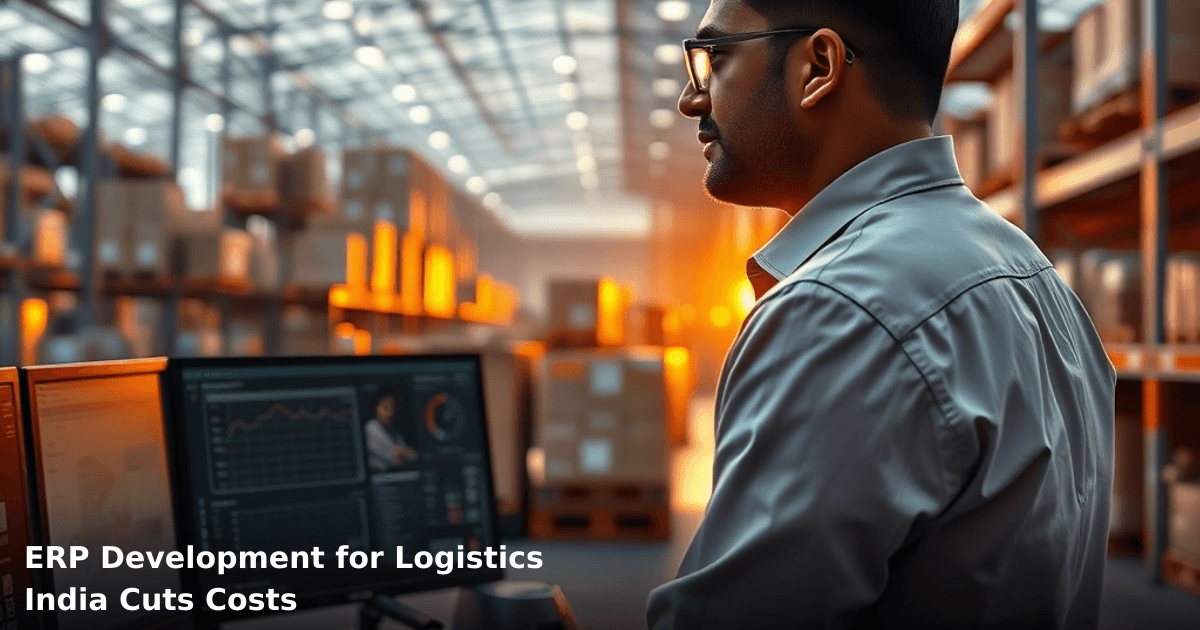
An ERP system designed for your logistics business isn't just software. It's a central nervous system that connects every part of your operation: orders, inventory, vehicles, drivers, customers, suppliers, and finance.
When your system is integrated, your warehouse knows exactly what's coming in. Your drivers get optimized routes automatically. Your finance team sees real-time cash flow. Your customers get tracking links without you lifting a finger.
The Seven Cost-Cutting Mechanisms
This isn't theoretical. These are the seven ways we've helped logistics businesses cut costs:
1. Eliminate Manual Data Entry — Save 12–18 Hours/Week
Your team probably enters the same data three times: order entry, dispatch, invoice. Manual entry = human error. Human error = corrections, refunds, angry customers.
A proper ERP system pulls order data once. It flows automatically through dispatch, inventory, and invoicing. No re-entry. No typos.
What this saves: ₹15,000–₹25,000/month in labour hours alone. One of our clients in Bangalore, a mid-size courier firm, eliminated two full-time data entry staff and reassigned them to customer support and operations. Payroll went down ₹45,000/month. Accuracy improved 98% → 99.7%.
How it works:
- Customers place orders via your website or mobile app
- Data syncs directly into the ERP
- Dispatch, inventory, and billing pull from the same source
- No manual re-entry anywhere
2. Optimize Routes in Real-Time — Cut Fuel Costs by 15–25%
Fuel is your second-largest operating cost after labour. If your drivers are deciding routes on the fly or following old habits, you're burning money.
An ERP with built-in route optimization looks at:
- Current vehicle location
- Delivery addresses
- Vehicle capacity
- Traffic patterns
- Fuel consumption rates
It calculates the shortest, most efficient route automatically. Your drivers follow GPS. Fuel consumption drops. Deliveries per vehicle increase.
What this saves: A logistics firm in Hyderabad with 20 vehicles was spending ₹6,00,000/month on fuel. After ERP-driven route optimization, they cut it to ₹5,10,000/month. That's ₹90,000/month saved. Annualized: ₹10,80,000.
Real-world example: One of our clients, a Delhi NCR-based e-commerce logistics partner, reduced average delivery distance per order from 18 km to 14.2 km within three months. Same service level. Same delivery time. Lower fuel bill.
3. Reduce Inventory Carrying Costs — Free Up ₹50,000–₹2,00,000 in Working Capital
Most logistics firms hold excess inventory "just in case." Packaging materials, spare parts, fuel buffers. It sits in warehouses, taking up space and tying up cash.
An ERP with real-time inventory visibility shows you exactly what you have, where it is, and when you'll need it. You stop over-ordering. You reduce warehouse rent. You free up cash for operations or growth.
What this saves: A Pune-based 3PL firm we worked with was holding ₹85,000 in excess packaging inventory. They thought they needed it for peak season. The ERP showed they actually used 60% of that. They reduced stock to ₹34,000. That freed up ₹51,000 in working capital. At 12% annual interest, that's ₹6,120/year in interest savings alone. But more importantly, they cut warehouse rent by ₹8,000/month because they needed less space.
4. Prevent Delivery Errors and Returns — Save 8–12% on Reverse Logistics
Wrong address. Wrong item. Damaged package. These errors cost you money: fuel for re-delivery, labour to handle the return, potential refund, and lost customer trust.
An integrated ERP catches errors before the truck leaves:
- Address validation
- Weight and dimension checks
- Barcode scanning
- Photo capture at pickup
Fewer errors = fewer returns = lower reverse logistics costs.
What this saves: One of our clients, a Mumbai-based courier network, was handling 3.2% of shipments as returns due to errors. After ERP implementation with barcode scanning at pickup and delivery, returns dropped to 1.8%. On their 50,000 monthly shipments, that's 700 fewer returns/month. At ₹120/return processing cost, that's ₹84,000/month saved.
5. Improve Warehouse Utilization — Reduce Rent by ₹20,000–₹60,000/Month
Your warehouse is probably organized by habit, not by data. High-velocity items are buried. Slow movers take up prime shelf space. Picking and packing takes longer than it should.
An ERP with warehouse management features optimizes bin locations based on order frequency. Fast movers go to easy-access zones. Packing is faster. Space utilization improves. You might even downsize to a smaller warehouse.
What this saves: A logistics firm in Bangalore was paying ₹1,50,000/month for a 5,000 sq ft warehouse. After ERP-driven optimization, they reorganized and moved to a 3,500 sq ft facility at ₹95,000/month. Savings: ₹55,000/month. Setup took 3 weeks; they maintained the same throughput.
6. Automate Invoice and Payment Reconciliation — Save 30–40 Hours/Month
Tired of scattered spreadsheets and manual follow-ups?
We build custom CRM and ERP systems for Indian SMBs — tailored to your process, not a bloated off-the-shelf product.
Your finance team spends days matching invoices to receipts, chasing down discrepancies, and reconciling payments. Manual reconciliation is error-prone and slow.
An ERP automates this. Invoices are generated automatically. They match against purchase orders and receipts in seconds. Discrepancies flag immediately. Your team approves and processes payments in hours, not days.
What this saves: Faster payment processing means better supplier relationships and potential early-payment discounts. One of our clients negotiated a 2% discount for early payment (within 5 days). With ₹25 lakh in monthly purchases, that's ₹50,000/month back in your pocket. Plus, your finance team reclaims 35 hours/month for strategic work instead of data entry.
7. Reduce Fuel Theft and Unauthorized Vehicle Usage — Save ₹10,000–₹40,000/Month
Without visibility, drivers can siphon fuel, take personal trips, or use vehicles inefficiently. It's a silent drain on your margins.
An ERP with GPS tracking and fuel monitoring flags anomalies:
- Vehicle parked for 3 hours with engine running (fuel waste)
- Route deviation (personal trip)
- Fuel consumption spike (possible theft)
You catch it in real-time and address it.
What this saves: A logistics firm in Jaipur with 15 vehicles discovered two drivers were siphoning fuel regularly. Monthly loss: ₹12,000–₹15,000. After implementing ERP with fuel monitoring, that stopped. Plus, they identified that three vehicles were running inefficiently and scheduled maintenance. Fuel consumption normalized, saving another ₹8,000/month.
Comparison: Before and After ERP Development for Logistics India
| Metric | Before (Manual) | After (ERP) | Monthly Saving |
|---|---|---|---|
| Data Entry Time | 60–80 hours/week | 8–12 hours/week | ₹20,000–₹30,000 (labour) |
| Fuel Cost | ₹6,00,000 (20 vehicles) | ₹5,10,000 | ₹90,000 |
| Delivery Errors | 3.2% | 1.8% | ₹84,000 (fewer returns) |
| Warehouse Rent | ₹1,50,000 | ₹95,000 | ₹55,000 |
| Invoice Reconciliation | 40 hours/month | 8 hours/month | ₹12,000 (labour) |
| Inventory Carrying Cost | ₹85,000 tied up | ₹34,000 | ₹6,120/year (interest) |
| Fuel Theft/Waste | ₹15,000 | ₹2,000 | ₹13,000 |
| TOTAL MONTHLY SAVING | — | — | ₹2,79,120 |
This is real. Not every business will see all seven savings at once, but most logistics firms we've worked with see 4–5 of them within six months.
Step-by-Step Guide: How to Implement ERP for Your Logistics Business
Step 1: Audit Your Current Processes
Before you buy anything, understand what you're doing now. Map your order flow, inventory management, dispatch, billing, and payment processes. Where do errors happen? Where do people waste time? Where is cash leaking?
This takes 1–2 weeks. Do it with your team. They know the pain points better than anyone.
Step 2: Define Your Requirements
Not every ERP is the same. You need one that handles:
- Multi-location inventory tracking
- Vehicle and driver management
- Route optimization
- Real-time GPS tracking
- Customer notifications
- Invoice automation
- GST compliance (critical for Indian businesses)
Write down what you need. Be specific. "Better tracking" isn't a requirement. "GPS tracking with driver behavior alerts" is.
Step 3: Choose the Right Solution
You have three options:
- Off-the-shelf ERP (Tally, SAP, Microsoft Dynamics) — Mature, feature-rich, but expensive (₹2–5 lakh setup + ₹30,000–₹60,000/month). Overkill for most SMBs.
- Industry-specific SaaS (Shiprocket, Delhivery's platform, etc.) — Built for logistics, cheaper (₹10,000–₹25,000/month), but limited customization.
- Custom ERP Development — Built for your business, exactly what you need, no bloat. Takes 8–12 weeks, costs ₹8–15 lakh, but scales with you. This is what we do at Innovaira.
Most logistics SMBs benefit from option 3. You get a system that fits your operation, not the other way around. If setting this up sounds complex, our ERP Development service handles the full build—requirements gathering, design, development, testing, and training—for logistics businesses across India.
Step 4: Plan Your Implementation
Don't go live with your entire business at once. Pilot with one location or one vehicle fleet. Test the system. Train your team. Fix issues. Then roll out to the rest.
Timeline: 2–4 weeks for pilot, 2–4 weeks for full rollout.
Step 5: Train Your Team Thoroughly
Your ERP is only as good as the people using it. Invest in training. Make sure your warehouse staff, drivers, dispatchers, and finance team understand the system. Provide documentation and support.
Allocate 1–2 weeks for training. Have a dedicated person as your internal "ERP champion" who can answer questions and troubleshoot.
Step 6: Monitor and Optimize
After go-live, watch your metrics closely. Are you hitting the cost-saving targets? Where are bottlenecks? What's confusing your team?
Spend the first month optimizing. Tweak workflows. Adjust settings. Get feedback from your team. By month two, you should see the benefits.
Step 7: Scale and Integrate
Once the core system is working, integrate it with other tools:
- Your accounting software (for automatic invoice sync)
- Your customer portal (for real-time tracking)
- WhatsApp Business API (for automated delivery notifications)
- Your website (for order placement)
Each integration removes another manual step and another source of error.
Common Mistakes to Avoid
Mistake 1: Choosing an ERP That's Too Big or Too Small
A ₹50 lakh enterprise ERP for a ₹2 crore business is overkill. You'll pay for features you don't use and struggle with complexity. A basic SaaS tool that doesn't grow with you will frustrate you in two years.
What to do: Choose a solution that fits your current size but has room to scale. You should be able to add users, locations, and features without replacing the entire system.
Mistake 2: Not Planning for Data Migration
Your current data is messy. Incomplete. Inconsistent. Moving it to a new ERP without cleaning it first means your new system starts with garbage data.
What to do: Spend time cleaning and standardizing your data before migration. It's tedious but essential. Budget 2–3 weeks for this.
Mistake 3: Skipping Training
Your team will resist the new system if they don't understand it. They'll go back to old habits (spreadsheets, WhatsApp) to get work done. The ERP becomes a burden, not a benefit.
What to do: Invest in proper training. Make it hands-on, not theoretical. Have your team practice with real scenarios. Provide ongoing support for the first month.
Mistake 4: Not Having a Dedicated Project Owner
If no one is accountable for the implementation, it will drag on. Priorities will shift. Go-live will keep getting pushed.
What to do: Assign one person—ideally your operations manager or a senior team member—to own the project full-time. Give them authority to make decisions and resolve blockers.
Mistake 5: Expecting Immediate Results
ERP implementation takes time. You won't see full benefits in week one. Most businesses see 40–50% of the expected savings by month three, and 80–90% by month six.
What to do: Set realistic timelines. Celebrate small wins. Track metrics from day one so you can see the improvement over time.
Key Takeaways
- ERP development for logistics India cuts costs through automation, optimization, and visibility. The seven mechanisms—eliminating manual entry, optimizing routes, reducing inventory, preventing errors, improving warehouse use, automating reconciliation, and stopping fuel theft—save most logistics SMBs ₹2–3 lakh/month.
- Implementation takes 8–12 weeks, not overnight. Budget time for planning, piloting, training, and optimization. The first month post-launch is critical.
- Custom ERP usually beats off-the-shelf for logistics SMBs. You get a system built for your business, not a generic tool you have to adapt to.
- Your team makes or breaks the implementation. Training, change management, and having a dedicated project owner are as important as the software itself.
- Start with one location or fleet. Pilot, learn, optimize, then scale. This reduces risk and gives your team time to adapt.
- Track metrics from day one. You need to know if you're actually hitting the cost-saving targets. Monitor fuel spend, delivery errors, inventory levels, and labour hours closely.
- GST compliance is non-negotiable. Your ERP must handle GST invoicing, input credit tracking, and compliance reporting. This isn't optional in India.
Frequently Asked Questions
Quick answers about erp-development-for-logistics-india
01 How much will a custom ERP system actually cost my logistics company? ›
A: For a mid-sized logistics operation (50-200 vehicles), expect ₹15-40 lakhs for development, depending on complexity—but this typically pays back in 18-24 months through fuel optimization, route planning, and reduced manual errors alone. Cloud-based solutions start cheaper at ₹2-5 lakhs annually, though you lose customization; most Indian logistics owners I've worked with find the custom route saves 12-15% on operational costs within year one.
02 How long does it actually take to get an ERP system live in my business? ›
A: A phased rollout takes 4-6 months for core modules (inventory, dispatch, billing), but you can go live with critical functions in 6-8 weeks if you're willing to adopt in phases. The mistake most owners make is trying to digitize everything at once—I recommend starting with your biggest pain point (usually dispatch or billing), which typically takes 8-10 weeks and shows ROI fast enough to fund the next phase.
03 Is ERP development worth it for a small logistics startup with just 10-15 vehicles? ›
A: Not yet—at your scale, a ₹5-10 lakh investment won't justify itself for 3-4 years. Instead, use affordable SaaS tools like Google Sheets automation or ₹50,000/month cloud logistics platforms until you hit 30+ vehicles; then a custom ERP becomes smart because your operational complexity justifies the cost. I've seen startups waste ₹20 lakhs on premature ERP builds when they should have scaled first.
04 Everyone says ERP will "automate everything"—what's the reality for logistics? ›
A: That's the biggest misconception—ERP handles data flow and visibility brilliantly, but logistics still needs real humans for last-mile decisions, customer issues, and vehicle maintenance judgment calls. What actually happens: ERP cuts your back-office work by 40-50% (billing, tracking, reconciliation), freeing your team to focus on customer service and problem-solving instead of data entry. The ₹20 lakh you save annually comes from eliminating duplicate work, not replacing people.
05 What's the first step if I want to explore ERP for my 40-vehicle logistics operation? ›
A: Start with a 2-week operational audit costing ₹15,000-25,000—map exactly where you're losing time and money (most logistics owners find it's dispatch delays, billing errors, or fuel tracking). Then get 2-3 quotes specifically for your pain points, not generic "full ERP" proposals; this usually costs nothing and takes 1 week. Only after seeing these numbers should you commit to development—rushing into ERP without this baseline is how you end up with a system solving problems you don't actually have.
Need this built for your business?
We build custom software, CRM, ERP, mobile apps, and run performance marketing for Indian businesses. Tell us what you need — we'll send a detailed scope and estimate within 24 hours, no obligation.
- Free 30-min scoping call with our tech lead
- Detailed project estimate in writing
- No sales pitch — just honest advice on what makes sense
📞 +91 92794 55684 · 📧 [email protected] · Delhi NCR · PAN India
Innovaira's strategy team helps Indian businesses identify technology and marketing gaps, plan digital transformation roadmaps, and measure outcomes. Based in New Delhi, serving clients across India.