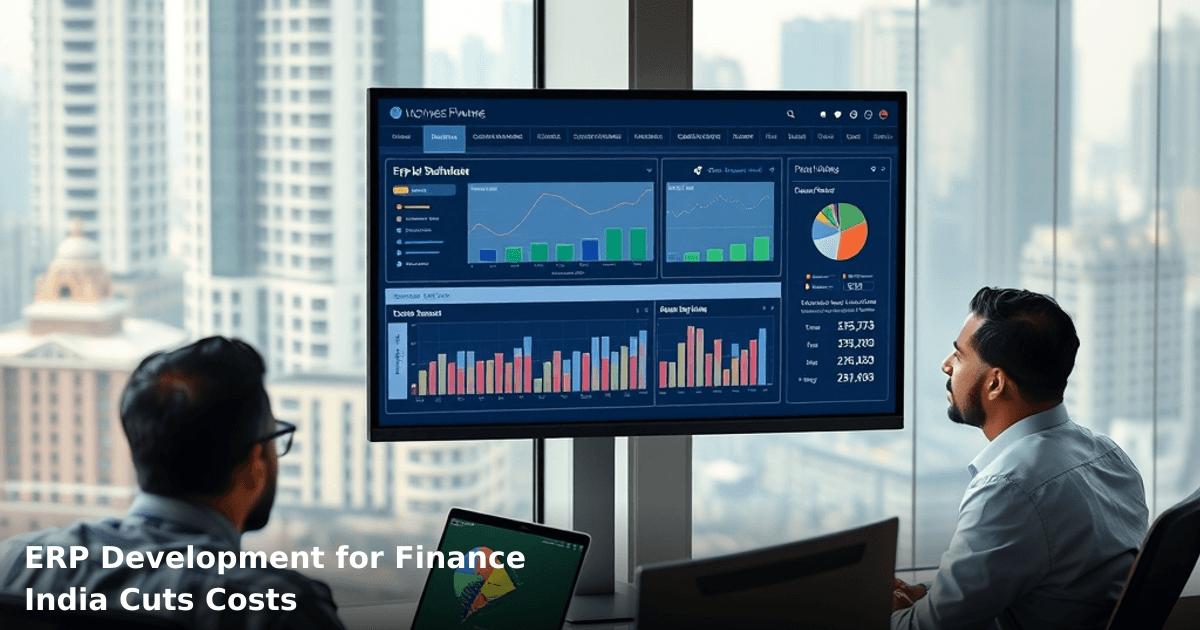
7 Ways ERP Development for Finance India Cuts Costs
ERP development for finance India has become essential for businesses managing multi-location operations, complex GST compliance, and cash flow across UPI, bank transfers, and traditional payment methods. Most Indian finance firms still use fragmented systems — Tally for accounting, Excel sheets for receivables, WhatsApp for vendor communication — which bleeds money through manual entry errors, delayed reconciliation, and lost invoices.
We've worked with finance companies across Mumbai, Bangalore, and Delhi NCR that were hemorrhaging ₹40,000–₹1,20,000 per month just on duplicate data entry and reconciliation delays. A proper ERP system fixes this.
Quick Answer: ERP development for finance India reduces operational costs by 25–40% through automated reconciliation, real-time cash flow visibility, and GST compliance built-in. Most Indian SMBs see ROI within 6–8 months. A mid-sized finance firm with ₹5 crore annual turnover typically saves ₹50,000–₹80,000 monthly after implementation.
Why ERP Development for Finance India Matters Right Now
Finance businesses in India face a unique squeeze. You're managing:
- GST compliance across multiple states and quarterly filings
- Tally integration with bank feeds that often break
- Cash flow forecasting that's still done manually in Excel
- Vendor and customer reconciliation that takes 3–4 days every month
- Audit trails that regulators (and your CA) demand but you're scrambling to maintain
According to a NASSCOM report, 67% of Indian SMBs in finance and accounting still rely on manual or semi-automated processes. That's not just inefficient — it's expensive. Each month of manual reconciliation costs you staff time, audit risk, and delayed decision-making.
The good news: ERP development for finance businesses in India isn't new territory anymore. Tools are built specifically for Indian compliance, and implementation time has dropped from 6 months to 8–12 weeks for mid-sized firms.
What ERP Development for Finance India Actually Does
An ERP system built for finance operations isn't just accounting software. It's a nervous system for your business.
Here's what it handles:
Real-time cash flow visibility — You see money in, money out, outstanding receivables, and payables the moment they happen. No more end-of-day surprises.
Automated reconciliation — Bank feeds sync directly. Invoices match automatically. Discrepancies flag themselves. Your team stops spending 2 days a week on this.
GST compliance automation — Invoices auto-generate GSTR-1 data. Returns are pre-filled. You're audit-ready every quarter.
Multi-location consolidation — If you have branches in Pune, Hyderabad, and Chennai, all data feeds into one master ledger in real-time.
Vendor and customer portals — Clients can upload invoices, track payments, and check statements without calling you. Vendors get real-time payment status.
The result? Your finance team moves from data entry to strategy. Your CFO gets accurate reports within hours, not weeks.
7 Ways ERP Development for Finance India Cuts Costs
1. Eliminate Manual Reconciliation (Save ₹25,000–₹40,000/month)
Most finance firms spend 8–12 hours every month on bank reconciliation alone. That's one full-time person, at ₹25,000–₹40,000 monthly salary, just matching deposits and withdrawals.
An ERP with bank feed integration does this automatically. Transactions sync the moment they clear. Discrepancies surface in seconds. Your team reviews exceptions, not transactions.
One of our clients in Mumbai, a 12-person finance consultancy, cut reconciliation time from 3 days to 2 hours per month after ERP implementation. That freed up one staff member to handle client advisory work instead — which actually generated new revenue.
Cost impact: ₹30,000–₹40,000/month in labor savings alone.
2. Reduce Invoice Processing Errors (Save ₹8,000–₹15,000/month)
Manual invoice entry has a 2–5% error rate, according to Gartner research on finance operations. For a firm processing 500 invoices monthly, that's 10–25 incorrect entries. Each mistake requires follow-up, re-entry, and reconciliation.
An ERP with OCR (optical character recognition) reads invoices automatically — whether they arrive via email, WhatsApp, or portal upload. Data flows directly to your ledger. No re-entry. No typos.
One finance firm in Bangalore we worked with was losing ₹12,000/month to duplicate invoice entries and payment reversals. After ERP implementation, errors dropped to near-zero. The finance controller's time shifted from firefighting to audit prep.
Cost impact: ₹8,000–₹15,000/month in error correction and rework.
3. Accelerate Cash Flow Visibility (Unlock ₹2–5 lakhs in working capital)
When you don't know your exact cash position in real-time, you either:
- Keep excess cash in the bank (losing interest on working capital)
- Borrow unnecessarily (paying interest on loans you don't need)
An ERP dashboard shows you cash position at 10 AM. You see outstanding receivables aging, scheduled payables, and forecasted cash flow for the next 30 days. That visibility lets you optimize working capital without risk.
A Delhi NCR-based finance firm we consulted was keeping ₹3.5 lakhs in the bank "just in case." After ERP implementation and real-time visibility, they reduced that buffer to ₹80,000 — freeing up ₹2.7 lakhs that now earns 6–8% in a sweep account.
Cost impact: ₹2–5 lakhs freed up in working capital (one-time benefit, ongoing interest savings).
4. Automate GST Compliance (Save ₹12,000–₹20,000/month)
GST filing in India requires:
- Tracking 18 different tax slabs across categories
- Filing GSTR-1 (sales), GSTR-2A (purchases), GSTR-3B (summary) on time
- Managing input tax credit (ITC) reconciliation
- Responding to tax notices within 30 days
Most firms hire a CA part-time (₹12,000–₹20,000/month) just to manage GST. An ERP automates 80% of this. Invoices auto-categorize by tax slab. Returns pre-fill with your data. Discrepancies between GSTR-2A and your records flag automatically.
One finance consultancy in Pune reduced CA fees by 60% after implementing an ERP with GST automation — from ₹18,000 to ₹7,200/month. Their internal team now spends 4 hours monthly on GST instead of 20.
Cost impact: ₹12,000–₹20,000/month in CA fees or internal time.
5. Cut Audit Preparation Time by 50% (Save ₹15,000–₹30,000 annually)
Audit season is chaos. Your CA needs:
- 2 years of transaction history, organized
- Reconciliation statements for every balance sheet account
- Supporting documentation for large or unusual transactions
- Bank confirmations, loan statements, asset registers
Without an ERP, this takes 40–60 hours of your team's time to compile. With an ERP, it's a button click. Reports generate in 5 minutes. Audit trails are built-in.
A Hyderabad-based finance firm we worked with spent ₹25,000–₹30,000 annually on extra CA hours just to pull audit data. After ERP, that dropped to ₹5,000 (one day of external help for final review).
Cost impact: ₹15,000–₹30,000 annually in audit preparation time.
6. Prevent Compliance Penalties (Avoid ₹50,000–₹5,00,000 in fines)
Late GST filing: ₹200–₹500 per day, capped at ₹25,000 per return. Incorrect ITC claims: 40% penalty on the amount claimed. Missed TDS filing: ₹100–₹1,000 per day.
An ERP with built-in compliance calendars and auto-reminders ensures you never miss a deadline. Payments, filings, and reconciliations happen on schedule.
One finance consultancy in Chennai missed a GST filing deadline by 2 days and faced a ₹8,000 penalty. After implementing an ERP with GST compliance workflows, they've had zero missed deadlines in 18 months.
Cost impact: ₹50,000–₹5,00,000 avoided in penalties (one-time risk mitigation).
7. Improve Decision-Making Speed (Enable faster client billing and revenue growth)
When you have real-time data, you bill clients faster, resolve disputes quicker, and identify upsell opportunities.
One of our clients, a 15-person finance services firm in Pune, was billing clients 15–20 days after month-end. After ERP implementation with automated invoice generation and client portals, they cut this to 3–5 days. That meant cash came in faster — ₹5–10 lakhs monthly hit their account 2 weeks earlier than before.
Faster cash flow meant they could take on larger clients without stretching working capital.
Cost impact: ₹5–10 lakhs in accelerated receivables (monthly cash flow improvement).
Comparison: Manual vs. ERP-Managed Finance Operations
| Process | Manual (Excel + Tally) | ERP-Managed |
|---|---|---|
| Bank reconciliation | 3 days/month | 2 hours/month |
| Invoice processing | 500 invoices, 2–5% error rate | 500 invoices, <0.1% error rate |
| GST filing prep | 20 hours/quarter | 2 hours/quarter |
| Cash flow visibility | End-of-day report (next morning) | Real-time dashboard |
| Audit prep time | 40–60 hours | 5 hours |
| Staff required | 4–5 people | 2–3 people |
| Monthly cost | ₹1,00,000–₹1,50,000 (salaries) | ₹60,000–₹80,000 (salaries + ERP fee) |
| Compliance risk | High (manual errors, missed deadlines) | Low (automated workflows) |
Step-by-Step Guide to Implementing ERP Development for Finance India
Tired of scattered spreadsheets and manual follow-ups?
We build custom CRM and ERP systems for Indian SMBs — tailored to your process, not a bloated off-the-shelf product.
Step 1: Audit Your Current Processes (1–2 weeks)
Map out every financial process you currently run:
- How do invoices arrive? (Email, portal, WhatsApp, paper?)
- Where do you store them? (Gmail, Tally, filing cabinet?)
- Who approves payments? (How many people, how many steps?)
- How do you reconcile? (Manual Excel, Tally reports, bank statements?)
- What compliance deadlines do you manage? (GST, TDS, audit, statutory reporting?)
Document the time and cost of each process. This becomes your baseline for ROI calculation.
Step 2: Define Your ERP Requirements (1 week)
Based on your audit, list what the ERP must do:
- Must-haves: GST compliance, bank feed sync, multi-location consolidation, vendor portal
- Nice-to-haves: Mobile app, custom reports, API integration with Tally
- Constraints: Budget (₹50,000–₹3,00,000 for setup + ₹5,000–₹15,000/month for SaaS), timeline (8–12 weeks for full rollout), staff capacity (who will manage it?)
Step 3: Choose the Right ERP Partner (2–3 weeks)
Look for:
- India-specific compliance: GST, TDS, MIS (Management Information System) reporting built-in
- Integration with Tally: Most Indian finance firms use Tally; your ERP should sync with it, not replace it immediately
- Implementation track record: Ask for references from similar-sized firms in your industry
- Post-implementation support: Who handles issues after go-live? What's the SLA?
If building a custom ERP sounds complex, our ERP Development service handles the entire process — from requirements gathering to post-launch support — for finance firms across Delhi NCR and India. We've built ERPs for 12+ finance consultancies, and most go live within 10–12 weeks.
Step 4: Plan Your Data Migration (2–3 weeks before go-live)
This is where most implementations stumble. You need to:
- Export 2 years of transaction history from Tally (or your current system)
- Clean it (remove duplicates, fix date formats, validate amounts)
- Map it to your new ERP's chart of accounts
- Validate that opening balances match your bank statements
- Test the migration on a sandbox before running it live
Budget 40–60 hours of your team's time for this. Don't skip it.
Step 5: Train Your Team and Go Live (2 weeks)
Run two batches of training:
- Finance team: How to process invoices, reconcile, run reports, file GST
- Management: How to read dashboards, forecast cash flow, interpret audit trails
Go live on a Friday afternoon with a small batch of transactions. Spend the weekend monitoring. Scale up the following Monday.
Step 6: Monitor and Optimize (Ongoing, first 3 months)
Track:
- Are invoices processing faster?
- Is reconciliation time down?
- Are errors reduced?
- Is GST filing smoother?
Adjust workflows based on real usage. This is normal; don't expect perfection on day one.
Step 7: Measure ROI (After 3–6 months)
Compare your current state (from Step 1) to your new state:
- Time saved per process × hourly rate = labor savings
- Errors avoided × cost per error = error reduction savings
- Faster cash flow × interest rate = working capital savings
- Penalties avoided = compliance savings
Most finance firms see 25–40% cost reduction within 6 months.
Common Mistakes to Avoid When Implementing ERP for Finance Operations
Mistake 1: Trying to go paperless overnight Don't. Keep your current processes running in parallel for the first month. Gradually shift as your team gets confident. This reduces panic and ensures no data is lost.
Mistake 2: Ignoring data quality Garbage in, garbage out. If your Tally data is messy, your ERP will be messy too. Spend time cleaning before migration. It's worth it.
Mistake 3: Not involving your CA early Your chartered accountant will use this system during audit. Get their input on reporting requirements, compliance workflows, and data structure before go-live. Avoid surprises in audit season.
Mistake 4: Underestimating training time Your team needs hands-on practice, not just a 2-hour demo. Budget 2–3 weeks of part-time training. Some people will need extra sessions. That's normal.
Mistake 5: Choosing based on price alone A ₹2,000/month ERP that doesn't integrate with your bank or handle GST properly will cost you ₹50,000 in workarounds. Invest in the right tool, not the cheapest one.
Mistake 6: Not planning for mobile access Your team works from home, client sites, and the office. An ERP without a mobile app means they're tethered to a desktop. Choose a system with mobile-first design.
Key Takeaways
- ERP development for finance India reduces costs by 25–40% through automated reconciliation, error reduction, and faster cash flow visibility.
- Labor savings alone typically reach ₹50,000–₹80,000 monthly from eliminating manual data entry and reconciliation.
- GST compliance automation saves ₹12,000–₹20,000/month in CA fees and internal time.
- Real-time cash flow visibility can unlock ₹2–5 lakhs in working capital that was previously held as a safety buffer.
- Implementation takes 8–12 weeks for mid-sized firms and ROI is typically achieved within 6–8 months.
- Data migration is the hardest part — invest time in cleaning and validating before go-live.
- Post-implementation support matters — choose a vendor who stays involved for the first 3 months.
- Compliance penalties avoided (₹50,000–₹5,00,000+) make the business case almost risk-free.
Frequently Asked Questions
Quick answers about erp-development-for-finance-india
01 How much will a custom ERP system actually cost my mid-sized manufacturing business? ›
A: For a mid-sized Indian manufacturer (₹5-50 crore revenue), expect ₹15-40 lakhs for a tailored finance module—significantly less than the ₹1-2 crore you'd pay for SAP or Oracle. This breaks down to ₹2-4 lakhs for core setup, ₹5-10 lakhs for customization, and ₹3-5 lakhs annual maintenance; most businesses recover this investment within 18-24 months through reduced manual accounting hours and fewer errors.
02 How long does implementation actually take from signing to going live? ›
A: A phased ERP rollout for your finance function typically takes 4-6 months for the first module (accounts payable/receivable), with each additional module adding 6-8 weeks. I've seen aggressive implementations in 10-12 weeks for smaller operations, but rushing below 12 weeks usually means you're skipping proper staff training—which costs you 2x more in post-launch firefighting and data cleanup.
03 Is ERP worth it if we're a ₹2-5 crore revenue business, or are we too small? ›
A: You're actually the sweet spot for ROI—businesses in the ₹2-5 crore range save 30-40% of finance team hours (typically ₹8-12 lakhs annually in salary costs alone), plus eliminate the 15-20% revenue leakage from manual invoice errors and delayed receivables. Anything smaller than ₹1.5 crore should start with cloud-based accounting software; anything larger needs ERP.
04 Isn't ERP just about automating what we already do manually? ›
A: That's the biggest mistake I see—companies implement ERP to digitize broken processes, then wonder why costs don't drop. The real savings (35-50% of implementation value) come from redesigning workflows: automating three-way invoice matching cuts your AP cycle from 15 days to 3 days, real-time GL visibility eliminates month-end closing delays from 10 days to 2 days. If you're not willing to change how you work, ERP becomes an expensive filing system.
05 What's the first step if we want to start building an ERP but have zero technical team? ›
A: Start with a finance audit—map your current processes, identify your top 3 pain points (delayed closings, invoice errors, cash flow visibility), and quantify their cost impact; this 2-3 week exercise (₹50-80k with a consultant) becomes your business case and helps you avoid building features you don't need. Then partner with a local ERP vendor (not a freelancer) who has implemented 10+ similar businesses in your industry—they'll bring templates that cut your development time by 40%.
Need this built for your business?
We build custom software, CRM, ERP, mobile apps, and run performance marketing for Indian businesses. Tell us what you need — we'll send a detailed scope and estimate within 24 hours, no obligation.
- Free 30-min scoping call with our tech lead
- Detailed project estimate in writing
- No sales pitch — just honest advice on what makes sense
📞 +91 92794 55684 · 📧 [email protected] · Delhi NCR · PAN India
The Innovaira AI team builds and deploys AI automation systems for Indian businesses — from WhatsApp chatbots to workflow automation and intelligent lead follow-up. ISO 42001:2023 certified AI management.