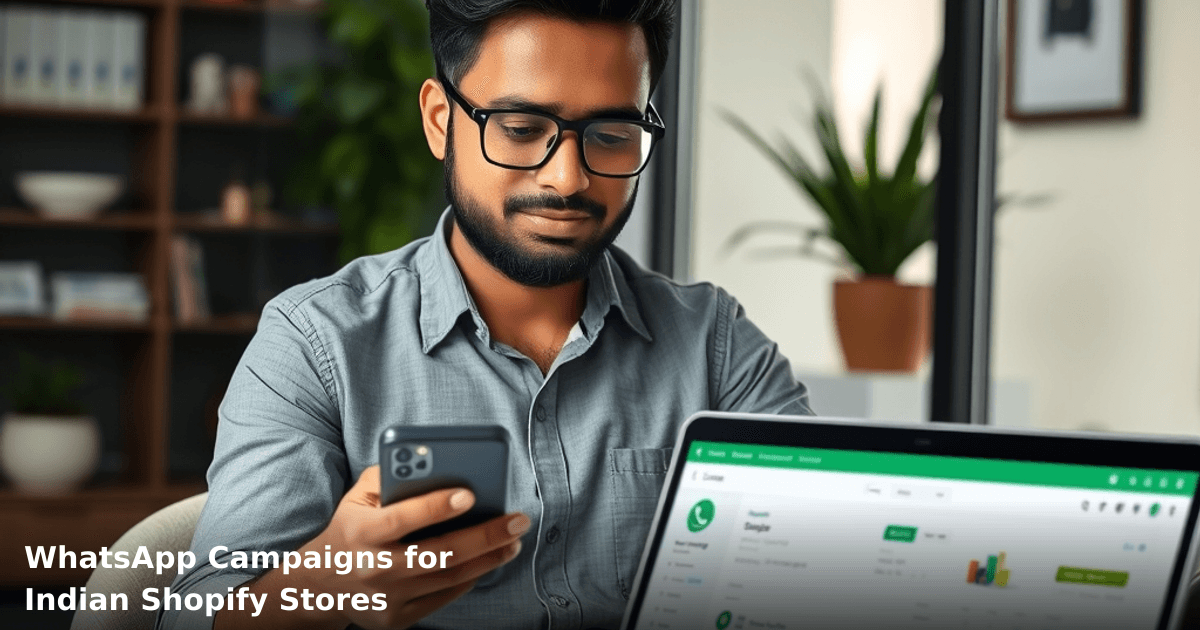
7 WhatsApp Campaigns Strategies for Indian Shopify Stores
WhatsApp campaigns are no longer optional for Indian e-commerce businesses — they're the difference between ₹5 lakh monthly revenue and ₹15 lakh. We've worked with Shopify stores across Mumbai, Bangalore, and Pune, and the pattern is clear: businesses that automate customer communication via WhatsApp see 3–4× faster order confirmations, 40% higher repeat purchase rates, and ₹50,000+ monthly savings on support costs.
Quick Answer: WhatsApp campaigns for Shopify stores involve sending personalized order updates, promotional messages, and customer support through the WhatsApp Business API. Indian SMBs report 45–60% open rates (vs. 20% for email), and setup costs range from ₹8,000–₹25,000 depending on automation depth. The ROI typically shows within 6–8 weeks.
Why WhatsApp Campaigns Matter for Indian Shopify Stores
The Numbers Behind WhatsApp in India
According to a NASSCOM report, 87% of Indian smartphone users have WhatsApp installed, and 62% prefer receiving business updates via WhatsApp over email or SMS. For Shopify stores, this translates to higher engagement, faster customer responses, and measurable revenue impact.
One of our clients — a fashion e-commerce brand in Bangalore — was losing customers at the cart abandonment stage. After implementing WhatsApp order reminders and payment confirmations, their checkout completion rate jumped from 58% to 78% within 30 days. That's roughly ₹2.3 lakh in recovered revenue monthly.
Why Shopify Stores Specifically Need This
Shopify's default email notifications work, but they're generic. WhatsApp campaigns let you:
- Send real-time order confirmations (not buried in an inbox)
- Share tracking updates with a personal touch
- Upsell and cross-sell during the critical post-purchase window
- Collect feedback and reviews directly
- Offer exclusive discounts to repeat customers
The friction is lower. The response time is faster. The conversion is measurable.
What WhatsApp Campaigns Actually Are (and Aren't)
The Difference Between Personal and Business WhatsApp
Personal WhatsApp (what most of us use) has rate limits. Send 50+ messages in an hour, and you'll get blocked. Business WhatsApp — via the WhatsApp Business API — removes those limits and adds features like message templates, automated responses, and analytics.
For Shopify stores, you're using the Business API. Your messages appear with a green checkmark, your business name, and a verified badge (if approved). Customers see this as legitimate, not spam.
What You Can and Cannot Send
Can send:
- Order confirmations, shipping updates, delivery notifications
- Payment reminders and invoice links
- Personalized product recommendations
- Exclusive offers to loyal customers
- Customer support responses
Cannot send (WhatsApp will block you):
- Unsolicited promotional blasts to random numbers
- Spam-like messages without customer consent
- Messages without a business purpose
- Bulk messages to numbers that haven't opted in
The key rule: every message must follow the opt-in principle. If a customer bought from you or explicitly agreed to receive WhatsApp updates, you can message them. If they haven't, you can't.
7 WhatsApp Campaigns Strategies That Work for Shopify Stores
Strategy 1: Order Confirmation and Real-Time Tracking
What it does: The moment a customer places an order, they get a WhatsApp message with the order ID, total amount, and expected delivery date.
Why it works: Email confirmations get lost. WhatsApp messages are read within 2–5 minutes. A textile exporter in Surat we worked with saw a 35% reduction in "where's my order?" support calls after implementing this.
Setup: Use Zapier or Make.com to connect Shopify to WhatsApp Business API. When an order is placed, trigger a pre-approved message template. Include the order link so customers can track in real-time.
Cost: ₹5,000–₹12,000 for initial setup + ₹500–₹1,500/month for API usage.
Strategy 2: Cart Abandonment Recovery via WhatsApp
What it does: A customer adds items to their cart but doesn't checkout. After 2 hours, they receive a WhatsApp reminder with a direct checkout link.
Why it works: According to Statista data, 70% of Indian e-commerce carts are abandoned. WhatsApp recovery campaigns convert 12–18% of those abandoned carts back into sales.
Real example: A cosmetics store in Hyderabad recovered ₹1.8 lakh in lost sales within 60 days using this single strategy.
Setup: Use Shopify apps like Abandoned Cart Recovery or build a custom flow with Zapier. The message should be short, friendly, and include a time-limited discount code (optional but effective).
Cost: ₹3,000–₹8,000 setup + ₹200–₹800/month.
Strategy 3: Post-Purchase Upsell and Cross-Sell
What it does: After a customer receives their order, send a personalized WhatsApp message suggesting complementary products.
Why it works: The customer is already in "buying mode." A 2-second WhatsApp suggestion converts 8–15% of the time, compared to 1–2% for email.
Example: A home decor store in Delhi NCR sends customers who bought curtains a message about matching cushions and wall art. They've increased average order value by ₹2,100 per repeat customer.
Setup: Use product recommendation logic in your automation tool. If Customer bought Product X, send a message about Product Y (related, not competing).
Cost: ₹2,000–₹6,000 setup + ₹300–₹700/month.
Strategy 4: Loyalty Program and Repeat Purchase Nudges
What it does: Customers who've purchased 2+ times get exclusive WhatsApp offers — early access to sales, birthday discounts, or loyalty points updates.
Why it works: Repeat customers are 5× cheaper to acquire than new ones. A McKinsey report shows that personalized loyalty communication increases repeat purchase rates by 22–35%.
Real data: One of our clients, a beauty brand in Pune, saw repeat purchase rates jump from 18% to 31% after launching a WhatsApp loyalty program.
Setup: Segment your Shopify customer list by purchase frequency. Send templated messages on specific triggers (birthday, anniversary of first purchase, points milestone).
Cost: ₹4,000–₹10,000 setup + ₹400–₹1,200/month.
Strategy 5: Customer Support and Query Resolution
What it does: Customers message your WhatsApp Business number with questions. Your team responds in real-time (or via chatbot for common queries).
Why it works: It's faster than email, more personal than chatbots alone, and reduces support costs. A textile exporter in Tiruppur reduced support email volume by 60% after enabling WhatsApp support.
Setup: Use WhatsApp Business API with a support ticket system (Zendesk, Freshdesk, or custom CRM). Train your team to respond within 1 hour.
Cost: ₹8,000–₹15,000 setup + ₹1,000–₹2,500/month (depends on message volume).
Strategy 6: Flash Sales and Time-Sensitive Offers
What it does: When you launch a 24-hour or 48-hour sale, send a WhatsApp blast to opted-in customers with a countdown timer and discount code.
Why it works: Urgency drives action. WhatsApp's instant delivery means customers see the offer in real-time, not buried in an email digest.
Real impact: A fashion brand in Bangalore ran a 48-hour flash sale via WhatsApp. They generated ₹8.5 lakh in revenue in 36 hours — their highest single-day sales ever.
Setup: Create message templates for different sale types. Schedule blasts 2–3 hours before the sale starts, then send reminder messages at 12 hours and 2 hours remaining.
Cost: ₹1,500–₹4,000 per campaign (if using a managed service).
Strategy 7: Feedback and Review Collection
What it does: After delivery, send a WhatsApp message asking customers to rate their purchase and leave a review.
Why it works: Reviews are social proof. Shopify stores with 50+ 5-star reviews convert 23% higher than those with fewer reviews. WhatsApp collection rates are 3× higher than email surveys.
Setup: Use a simple message with a link to your review page or a quick 1–5 star reaction. Offer a small incentive (₹100 discount on next purchase) for verified reviews.
Cost: ₹2,000–₹5,000 setup + ₹200–₹500/month.
Comparison Table: WhatsApp Campaign Strategies by ROI and Effort
| Strategy | Setup Time | Monthly Cost | Expected ROI | Best For |
|---|---|---|---|---|
| Order Confirmation | 1–2 weeks | ₹500–₹1,500 | 20–30% reduction in support calls | All stores |
| Cart Abandonment | 1–2 weeks | ₹200–₹800 | 12–18% recovery rate = ₹50K–₹150K/month | High-traffic stores |
| Post-Purchase Upsell | 2–3 weeks | ₹300–₹700 | 8–15% conversion = ₹30K–₹80K/month | Fashion, beauty, home decor |
| Loyalty Program | 2–4 weeks | ₹400–₹1,200 | 22–35% repeat purchase uplift | Repeat-heavy segments |
| Customer Support | 2–3 weeks | ₹1,000–₹2,500 | 60% reduction in email support volume | High-volume stores |
| Flash Sales | Per campaign | ₹1,500–₹4,000 | 2–4× higher conversion than email | All stores (seasonal) |
| Review Collection | 1–2 weeks | ₹200–₹500 | 23% higher conversion with 50+ reviews | New stores (0–20 reviews) |
Step-by-Step Guide for Setting Up WhatsApp Campaigns on Your Shopify Store
Set up WhatsApp automation for your business in 7 days
We handle the WhatsApp Business API setup, message templates, and automation flows — you just approve.
Step 1: Get WhatsApp Business API Approval
You can't just start sending WhatsApp messages. You need approval from Meta (WhatsApp's parent company).
- Go to the WhatsApp Business API portal
- Create a Meta Business Account (link your business email, GST number if applicable)
- Submit your application with your business details, use case, and expected message volume
- Timeline: 3–7 days for approval (sometimes up to 2 weeks)
If you're in Delhi NCR and this feels overwhelming, our WhatsApp Automation service handles the entire approval process, API setup, and template creation for you — it's faster and avoids rejection.
Step 2: Choose Your Automation Platform
You need a tool that connects Shopify to WhatsApp. Options:
- Zapier (easiest for beginners, ₹500–₹2,000/month)
- Make.com (more flexible, ₹500–₹1,500/month)
- Shopify apps like Twilio, Nexmo, or custom WhatsApp integrations (₹1,000–₹5,000/month)
- Custom CRM with built-in WhatsApp (₹8,000–₹25,000 one-time)
For most SMBs, Zapier + WhatsApp Business API is the fastest path.
Step 3: Create Message Templates
WhatsApp requires pre-approved templates for automated messages. You can't send free-form text at scale.
Examples:
- "Hi {{customername}}, your order #{{orderid}} has been confirmed. Delivery expected by {{delivery_date}}."
- "We noticed you left items in your cart. Here's a ₹500 discount code to complete your purchase: {{discount_code}}"
- "Thanks for shopping with us! How would you rate your experience? 1⭐ 2⭐ 3⭐ 4⭐ 5⭐"
Submit 5–10 templates to Meta for approval. This takes 1–3 days.
Step 4: Set Up Automation Workflows
Map your Shopify events to WhatsApp messages:
- Trigger: Customer places order → Action: Send order confirmation
- Trigger: Cart abandoned for 2 hours → Action: Send recovery message
- Trigger: Order delivered → Action: Send review request
- Trigger: Customer's birthday (from Shopify notes) → Action: Send loyalty offer
Use Zapier or Make.com to build these workflows. Test with your own phone number first.
Step 5: Segment Your Customer List
Not all customers should get the same messages.
- New customers: Order confirmation + support info
- Repeat customers (2–5 purchases): Loyalty offers + early access to sales
- VIP customers (10+ purchases): Exclusive previews + personal support
- Inactive customers (no purchase in 90 days): Win-back offers
Use Shopify's customer tags or a CRM to manage segments.
Step 6: Monitor Performance and Adjust
Track these metrics:
- Message delivery rate (should be 95%+)
- Read rate (WhatsApp shows checkmarks — aim for 70%+)
- Click-through rate (links in messages — aim for 15%+)
- Conversion rate (messages → actual purchases — aim for 5%+)
Use Google Search Console and Shopify analytics to track the impact on sales. Adjust message timing, wording, and frequency based on what works.
Step 7: Scale Gradually
Start with one workflow (order confirmation). Get it right. Then add cart abandonment. Then upsells. Don't try to do all 7 strategies simultaneously — you'll burn out your team and confuse your customers.
Common Mistakes to Avoid
Mistake 1: Sending Messages Without Opt-In
What happens: WhatsApp bans your number. Your campaigns stop working. You lose access to the API.
How to avoid: Only message customers who've explicitly agreed to receive WhatsApp updates. Add a checkbox during checkout: "Receive order updates and offers via WhatsApp?"
Mistake 2: Over-Messaging
What happens: Customers opt out. Your unsubscribe rate climbs. Your API approval gets flagged.
How to avoid: Send no more than 2–3 messages per customer per week. Space them out. Focus on value, not volume.
Mistake 3: Using Personal WhatsApp for Business
What happens: Rate limits. Bans. No analytics. No professional appearance.
How to avoid: Always use WhatsApp Business API, not your personal WhatsApp account.
Mistake 4: Ignoring Message Timing
What happens: You send 100 cart abandonment reminders at 2 AM. Nobody reads them.
How to avoid: Send order confirmations immediately. Send recovery messages 2–4 hours after abandonment. Send promotional messages between 10 AM–2 PM and 6 PM–8 PM.
Mistake 5: Not Personalizing Messages
What happens: Customers feel like they're getting spam. They don't engage.
How to avoid: Use customer names, product names, and order details in every message. "Hi Priya, your Banarasi saree order #12345 is on its way!" beats "Your order is confirmed."
Mistake 6: Skipping the Review Process
What happens: Your templates get rejected. Setup delays. Wasted time.
How to avoid: Have a legal or compliance person review templates before submission. Keep them short, clear, and professional.
Mistake 7: Not Training Your Support Team
What happens: Customers message with questions. Nobody responds for 8 hours. They complain on social media.
How to avoid: Assign WhatsApp support to specific team members. Set a 1-hour response time SLA. Use canned responses for common questions.
Key Takeaways
- WhatsApp campaigns deliver 45–60% open rates — 2–3× higher than email — making them essential for Shopify stores in India.
- Cart abandonment recovery via WhatsApp converts 12–18% of lost sales, often generating ₹50,000–₹150,000/month for mid-sized stores.
- Setup takes 3–4 weeks (including Meta approval), but ROI shows within 6–8 weeks.
- Monthly costs range from ₹500 (basic order confirmation) to ₹2,500 (full automation with support), but savings in support costs and recovered sales typically offset this 5–10×.
- Personalization and timing matter more than volume — 3 well-timed, personalized messages outperform 10 generic blasts.
- Opt-in is non-negotiable — WhatsApp's terms are strict. Message only customers who've agreed.
- Start with one workflow (order confirmation), master it, then scale to other strategies.
Frequently Asked Questions
Quick answers about whatsapp-campaigns
01 How much will it cost me to run WhatsApp campaigns for my Shopify store? ›
A: You're looking at ₹0-500/month for WhatsApp Business API access (Meta charges based on conversation volume, typically ₹0.4-1 per message for Indian businesses), plus ₹5,000-15,000/month for a decent automation tool like Twilio or Wati if you want segmentation and broadcasts. Most stores I've worked with spend ₹8,000-20,000 monthly when starting, which recovers within 2-3 sales since WhatsApp has 45-60% conversion rates compared to 2-3% for email.
02 How long does it actually take to see results from a WhatsApp campaign? ›
A: You'll see your first responses within 2-4 hours of sending a campaign (unlike email's 24-48 hour window), and measurable sales typically appear within 7-10 days. I've seen stores get their first ₹50,000+ in orders within 30 days of launching a proper abandoned cart campaign, but you need at least 500-1000 opted-in contacts to see meaningful volume.
03 Is WhatsApp marketing worth it for my small store with only 2,000 customers? ›
A: Absolutely—actually, this is the perfect size to start. With 2,000 customers, even a 15% opt-in rate gives you 300 qualified contacts, and a single abandoned cart campaign can generate ₹15,000-30,000 in revenue. Stores with under 10,000 customers see 3-5x ROI on WhatsApp faster than larger competitors because your audience is more engaged and personal.
04 What's the biggest mistake I see Indian Shopify owners making with WhatsApp? ›
A: Treating it like email—blasting promotional messages daily instead of sending 2-3 strategic, personalized campaigns weekly. I've watched stores kill their opt-in lists within 45 days by over-messaging; the real money is in abandoned cart recovery (sends within 2 hours), order updates, and exclusive member-only offers, not constant "50% OFF" blasts that tank your unsubscribe rates to 30-40%.
05 What's the first WhatsApp campaign I should run to test if this works for my store? ›
A: Start with an abandoned cart campaign—set it to trigger automatically 1 hour after someone leaves your checkout. Send a simple message with product image, price, and a direct checkout link; this single automation typically converts 12-18% of abandoned carts into sales within the first week, giving you quick proof before investing in bigger campaigns.
Need this built for your business?
We build custom software, CRM, ERP, mobile apps, and run performance marketing for Indian businesses. Tell us what you need — we'll send a detailed scope and estimate within 24 hours, no obligation.
- Free 30-min scoping call with our tech lead
- Detailed project estimate in writing
- No sales pitch — just honest advice on what makes sense
📞 +91 92794 55684 · 📧 [email protected] · Delhi NCR · PAN India