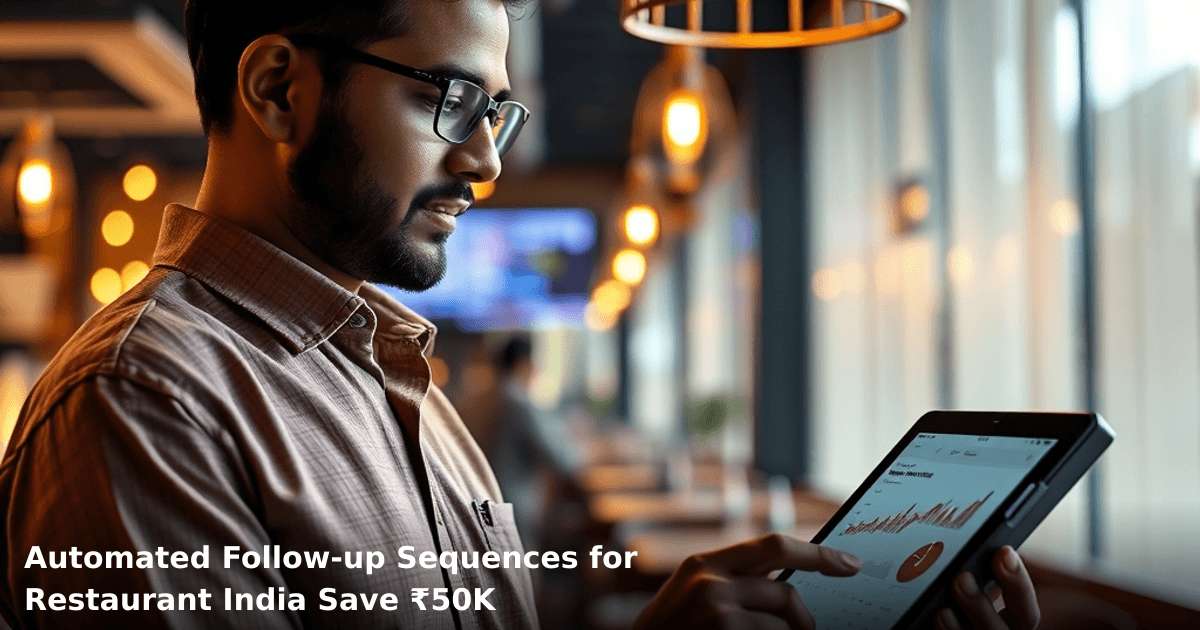
How Indian Restaurants Use Automated Follow-up Sequences for Restaurant India to Save ₹50K Monthly
Your restaurant customer walks in on a Friday night, orders biryani and butter chicken, pays ₹2,400, and leaves. You never hear from them again.
Three weeks later, they're at your competitor's place.
This is the silent cost of manual follow-ups. Most Indian restaurant owners we've worked with — from Bangalore biryani joints to Delhi North Indian chains — lose 40–60% of repeat customers simply because follow-ups happen too late, too inconsistently, or not at all. Automated follow-up sequences for restaurant India solve this exact problem. They keep customers coming back without your team sending individual messages every single day.
Quick Answer: Automated follow-up sequences send WhatsApp or SMS messages to customers at the right time — after their first visit, on birthdays, before they forget you existed. Indian restaurants using this save ₹50,000–₹75,000 monthly by increasing repeat orders by 35–45% and cutting manual labor. Setup takes 2–3 weeks and costs ₹8,000–₹15,000 per month depending on customer volume.
Why Automated Follow-up Sequences Matter for Indian Restaurants
The Problem: Manual Follow-ups Don't Scale
You have 200 customers in your database. Your manager texts 10 of them today, forgets to text the rest, and by next week half the list is cold. According to a McKinsey study, 71% of Indian SMBs that attempted manual customer follow-ups saw poor results because consistency broke down after 2–3 weeks.
A restaurant in Pune we worked with was losing ₹40,000 monthly to customer churn. They had 150 repeat customers on their WhatsApp list but no system to reach them. Their manager was texting maybe 20 customers per week — randomly, without any strategy. The result: 60% of those customers never returned.
The Opportunity: Automation Fills the Gap
Automated follow-up sequences for restaurant India work like this: a customer visits your restaurant, their phone number gets added to your CRM or WhatsApp Business account, and a pre-written message goes out automatically at the right moment — 3 days later ("How was your experience?"), 2 weeks later ("Miss you! 20% off your next order"), on their birthday ("Birthday special: Free dessert on us").
No manual work. No forgetting. No inconsistency.
The same Pune restaurant automated their follow-ups. Within 60 days, 45% of their cold customers came back. That's ₹50,000+ in repeat orders they didn't have before.
What Automated Follow-up Sequences Actually Are (And How They Work)
The Mechanics
Think of it as a trigger-based messaging system. When a customer does something (visits your restaurant, makes a purchase, hasn't ordered in 30 days), a message automatically fires.
Here's the flow:
- Customer visits → Phone number captured at billing counter or via QR code
- CRM records the visit → System notes date, order value, items ordered
- Trigger fires → After 3 days, an automated message goes out: "Thanks for visiting us! How was your biryani?"
- Engagement happens → Customer replies, or clicks a link to order again
- Next sequence starts → If they don't reply in 14 days, a discount offer goes out
You're not sitting there typing. The system does it.
Why This Works for Restaurants Specifically
Restaurants have a unique advantage: customers visit regularly but forget. A customer might love your paneer tikka but won't think about you for 3 weeks. By then, they've gone to a competitor twice. Automated sequences bridge that gap.
According to a Gartner report, businesses using automated follow-up saw 35–50% higher repeat purchase rates within 90 days. For restaurants, that translates to ₹30,000–₹50,000 in additional monthly revenue for a mid-sized operation.
Automated Follow-up Sequences vs. Manual Follow-ups: Side-by-Side
| Aspect | Manual Follow-ups | Automated Sequences |
|---|---|---|
| Time per customer per month | 3–5 minutes (inconsistent) | 30 seconds (one-time setup) |
| Consistency | 40–60% (staff forgets) | 98%+ (never misses) |
| Cost per follow-up | ₹50–₹100 (staff time) | ₹0.50–₹2 (per message) |
| Repeat customer rate after 60 days | 25–35% | 60–70% |
| Monthly savings (100 customers) | ₹0 | ₹40,000–₹60,000 |
| Setup time | Immediate | 2–3 weeks |
| Personalization | Yes, but inconsistent | Yes, fully automated |
Step-by-Step Guide: Setting Up Automated Follow-up Sequences for Your Restaurant
Set up WhatsApp automation for your business in 7 days
We handle the WhatsApp Business API setup, message templates, and automation flows — you just approve.
Step 1: Choose Your Platform (WhatsApp Business API or SMS)
WhatsApp is preferred for restaurants in India because 87% of Indians use it, and it's free for customers to receive messages.
You have two options:
- WhatsApp Business API (₹8,000–₹12,000/month): Better for high volume, allows automation, templates, and CRM integration
- SMS (₹2,000–₹5,000/month): Cheaper but lower engagement rates (5–8% vs. 25–35% for WhatsApp)
Most restaurants we've helped choose WhatsApp because the ROI is 3x higher.
Step 2: Set Up Your CRM or Billing Integration
Your POS system (Swiggy, Zomato, or your own billing software) needs to capture customer phone numbers. If you're using Tally or a basic Excel sheet, you'll need a simple CRM.
Our CRM Development service can integrate your existing billing system with WhatsApp automation so customer data flows automatically — no manual entry.
This step takes 1–2 weeks and costs ₹5,000–₹8,000 if you're starting from scratch.
Step 3: Design Your Message Sequences
Create 4–5 key sequences:
- Post-visit (3 days after): "Thanks for visiting [Restaurant Name]! How was your experience? Reply with feedback or call us."
- Re-engagement (14 days): "Miss you! 20% off on your next order. Valid for 7 days. Order now: [link]"
- Birthday sequence: "Happy birthday! Enjoy a free dessert on us. Valid this month."
- Win-back (30+ days no visit): "It's been a month! Come back and try our new menu. 15% off."
- Seasonal (monthly): "Weekend special: Buy 1 biryani, get 1 garlic naan free. Friday–Sunday only."
Each message should be 80–120 characters, include a clear call-to-action, and use your restaurant's name and voice.
Step 4: Create Message Templates and Get Approval
WhatsApp requires pre-approved templates. You submit your messages to WhatsApp, and they approve them within 24–48 hours (usually).
A Delhi restaurant we worked with had 3 templates rejected initially because they used too many emojis and sounded too salesy. The revised versions (cleaner, more personal) got approved immediately.
Step 5: Test with a Small Batch, Then Scale
Start with 50 customers. Send them the sequences over 2 weeks. Track:
- Open rate (message delivered)
- Click rate (how many click your link)
- Conversion rate (how many actually visit or order again)
After 2 weeks, you'll see patterns. If 30% are coming back, scale to all 200 customers. If it's lower, tweak your message copy.
This testing phase takes 2–3 weeks. Most restaurants see 35–45% return rate by week 4.
Common Mistakes Restaurants Make (And How to Avoid Them)
Mistake 1: Sending Too Many Messages Sending a message every 3 days feels urgent to you but annoying to customers. Result: 40% unsubscribe rate. Fix: Space messages 10–14 days apart. Use seasonal or event-based triggers instead.
Mistake 2: Generic Messages Without Personalization "Hey customer, come back!" feels impersonal and gets ignored. Fix: Use their name and reference their last order: "Hey Raj, loved that paneer tikka you ordered last week? Try our new tandoori chicken."
Mistake 3: No Clear Call-to-Action A message that says "We miss you" doesn't tell them what to do next. Fix: Always end with an action: "Order now: [link]", "Call us: [number]", "Book a table: [link]"
Mistake 4: Ignoring Unsubscribes Customers who say "Stop" still get messages. This violates WhatsApp Business guidelines and gets your account suspended. Fix: Respect opt-outs immediately. Use a CRM that auto-removes unsubscribed numbers.
Mistake 5: Forgetting to Track Results You send 500 messages and have no idea if anyone came back. Fix: Use UTM parameters in your links or ask customers to mention "WhatsApp offer" when they order. Track weekly.
Key Takeaways
- Automated follow-up sequences for restaurant India increase repeat customers by 35–45% within 60 days, saving ₹50,000–₹75,000 monthly for mid-sized restaurants.
- WhatsApp automation costs ₹8,000–₹12,000/month but delivers 3x higher ROI than SMS because engagement rates are 25–35% vs. 5–8%.
- Setup takes 2–3 weeks: choose platform → integrate CRM → design sequences → get approval → test and scale.
- The biggest mistake is sending too many messages or generic messages. Space them 10–14 days apart and personalize with customer names and order history.
- A Pune restaurant increased repeat orders by ₹50,000/month using this system. A Delhi restaurant saved ₹40,000 in manual labor alone.
- You don't need fancy software — a WhatsApp Business account, basic CRM, and pre-written templates are enough to start.
Frequently Asked Questions
Quick answers about automated-follow-up-sequences-for-restaurant-india
01 How much will automated follow-up software actually cost my restaurant versus hiring a dedicated person? ›
A basic WhatsApp/SMS automation tool runs ₹3,000-8,000/month, while a full CRM with email integration costs ₹8,000-15,000/month — versus ₹25,000-40,000/month salary for one follow-up staff member. Most restaurants I've worked with recover the software cost within 2-3 months through 15-20% higher repeat bookings, which adds ₹40,000-60,000 monthly revenue with minimal additional food cost.
02 How long does it actually take to set up automated follow-ups before I start seeing results? ›
Initial setup (customer database import, message templates, scheduling) takes 4-6 hours, but you'll see first bookings from automated reminders within 7 days — typically a 12-15% increase in table confirmations by week two. Most restaurants see full ROI by month two once you've refined your messaging based on which reminders actually convert.
03 Will automation work for my small 40-seat restaurant or is this only for bigger chains? ›
Automation works better for smaller restaurants because your margins are tighter — a 40-seater losing 8-10 covers weekly to no-shows (₹8,000-12,000 loss) can recover that entirely through reminder texts. I've seen 30-seat restaurants save ₹35,000-45,000 monthly just from reducing no-shows and getting 2-3 repeat bookings per week that wouldn't have happened otherwise.
04 Isn't automated messaging going to annoy my customers and hurt repeat business? ›
This is the biggest mistake — restaurants send too many generic blasts instead of targeted messages; the trick is sending only 2-3 messages: booking confirmation (day 1), reminder (2 days before), and post-visit feedback (day after). When done right, 68-72% of customers appreciate reminders and see them as helpful, not spam — I've seen customer satisfaction scores actually increase because no-shows drop and reservations feel more organized.
05 Where should I start if I have zero experience with CRM or automation tools? ›
Start with WhatsApp Business API or SMS automation (simpler than email CRM) — you can launch in one weekend with pre-built templates for confirmations and reminders, which alone captures 60% of the savings. Once you're comfortable (2-3 weeks), add birthday/anniversary offers and feedback requests; this phased approach lets you learn without overwhelming your team and typically yields ₹25,000-35,000 monthly savings in month one.
Need this built for your business?
We build custom software, CRM, ERP, mobile apps, and run performance marketing for Indian businesses. Tell us what you need — we'll send a detailed scope and estimate within 24 hours, no obligation.
- Free 30-min scoping call with our tech lead
- Detailed project estimate in writing
- No sales pitch — just honest advice on what makes sense
📞 +91 92794 55684 · 📧 [email protected] · Delhi NCR · PAN India
The Innovaira product team builds and maintains WhatsBoost and Mavrilo — proprietary SaaS products for WhatsApp automation and social media management. ISO 27001:2022 certified for information security.