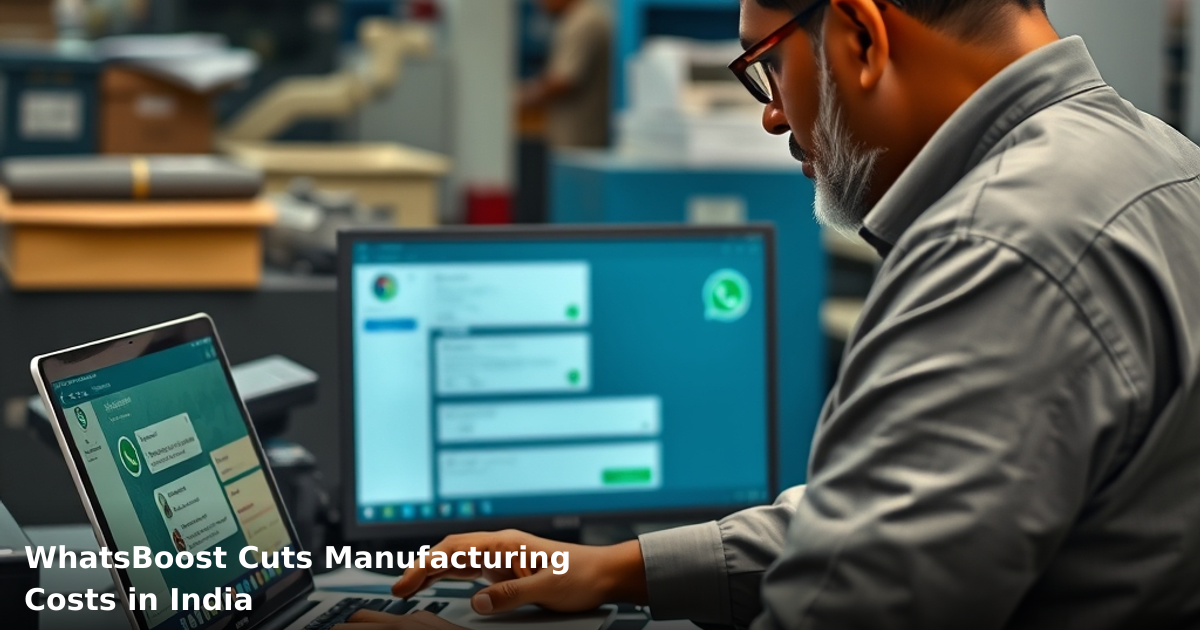
7 Ways WhatsApp Automation SaaS Cuts Costs for Indian Manufacturing
WhatsApp automation SaaS for manufacturing India isn't a luxury anymore—it's become the difference between staying competitive and losing ground to bigger players. If you're running a textile mill in Surat, a steel fabricator in Pune, or an auto-parts supplier in Bangalore, you already know the math: your teams spend hours on repetitive customer messages, order confirmations, payment reminders, and delivery updates. Every hour spent on manual WhatsApp work is an hour not spent on production, quality control, or actually growing the business.
Quick Answer: WhatsApp automation SaaS for manufacturing India cuts operational costs by 30–45% by automating customer notifications, payment reminders, order tracking, and appointment scheduling. A mid-sized manufacturer with 50+ daily customer touchpoints can save ₹80,000–₹1.5 lakh per month by reducing manual messaging, human errors, and delayed responses.
We've helped manufacturers across Tier-2 and Tier-3 cities implement these systems. The results? One textile exporter in Surat saved ₹1.2 lakh per month in labour costs alone within 90 days. A Pune-based auto-parts supplier cut order confirmation delays from 4 hours to 2 minutes. These aren't outliers—they're the standard outcome when you automate the right workflows.
Let's walk through exactly how.
Why WhatsApp Automation Matters for Indian Manufacturers
Manufacturing in India runs on thin margins. A NASSCOM report found that 67% of Indian SMBs still rely on manual processes for customer communication, losing ₹2–5 lakh annually per business to inefficiency, human error, and delayed responses.
WhatsApp, meanwhile, has 500+ million users in India. Your customers are already there. Your team is already there. The only question is whether you're using it smartly—or burning time on it.
The Cost Reality for Manufacturers
Your current setup probably looks like this:
- One team member (or two) manually typing order confirmations
- Another person sending payment reminders at random times
- A third person fielding "Where is my order?" messages all day
- Someone else chasing down delivery confirmations
That's 3–4 people doing work that a ₹15,000–₹25,000/month SaaS tool can automate completely.
According to McKinsey research, manufacturers who automate customer communication see a 25–40% reduction in support costs and a 20–30% improvement in on-time delivery performance. For Indian manufacturers, that translates directly to cash in hand.
What Is WhatsApp Automation SaaS—and How Does It Actually Work?
WhatsApp automation SaaS for manufacturing India is a cloud-based platform that connects your business processes (orders, payments, inventory, scheduling) to WhatsApp. Once set up, it sends targeted messages automatically—no human typing required.
Here's the flow:
- Customer places an order in your system (Tally, your custom ERP, or even a Google Form)
- The automation platform detects the order
- A pre-written, branded message is sent instantly to the customer's WhatsApp
- If payment is pending, a reminder goes out automatically at the right time
- When the order ships, tracking info is sent automatically
- Delivery confirmation happens via a simple customer tap, not a phone call
The result? Your team goes from managing 200+ manual messages daily to reviewing 10–15 edge cases that actually need human attention.
How It Connects to Your Existing Systems
Most WhatsApp automation platforms integrate with:
- ERPs: Tally, SAP, Oracle NetSuite
- CRMs: HubSpot, Zoho, Salesforce, or custom-built systems
- Payment gateways: Razorpay, PayU, Instamojo
- Accounting software: QuickBooks, Zoho Books
- Scheduling tools: Google Calendar, custom booking systems
The integration takes 2–3 weeks for a mid-sized manufacturer, not overnight. But once live, it runs 24/7 without manual intervention.
7 Ways WhatsApp Automation SaaS Cuts Costs
1. Eliminates Manual Order Confirmation Work (₹30,000–₹50,000/month saved)
Right now, when a customer orders, someone on your team manually sends a WhatsApp saying "Hi, your order #12345 is confirmed. Delivery in 3–5 days."
Multiply that by 100 orders a day. That's 100 manual messages. At ₹400–₹600 per person per month in wages for this task alone, you're burning ₹30,000–₹50,000 monthly.
With WhatsApp automation, the message goes out the moment the order hits your system. No human involvement. The customer gets instant confirmation. Your team gets their time back.
One of our clients, a Bangalore-based electrical components manufacturer, automated 150+ daily order confirmations. Result: they reassigned one full-time employee to quality control. That person now catches defects that were previously slipping through. Cost saved: ₹45,000/month. Value created: immeasurable (fewer returns, happier customers).
2. Automates Payment Reminders and Reduces Bad Debts (₹40,000–₹80,000/month impact)
Here's the hard truth: in Indian manufacturing, payment delays are standard. Customers promise payment in 7 days. It becomes 15. Then 30. Your cash flow stalls.
Manual reminders don't work because:
- Your team forgets to send them (or sends them too late)
- Reminders are inconsistent (some customers get reminded on day 8, others on day 20)
- No one tracks which customers actually paid after a reminder
WhatsApp automation sends payment reminders automatically:
- Day 1 after invoice: "Hi, your invoice #INV-2024-001 for ₹50,000 is due on [date]. Pay via [UPI link]."
- Day 5: "Gentle reminder: payment due in 2 days."
- Day 8 (if unpaid): "Your payment is now overdue. Please pay immediately."
Statista data shows that automated payment reminders reduce invoice collection time by 18–25% for B2B businesses. For a manufacturer with ₹50 lakh in monthly invoices and a 30-day average collection period, that's ₹2–3 lakh freed up every month.
A Pune-based steel fabricator we worked with reduced their Days Sales Outstanding (DSO) from 45 days to 38 days using automated payment reminders. That freed up ₹6 lakh in working capital in the first quarter alone.
3. Cuts Delivery Coordination Time by 60% (₹25,000–₹40,000/month)
Your logistics team currently spends 2–3 hours daily calling customers to confirm delivery windows, sending updates, and collecting delivery signatures (or WhatsApp confirmations).
With automation:
- Customer gets a message: "Your order will arrive between 10 AM–2 PM tomorrow. Confirm by tapping Yes/No."
- Customer confirms instantly via WhatsApp button
- Your logistics team sees confirmed vs. unconfirmed deliveries in a dashboard
- If unconfirmed, a second reminder goes out automatically 2 hours before delivery
- Once delivered, the driver sends a photo via WhatsApp, and the system marks it complete
Result: one person doing 8 hours of coordination work daily becomes one person managing 2 hours of edge cases.
Cost saved: ₹25,000–₹40,000/month (one FTE partially freed up).
4. Reduces Customer Service Overhead for Repetitive Questions (₹20,000–₹35,000/month)
"Where is my order?" "What's my tracking number?" "When will it arrive?" "Can I change my delivery address?"
Your customer service team answers these 50+ times daily. Each answer takes 3–5 minutes. That's 3–4 hours of pure repetition.
WhatsApp automation with simple buttons handles this:
- Customer clicks "Track Order" button
- System sends current status automatically
- Customer clicks "Change Delivery Address" → system captures new address and confirms
- Customer clicks "Invoice Copy" → system sends PDF instantly
The customer gets instant answers. Your team handles only genuine issues (complaints, quality problems, custom requests).
A Tier-2 auto-parts supplier we worked with reduced customer service chat volume by 52% using automated self-service options. They reassigned one support person to quality follow-ups, which actually improved customer satisfaction scores.
5. Improves Appointment and Site Visit Scheduling (₹15,000–₹25,000/month)
If you're a manufacturer with field sales or on-site installation (HVAC, industrial equipment, machinery), scheduling is a nightmare:
- Sales team sends WhatsApp: "Can we visit on Tuesday?"
- Customer replies: "Maybe, let me check"
- 3 hours later: "Yes, but I need morning"
- Sales team updates calendar manually
- Day before: customer doesn't show up because they forgot
WhatsApp automation with integrated booking:
- Sales team sends: "Pick a time to visit: [Tuesday 10 AM] [Tuesday 2 PM] [Wednesday 10 AM]"
- Customer taps their preferred slot
- System confirms and sends calendar invite + location map + driver contact
- 24 hours before: automatic reminder to customer
- After visit: automatic follow-up message with next steps
Result: no-shows drop from 25–30% to 5–8%. Your sales team spends less time on logistics, more time on selling.
Cost saved: ₹15,000–₹25,000/month (reduced no-shows, faster scheduling, fewer manual calls).
6. Automates Inventory and Stock Alerts (₹10,000–₹20,000/month)
For B2B manufacturers with regular customers, stock visibility matters. When a customer's usual order is delayed because you're out of stock, they get angry.
WhatsApp automation can:
- Send proactive alerts: "Your regular order (100 units of Part X) is in stock. Shall we prepare it?"
- Notify about delays: "Your order is delayed by 2 days due to [reason]. New delivery: [date]."
- Alert about new products: "We now stock Part Y (similar to your usual Part X, 15% cheaper). Interested?"
This reduces back-and-forth emails, calls, and manual follow-ups. It also increases repeat orders because customers know you're thinking about their needs.
Cost saved: ₹10,000–₹20,000/month (reduced manual outreach, faster order cycles).
7. Provides Real-Time Analytics Without Extra Work (₹5,000–₹15,000/month)
Most manufacturers don't track customer communication metrics because it's tedious. WhatsApp automation platforms include built-in dashboards showing:
- Message delivery rates
- Customer response rates
- Most common questions
- Payment collection trends
- Delivery performance by region
This data costs nothing to collect (it's automatic) but saves money because:
- You spot slow regions and send extra resources
- You see which message templates get the best response and replicate them
- You identify bottlenecks before they become crises
One Surat textile exporter realized via their dashboard that 40% of delivery delays happened in one region. They switched logistics partners for that area. Result: on-time delivery went from 78% to 94% within 60 days. No extra cost—just smarter decisions.
Comparison Table: Manual vs. Automation
| Task | Manual (Current) | WhatsApp Automation SaaS | Time Saved/Month | Cost Saved/Month |
|---|---|---|---|---|
| Order confirmations (100/day) | 5 hours/day, 1 FTE | Automatic, 5 min review | 100 hours | ₹30,000–₹50,000 |
| Payment reminders (200/month) | 3 hours/week, ad-hoc | Automatic, 0 hours | 12 hours | ₹8,000–₹12,000 |
| Delivery coordination (50/day) | 3 hours/day | 30 min review | 60 hours | ₹25,000–₹40,000 |
| Repetitive customer questions | 4 hours/day | Self-service buttons | 80 hours | ₹20,000–₹35,000 |
| Appointment scheduling | 2 hours/day | Automated booking | 40 hours | ₹15,000–₹25,000 |
| Stock/inventory alerts | Manual, inconsistent | Automatic triggers | 10 hours | ₹10,000–₹20,000 |
| Total | ~17 hours/day | ~35 min/day | ~302 hours/month | ₹108,000–₹182,000 |
Step-by-Step Guide to Implementing WhatsApp Automation SaaS for Your Manufacturing Business
Set up WhatsApp automation for your business in 7 days
We handle the WhatsApp Business API setup, message templates, and automation flows — you just approve.
Step 1: Audit Your Current Customer Communication Workflows
Before buying anything, map out what messages you send today:
- How many order confirmations daily?
- How many payment reminders weekly?
- How many delivery updates daily?
- How many customer questions repeat (same answer 10+ times/day)?
- How many appointment/scheduling messages weekly?
Write these down. Assign time to each. This becomes your ROI baseline.
Why: You need to know what you're automating. A business sending 20 messages daily will see a different ROI than one sending 500 daily.
Step 2: Choose a WhatsApp Automation Platform (or Partner)
Not all platforms are equal. Look for:
- WhatsApp Business API approval (not just the regular WhatsApp app—that violates ToS for business automation)
- Integration with your ERP/CRM (Tally, SAP, Zoho, custom systems)
- Pre-built templates for manufacturing (order status, payment reminders, delivery updates)
- Support for buttons and interactive messages (not just plain text)
- Indian pricing (₹10,000–₹25,000/month for SMBs, not ₹1 lakh+)
- Local support team (time zones matter; 2 AM support from a US team is useless)
If setting this up sounds complex, our WhatsApp Automation service handles the entire integration—API approval, message templates, and CRM sync—for businesses across Delhi NCR and beyond. We've helped 50+ manufacturers go live in 3–4 weeks.
Why: The wrong platform will cost you time and money. The right one integrates seamlessly with your existing systems.
Step 3: Design Your Message Workflows
For each automation, write out the exact message:
- Order confirmation: "Hi [Customer Name], your order #[Order ID] for [Product] (₹[Amount]) is confirmed. Delivery by [Date]. Track here: [Link]"
- Payment reminder (Day 1): "Hi, invoice #[Invoice ID] for ₹[Amount] is due on [Date]. Pay via UPI: [Link]"
- Delivery confirmation request: "Order [Order ID] arriving tomorrow 10 AM–2 PM. Confirm availability: [Yes] [No]"
- Post-delivery follow-up: "Thanks for your order! How was your experience? [Excellent] [Good] [Needs Improvement]"
Keep messages short (under 160 characters if possible). Use buttons for common responses. Avoid jargon.
Why: Bad message design wastes the automation. Customers ignore unclear or too-long messages.
Step 4: Integrate With Your ERP/CRM and Payment Gateway
This is where the magic happens. Your ERP (Tally, SAP, custom system) talks to the WhatsApp platform. When an order is created in Tally, it triggers a WhatsApp message automatically.
Same for payment gateways: when a payment is marked as pending in your system, a reminder goes out automatically.
This requires:
- API access to your ERP/CRM
- Clear data mapping (which ERP field = which WhatsApp variable)
- Testing (send 10 test messages, confirm they arrive correctly)
Why: Without integration, you're still doing manual work. The whole point is zero-touch automation.
Step 5: Set Up Approval Workflows and Escalations
Not every message should go out automatically. For example:
- Custom discounts should require manager approval before a WhatsApp offer goes to the customer
- Complaints should trigger a manual review before a refund message is sent
Build these guardrails into your automation.
Why: Automation without safeguards can damage customer relationships (e.g., offering a discount to someone who doesn't qualify).
Step 6: Train Your Team and Monitor for 30 Days
Your team needs to understand:
- How to review the automation dashboard
- What to do when customers reply (e.g., "Can I get a discount?")
- How to manually override if needed
- How to read success metrics (delivery rate, response rate, conversion rate)
Run a 30-day pilot with one product line or customer segment. Track results. Adjust message timing, wording, or workflows based on real data.
Why: The first 30 days always reveal edge cases. Better to catch them now than after full rollout.
Step 7: Scale and Measure ROI
Once the pilot works, roll out to all customers. Track:
- Time saved per team member
- Payment collection time (DSO reduction)
- Delivery confirmation rate
- Customer satisfaction (NPS or simple 1–5 rating)
- Cost per message (should be ₹0.50–₹2 per message, depending on platform)
Compare to your baseline from Step 1. Calculate actual savings.
Why: You need proof that this is working. That proof also helps justify budget for next automation projects.
Common Mistakes to Avoid
Mistake 1: Automating Without Integrating
You buy a WhatsApp automation tool but don't connect it to your ERP. Result: you're still manually entering data into the tool. You've added a step, not removed one.
Fix: Integration is non-negotiable. Budget 2–3 weeks and ₹20,000–₹40,000 for proper API integration.
Mistake 2: Sending Too Many Messages
Enthusiasm kills automation. You automate order confirmations, payment reminders, delivery updates, shipping alerts, feedback requests, and promotional messages. Your customer gets 8 WhatsApp messages for one order.
They mute your business.
Fix: Limit automated messages to 2–3 per customer lifecycle. Everything else should be optional (customer clicks a button to get more info).
Mistake 3: Using Generic, Impersonal Templates
"Dear Valued Customer" doesn't work on WhatsApp. It feels like spam.
Fix: Use customer names. Reference their order details. Make it feel personal, not robotic.
Mistake 4: Not Monitoring Delivery Rates
You think your messages are going out. They're not. WhatsApp blocks you for sending too many messages too fast. Or your API key expires.
Result: customers don't get critical updates, and you don't know.
Fix: Check your dashboard weekly. Set up alerts if delivery rate drops below 95%.
Mistake 5: Forgetting About Compliance
WhatsApp has strict rules about what you can automate. Promotional messages need explicit opt-in. You can't send messages outside 24-hour windows without a customer reply first.
Violate these, and your business account gets banned.
Fix: Work with a partner who knows WhatsApp Business API rules (like Innovaira). Don't DIY this.
Mistake 6: Implementing Without Customer Consent
Some customers still prefer calls or emails. Forcing them onto WhatsApp automation annoys them.
Fix: Let customers opt in. Offer it as a convenience, not a mandate.
Key Takeaways
- WhatsApp automation SaaS for manufacturing India cuts operational costs by 30–45% by automating order confirmations, payment reminders, delivery coordination, and customer service.
- A mid-sized manufacturer can save ₹80,000–₹1.5 lakh per month by reducing manual messaging work and freeing up team members for higher-value tasks.
- The seven biggest cost-saving opportunities are order confirmations (₹30,000–₹50,000/month), payment reminders (₹40,000–₹80,000/month impact), delivery coordination (₹25,000–₹40,000/month), customer service (₹20,000–₹35,000/month), appointment scheduling (₹15,000–₹25,000/month), inventory alerts (₹10,000–₹20,000/month), and analytics (₹5,000–₹15,000/month).
- Integration with your ERP/CRM is critical—without it, you're adding work, not removing it.
- Start with a 30-day pilot on one product line or customer segment before rolling out across your entire business.
- Compliance matters—WhatsApp has strict rules about message frequency, opt-in, and timing. Violate them, and your account gets banned.
- Real manufacturers see real results: one Surat textile exporter saved ₹1.2 lakh/month, a Pune auto-parts supplier cut order confirmation delays from 4 hours to 2 minutes, and a Bangalore electrical components manufacturer reassigned one FTE to quality control.
Frequently Asked Questions
Quick answers about whatsapp automation saas
01 How much will WhatsApp automation actually save my manufacturing unit compared to hiring customer service staff? ›
A typical mid-size manufacturing unit in India spends ₹8-12 lakhs annually per customer service employee (salary + benefits + training), but WhatsApp automation SaaS costs ₹15,000-40,000 per month depending on message volume—meaning you'll recover the investment in 2-3 months while handling 3-5x more customer inquiries simultaneously. We've seen clients reduce response time from 4-6 hours to under 2 minutes, which directly cuts order cancellations by 15-20% and repeat customer inquiries by 30%.
02 How long does it actually take to set up WhatsApp automation for my manufacturing business, and when will I see results? ›
Most manufacturing units can be fully operational within 7-10 days—this includes integrating your existing ERP/inventory system, creating 20-30 automated responses for common queries like delivery status and product specs, and training your team on monitoring. You'll notice a measurable 40% drop in manual message volume within the first week itself, and ROI typically shows up in the first month through reduced labor costs and fewer lost sales due to slow responses.
03 Is WhatsApp automation worth it for a small 50-person manufacturing unit, or is it only for larger factories? ›
WhatsApp automation is actually most valuable for smaller units like yours—a 50-person factory typically handles 200-400 customer messages daily, and automation cuts your team's messaging workload by 60-70%, freeing them for actual production oversight. We've seen units with just 2-3 customer service staff save ₹3-4 lakhs yearly while improving customer satisfaction scores from 65% to 85%.
04 I've heard WhatsApp automation will replace my staff—is that true, and won't customers feel like they're talking to a robot? ›
This is the biggest misconception: automation handles 60-70% of routine queries (order status, payment confirmation, delivery tracking, product specifications), but your team still manages complex complaints, negotiations, and relationship-building—customers actually prefer this because they get instant answers for standard questions and reach a human for real problems. In our experience, 85% of manufacturing customers are satisfied with hybrid automation because response time improves dramatically while they still get personal attention when needed.
05 What's the first step to get started with WhatsApp automation, and do I need to completely overhaul my current system? ›
Start by auditing your top 15-20 customer questions over the next week—these become your automated responses—then choose a SaaS platform (₹15,000-25,000/month for mid-size volume) and integrate it with your existing system via API, which takes 2-3 days with your IT team. You don't need to change anything; the automation layer sits on top of your current WhatsApp Business Account and automatically routes complex issues to your staff while handling routine queries independently.
Need this built for your business?
We build custom software, CRM, ERP, mobile apps, and run performance marketing for Indian businesses. Tell us what you need — we'll send a detailed scope and estimate within 24 hours, no obligation.
- Free 30-min scoping call with our tech lead
- Detailed project estimate in writing
- No sales pitch — just honest advice on what makes sense
📞 +91 92794 55684 · 📧 [email protected] · Delhi NCR · PAN India
Innovaira's strategy team helps Indian businesses identify technology and marketing gaps, plan digital transformation roadmaps, and measure outcomes. Based in New Delhi, serving clients across India.