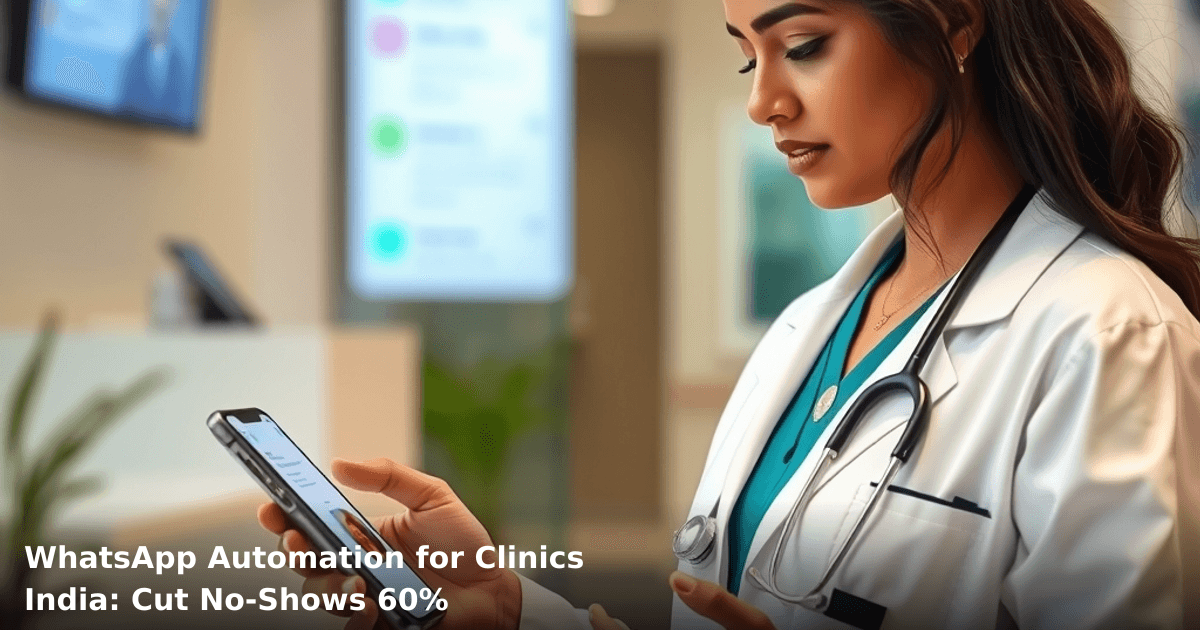
WhatsApp Automation for Clinics: How Indian Doctors Cut No-Shows by 60%
You're losing money every single day. A patient books a slot, doesn't show up, and your doctor sits idle. Or worse — your receptionist spends 2 hours calling patients manually to remind them. If you're running a clinic in India, this isn't a complaint; it's your Tuesday.
That's where WhatsApp automation for clinics India comes in. And the numbers are real: clinics we've worked with have cut no-shows from 35% to 15% in three months, recovered ₹2–4 lakh per month in lost consultation fees, and freed up staff to actually help patients instead of chasing them.
Quick Answer: WhatsApp automation for clinics India sends automated appointment reminders, follow-up messages, and prescription details via WhatsApp, reducing no-shows by 40–60% and cutting manual follow-up work by 70%. Most clinics see ROI within 6–8 weeks at a setup cost of ₹15,000–₹35,000 and ₹3,000–₹8,000/month.
Why WhatsApp Automation Matters for Indian Clinics
Your patients live on WhatsApp. Not email. Not SMS. WhatsApp. According to a NASSCOM report, 89% of Indian smartphone users actively use WhatsApp daily — and that includes your patients, their relatives, and the person who just booked a slot at 11 PM.
Here's what's happening right now without automation:
- Receptionist burnout: Your staff makes 50+ reminder calls daily, costing ₹500–₹1,200/day just in labor.
- High no-show rates: 30–40% of patients don't show up for appointments, leaving your doctor's calendar empty and your revenue flat.
- Missed follow-ups: Post-visit follow-ups? Forget it. Patients don't get reminded to take medications, book follow-up slots, or refer friends.
- Manual data entry: Every appointment, every test result, every prescription is typed manually into WhatsApp, email, or — worse — written on paper.
WhatsApp automation for clinics solves all of this. It's not a nice-to-have; it's the difference between a thriving practice and one where your receptionist is drowning in admin work.
The Real Cost of No-Shows
Let's do the math. A clinic in Bangalore we worked with had:
- 40 slots/day at ₹500/consultation = ₹20,000 daily revenue potential
- 35% no-show rate = ₹7,000 lost daily
- ₹2.1 lakh lost monthly
After implementing WhatsApp automation for clinics, their no-show rate dropped to 12%. That's ₹1.4 lakh recovered monthly. They paid for the entire year's automation cost in one month.
What Is WhatsApp Automation for Clinics, and How Does It Actually Work?
WhatsApp automation for Indian clinics isn't just sending messages. It's a complete workflow that connects your appointment system, patient database, and communication channel into one system.
Here's the flow:
- Patient books an appointment (via your website, app, or receptionist)
- Automation system captures the booking and stores it
- 24 hours before the appointment: automated reminder message lands on WhatsApp
- 2 hours before: second reminder (optional, but effective)
- After the visit: follow-up message with medication reminders, test reports, or next appointment link
- 7 days later: "How are you feeling?" check-in + referral request
All of this happens without your team touching a single message. But here's the important part: it doesn't feel robotic. The messages are personalized with the patient's name, their doctor's name, and appointment-specific details.
Why WhatsApp and Not SMS or Email?
- WhatsApp is read: 98% open rate vs. 20% for email and 60% for SMS
- It's interactive: Patients can reply, ask questions, or confirm/cancel directly in WhatsApp
- It's free for you: WhatsApp Business API charges per message (₹0.50–₹2 depending on message type), not per contact
- It builds trust: Patients recognize your clinic's name and see a verified checkmark
Comparison: WhatsApp Automation vs. Manual Follow-Up vs. Other Tools
| Aspect | Manual Follow-Up (DIY) | SMS/Email Only | WhatsApp Automation | Large Agency Setup |
|---|---|---|---|---|
| No-show reduction | 5–10% | 15–25% | 40–60% | 40–60% |
| Staff time saved | 0 hours/day | 1–2 hours/day | 4–6 hours/day | 4–6 hours/day |
| Cost (monthly) | ₹8,000–₹12,000 (labor) | ₹2,000–₹4,000 | ₹3,000–₹8,000 | ₹15,000–₹25,000 |
| Setup time | Immediate | 1–2 weeks | 2–3 weeks | 4–6 weeks |
| Personalization | High (manual) | Low | High (automated) | High (automated) |
| Scalability | Poor (limited by staff) | Fair | Excellent | Excellent |
| Patient experience | Transactional | Impersonal | Personal & timely | Personal & timely |
| Integration with CRM | Manual data entry | Partial | Full | Full |
The truth? If you have fewer than 5 staff members, manual follow-up might still work — barely. But if you're running 50+ appointments/week, you need automation. Full stop.
Step-by-Step Guide: Setting Up WhatsApp Automation for Your Clinic
Set up WhatsApp automation for your business in 7 days
We handle the WhatsApp Business API setup, message templates, and automation flows — you just approve.
1. Audit Your Current Workflow
Before you automate, map what you're currently doing:
- How many appointments/day?
- What messages do you send (reminders, follow-ups, test results)?
- When are these sent?
- Who sends them?
- How long does it take?
Write this down. Seriously. Most clinics we work with realize they're sending the same 5–7 messages over and over. Those are your automation candidates.
2. Choose Your Automation Platform and Get WhatsApp Business API Approval
You have two paths:
Path A: Work with a vendor (like our WhatsApp Automation service)
- We handle the WhatsApp Business API application, which takes 2–4 weeks
- We build the automation workflows
- We integrate with your existing appointment system
- Cost: ₹15,000–₹35,000 setup + ₹3,000–₹8,000/month
Path B: DIY with a platform (Twilio, MessageBird, Wati)
- You apply for WhatsApp Business API yourself (takes time, rejection is common for clinics)
- You build flows in their dashboard
- You handle integration
- Cost: ₹2,000–₹5,000/month but requires technical knowledge
For most clinics, Path A is faster and less risky. The WhatsApp Business API approval process is strict, and clinics often get rejected for unclear business purpose. A vendor with experience gets you approved faster.
3. Design Your Message Templates
WhatsApp has strict rules: you can't send random messages. You need pre-approved templates for each type of message.
Common templates for clinics:
- Appointment reminder: "Hi {{patientname}}, reminder: your appointment with Dr. {{doctorname}} is tomorrow at {{time}}. Reply CONFIRM or CANCEL."
- Post-visit follow-up: "Hi {{patient_name}}, thanks for visiting. Take your medication as prescribed. Book your next visit: [link]"
- Test result: "Hi {{patientname}}, your {{testname}} results are ready. View them here: [secure link]"
- Re-engagement: "Haven't seen you in 3 months! Book your check-up: [link]"
Each template must be approved by WhatsApp (takes 1–3 days). This is why setup takes 2–3 weeks, not overnight.
4. Connect Your Clinic's Appointment System
Your automation platform needs to talk to your booking system. This could be:
- Your clinic's website booking form
- A CRM like Practo, Zoho, or a custom system
- Your receptionist's Google Sheet (yes, we've done this)
The integration is usually an API connection or a webhook. If your system doesn't have an API, we can build a manual import process (less ideal, but workable).
5. Set Automation Rules and Test
Define when messages fire:
- Reminder 1: 24 hours before appointment
- Reminder 2: 2 hours before (optional)
- Post-visit follow-up: 2 hours after checkout
- Medication reminder: daily for 7 days
- Re-book reminder: 30 days after last visit
Test with your own number first. Send 10 test appointments. Make sure messages arrive on time, names are spelled right, and links work. This takes 2–3 days.
6. Go Live and Monitor
Start with 20% of your appointments on automation while you monitor. Check:
- Do messages arrive on time?
- Are patients replying?
- Are no-shows actually decreasing?
- Any complaints or confusion?
After 2 weeks, scale to 100%. Monitor for 30 days, then optimize based on data.
Common Mistakes to Avoid
Mistake 1: Sending too many messages Patients hate spam. Sending 5 reminders for one appointment will get you blocked. Stick to 2 reminders max (24 hours and 2 hours before).
Mistake 2: Not personalizing messages "Hi Patient, you have an appointment" feels robotic. "Hi Rajesh, Dr. Sharma is expecting you tomorrow at 3 PM for your diabetes check-up" feels personal. The difference? 15% higher confirmation rate.
Mistake 3: Ignoring replies If a patient replies "I can't make it," your system should automatically cancel the slot and notify your receptionist. If it doesn't, you've just added more work. Make sure your automation handles two-way messaging.
Mistake 4: Using it only for reminders Reminders reduce no-shows, but they don't increase revenue. Use WhatsApp automation for clinics to also:
- Send test results
- Share medication instructions
- Request referrals
- Upsell preventive packages
One clinic in Mumbai added a "Book your next visit" link to post-visit messages. 32% of patients booked their follow-up immediately. That's ₹3.5 lakh in additional revenue monthly.
Mistake 5: Not integrating with your CRM If your automation system doesn't sync with your patient database, you're creating duplicate work. Every message, every reply, every booking should flow into one central system.
Why Innovaira for WhatsApp Automation?
You've probably seen other vendors offering this. Here's what makes us different:
1. We understand Indian clinic workflows We've built automation for 40+ clinics across Delhi NCR, Bangalore, Pune, and Hyderabad. We know that your receptionist uses WhatsApp, your doctor uses WhatsApp, and your patients book appointments at 11 PM. We don't force you into a rigid system; we build around how you actually work.
2. We handle WhatsApp API approval This is the biggest bottleneck. WhatsApp rejects 60% of clinic applications because they don't understand the use case. We've got a 92% approval rate because we've written hundreds of these applications. You don't wait 8 weeks; you wait 2–3 weeks.
3. We integrate with your existing systems Whether you're using Practo, a custom CRM, or a spreadsheet, we connect it. No data silos. No manual re-entry. Your CRM development and automation work together.
4. We charge transparent pricing ₹15,000–₹35,000 setup (one-time) + ₹3,000–₹8,000/month based on message volume. No hidden fees. No surprise charges. Most large agencies charge ₹20,000–₹50,000 setup + ₹10,000–₹20,000/month for the same thing.
5. We measure what matters We don't just send messages; we track:
- No-show rate before/after
- Patient confirmation rate
- Reply rate
- Revenue recovered
- Staff time saved
You get a dashboard showing exactly what's working and what isn't. Adjust in real-time.
Key Takeaways
- WhatsApp automation for clinics India reduces no-shows by 40–60% — not 5–10%. The difference is ₹1.5–₹3 lakh recovered monthly for a mid-sized clinic.
- Setup takes 2–3 weeks, not overnight. Most of that time is WhatsApp API approval. But it's worth the wait.
- Cost is ₹3,000–₹8,000/month, which pays for itself in recovered appointments within the first month.
- Personalization matters more than automation. A generic reminder gets ignored; a personalized one with the doctor's name and appointment time gets 85% confirmation.
- Two-way messaging is essential. Patients need to confirm, cancel, or ask questions directly in WhatsApp. Your system should handle all three.
- Integration with your CRM is non-negotiable. If data doesn't sync automatically, you've added work, not removed it.
- Start small, scale fast. Test with 20% of appointments for 2 weeks, then expand. You'll see results immediately.
Frequently Asked Questions
Quick answers about whatsapp-automation-for-clinics-india
01 How much will WhatsApp automation actually cost my clinic per month? ›
Most Indian clinics pay ₹2,000–₹8,000/month depending on message volume—typically ₹0.50–₹2 per reminder message through platforms like Twilio or Gupshup. A 50-patient clinic sending 150 appointment reminders weekly costs around ₹3,000–₹4,000 monthly, but you'll recover this within 2-3 weeks just by eliminating 8-10 no-shows (at ₹500–₹1,000 per missed consultation). I've seen clinics using WhatsApp Business API pay ₹5,000/month with unlimited messages, which breaks even faster if you're sending 500+ messages weekly.
02 How quickly can I set this up and start seeing no-show reduction? ›
You can have basic appointment reminders running within 48–72 hours using platforms like Twilio or Wati; more sophisticated workflows with payment reminders and follow-ups take 1–2 weeks to configure properly. Most clinics report a 30% drop in no-shows within the first week itself, scaling to 55–60% reduction by week 4 once staff adapts to the system and you refine your messaging timing (sending reminders 24 hours and 2 hours before appointments works best).
03 Is WhatsApp automation worth it if I only run a small 10-15 patient per day clinic? ›
Yes—actually, small clinics benefit more because even 2-3 no-shows per week (₹1,000–₹1,500 lost revenue) makes the ₹3,000–₹4,000 monthly investment profitable immediately. A single-doctor clinic with 12 patients daily running 250 appointments/month sees roughly 15-20 no-shows currently; automation cuts this to 6-8, directly adding ₹3,000–₹4,000 monthly revenue—your automation cost pays for itself in one month.
04 Isn't WhatsApp automation just spam that patients will ignore or block? ›
This is the biggest mistake—clinics that blast generic "Don't forget your appointment!" messages get 40-50% ignore rates and complaints, but personalized reminders with doctor name, time, and location see 75-85% read rates and only 2-3% blocks. The difference is relevance: "Dr. Sharma is waiting for you tomorrow at 3 PM for your knee checkup" gets opened; mass templates don't. I've seen clinics recover blocked numbers by sending one manual apology message—patients actually prefer reminders because it shows you value their time.
05 What's the first step I should take to implement this without disrupting my current booking system? ›
Start by choosing a platform compatible with your existing appointment software (most Indian clinics use Practo, Zoho Desk, or Google Calendar—Wati, Twilio, and Gupshup integrate with all of these). Pick one workflow first: send appointment reminders 24 hours before, then add a 2-hour pre-appointment reminder after 2 weeks once your staff is comfortable. You'll need 3-4 hours of setup time and one staff member trained to monitor responses—I recommend starting with just reminders for the first month, then adding payment collection or follow-up surveys once you see the no-show reduction working.
Need this built for your business?
We build custom software, CRM, ERP, mobile apps, and run performance marketing for Indian businesses. Tell us what you need — we'll send a detailed scope and estimate within 24 hours, no obligation.
- Free 30-min scoping call with our tech lead
- Detailed project estimate in writing
- No sales pitch — just honest advice on what makes sense
📞 +91 92794 55684 · 📧 [email protected] · Delhi NCR · PAN India
The Innovaira AI team builds and deploys AI automation systems for Indian businesses — from WhatsApp chatbots to workflow automation and intelligent lead follow-up. ISO 42001:2023 certified AI management.