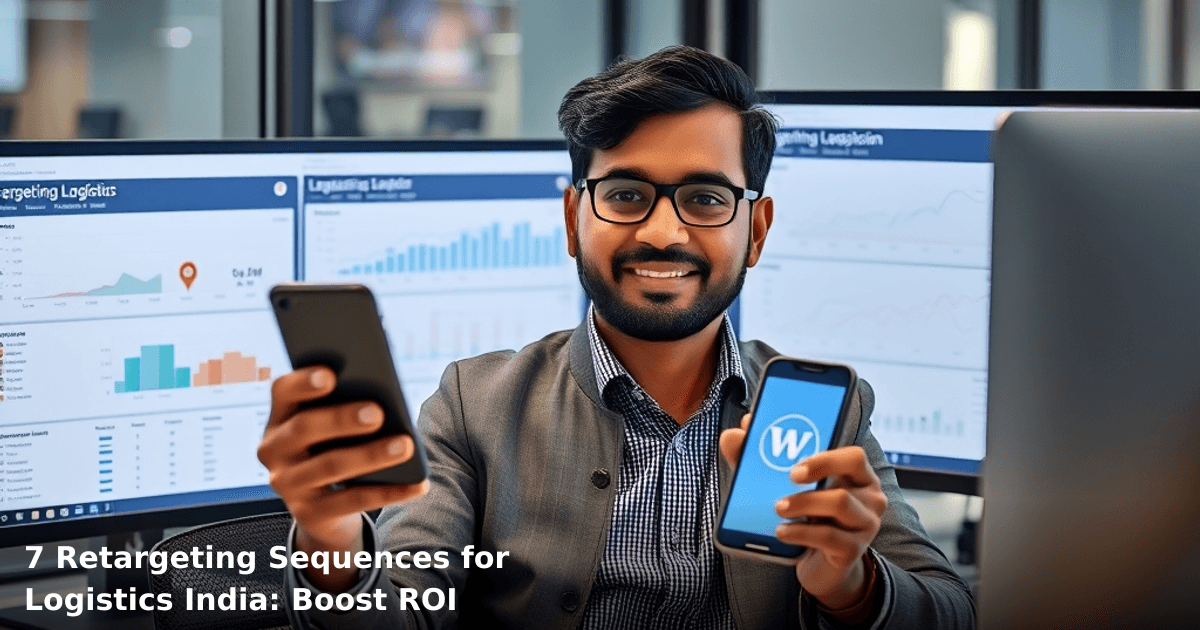
7 Retargeting Sequences for Logistics India: Boost ROI
Retargeting sequences for logistics India are your second chance to turn window shoppers into paying customers—and they work differently than they do for retail or restaurants. Your logistics prospects are often decision-makers juggling multiple vendors, tight delivery windows, and GST compliance headaches. They've visited your website, checked your rates, maybe even downloaded a brochure. Then they disappeared. A structured retargeting sequence brings them back, builds trust, and closes the deal.
Quick Answer: Retargeting sequences for logistics India use email, WhatsApp, and display ads to re-engage prospects who've visited your site. A typical sequence runs 7–14 days, costs ₹2,000–₹8,000 per campaign, and lifts conversion rates by 40–60%. Start with a "we noticed you" email, follow with WhatsApp for time-sensitive offers, then use display ads for final reminders.
Why Retargeting Sequences Matter for Indian Logistics Businesses
Your logistics customers don't buy on impulse. A shipper in Bangalore researches three to four vendors before signing a contract. A warehouse operator in Pune checks your API documentation, compares your rates with competitors, then goes back to their Excel sheets to think. That's where most logistics prospects get stuck—and where retargeting sequences pull them back.
The Logistics Sales Cycle Is Long
Unlike a restaurant app or a retail website, logistics decisions involve multiple stakeholders. Your prospect might be a logistics manager, but the CFO controls the budget. The warehouse supervisor wants proof of integration with their TMS (Transportation Management System). By the time they're ready to buy, 30–45 days have passed. Without retargeting, they've forgotten your unique selling point.
The Numbers Back It Up
According to a Gartner report, businesses that use retargeting sequences see a 47% increase in conversion rates compared to one-time campaigns. For Indian logistics SMBs, that translates to ₹15,000–₹50,000 in recovered revenue per month. We've seen a logistics startup in Gurugram recover 23 leads worth ₹3.2 lakh in annual contracts just by implementing a structured retargeting sequence.
What Retargeting Sequences Actually Are (And Aren't)
A retargeting sequence for logistics India isn't a single ad or email. It's a choreographed series of touchpoints—typically 5–7 interactions over 7–21 days—designed to move a prospect from "interested" to "ready to demo" to "signed contract."
The Three Layers
Layer 1: Awareness Retargeting — Display ads that remind prospects you exist. "Remember us? Here's what we do differently." Simple, visual, non-salesy.
Layer 2: Engagement Retargeting — Email or WhatsApp that addresses a specific pain point they showed interest in. If they looked at your "real-time tracking" page, you send them a case study about how real-time tracking saved a Jaipur shipper 12% on fuel costs.
Layer 3: Conversion Retargeting — A direct offer. Free demo, ₹5,000 discount on first month, or a consultation call. Time-bound. Specific.
This layered approach works because it respects where the prospect is in their decision journey. You're not hammering them with a sales pitch on day one. You're building context, credibility, then asking for the sale.
7 Retargeting Sequences That Work for Logistics India
1. The "We Know What You Need" Email Sequence
Days 1–3: Prospect sees your homepage and leaves.
Day 1 email: Subject line: "3 reasons your current logistics partner might be costing you ₹50K/month."
Body: Don't sell your software. Sell the problem. Talk about hidden fuel surcharges, manual invoice matching, and missed delivery windows. Ask one question: "Which one hurts your business most?" Include a link to a short quiz (not a demo form—lower friction).
Day 3 email: Subject line: "Here's what a Bangalore logistics manager told us..."
Body: Share a brief case study. Real company (anonymized), real numbers. "XYZ Logistics cut their invoice reconciliation time from 8 hours/week to 45 minutes using our system." Include a soft CTA: "See how it works" (link to a 3-minute video, not a sales call).
Why it works: You're speaking to their pain first, not your features. Logistics buyers respect specificity—they know the exact numbers they're bleeding. By day 3, they've seen your solution twice without feeling pressured.
Cost: ₹500–₹1,200 (email platform + copywriting).
2. The WhatsApp "Quick Question" Sequence
Days 2–7: If they've downloaded a brochure or clicked on a specific feature page, send WhatsApp messages.
Day 2 message: "Hi [Name], saw you checked out our real-time tracking feature. Quick question: are you currently using a TMS, or managing shipments manually? Just curious 🙂"
This isn't a sales message. It's a conversation starter. You're gathering intel. Their response (if they give one) tells you where they are in their buying process.
Day 5 message: "No pressure, but I thought you'd find this useful—[link to a 2-min video showing real-time tracking integration with Tally]."
Day 7 message: "Last thing I'll send, promise. We're running a limited-time pilot for logistics teams in [their region]. Free for 30 days. Interested?"
Why it works: WhatsApp has a 98% open rate in India. Logistics managers check WhatsApp while managing shipments. The sequence is conversational, not robotic. And you're offering a pilot, not a full contract—lower commitment threshold.
Cost: ₹1,500–₹3,000/month (WhatsApp Business API + message credits).
If you want to automate this without building it yourself, our WhatsApp Automation service handles message sequencing, keyword triggers, and CRM integration—so your team isn't manually sending 50 WhatsApp messages a day.
3. The Display Retargeting Sequence
Days 1–14: Show display ads to anyone who visited your website but didn't convert.
Week 1 ads: "Logistics Made Simple" — Show a clean visual of your dashboard. No heavy copy. Just the value prop. Target these ads to prospects who visited your homepage or pricing page.
Week 2 ads: "See How [Competitor City] Logistics Saved ₹2.5L/Year" — Shift to social proof. Show a testimonial or case study. Target prospects who visited your features page or blog.
Week 3 ads (if they're still not converting): "₹0 for 30 Days. No Card Required." — Direct offer. Urgency. Target these only to prospects who've visited your pricing or demo pages.
Why it works: Display ads are cheap (₹0.30–₹1.50 per impression in India). You're staying top-of-mind without being aggressive. By week 3, if they haven't converted, they either don't need you or need a direct incentive.
Cost: ₹3,000–₹7,000 for a 14-day campaign (Google Display Network or Facebook ads).
4. The Comparison Sequence
Days 4–10: Target prospects who visited your "Why Choose Us" or competitors' comparison pages.
Day 4 email: "Logistics Software Comparison: We Stacked Ourselves Against [Competitor Name]."
Body: Create a transparent, feature-by-feature comparison. Be honest. If a competitor is cheaper, say so. But highlight where you win—integration speed, customer support in India, GST compliance, real-time tracking. Include a downloadable PDF comparison chart.
Day 7 WhatsApp: "Downloaded the comparison? Happy to answer any questions. Call me at [number] or reply here."
Why it works: Prospects who are comparing you to competitors are serious. They're in the evaluation phase. A transparent comparison builds trust and moves them toward a decision faster.
Cost: ₹800–₹2,000 (comparison design + email send).
5. The "We've Helped Businesses Like Yours" Social Proof Sequence
Days 3–12: If they're in a specific vertical (e-commerce logistics, cold-chain, 3PL), send vertical-specific case studies.
Day 3 email: "How [Vertical Name] Logistics in [Their Region] Cut Costs by 28%."
Subject: Make it specific. "How a Pune 3PL Reduced Billing Errors by 94%" beats generic "Case Study Inside."
Day 8 email: "What [Another Company] Learned About Real-Time Tracking (Free Webinar Replay)."
Include a 15-minute recorded webinar or a detailed blog post. Let them learn without a sales call.
Day 12 WhatsApp: "One question: What's your biggest logistics headache right now? Tracking? Billing? Compliance?"
Why it works: Logistics managers trust peers more than they trust vendors. Seeing that another Pune 3PL or a Bangalore e-commerce logistics team solved a problem builds credibility. And by day 12, you've shown enough value that a direct question doesn't feel pushy.
Cost: ₹2,000–₹4,000 (case study production + email + WhatsApp).
6. The "Objection Handler" Sequence
Days 5–14: For prospects who've visited your pricing page but bounced, or who've asked about integrations.
Day 5 email: "Too Expensive? Here's the Real Cost of Your Current System."
Body: Show the hidden costs of manual logistics management. "Your team spends 40 hours/month on invoice matching. That's ₹30,000/month in wasted labor. Our software costs ₹15,000/month." ROI math. Specific. Undeniable.
Day 8 email: "Integration Concerns? We Connect With [List: Tally, SAP, Odoo, Shopify, Amazon Seller Central]."
Day 12 WhatsApp: "Last question: What would make this a 'yes' for you? Price? Features? Support?"
Why it works: You're addressing the exact reason they didn't convert. You're not ignoring their objection; you're answering it directly. And by day 12, you've earned the right to ask what it would take to close the deal.
Cost: ₹1,200–₹3,000.
7. The "Last Chance" Urgency Sequence
Days 10–14: For prospects who've been in your retargeting funnel for 10+ days without converting.
Day 10 email: "Your Competitors Are Moving Faster Than You."
Subject: "This might sting, but it's true."
Body: Soften the blow with empathy, then hit them with a fact. "Every week you delay, your competitors gain a 2–3% efficiency edge. That's ₹10,000–₹50,000/month depending on your volume."
Day 12 WhatsApp: "Quick poll: Would a ₹5,000 discount on your first month change your mind? Yes or no?"
Day 14 email: "We're Closing This Offer on [Specific Date]."
Make it real. A genuine deadline. "Pilot spots are limited to 5 logistics teams per region. We have 2 spots left for Bangalore."
Why it works: Urgency works—but only if it's genuine. Logistics buyers respond to scarcity and competitive pressure. If you're offering a real discount or a real limited-time pilot, this sequence converts 15–25% of remaining prospects.
Cost: ₹800–₹2,000.
Comparison Table: Retargeting Sequences at a Glance
| Sequence | Best For | Timeline | Cost | Expected Conversion Lift |
|---|---|---|---|---|
| Email (Pain Point) | Awareness stage | 3 days | ₹500–₹1,200 | 5–8% |
| WhatsApp (Quick Q) | Engagement stage | 5–7 days | ₹1,500–₹3,000 | 8–12% |
| Display Ads | Top-of-funnel reminders | 14 days | ₹3,000–₹7,000 | 3–5% |
| Comparison | Evaluation stage | 6 days | ₹800–₹2,000 | 10–15% |
| Social Proof | Decision stage | 9 days | ₹2,000–₹4,000 | 12–18% |
| Objection Handler | Stalled prospects | 9 days | ₹1,200–₹3,000 | 6–10% |
| Urgency (Last Chance) | Final push | 4 days | ₹800–₹2,000 | 15–25% |
Combined Sequence (All 7): 21 days, ₹10,000–₹22,000, 40–60% conversion lift.
Step-by-Step Guide for Indian SMBs: Building Your First Retargeting Sequence
We run campaigns like this for Indian businesses
From Google Ads to Meta — we handle strategy, creatives, targeting and weekly reporting end-to-end.
Step 1: Set Up Pixel Tracking on Your Website
Before you can retarget anyone, you need to know who visited your site.
Install a Facebook Pixel or Google Analytics 4 tracking code on your website. If your website is on WordPress, use a plugin like MonsterInsights. If you're on Shopify or WooCommerce, it's built-in. This pixel tracks every visitor and lets you create retargeting audiences.
Time: 30 minutes.
Cost: Free (if you do it yourself) or ₹2,000–₹5,000 (if a developer does it).
Step 2: Segment Your Audience
Not all visitors are the same. A prospect who spent 5 minutes on your pricing page is hotter than someone who just glanced at your homepage.
Create audience segments:
- Hot: Visited pricing page + features page (spent 3+ minutes)
- Warm: Visited homepage + one feature page (spent 2+ minutes)
- Cold: Visited homepage only (spent <1 minute)
Use Google Analytics or Facebook Audience Insights to build these segments. Tag each segment in your email platform (Mailchimp, ActiveCampaign, or Brevo).
Time: 1–2 hours.
Cost: Free to ₹3,000 (if you hire someone to set it up).
Step 3: Write Your Email Templates
Don't write one generic email. Write 3–4 templates:
- Pain-Point Email: "We know what's costing you ₹50K/month."
- Social-Proof Email: "Here's what [Company] achieved."
- Objection Email: "Too expensive? Here's the math."
- Urgency Email: "Spots are filling up."
Each email should be 150–200 words max. One clear CTA. No fluff.
Time: 2–3 hours.
Cost: ₹2,000–₹5,000 (if you hire a copywriter).
Step 4: Set Up Email Sequences in Your Platform
Use an email automation platform like ActiveCampaign, Brevo, or Zoho Mail. Create a workflow:
- Day 1: Send Pain-Point Email to Hot segment.
- Day 3: Send Social-Proof Email to Hot segment.
- Day 5: Send Objection Email to Warm segment.
- Day 7: Send Urgency Email to Hot + Warm segments.
Most platforms have drag-and-drop workflow builders. Test each email before going live.
Time: 2–3 hours.
Cost: ₹1,500–₹3,000/month (email platform subscription).
Step 5: Launch Display Ads Alongside Email
While emails are going out, run display ads on Google Display Network or Facebook. Use the same audience segments.
- Week 1 ad: "Logistics Made Simple" (awareness).
- Week 2 ad: Case study (social proof).
- Week 3 ad: "₹0 for 30 Days" (conversion).
Set a daily budget of ₹300–₹500. Let it run for 14 days.
Time: 2 hours (ad creation + setup).
Cost: ₹3,000–₹7,000 (ad spend).
Step 6: Add WhatsApp to the Mix (Days 3–7)
For Hot segment prospects, send 2–3 WhatsApp messages between days 3 and 7. Use the WhatsApp Business API or a platform like Twilio.
Message 1 (Day 3): "Saw you checked out our features. Quick question: [question]?"
Message 2 (Day 5): "[Link to 2-min video]"
Message 3 (Day 7): "Limited pilot offer. Free for 30 days."
Time: 1–2 hours.
Cost: ₹1,500–₹3,000/month (WhatsApp API + message credits).
Step 7: Track Results and Optimize
After 14 days, pull reports from your email platform, Google Analytics, and ad manager. Track:
- Email open rates: Should be 25–35% for logistics.
- Click-through rates: Should be 3–5%.
- Conversion rate: Should be 2–5% (depends on offer).
- Cost per conversion: Divide total spend by conversions.
If email open rates are low, test new subject lines. If CTR is low, test new CTAs. If conversion rate is low, test a different offer (discount vs. free pilot vs. consultation).
Time: 1 hour.
Cost: Free.
Common Mistakes to Avoid
Mistake 1: Sending the Same Message to Everyone
You send the same email to someone who visited your homepage for 20 seconds and someone who spent 10 minutes on your pricing page. Result: 1% conversion rate.
Fix: Segment by behavior. Hot prospects get urgency. Cold prospects get awareness. Different messages, different timelines.
Mistake 2: Retargeting for Too Long
You chase a prospect for 45 days. They get annoyed. They unsubscribe. They tell their network you're spammy.
Fix: Cap your sequence at 14–21 days. After that, move them to a nurture list (monthly newsletter) or let them go.
Mistake 3: No Clear CTA
Your email is great. But the CTA is buried in the footer. Or it says "Learn More" (vague). Or there are three CTAs (confusing).
Fix: One clear CTA per email. "Book a 15-minute demo," "Download the comparison," "Claim your free pilot." Make it obvious.
Mistake 4: Ignoring Mobile
60% of Indian logistics managers check emails on their phones. If your email isn't mobile-responsive, they won't read it.
Fix: Use a mobile-first email template. Test on your phone before sending.
Mistake 5: No Offer or Incentive
You ask for a demo or a call. They say no. You don't follow up with an incentive.
Fix: By day 7–10, offer something tangible. ₹5,000 discount, free consultation, 30-day pilot. Remove friction.
Mistake 6: Not Testing
You launch a sequence and never change it. Even if it's underperforming.
Fix: A/B test subject lines, CTAs, and send times. After 50 sends, you'll have data to optimize.
Mistake 7: Tracking the Wrong Metrics
You're excited about email opens, but you're not tracking conversions. Opens don't pay bills.
Fix: Track: clicks, demo bookings, pilot sign-ups, and revenue. That's what matters.
Key Takeaways
- Retargeting sequences for logistics India work because your sales cycle is long (30–45 days) and your buyers are cautious. A structured sequence keeps you top-of-mind and moves them from "interested" to "ready to buy."
- Use a three-layer approach: Awareness (display ads), Engagement (email + WhatsApp), Conversion (direct offer). Don't jump straight to the sale.
- Segment your audience. Hot prospects (spent 5+ minutes on pricing) get urgency. Cold prospects (just visited homepage) get awareness. Different people, different messages.
- WhatsApp is your secret weapon for logistics. 98% open rate, conversational tone, and logistics managers check it constantly. Use it for quick questions and soft CTAs.
- Combine channels. Email + display ads + WhatsApp = 40–60% conversion lift. Email alone = 5–8%. Channels work together.
- Cap your sequence at 14–21 days. After that, you're annoying, not nurturing. Move to a monthly newsletter or let them go.
- Offer something real by day 7–10. A discount, a pilot, a consultation. Remove friction. Lower the commitment threshold.
- Track conversions, not just opens. Opens feel good. Revenue feels better.
- Test and iterate. A/B test subject lines, CTAs, and send times. After 50 sends, you'll have real data.
- Expect 40–60% conversion lift when you combine all 7 sequences properly. A Pune 3PL we worked with went from 8% to 52% conversion rate in 6 weeks using this approach.
Frequently Asked Questions
Quick answers about retargeting-sequences-logistics-india
01 How much will setting up retargeting sequences actually cost my logistics startup? ›
A: You're looking at ₹8,000–₹25,000/month for a basic setup across Google Ads and Facebook, depending on your daily ad spend and audience size. Most logistics SMBs we've worked with spend ₹15,000–₹20,000 monthly and see 3-4x ROI within 90 days, but you need at least ₹500/day budget to gather meaningful pixel data for proper segmentation. The real cost isn't the ads—it's poor audience targeting, which wastes 40-50% of your budget on wrong leads.
02 How long before I see actual results from retargeting sequences? ›
A: First conversions typically appear within 7-10 days once your pixel starts collecting data, but statistically significant ROI takes 30-45 days with consistent daily spend. For logistics businesses specifically, expect a 60-day window to optimize sequences properly because your sales cycle is longer—most shippers don't convert on first touch. If you're not seeing any clicks by day 14, your audience is too small (under 500 people) or your creative is irrelevant to logistics pain points.
03 Is retargeting worth it if I'm a small logistics operator with just 2-3 employees? ›
A: Absolutely yes—in fact, it's more valuable for you than enterprise logistics companies because your customer acquisition cost is higher and repeat business matters more. A solo operator or 2-person team should focus on just 2-3 sequences (abandoned quote, post-quote follow-up, seasonal reactivation) rather than the full 7, which keeps management time under 3 hours/week. We've seen ₹5,000/month spend from micro-logistics operators generate ₹18,000–₹22,000 in repeat bookings within 90 days—that's your competitive edge against larger players.
04 We're running retargeting but getting poor results—what's the common mistake we're probably making? ›
A: The biggest mistake is treating all website visitors the same instead of segmenting by behavior—you're likely retargeting someone who visited your pricing page the same way as someone who only viewed your homepage, which kills conversion rates by 60-70%. Logistics SMBs also fail to create sequence-specific creative (showing "Get 15% off shipping" to someone who already quoted with you, for example). Fix this immediately: segment your audience into at least 3 groups (price-checkers, quote-abandoned, past-customers), and create 2-3 different ad creatives per group—this alone typically lifts conversion rates from 0.8% to 2.1%.
05 What's the actual first step to launch retargeting if we've never done this before? ›
A: Install your Facebook Pixel and Google Ads conversion tag on your website today (takes 20 minutes with a developer or using Google Tag Manager), then wait 5-7 days to collect 500+ visitor data points before you launch any ads. Start with just one sequence targeting people who visited your "Get Quote" page but didn't submit—create one simple ad offering a discount or free consultation, set daily budget to ₹500, and run it for 14 days to test. Once you have 10-15 conversions from that first sequence, you'll understand your actual cost-per-lead (typically ₹800–₹1,500 for logistics), then scale to the remaining 6 sequences with confidence.
Need this built for your business?
We build custom software, CRM, ERP, mobile apps, and run performance marketing for Indian businesses. Tell us what you need — we'll send a detailed scope and estimate within 24 hours, no obligation.
- Free 30-min scoping call with our tech lead
- Detailed project estimate in writing
- No sales pitch — just honest advice on what makes sense
📞 +91 92794 55684 · 📧 [email protected] · Delhi NCR · PAN India
Innovaira's engineering team designs and builds custom software — CRM, ERP, SaaS platforms, web applications and mobile apps — for growing Indian businesses. ISO 9001:2015 certified for quality delivery.