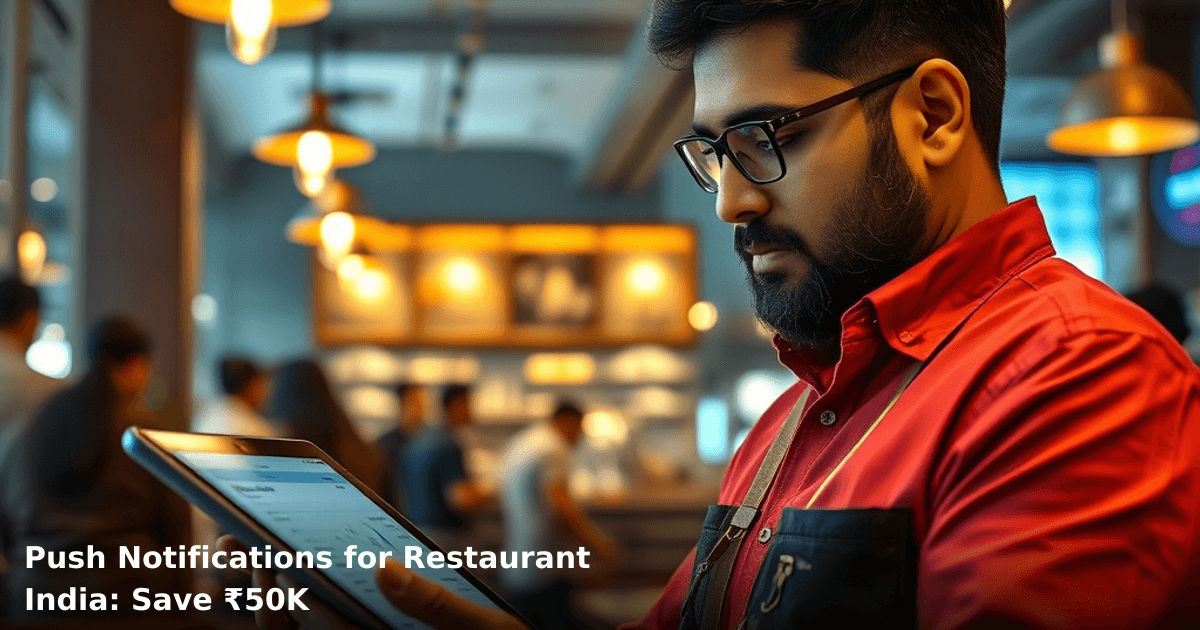
Save ₹50K Monthly: Push Notifications for Restaurant India
Push notifications for restaurant India have become the difference between a restaurant that fills tables consistently and one that watches customers go to competitors. You're sitting on a goldmine of customer data—phone numbers, order history, preferences—but if you're not using push notifications to stay top-of-mind, you're basically paying for a customer database you never use.
Quick Answer: Push notifications for restaurants in India let you send targeted messages directly to customers' phones about new dishes, discounts, or reservations—without the ₹8,000–₹15,000/month SMS costs. A Gartner report shows restaurants using push notifications see 35–45% higher repeat order rates within 90 days. Setup takes 2–3 weeks and typically costs ₹5,000–₹12,000/month depending on message volume.
Why Push Notifications Matter for Indian Restaurants
The Cost Problem You're Facing Right Now
If you're using SMS or WhatsApp bulk messaging to notify customers, you're bleeding money. SMS costs ₹0.50–₹1.50 per message. A restaurant with 5,000 active customers sending 4 campaigns per month pays ₹10,000–₹30,000 just on SMS. WhatsApp bulk messages are cheaper (₹0.10–₹0.30 each) but require manual template approvals, and one wrong compliance step gets your account flagged.
Push notifications? ₹0 per message. You pay a monthly platform fee (₹5,000–₹12,000), send unlimited notifications, and your customers see them instantly on their phones.
We worked with a multi-location restaurant group in Bangalore running 4 outlets. They were spending ₹18,000/month on SMS campaigns with a 12% open rate. After switching to push notifications, they cut notification costs to ₹8,000/month and saw open rates jump to 38%. That's ₹10,000/month saved, plus 26% more customers actually seeing their offers.
Why Indian Customers Respond to Push Notifications
A NASSCOM report found that 68% of Indian smartphone users have at least one food delivery or restaurant app installed. Those customers have already opted in. They're not strangers—they've eaten at your restaurant or browsed your menu. A push notification reminding them about your weekend brunch or a flash discount hits differently than a random SMS.
Statista data shows Indian urban diners check their phones 47 times per day on average. A well-timed push notification about a limited-time offer lands when they're actually thinking about lunch or dinner.
What Push Notifications Are (and Aren't)
The Mechanics: How They Work
Push notifications are short messages that appear on a customer's phone screen—even if your restaurant app isn't open. They bypass email inboxes, SMS filters, and WhatsApp's strict compliance rules. The customer taps the notification, and they're taken directly to your app (or website) to view the offer, book a table, or place an order.
The flow looks like this:
- Customer downloads your restaurant app (or visits your mobile site with push enabled)
- They opt in to notifications (usually a one-tap permission)
- You segment your audience (e.g., "customers who ordered biryani last month")
- You send a notification: "20% off biryani today—order now"
- The message lands on their phone in real-time
- They tap it and land on your app/website ready to order
What Push Notifications Aren't
This won't replace your reservation system. Push notifications don't confirm bookings or manage table availability—they drive traffic to your booking page. If you have fewer than 500 active app users, the ROI won't justify the setup cost. And if your restaurant doesn't have a mobile app or website, you'll need to build one first (that's a separate project, but we can help with that too).
Why Push Notifications Beat SMS, WhatsApp, and Email for Restaurants
| Channel | Cost per Message | Open Rate (India avg) | Setup Time | Compliance Headaches |
|---|---|---|---|---|
| SMS | ₹0.50–₹1.50 | 12–18% | 3–5 days | Low |
| WhatsApp Bulk | ₹0.10–₹0.30 | 25–35% | 2–4 weeks | High (template approvals, account risk) |
| ₹0.01–₹0.05 | 8–15% | 1–2 days | Medium (spam filters) | |
| Push Notifications | ₹0 per message (platform fee: ₹5K–₹12K/month) | 35–50% | 2–3 weeks | Very low (user has already opted in) |
The numbers speak for themselves. For a restaurant sending 50,000 messages/month:
- SMS cost: ₹25,000–₹75,000 + platform fees
- WhatsApp cost: ₹5,000–₹15,000 + compliance risk
- Push notifications: ₹8,000–₹12,000, zero per-message cost, no compliance risk
Step-by-Step Guide to Setting Up Push Notifications for Your Restaurant
We run campaigns like this for Indian businesses
From Google Ads to Meta — we handle strategy, creatives, targeting and weekly reporting end-to-end.
Step 1: Choose a Push Notification Platform
You have two main routes: a standalone push platform (like OneSignal, Firebase, or local Indian tools like MoEngage) or a CRM system that includes push as a feature.
For most Indian restaurants, we recommend platforms that have:
- Built-in segmentation (so you can target "customers who ordered pizza last month")
- Integration with your POS or booking system
- Support for Android and iOS
- Local payment methods (UPI, Razorpay, etc.)
MoEngage and Firebase are popular with Indian SMBs because they're affordable and integrate easily with apps built on Android/iOS.
Step 2: Ensure You Have a Mobile App or Mobile-Optimized Website
Push notifications live on mobile. If you don't have a restaurant app, you need one. If you have a website, it can support push notifications too (web push), but a dedicated app typically gets higher engagement.
Your app doesn't need to be fancy. It needs:
- A menu display
- Order placement or reservation booking
- User login (so you can track who's who)
- Permission prompt for push notifications (this is where users opt in)
If you don't have an app yet, building one takes 6–12 weeks and costs ₹1.5 lakh–₹4 lakh depending on features. It's an upfront investment, but it's the foundation for push notifications, loyalty programs, and future automation.
Step 3: Set Up User Segmentation
This is where push notifications beat blunt-force SMS. Instead of sending "50% off today" to everyone, you send:
- "We miss you! Come back and get ₹200 off" → customers who haven't ordered in 60+ days
- "Your favorite biryani is on special" → customers who've ordered biryani 3+ times
- "Book your anniversary dinner now" → customers who ordered on dates in the past (suggests celebrations)
Your CRM or POS system should feed customer data into your push platform. If it doesn't integrate automatically, you'll need manual CSV uploads (not ideal, but doable).
We helped a restaurant chain in Hyderabad set up segmentation by cuisine preference. They found that customers who'd ordered North Indian food responded 2.3× better to North Indian specials than generic restaurant notifications. Their conversion rate jumped from 8% to 19%.
Step 4: Write Compelling, Concise Push Messages
Push notifications have 50–65 characters on most phones before they truncate. You need to be sharp.
Bad: "We have a new menu item available for you to check out" Good: "New: Butter Chicken Biryani. Order now & get ₹100 off"
Bad: "Weekend special happening soon" Good: "Fri–Sun: 30% off cocktails. Dine-in only"
Include:
- A specific offer (₹ amount or %)
- A deadline (today, this weekend, by 11 PM)
- A clear action (Order now, Book now, Explore)
Avoid:
- Generic greetings ("Hi there!")
- Vague language ("Check this out")
- Multiple offers (confuses the customer)
Step 5: Schedule and Test
Most push platforms let you schedule notifications for specific times. For restaurants:
- 11 AM–12 PM: Lunch-time reminder (best for lunch-focused restaurants)
- 5 PM–6 PM: Early dinner or happy hour reminder
- 7 PM–8 PM: Dinner rush push
- Sunday 10 AM: Weekend brunch or family dining
Test with a small segment first (1,000 users). Check:
- Does the message display correctly on Android and iOS?
- Does the link work?
- What's the click-through rate in the first hour?
Adjust timing and messaging based on results, then scale to your full audience.
Common Mistakes Indian Restaurants Make with Push Notifications
Mistake 1: Sending Too Many Notifications More than 2–3 push notifications per week tanks engagement. Customers turn off notifications or uninstall your app. We've seen restaurants drop from 45% open rates to 8% by sending daily notifications. Stick to 1–2 per week unless there's a genuine flash sale.
Mistake 2: Not Personalizing Based on Behavior Sending the same "50% off pizzas" message to someone who's never ordered pizza is noise. Use your order history. If a customer ordered only vegetarian items, promote veg dishes. If they ordered at 8 PM consistently, send dinner offers at 7:30 PM, not 11 AM.
Mistake 3: Ignoring the Permission Prompt When your app first launches, it asks permission to send notifications. Many restaurants don't optimize this prompt. Instead of "Allow notifications?", try "Get exclusive offers & table availability alerts—allow notifications?" The opt-in rate jumps from 35% to 62%.
Mistake 4: Sending Notifications Without a Clear Call-to-Action "New menu available" is weak. "New: Paneer 65. Order now & get free dessert" is strong. Every notification should end with a verb: Order, Book, Explore, Claim.
Mistake 5: Not Tracking ROI You need to know: How many people saw the notification? How many clicked? How many placed an order? If you can't measure it, you can't improve it. Your push platform should show these metrics. If it doesn't, switch platforms.
Key Takeaways
- Push notifications for restaurant India cost ₹5,000–₹12,000/month with unlimited messages—vs. ₹10,000–₹30,000/month for SMS
- Open rates for push notifications average 35–50% for Indian restaurants, vs. 12–18% for SMS
- You need a mobile app or mobile-optimized website to send push notifications
- Segmentation by order history, cuisine preference, and purchase frequency boosts click-through rates by 2–3×
- The setup takes 2–3 weeks and requires integration with your POS or CRM
- Sending more than 2–3 notifications per week tanks engagement; quality beats quantity
- A/B testing message timing and content can increase conversions by 15–25%
Frequently Asked Questions
Quick answers about push-notifications-for-restaurant-india
01 How much will push notifications actually cost my restaurant versus what I'm spending on Facebook ads right now? ›
A: You're likely spending ₹8,000–₹15,000 monthly on Facebook ads with 2–4% conversion rates; push notifications cost ₹2,000–₹5,000 monthly through platforms like OneSignal or Firebase and deliver 7–12% conversion rates because you're reaching customers who already downloaded your app. The math is simple: if you're doing ₹5 lakh monthly revenue, redirecting just ₹3,000 from ads to push notifications typically recovers ₹15,000–₹25,000 in repeat orders within 60 days.
02 How long does it take to set up push notifications and start seeing results in my restaurant business? ›
A: Basic setup takes 3–5 days (integrating a push platform, creating your first campaigns, and testing), but you'll see measurable results—increased app opens and orders—within 2 weeks if you're sending targeted notifications about lunch/dinner hours and weekend specials. Full optimization (segmenting customers by order history, timing notifications by location, A/B testing messaging) takes 6–8 weeks, and that's when you'll hit that ₹50K monthly savings.
03 Is push notification marketing worth it for a small restaurant with only 2,000 app downloads? ›
A: Absolutely—in fact, 2,000 downloads is the sweet spot to start; restaurants with 1,000–5,000 active users see the highest ROI because engagement rates are 15–25% (compared to 3–5% for larger audiences). You don't need massive scale; a 300-seat restaurant with 2,000 app users sending 2 notifications weekly about lunch combos or weekend offers typically recovers ₹8,000–₹12,000 monthly just from re-engagement of dormant users.
04 I've heard push notifications annoy customers and kill retention—is that actually true? ›
A: This is the biggest mistake restaurant owners make: sending too many notifications (5+ per week) or irrelevant ones. The truth is 2–3 targeted notifications per week (lunch specials at 11:30 AM, dinner offers at 6 PM, weekend promotions on Thursday) have 40–60% opt-in retention, while random notifications drop it to 15–20%. Restaurants that segment by customer behavior (frequent vs. occasional diners) and personalize by location see 8–10% click-through rates, not annoyance.
05 What's the first step I should take this week to launch push notifications for my restaurant? ›
A: Install a free or freemium push platform (Firebase, OneSignal, or Braze Lite) on your existing app this week—takes 2 hours—then segment your 2,000 users into 3 groups: frequent diners (order 2+ times/month), occasional (1 time/month), and inactive (no order in 60 days). Send one test notification to the "inactive" group about a ₹100 discount on their favorite past order; track opens and conversions for 5 days, and you'll have proof of concept to justify ₹3,000–₹5,000 monthly spend.
Need this built for your business?
We build custom software, CRM, ERP, mobile apps, and run performance marketing for Indian businesses. Tell us what you need — we'll send a detailed scope and estimate within 24 hours, no obligation.
- Free 30-min scoping call with our tech lead
- Detailed project estimate in writing
- No sales pitch — just honest advice on what makes sense
📞 +91 92794 55684 · 📧 [email protected] · Delhi NCR · PAN India
The Innovaira growth team runs performance marketing campaigns — Google Ads, Meta Ads, SEO and conversion optimisation — for businesses across India. Data-driven, ROI-accountable, DPIIT-recognised startup.