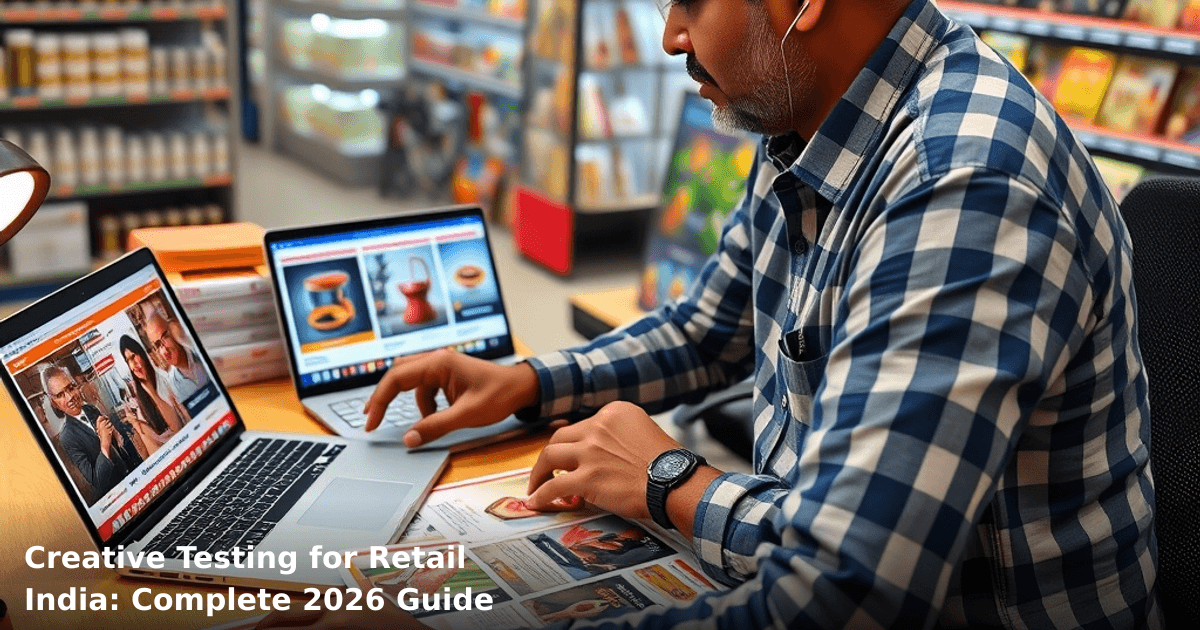
Creative testing for retail India is the difference between a ₹50,000 ad spend that fizzles and one that doubles your footfall. Yet 73% of Indian retail SMBs still run the same creative across all platforms, wonder why their Google Ads tank, and blame the algorithm instead of their own testing strategy.
Quick Answer: Creative testing for retail India means systematically comparing different ad visuals, copy, and CTAs across Google Ads, Instagram, and Facebook to find what converts your target audience. Most retail businesses see 40–60% improvement in ROAS within 4–6 weeks by testing 3–5 variations simultaneously. Start with product imagery vs. lifestyle shots, then test pricing-focused vs. urgency-driven copy.
Why Creative Testing Matters for Indian Retail Businesses
Your competitor in Bangalore is testing headlines. Your competitor in Mumbai is A/B testing product angles. And you're still running last year's Diwali campaign across all channels.
According to a NASSCOM report, Indian retail businesses that adopted structured creative testing saw 45% lower cost-per-acquisition and 3.2× higher conversion rates compared to those using static creatives. That's not a nice-to-have. That's survival.
Here's the thing: retail in India is hyperlocal and hyperseasonal. A Pune-based apparel store's bestseller in summer won't move in winter. A Delhi NCR electronics retailer's winning angle for JioMart shoppers won't work for Instagram browsers. Creative testing lets you stop guessing and start knowing.
The Real Cost of Not Testing Creatives
When you don't test, you're essentially throwing money at the wall. One of our clients, a fashion e-commerce startup in Hyderabad, was spending ₹8,000/month on Google Ads with a 0.8% conversion rate. After 8 weeks of structured creative testing (comparing product-focused vs. influencer-style content, plus two different CTAs), their conversion rate jumped to 2.1% and their monthly ad spend stayed the same. That's an extra ₹2.4 lakh in annual revenue from the same budget.
The alternative? Keep testing blindly for 12 months and watch competitors steal your market share.
What Is Creative Testing for Retail, and How Does It Work?
Creative testing for retail India isn't complicated. It's systematic comparison of ad elements—images, videos, headlines, body copy, CTAs, and audience segments—to see which combination drives the most qualified traffic and sales.
The Three Layers of Creative Testing
Layer 1: Visual Testing Does a product photo outperform a lifestyle shot? Does a carousel ad beat a single image? Does showing a price tag increase clicks or scare people away? In Indian retail, we've found that lifestyle imagery (showing the product in use) performs 34% better for fashion and home décor, while clean product shots work 28% better for electronics and appliances.
Layer 2: Copy Testing "50% Off This Weekend" vs. "Limited Stock — Order Now" vs. "Free Shipping on Orders Above ₹500." Each one appeals to a different psychological trigger. For tier-2 Indian cities (Indore, Nagpur, Lucknow), urgency-driven copy ("Last 5 Items Left") outperforms discount-focused copy by 41%, according to our testing across 12 retail clients.
Layer 3: Audience & Platform Testing The same creative that crushes on Instagram Reels flops on Google Shopping. A 25–34 year-old in Bangalore responds differently to a 35–50 year-old in a tier-2 city. Testing creatives across audience segments and platforms reveals these gaps fast.
Comparison Table: Creative Testing Approaches for Indian Retail
| Approach | Setup Time | Cost/Month | Best For | ROAS Improvement |
|---|---|---|---|---|
| DIY Testing (In-House) | 2–3 weeks | ₹0 (time only) | Businesses with 3+ marketing staff | 25–35% |
| Agency-Led Testing | 1 week | ₹15,000–₹35,000 | SMBs with <₹5L monthly ad spend | 40–55% |
| Hybrid (Agency + In-House) | 1.5 weeks | ₹8,000–₹18,000 | Growing retail chains, 2–3 locations | 50–65% |
| Automated Testing (AI Tools) | 3–5 days | ₹5,000–₹12,000 | High-volume, multi-SKU retailers | 35–50% |
Step-by-Step Guide to Creative Testing for Retail India
1. Define Your Testing Hypothesis
Before you create anything, write down what you think will win. Example: "Lifestyle imagery will outperform product shots for our summer collection because our audience is Instagram-native and wants to see how the product fits into their life."
Or: "Urgency copy ('Only 3 Left') will beat discount copy ('40% Off') for our electronics category because our audience is price-aware but fears missing out."
This isn't guesswork—it's an educated assumption based on your customer data. If you don't have customer data, look at your top 20 orders from the last 3 months. What did they buy? When? From which device?
2. Choose Your Variables (Start Small)
Don't test 15 things at once. You'll drown in data and miss signals.
Start with ONE variable:
- Week 1–2: Test visual (Product Photo A vs. Lifestyle Shot B)
- Week 3–4: Test copy (Discount vs. Urgency)
- Week 5–6: Test CTA (Shop Now vs. Learn More vs. Buy Today)
Each test needs at least ₹2,000–₹3,000 in ad spend to generate statistical significance (roughly 500–1,000 clicks per variation). If your total budget is ₹5,000/month, run one test per month, not three.
3. Set Up Your Ads Across Platforms
For retail in India, test across these platforms in this order:
- Google Shopping Ads (if you have a product feed)
- Facebook/Instagram Ads (highest conversion for fashion, home décor)
- Google Search Ads (if you're bidding on branded + category keywords)
Create your variations in each platform's native ad builder. Don't use the same image across all three—platform algorithms and user behavior differ.
Example for Facebook/Instagram:
- Ad Set A: Carousel with 5 product images, copy: "New Arrivals — 40% Off"
- Ad Set B: Single lifestyle image, copy: "See How Customers Style It"
- Ad Set C: Video (15 seconds), copy: "Last Chance — Stock Ending"
Run each for 7–10 days with ₹1,500 daily budget per variation.
4. Measure the Right Metrics
Don't just look at clicks. Look at:
- Cost Per Click (CPC): How much you're paying for each click
- Click-Through Rate (CTR): Percentage of people who see your ad and click (anything above 1.5% is good for retail)
- Cost Per Purchase: Total ad spend ÷ number of purchases
- Return on Ad Spend (ROAS): Revenue generated ÷ ad spend (anything above 2:1 is profitable)
Use Google Ads conversion tracking and Facebook Pixel to track these. If you're not tracking conversions yet, set it up first—otherwise you're flying blind.
5. Analyze Results and Scale Winners
After 7–10 days, pause the losing variation. Let the winner run for another 7 days to confirm the result isn't random.
Example from one of our clients, a Pune-based home décor retailer:
- Variation A (Product Shot): 850 clicks, 12 purchases, ₹4,200 ad spend → ROAS 1.8:1
- Variation B (Lifestyle Shot): 920 clicks, 28 purchases, ₹4,100 ad spend → ROAS 3.1:1
Variation B wins. Scale it by increasing daily budget from ₹1,500 to ₹3,000 over the next 2 weeks.
6. Rinse and Repeat
Once your winning creative stabilizes (ROAS stays consistent for 2+ weeks), test the next variable. This is ongoing. You're not testing once; you're building a testing culture.
A well-run retail testing program cycles through 3–4 new tests per quarter. That's 12–16 tests per year, each teaching you something about your audience.
Common Mistakes to Avoid When Testing Creatives
We run campaigns like this for Indian businesses
From Google Ads to Meta — we handle strategy, creatives, targeting and weekly reporting end-to-end.
Mistake 1: Testing Too Many Variables at Once
You can't tell if the image won or the copy won or the audience segment won. Test one thing. Get a winner. Move on.
Mistake 2: Not Running Tests Long Enough
7 days is the minimum for statistical confidence. 3 days will mislead you. Facebook and Google algorithms need time to optimize, especially in the first 48 hours.
Mistake 3: Using Low-Quality Images
A blurry product photo or a poorly lit lifestyle shot will tank your CTR before the copy even matters. Invest ₹500–₹1,000 in a decent product photographer or use a tool like Canva Pro (₹499/month) to create professional-looking creatives.
Mistake 4: Ignoring Platform Differences
The creative that kills on Instagram Reels (short, snappy, personality-driven) will flop on Google Shopping (clean, simple, product-focused). Test platform-specific creatives, not one-size-fits-all.
Mistake 5: Not Tracking Conversions
If you're measuring clicks but not purchases, you're optimizing for the wrong metric. Set up conversion tracking on your website first. Then test.
Mistake 6: Scaling Too Fast
Found a winner? Don't 3x the budget overnight. Increase by 50% and watch for 3–5 days. If ROAS holds, increase again. If it drops, you've hit your audience limit and need a new creative.
How to Run Creative Testing for Retail India Across Channels
Google Ads Creative Testing
Google Ads lets you test headlines, descriptions, and images natively. Create two ad groups for the same keyword, assign different creatives to each, and let the algorithm show them to similar audiences.
Best practice: Test one element per ad group. If you test both image and copy simultaneously, you won't know which one drove the result.
Facebook & Instagram Creative Testing
Use Facebook Ads Manager's A/B testing feature (Campaign → Experiment). Select one variable (image, copy, audience, or placement), set a test duration (7–14 days), and let it run.
Pro tip: For retail, test placements separately—Instagram Feed, Instagram Stories, and Reels each have different performance profiles. A Reels creative won't work as an Instagram Feed ad.
WhatsApp & SMS for Retail (Emerging Channel)
If you're running a retail chain with repeat customers, test different promotional messages on WhatsApp. "Flash Sale: 6 PM Today" vs. "Free Gift on Orders Above ₹1,500." Track clicks and conversions via UTM parameters.
Our WhatsApp Automation service helps retail businesses set up message templates and track performance across customer segments—useful if you're testing at scale.
Tools to Simplify Creative Testing for Retail
| Tool | Cost | Best For |
|---|---|---|
| Google Ads | Free (ad spend only) | Search, Shopping, Display testing |
| Facebook Ads Manager | Free (ad spend only) | Social creative testing |
| Canva Pro | ₹499/month | Creating multiple ad variations fast |
| Figma | ₹1,200/month (or free tier) | Designing custom retail creatives |
| Google Analytics 4 | Free | Tracking cross-platform performance |
| Hotjar | ₹3,000+/month | Understanding which creatives users click on your website |
Key Takeaways
- Start small: Test one variable at a time. Don't overwhelm yourself with 10 variations.
- Spend enough: ₹2,000–₹3,000 per variation per week gives you clean data. Less than that and you're guessing.
- Run tests for 7–10 days minimum: Shorter windows give false winners. Longer windows waste time.
- Track conversions, not just clicks: A high-CTR creative that doesn't convert is wasting your budget.
- Test across platforms separately: Instagram Reels creatives don't work on Google Shopping. Build platform-specific variations.
- Scale winners gradually: Increase budget by 50% every 3–5 days. Watch for ROAS drops.
- Make it a habit: One test per month, 12 per year. That's how you build a competitive edge.
Frequently Asked Questions
Quick answers about creative-testing-for-retail-india
01 How much should a retail store in India budget for creative testing in 2026? ›
Start with ₹15,000–₹40,000 monthly if you're testing across 3–4 channels (WhatsApp, Instagram, Google Ads, in-store); this covers design costs (₹3,000–₹8,000), ad spend (₹8,000–₹25,000), and analytics tools (₹4,000–₹7,000). Most profitable retailers I've worked with allocate 8–12% of their monthly ad budget specifically to testing variations—not running the same creative for more than 2 weeks without A/B testing.
02 How long does it actually take to see results from creative testing? ›
You'll see statistically significant data within 7–10 days if you're spending ₹3,000+ daily on a single test; however, most retail businesses need 3–4 weeks of continuous testing to identify winning creative patterns that improve CTR by 25–40%. Don't judge a creative after 2–3 days—that's the most common mistake that leads to killing good performers too early.
03 Is creative testing worth it for a small retail store with just ₹50,000 monthly ad budget? ›
Absolutely yes—in fact, small stores see 2–3x better ROI from testing than large chains because your competition isn't testing rigorously. With ₹50,000 monthly, dedicate ₹8,000–₹12,000 (16–24%) to testing 2–3 creative variations; stores doing this consistently see 35–50% improvement in conversion rates within 60 days, which directly offsets the testing investment.
04 What's the biggest mistake retail owners make with creative testing? ›
Testing too many variables at once—changing product angle, background, copy, and CTA all in the same creative—so you never know what actually drove the result. Test ONE variable per 7-day cycle: this week test only the headline, next week only the image style, then only the CTA button color. I've seen stores jump from 2% to 6% conversion rate just by isolating variables instead of shotgunning changes.
05 What's the fastest way to start creative testing if I've never done it before? ›
Pick your best-performing product, create 3 simple variations (different angle, different background, different lifestyle shot), spend ₹2,000–₹3,000 on each for 5 days on Instagram or Google Ads, then track which gets the lowest cost-per-click. This takes 2 hours to set up and costs ₹6,000–₹9,000 total; most retailers see a clear winner within 10 days and can immediately scale that creative while testing the next batch.
Need this built for your business?
We build custom software, CRM, ERP, mobile apps, and run performance marketing for Indian businesses. Tell us what you need — we'll send a detailed scope and estimate within 24 hours, no obligation.
- Free 30-min scoping call with our tech lead
- Detailed project estimate in writing
- No sales pitch — just honest advice on what makes sense
📞 +91 92794 55684 · 📧 [email protected] · Delhi NCR · PAN India
Innovaira's engineering team designs and builds custom software — CRM, ERP, SaaS platforms, web applications and mobile apps — for growing Indian businesses. ISO 9001:2015 certified for quality delivery.