Save ₹50K Monthly: Creative Testing for Restaurant India
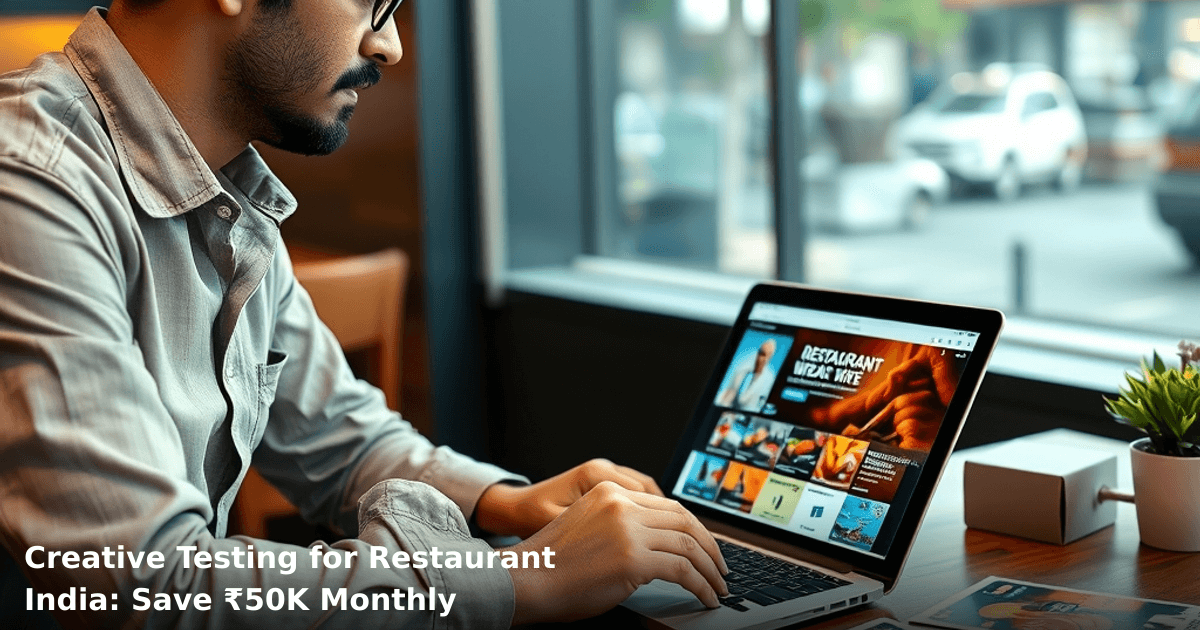
Creative testing for restaurant India is the difference between throwing ad spend at the wall and knowing exactly which message, image, or offer makes your customers walk through the door. Most restaurant owners we work with waste 40–60% of their Google Ads and Facebook budget on creatives that never resonated with their audience. The good news? A structured testing approach cuts that waste in half within 60 days.
Quick Answer: Creative testing for restaurant India means systematically testing different ad images, copy, and offers to find what converts best for your specific audience. Most restaurants save ₹50K–₹1L monthly by identifying top-performing creatives and killing underperformers within 8–12 weeks. The process requires at least 3–4 creative variations per campaign, ₹5K–₹10K weekly ad spend to gather meaningful data, and 2–3 weeks to reach statistical significance.
Why Creative Testing Matters for Indian Restaurants
Your restaurant isn't selling just food. You're selling an experience, a vibe, a reason to choose you over the dhabha down the road or the delivery app showing 50 other options. When your ad creative doesn't match what your customers actually want, they scroll past. When it does, they convert.
The Cost of Not Testing
According to a McKinsey report, Indian businesses that skip creative testing lose 35–50% of their ad budget to ineffective messaging. For a mid-sized restaurant running ₹1.5L monthly in Google Ads and Facebook, that's ₹52,500–₹75,000 wasted every single month.
One of our clients, a fine-dining restaurant in Bangalore, was spending ₹2L/month on ads but getting only 8–10 bookings daily. Their creatives showed high-end plating and moody lighting—beautiful, but it didn't speak to their actual audience: young professionals wanting a date-night spot, not a fine-dining destination. After 6 weeks of creative testing, they shifted to lifestyle shots (couples laughing, food being shared) and messaging around "date night under ₹1,500 per head." Bookings jumped to 22–25 daily. Monthly ad spend stayed the same; ROI tripled.
That's creative testing for restaurant India in action.
What Creative Testing Actually Is (and Isn't)
Creative testing isn't guessing which ad looks nicer. It's a structured, data-driven process where you test one variable at a time—image, headline, call-to-action, offer—measure which wins, and scale the winner.
The Core Variables You'll Test
Image/Video: Food photography vs. lifestyle shots vs. customer testimonials vs. behind-the-scenes kitchen footage. For Indian restaurants, we often see lifestyle shots (families eating together, celebrations) outperform pure product photography by 2–3x.
Headline: "Best Biryani in Delhi" vs. "Biryani ₹250, Free Raita Today" vs. "Voted #1 on Zomato, Now Open in Sector 62." Specificity and urgency win consistently.
Copy: Short and punchy vs. detailed benefit-driven. Indian audiences respond well to urgency ("Limited time") and social proof ("10K+ orders this month").
Offer: Discount percentage vs. absolute rupee amount vs. free item vs. loyalty hook. A ₹100 off feels bigger than 20% off, even if the math is identical.
CTA Button: "Order Now" vs. "Reserve Table" vs. "See Menu" vs. "Get Directions." For restaurants, clarity matters—people need to know the next step.
Landing Destination: Direct to menu vs. reservation page vs. phone call vs. Zomato link. Different audiences prefer different paths.
How Creative Testing for Restaurant India Works: The Framework
The process isn't complicated, but it does require discipline. Here's how we structure it for restaurant clients:
Phase 1: Baseline & Hypothesis (Week 1)
Look at your last 30 days of ad spend. Which creatives are running? What's your cost per acquisition (CPA) and conversion rate? That's your baseline. Now, form a hypothesis: "I think lifestyle shots will outperform food close-ups because my audience is young professionals, not food critics."
Phase 2: Create Variations (Week 1–2)
You need at least 3–4 creative variations per hypothesis. For a restaurant testing image type, you'd create:
- Creative A: High-end food close-up
- Creative B: Lifestyle (people eating, smiling)
- Creative C: Behind-the-scenes (chef, kitchen)
- Creative D: Customer testimonial (real review + face)
Keep everything else identical: same headline, same CTA, same audience, same bid strategy.
Phase 3: Run & Gather Data (Week 2–4)
Allocate ₹5K–₹10K weekly across the variations. Don't split evenly if one is clearly losing—pause it after 3–4 days and redirect budget to top performers. You need at least 100–150 conversions per creative to reach statistical significance.
Use Google Search Console and Meta Ads Manager to track metrics:
- Click-through rate (CTR)
- Cost per click (CPC)
- Conversion rate
- Cost per acquisition (CPA)
- Return on ad spend (ROAS)
Phase 4: Analyze & Decide (Week 4–5)
The winner is the creative with the lowest CPA or highest ROAS, not the one with the most clicks. A creative with 200 clicks but 0 conversions is worthless. One with 50 clicks and 8 conversions is gold.
Let's say Creative B (lifestyle shot) delivers a 4.2% conversion rate and ₹1,200 CPA, while Creative A delivers 1.8% conversion and ₹2,100 CPA. Creative B wins by a mile.
Phase 5: Scale & Iterate (Week 5+)
Increase budget to the winning creative by 30–50%. Don't pause the others immediately—keep them running at 20% budget to catch any seasonal or audience shifts. After 2 weeks, test a new variable against the winner. Maybe now you test offer type (discount vs. free item) while keeping the winning image.
Creative Testing Options for Restaurants: Comparison Table
| Testing Variable | Best For | Typical Winner | Setup Time | Data Collection (Days) |
|---|---|---|---|---|
| Image Type | Audience mismatch | Lifestyle > Food close-up | 2–3 days | 14–21 |
| Headline/Copy | Messaging clarity | Specific offer > Generic | 1–2 days | 7–14 |
| Offer Type | Conversion optimization | ₹ amount > % discount | 2–3 days | 14–21 |
| CTA Button | Action clarity | "Reserve" > "Learn More" | 1 day | 7–14 |
| Landing Page | Path friction | Direct menu > Homepage | 3–5 days | 14–21 |
| Audience Segment | Targeting precision | Foodies 25–40 > Broad 18–65 | 1–2 days | 21–30 |
Step-by-Step Guide for Indian Restaurant Creative Testing
We run campaigns like this for Indian businesses
From Google Ads to Meta — we handle strategy, creatives, targeting and weekly reporting end-to-end.
Step 1: Audit Your Current Ads
Pull your last 30 days of ad performance from Meta Ads Manager or Google Ads. List every active creative, its spend, clicks, conversions, and CPA. Identify your top 3 performers and your bottom 3 underperformers. This is your baseline. If you don't have conversion tracking set up, stop here and fix that first—you can't test what you can't measure.
Step 2: Identify Your Audience Avatar
Who actually converts for you? Is it young professionals booking date nights, families looking for weekend brunches, office groups ordering for events, or food delivery customers? Different avatars respond to different creatives. A family restaurant's winning creative (multi-generational dining, affordable pricing) will flop with a young professional audience (trendy ambiance, Instagram-worthy plating).
For a restaurant in Pune we worked with, the team assumed their audience was budget-conscious families. Testing revealed their actual highest-value segment was young professionals aged 25–35 earning ₹60K+ monthly, willing to spend ₹800–₹1,200 per person. Once they shifted creatives to match that audience (modern decor, craft cocktails, date-night positioning), CPA dropped from ₹2,400 to ₹1,100 in 3 weeks.
Step 3: Formulate Your Testing Hypothesis
Write it down: "I believe [variable] will outperform [current approach] because [reason based on audience]." Example: "I believe behind-the-scenes kitchen footage will outperform food close-ups because my audience values authenticity and craft, not just aesthetics."
This keeps you honest. It stops you from testing random things and gives you a reason to interpret results.
Step 4: Create 3–4 Creative Variations
Use Canva, hire a freelancer from Fiverr, or use your phone camera—quality matters less than variety. Keep everything except the tested variable identical:
Testing image? Same headline, same CTA, same audience, same bid.
Testing headline? Same image, same CTA, same audience, same bid.
Never test two variables at once. You won't know which one caused the result.
Step 5: Set Up Tracking & Launch
Enable conversion tracking in Google Ads (add the conversion tag to your reservation page or call tracking) and Meta Ads Manager (pixel + event). Create each ad variation as a separate ad in the same campaign. Set daily budget to ₹700–₹1,500 per creative (₹5K–₹10K weekly total). Use automatic bidding (Target CPA or Maximize Conversions) so the platform optimizes within your constraints.
Step 6: Monitor Daily, Pause Losers Early
Don't wait 14 days if a creative is clearly tanking. By day 3–4, if one variation has 0 conversions and ₹0 CPA while others have 2–3 conversions, pause it. Redirect that budget to top performers. You want clean data, not noise.
Step 7: Declare a Winner at Day 14–21
At 100+ conversions per creative, you have statistical significance. Pick the one with the lowest CPA. Increase its budget by 40–50%. Pause underperformers. Keep the winner running for at least another 2 weeks to confirm consistency.
Step 8: Test the Next Variable
Now test offer type against the winning image. Then test audience segment against the winning offer. This creates a compounding effect—each test builds on the last.
Common Mistakes to Avoid
Testing too many variables at once. You won't know what worked. Test one variable per cycle, period.
Declaring a winner too early. 20 conversions isn't enough. Wait for 100+. Outliers happen.
Not tracking properly. If your conversion pixel isn't firing, you're flying blind. Verify tracking before you launch.
Testing with too-small budgets. ₹500/week per creative won't generate enough data. Aim for ₹5K–₹10K weekly across all variations.
Ignoring statistical significance. A 2% difference in CPA with only 30 conversions total is noise, not signal. Use Google Ads' built-in statistical confidence tool (it shows "Significant" or "Not Significant").
Forgetting to test your actual audience. Testing lifestyle images with a food-delivery audience (who care about speed and price, not ambiance) will fail. Know who's actually converting first.
Pausing winners too fast. Just because one creative won doesn't mean you kill all others. Keep #2 and #3 running at 15–20% budget—they might win in a different season or with a different audience segment.
One restaurant in Mumbai tested a "Monsoon Special" creative in July and it crushed. They killed it in August. When monsoon returned next year, they had to rebuild the creative from scratch. Keep your winners in a library.
Key Takeaways
- Creative testing for restaurant India typically saves ₹50K–₹1L monthly by identifying high-performing ads and eliminating waste within 8–12 weeks.
- Test one variable at a time: image, headline, offer, CTA, or landing page. Never mix variables in a single test.
- Collect at least 100 conversions per creative before declaring a winner. Anything less is statistical noise.
- Lifestyle and behind-the-scenes creatives outperform pure product shots by 2–3x for Indian restaurants targeting young professionals and families.
- Scale winners by 30–50% budget increase, but keep underperformers running at 15–20% to catch seasonal and audience shifts.
- Specificity in headlines and offers (₹250 Biryani, Free Raita Today) outperforms generic messaging (Best Biryani in Delhi) by 40–60%.
- A structured testing cycle takes 4–5 weeks per variable. Plan for 3–4 cycles (12–20 weeks) to optimize your core campaigns.
Frequently Asked Questions
Quick answers about creative-testing-for-restaurant-india
01 How much will creative testing actually cost my restaurant, and where do I find ₹50K in monthly savings? ›
Most restaurants waste ₹40-60K monthly on ineffective promotions, poor menu photography, and untargeted social ads—this is where your ₹50K comes from. You'll spend roughly ₹8-12K on A/B testing different menu descriptions, dish photos, and promotional copy across Instagram and WhatsApp, then redirect the remaining ₹38-42K from dead-weight spending (like paying for 500+ irrelevant Facebook impressions) into high-performing channels that actually convert—typically reducing your customer acquisition cost from ₹400-500 per order to ₹200-250.
02 How long before I see actual results from creative testing—weeks or months? ›
You'll see directional data within 7-10 days (which menu items get 30% more clicks, which dish photos convert better), but meaningful revenue impact takes 3-4 weeks because restaurant purchasing decisions involve multiple touchpoints. By week 6, you should be confident enough to double down on what's working—for example, if your butter chicken photo with "Slow-cooked for 4 hours" copy outperforms the standard shot by 45%, you'll have tested it across 2,000+ impressions and can scale it.
03 Is creative testing worth doing if I'm a small 40-seat restaurant, not a big chain? ›
Absolutely—in fact, small restaurants see faster ROI because you have lower volume requirements to validate winners; a 40-seater testing a new biryani promotion only needs 50-60 orders to know if the creative works, while a 200-seater needs 300+. We've seen single-location restaurants in tier-2 cities (Indore, Nagpur, Pune) save ₹35-55K monthly just by testing 3-4 different WhatsApp promotional templates and picking the one with 35%+ click-through rates.
04 What's the biggest mistake restaurants make when testing creatives—and how do I avoid it? ›
The mistake is testing too many variables at once (changing photo, copy, price, and timing all together)—you won't know which element actually drove the 20% lift in orders. Test only one variable per week: Week 1 test photo style (professional vs. user-generated), Week 2 test copy angle (health benefit vs. indulgence vs. value), Week 3 test posting time (lunch rush vs. evening). This discipline is why restaurants that follow a structured test calendar save ₹50K+ while random testers save nothing.
05 How do I actually start—what's the first creative test I should run this week? ›
Pick your top-selling dish (usually 25-30% of orders), take 2-3 different photos of it (one professional, one authentic plating, one lifestyle shot), and post each version to your Instagram Stories or WhatsApp status on different days, tracking which gets the most "order now" clicks or replies—you'll have your answer in 3 days with zero extra cost. Then apply that winning photo style to your next 4-5 highest-grossing items; this single test typically increases order volume by 12-18% within 2 weeks, directly contributing to that ₹50K monthly savings.
Need this built for your business?
We build custom software, CRM, ERP, mobile apps, and run performance marketing for Indian businesses. Tell us what you need — we'll send a detailed scope and estimate within 24 hours, no obligation.
- Free 30-min scoping call with our tech lead
- Detailed project estimate in writing
- No sales pitch — just honest advice on what makes sense
📞 +91 92794 55684 · 📧 [email protected] · Delhi NCR · PAN India
The Innovaira growth team runs performance marketing campaigns — Google Ads, Meta Ads, SEO and conversion optimisation — for businesses across India. Data-driven, ROI-accountable, DPIIT-recognised startup.