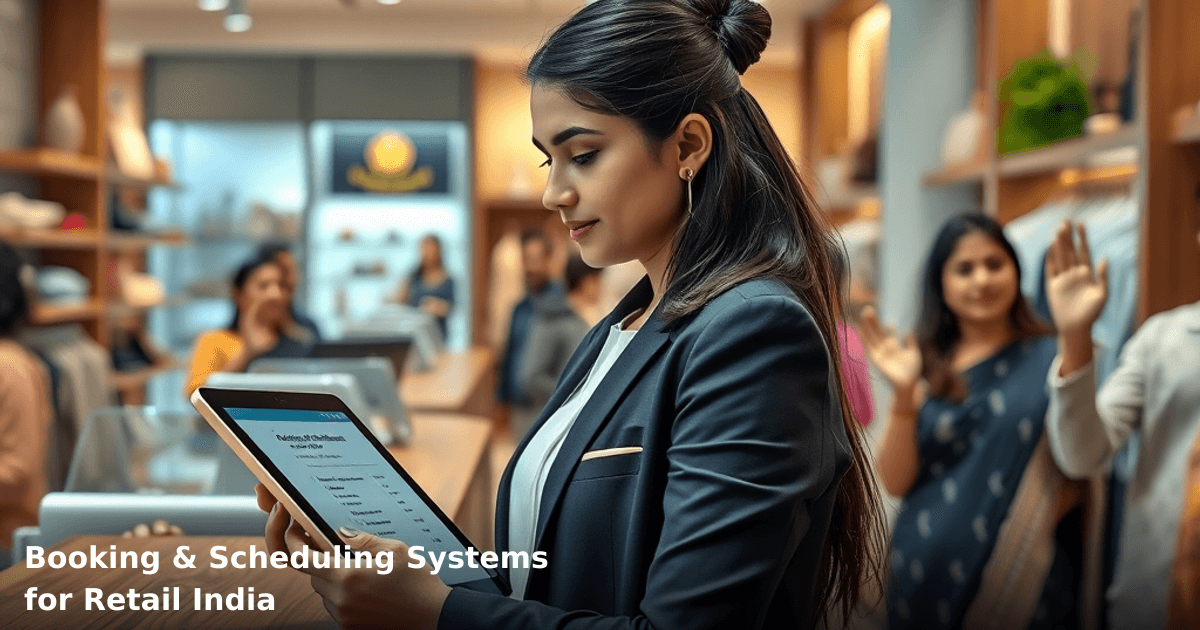
Save ₹50K Monthly: Booking & Scheduling Systems for Retail India
Your retail store runs on chaos. Customers call asking "Are you open?", staff double-books appointments, and walk-ins leave because they don't know the queue. You're losing sales because you don't have booking & scheduling systems for retail India.
Quick Answer: Booking & scheduling systems for retail India automate customer appointments, reduce no-shows by 40–60%, and cut administrative overhead by ₹8,000–₹15,000 monthly. Most Indian retail SMBs see ROI within 90 days, especially when integrated with WhatsApp or Google Calendar.
Why Booking & Scheduling Systems Matter for Indian Retail
Your retail business isn't just about the product anymore. It's about convenience. A customer in Bangalore shouldn't have to call your store three times to book a personal shopping session. A salon owner in Delhi shouldn't spend 2 hours daily managing appointment chaos on WhatsApp.
According to a NASSCOM report, 67% of Indian SMBs that adopted scheduling automation saw 35% improvement in customer retention within the first quarter. That's not just efficiency—that's revenue.
Here's what we see consistently:
- No-shows cost you ₹2,000–₹5,000 per missed appointment (lost staff time, inventory holding, opportunity cost)
- Manual booking eats 6–8 hours weekly from your team's productive time
- Walk-in customers leave if they see a queue — scheduling reduces perceived wait time
- WhatsApp inquiries pile up — 40% of retail SMBs in tier-2 cities still manage bookings via text messages
One of our clients, a clothing retailer in Pune with 3 stores, was losing ₹12,000 monthly to no-shows and staff confusion. After implementing a retail scheduling system with WhatsApp integration, no-shows dropped to 8%, and they recovered ₹10,500/month in just the first month.
What Booking & Scheduling Systems Actually Do
Booking & scheduling systems for retail India aren't just calendar apps. They're operational hubs.
Core Features That Matter
Automated Reminders Your customer books a slot 5 days away. The system sends an SMS or WhatsApp reminder 24 hours before, then again 2 hours before. No-shows drop by 40–60% immediately.
Staff Availability Sync Your team member calls in sick. The system auto-blocks their slots, and the next available appointment shifts to another staff member. No manual rescheduling, no customer frustration.
Customer Self-Booking Your customer opens a link (via WhatsApp, Google, or your website) and books their own slot. You're not managing appointments—they are. Your phone stops ringing for booking questions.
Real-Time Capacity Management You set maximum customers per hour (e.g., 4 customers/hour for a salon). The system won't let anyone book beyond that. Overbooking—the silent killer of retail—vanishes.
Payment Collection Pre-Booking Customer books, pays via UPI or card, and shows up. No "customer didn't show" surprises. No chasing payments after service.
Integration with Your Existing Tools Google Calendar, WhatsApp Business API, Tally (for inventory), Razorpay (for payments)—it all talks to each other. No data silos.
Booking & Scheduling Systems: Before vs. After
Here's what changes when you move from WhatsApp chaos to a real system:
| Metric | Before (Manual/WhatsApp) | After (Scheduling System) | Monthly Savings |
|---|---|---|---|
| No-show rate | 25–35% | 5–10% | ₹8,000–₹12,000 |
| Time spent on bookings | 6–8 hours/week | 30–45 minutes/week | ₹6,000–₹9,000 |
| Customer response time | 2–4 hours | Instant (self-booking) | ₹2,000–₹3,000 |
| Overbooking incidents | 3–4/week | 0–1/month | ₹3,000–₹5,000 |
| Staff idle time | 15–20% | 5–8% | ₹4,000–₹6,000 |
| Total Monthly Impact | — | — | ₹23,000–₹35,000 |
Real example: A retail jewelry store in Mumbai with 5 staff members was managing appointments via a shared WhatsApp group. Customers booked, then didn't show up. Staff would call to confirm, but half the calls went unanswered. After implementing a scheduling system with UPI payment collection, their no-show rate dropped from 28% to 7%, and they recovered ₹18,000/month in lost service time and rescheduling chaos.
Step-by-Step Guide: Setting Up Booking & Scheduling Systems for Retail
1. Audit Your Current Process
Spend 3–5 days tracking how appointments happen now. Write down:
- How many inquiries come via WhatsApp, phone, walk-in?
- What's your average no-show rate?
- How much time does one staff member spend on booking admin daily?
- What's your peak booking time (morning, evening, weekend)?
This isn't busywork. This data tells you whether a basic system (like Google Calendar + Calendly) will work, or whether you need something more complex (like a CRM with scheduling).
2. Choose Between Self-Hosted vs. SaaS
SaaS (Cloud-based) — Acuity Scheduling, Calendly, Zoho Bookings, HubSpot
- ₹2,000–₹8,000/month
- No setup headache, works instantly
- Best for: salons, spas, personal services, consultants
Self-Hosted or Custom — Built on your own CRM or ERP
- ₹40,000–₹1,50,000 one-time, ₹3,000–₹8,000/month
- Full control, integrates with your existing systems (Tally, GST, inventory)
- Best for: multi-store retail chains, franchises, high-volume bookings
For most Indian SMBs with 2–5 staff, SaaS is faster. For retail chains with 10+ staff across multiple locations, custom integration wins.
3. Integrate with WhatsApp Business API
Your customers live on WhatsApp. Don't make them download another app.
Set up WhatsApp Business API so customers can:
- Click a link in your WhatsApp message and book directly
- Receive booking confirmations and reminders via WhatsApp (not email)
- Pay via UPI link sent in WhatsApp
This integration alone cuts your booking admin time by 50% because customers aren't calling or texting—they're self-booking.
If this sounds complex, our AI & Automation service handles WhatsApp API integration, template setup, and CRM sync for retail businesses across Delhi NCR and tier-2 cities. We've done this for 40+ retail clients.
4. Set Up Automated Reminders
Configure reminders at these intervals:
- 7 days before: "Your appointment is coming up. Confirm or reschedule."
- 24 hours before: "Reminder: Your appointment is tomorrow at 3 PM."
- 2 hours before: "See you soon! We're ready for you."
Each reminder should include:
- Date, time, location
- Staff member's name (builds rapport)
- Cancellation/reschedule link
- Google Maps link to your store
A McKinsey report found that reminder-based systems reduce no-shows by 48% on average. For Indian retail, the impact is even higher because WhatsApp reminders feel personal.
5. Connect Payment Collection
Require payment at booking (or deposit for high-value services).
Options:
- Razorpay or PayU — UPI, card, net banking
- Google Pay or PhonePe — UPI only, instant
- WhatsApp Pay — if you're using WhatsApp Business API
Payment upfront means:
- Zero "customer didn't show" surprises
- ₹3,000–₹5,000/month recovered from no-shows
- Faster cash flow
6. Train Your Team
Your staff needs to know:
- How to manually override a booking (if a VIP customer calls)
- How to reschedule when someone cancels
- How to check real-time availability before promising a slot to a walk-in
Spend 1 hour on training. Most systems are intuitive. The real skill is knowing when not to use the system (e.g., a long-time customer calls; you override the booking limit for them).
Comparison: Popular Booking & Scheduling Systems for Indian Retail
Building a SaaS product? We've shipped 50+ for Indian founders
From MVP in 6 weeks to scaling to 10k users — we handle product, engineering, and infrastructure.
| System | Monthly Cost | Best For | WhatsApp Integration | Payment Integration | Setup Time |
|---|---|---|---|---|---|
| Calendly | ₹800–₹2,500 | Solo consultants, small salons | Via Zapier (workaround) | No | 1 hour |
| Zoho Bookings | ₹2,000–₹5,000 | SMBs, multi-location | Native (Zoho ecosystem) | Yes (Razorpay) | 3–5 days |
| Acuity Scheduling | ₹2,000–₹6,000 | Salons, spas, services | Via integration | Yes | 2–3 days |
| HubSpot Scheduling | ₹3,000–₹8,000 | CRM-first retail chains | Via custom integration | Yes | 5–7 days |
| Custom CRM + Scheduling | ₹40,000–₹1,50,000 (one-time) | Multi-store chains, franchises | Yes (native) | Yes (native) | 2–4 weeks |
Honest take: For a single-location retail store with 3–5 staff, Zoho Bookings or Acuity Scheduling works. For 2+ locations or complex workflows (e.g., inventory-linked bookings), a custom system pays for itself in 4–6 months.
Common Mistakes to Avoid
Mistake 1: Not syncing with your staff calendar
You set up booking system, but your staff doesn't check it. They're still working from a personal Google Calendar. Overbooking happens. Customers get angry.
Fix: Require staff to use the system as their primary calendar. Make it non-negotiable.
Mistake 2: Forgetting to set buffer time between bookings
A salon books back-to-back appointments at 30-minute intervals. By appointment 3, staff is exhausted, quality drops, customers notice.
Fix: Set 10–15 minute buffers between bookings for staff transition, payment, and breathing room.
Mistake 3: Not collecting payment upfront
You think "payment after service is more customer-friendly." Result: 20% of customers don't show up, and you've lost ₹5,000 in staff time.
Fix: Require 50% deposit at booking. Full payment at booking for new customers.
Mistake 4: Ignoring the mobile experience
Your booking link works on desktop but is clunky on mobile. 60% of your customers browse on phones. They abandon the booking.
Fix: Test the booking flow on a phone before launch. Use a system with mobile-first design.
Mistake 5: Not training staff on the system
You launch the system, but staff doesn't know how to handle edge cases (e.g., a VIP customer wants to override the booking limit). They fall back to WhatsApp chaos.
Fix: Spend 2 hours on training. Create a one-page cheat sheet for common scenarios.
Key Takeaways
- Booking & scheduling systems for retail India cut no-shows by 40–60%, recovering ₹8,000–₹12,000/month
- Staff time savings alone justify the cost — 6–8 hours/week of admin work becomes 30–45 minutes
- WhatsApp integration is non-negotiable — your customers already live there
- Payment collection upfront eliminates "customer didn't show" losses — worth ₹3,000–₹5,000/month
- SaaS systems (₹2,000–₹8,000/month) work for most retail SMBs — custom systems make sense at 10+ staff or multi-location
- Setup takes 1–5 days for SaaS, 2–4 weeks for custom — ROI hits within 90 days
- Common mistakes (no staff sync, no buffers, no upfront payment) kill the ROI — avoid them and you'll see results immediately
Frequently Asked Questions
Quick answers about booking-and-scheduling-systems-for-retail-india
01 How much will a booking system actually cost my salon or clinic, and will I really save ₹50K monthly? ›
Most Indian SMBs spend ₹8,000–₹15,000/month on basic cloud booking tools like Acuity Scheduling or Zoho Bookings, but you'll save ₹50K+ monthly by eliminating no-shows (typically 20–30% of appointments), reducing staff time on phone bookings by 60–70%, and automating reminders that cut cancellations by 40%. For example, a 20-appointment-per-week salon losing 5 slots to no-shows (₹2,500/week loss) saves ₹10,000/month immediately, plus another ₹15,000 from reduced staff overhead—the math works if you're doing ₹3+ lakh monthly revenue.
02 How long will it take to set up a booking system and actually start seeing results? ›
Basic setup takes 3–5 days (integration with your phone, website, and WhatsApp), but you'll see measurable no-show reduction within 2 weeks as automated reminders kick in, and full monthly savings appear by week 6–8 once staff workflows stabilize. I've seen clinics reduce their admin time by 10 hours/week within the first month—that's ₹8,000–₹12,000 in labor cost savings alone if you're paying staff ₹80–₹100/hour.
03 Is a booking system worth it for my small 2–3 person business, or is it only for bigger operations? ›
A booking system becomes ROI-positive for any business doing ₹1.5+ lakh monthly with 8+ weekly appointments—that's typically a solo practitioner or 2-person team. Even a single beautician or consultant benefits because you'll recover 5–7 hours weekly from manual scheduling, which translates to ₹5,000–₹10,000 in reclaimed time; if you're smaller than this, a simple Google Calendar integration (free) works until you scale.
04 Won't my customers get annoyed with automated reminders, and won't they just ignore SMS/WhatsApp notifications? ›
This is the biggest misconception—data shows 68–72% of customers prefer automated reminders over calls, and SMS/WhatsApp open rates in India are 95%+ compared to email at 25–30%; the key is timing (send reminders 24 hours and 2 hours before), personalization (use their name), and keeping messages short. I've seen clinics reduce no-shows from 28% to 8% just by switching from manual calls to WhatsApp reminders—customers appreciate the convenience, not the intrusion.
05 What's the fastest way to get started without disrupting my current operations? ›
Pick a platform with built-in WhatsApp integration (Zoho Bookings, Acuity Scheduling, or Indian option like Marootz) and run a 2-week parallel test with 30–40% of your weekly appointments while keeping your manual system for the rest—this lets you iron out staff resistance and technical hiccups before full rollout. Most Indian SMBs complete full migration in 3–4 weeks with zero customer complaints if you give staff 2–3 hours of hands-on training and keep a phone backup during the transition period.
Need this built for your business?
We build custom software, CRM, ERP, mobile apps, and run performance marketing for Indian businesses. Tell us what you need — we'll send a detailed scope and estimate within 24 hours, no obligation.
- Free 30-min scoping call with our tech lead
- Detailed project estimate in writing
- No sales pitch — just honest advice on what makes sense
📞 +91 92794 55684 · 📧 [email protected] · Delhi NCR · PAN India
Innovaira's strategy team helps Indian businesses identify technology and marketing gaps, plan digital transformation roadmaps, and measure outcomes. Based in New Delhi, serving clients across India.