Best Monitoring & Alerting Company in Mumbai: How to Choose
If your business runs on servers, applications, or customer data—and you're based in Mumbai or anywhere across India—you need a monitoring & alerting mumbai india solution that actually works. Most SMBs we talk to discover the hard way: their website goes down for 3 hours, customers can't place orders, and they only find out when someone complains on WhatsApp. By then, you've already lost ₹50,000+ in sales and customer trust.
Quick Answer: A good monitoring & alerting service in Mumbai tracks your servers, apps, and databases 24/7 and sends instant alerts (SMS, email, Slack) when something breaks. Most Indian SMBs need this after their first outage costs them ₹1–5 lakh in lost revenue. Setup typically takes 2–3 weeks, and costs range from ₹3,000–₹15,000/month depending on your infrastructure size.
Why Monitoring & Alerting Matters for Indian Businesses
Your Mumbai-based business isn't just local anymore. A textile exporter we worked with ships across India and Southeast Asia. When their inventory system crashed for 2 hours, they couldn't confirm stock levels to buyers, missed three orders, and faced ₹2.8 lakh in penalties. A basic monitoring & alerting Mumbai service would have caught that in 90 seconds.
According to a NASSCOM report, 58% of Indian SMBs experienced at least one critical system outage in the past 18 months. The average cost? ₹3.2 lakh per incident. Monitoring & alerting systems reduce that impact dramatically—sometimes preventing the outage entirely by catching resource issues before they cascade.
The Real Cost of Downtime in Mumbai's Business Environment
Mumbai's competitive market moves fast. E-commerce, logistics, fintech startups, and manufacturing all operate on razor-thin margins. A 4-hour outage isn't just technical debt—it's customer churn. Your competitor's website stays up. Yours doesn't. That customer buys from them next time.
What Monitoring & Alerting Actually Does
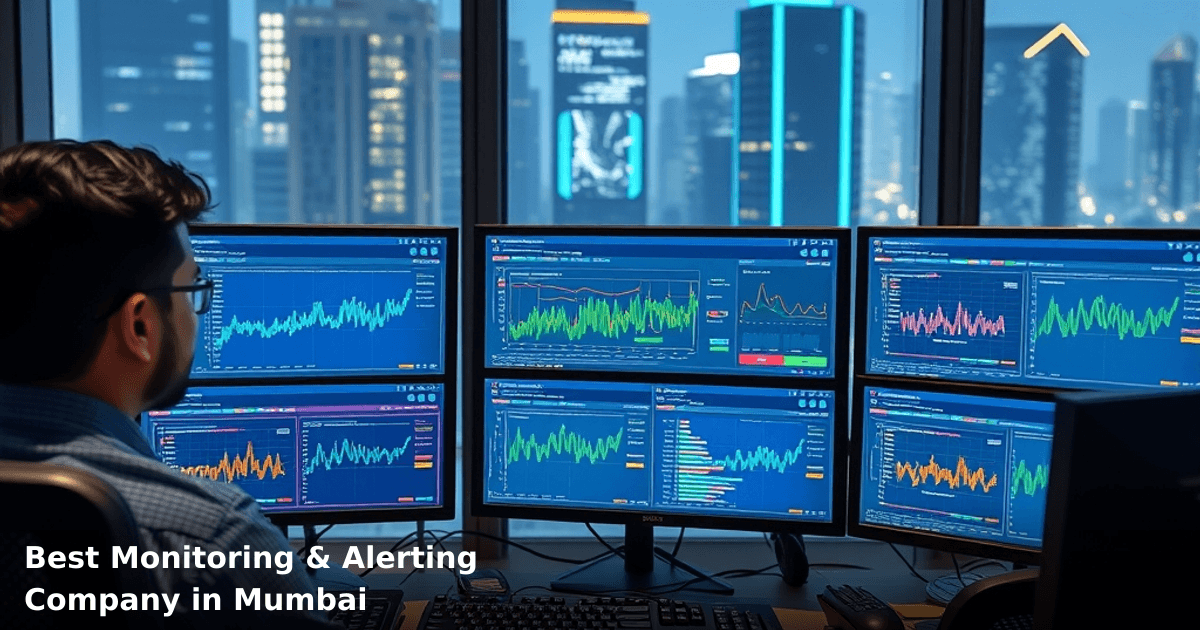
Monitoring & alerting in Mumbai (or anywhere) isn't complicated, but it's misunderstood. Think of it as a 24/7 security guard for your digital infrastructure.
Monitoring means constant observation:
- Server CPU, RAM, disk space, network bandwidth
- Application response times (how fast your website loads)
- Database query performance
- API uptime and error rates
- User login success rates
Alerting means instant notification:
- SMS to your phone the moment CPU hits 90%
- Slack message when your database is running out of space
- Email escalation if the alert isn't acknowledged in 15 minutes
- Automated actions (restart a service, scale up servers) before humans even wake up
How It Prevents Disasters
One of our clients—a Mumbai-based fintech processing ₹200 crore/month—had their payment gateway database filling up at 2 AM. The monitoring system caught it at 85% capacity, sent an alert, and their team cleared old logs before it hit 100% and crashed. That alert saved them ₹15–20 lakh in potential fraud disputes and regulatory fines.
Comparison Table: Monitoring & Alerting Options for Mumbai Businesses
| Feature | DIY (Nagios/Zabbix) | Cloud SaaS (DataDog, New Relic) | Managed Service (Innovaira Partner) |
|---|---|---|---|
| Setup Time | 4–6 weeks | 3–5 days | 2–3 weeks |
| Monthly Cost | ₹2,000–₹8,000 | ₹12,000–₹40,000+ | ₹5,000–₹12,000 |
| Your Team Effort | High (ongoing maintenance) | Low (vendor-managed) | Medium (we manage, you oversee) |
| Alert Channels | Email, SMS | Email, SMS, Slack, PagerDuty | Email, SMS, Slack, custom webhooks |
| Uptime SLA | Depends on your setup | 99.9%–99.99% | 99.5%–99.9% |
| Best For | Tech teams with 5+ staff | Rapid scaling, complex stacks | SMBs wanting simplicity |
| Learning Curve | Steep (weeks of training) | Gentle (docs + support) | Gentle (we handle it) |
Step-by-Step Guide: Choosing a Monitoring & Alerting Service in Mumbai
We set up and manage your cloud infrastructure
From AWS to Azure — we design, deploy, and maintain reliable infrastructure for Indian startups and SMBs.
1. Audit Your Current Infrastructure
Before you call anyone, list what you're running:
- How many servers? (physical, cloud, hybrid)
- What applications? (web app, mobile backend, CRM, ERP)
- How many databases? (MySQL, PostgreSQL, MongoDB, etc.)
- How many users/transactions per hour?
A logistics company in Navi Mumbai might have: 3 AWS EC2 instances, 1 RDS database, 1 Node.js API, 2 cron jobs. A manufacturing business might have: on-premise servers + cloud backup + ERP system. Know your stack before shopping.
2. Define Your Alert Thresholds
Not everything needs an alert. If you alert on every tiny blip, your team ignores alerts (alert fatigue). Instead, decide:
- CPU >85% for >5 minutes? Alert.
- Disk space <10%? Alert.
- Website response time >3 seconds? Alert.
- Failed login attempts >10/minute? Alert.
Write these down. A monitoring & alerting company in Mumbai worth their salt will help you tune these, but you need a starting point.
3. Choose Alert Channels That Fit Your Team
- SMS: Best for critical alerts (database down, payment system broken). Costs ₹0.50–₹1 per SMS.
- Email: Good for informational alerts (disk space warning). Gets ignored if your inbox is full.
- Slack: Ideal for dev teams. Instant, visible, searchable.
- PagerDuty: For on-call rotations (someone is always watching).
Most Mumbai businesses use SMS + Slack + email (redundancy). If your CTO is the only person who knows the server password, SMS to their phone is non-negotiable.
4. Evaluate 3–5 Providers (or Managed Partners)
Get quotes from:
- Gartner report lists leaders: DataDog, New Relic, Splunk (expensive for SMBs, but robust).
- Local managed service providers (often cheaper, more flexible).
- Open-source + managed hybrids (Prometheus + Grafana, hosted by a partner).
Ask each provider:
- How long until you see your first alert? (Should be <24 hours of setup.)
- Can you customize alert rules without coding?
- What's the SLA if their service goes down? (Should be 99.5%+ uptime.)
- Do you include on-call support, or is it extra?
5. Run a 2-Week Pilot Before Full Deployment
Start with one non-critical server or app. Monitor it for 2 weeks. Do you get alerts at the right time? Are they actionable? Does your team respond? Once you're confident, expand to your entire infrastructure.
If a provider can't do a 2-week trial, move on. You're not buying blind.
Common Mistakes to Avoid When Choosing a Monitoring & Alerting Service
Mistake 1: Chasing "Cheapest" Over "Right" ₹2,000/month sounds great until you miss an alert because the provider's SMS delivery is slow. A textile exporter in Dadar went with the cheapest option, didn't get an alert for 45 minutes during a server crash, and lost ₹6 lakh in orders. The "savings" cost them 300x more.
Mistake 2: Over-Alerting Setting 50 alert rules means your team ignores 45 of them. Start with 10 critical rules. Add more only when you understand your baseline.
Mistake 3: Ignoring Local Time Zones If your team is in Mumbai but your provider's support is in US time zones, you're on your own at 2 AM. Check support hours and escalation paths before signing.
Mistake 4: Not Testing Alerts Before Going Live A manufacturing business set up monitoring but never tested if the SMS actually arrived. When their server crashed, the alert was sent to a number that was disconnected 6 months ago. Test everything.
Mistake 5: Skipping Historical Data You need to see trends. "CPU was 60% yesterday, 75% today, 92% now"—that tells you when to scale up. Cheap tools don't keep history. Demand at least 30 days of data retention.
Key Takeaways
- Monitoring & alerting in Mumbai is non-negotiable if you run production systems. One outage costs ₹1–5 lakh; a good monitoring service costs ₹5,000–₹12,000/month.
- Downtime is invisible until it's too late. Set up monitoring before your first crisis, not after.
- Alert fatigue kills alerting. Start with 10 critical rules, not 100.
- Local support matters. A provider who understands Mumbai's business hours and GST regulations is worth the premium.
- Test everything. Alerts that don't arrive are worse than no alerts.
Frequently Asked Questions
Quick answers about monitoring-alerting-mumbai-india
01 How much does a good monitoring & alerting solution actually cost for a small business in Mumbai? ›
Most monitoring platforms charge between ₹5,000–₹25,000 per month depending on servers monitored and alert complexity, but here's what matters: a 20-server setup with basic uptime alerts runs ₹8,000–₹12,000/month, while adding custom dashboards and integration with your ticketing system pushes it to ₹15,000–₹20,000. I've seen SMBs waste ₹40,000+ monthly on enterprise tools they don't need—start with ₹8,000–₹10,000 and scale as your infrastructure grows.
02 How long does it take to actually get monitoring alerts running after signing up? ›
A basic setup takes 2–4 hours if you have your infrastructure details ready, but real-world implementation is 3–5 days because you'll need to integrate with your existing systems, test alert rules, and configure escalation policies properly. I recommend budgeting a full week if you're also setting up custom thresholds for your specific applications—rushing this means missing critical alerts or getting flooded with false positives.
03 Is monitoring & alerting necessary for a 5-10 person tech team or just large enterprises? ›
This is where most Mumbai SMBs get it wrong—you actually need it more at this size because you don't have dedicated DevOps staff absorbing outages silently; one unmonitored server going down directly impacts your revenue and customer trust. A 5-person team should invest ₹8,000–₹12,000/month to catch issues before customers do, which saves roughly ₹50,000–₹100,000 in emergency fixes and lost business per incident.
04 What's the biggest mistake SMBs make when choosing a monitoring tool? ›
The mistake isn't picking the "wrong" tool—it's setting alerts on everything and ignoring 80% of them, which costs you ₹15,000–₹20,000/month in wasted subscription fees and zero actionable insights. I've seen businesses with 500+ alerts daily where the team stops reading them after week two; instead, start with 8–12 critical alerts (CPU, memory, response time, error rate) and add intelligently based on actual incidents you've faced.
05 What's the first step to get started with monitoring if we've never done it before? ›
Start by listing your 3–5 most critical services (database, API, website, payment gateway), then pick a tool with a free tier like Prometheus or a 14-day trial from Datadog/New Relic to test-drive it for ₹0 investment. Once you've confirmed it catches real issues in your environment (usually within 5–7 days), commit to a 6-month plan at ₹8,000–₹12,000/month rather than month-to-month, which saves 15–20% in Mumbai-based vendor pricing.
Need this built for your business?
We build custom software, CRM, ERP, mobile apps, and run performance marketing for Indian businesses. Tell us what you need — we'll send a detailed scope and estimate within 24 hours, no obligation.
- Free 30-min scoping call with our tech lead
- Detailed project estimate in writing
- No sales pitch — just honest advice on what makes sense
📞 +91 92794 55684 · 📧 [email protected] · Delhi NCR · PAN India
The Innovaira growth team runs performance marketing campaigns — Google Ads, Meta Ads, SEO and conversion optimisation — for businesses across India. Data-driven, ROI-accountable, DPIIT-recognised startup.