Best Monitoring & Alerting Company in Ahmedabad: How to Choose
When your e-commerce platform goes down at 2 AM on a Friday, or your payment gateway starts dropping transactions silently, you lose money before you even know something's wrong. That's where monitoring & alerting Ahmedabad India services come in—they watch your systems 24/7 so you don't have to stay awake doing it yourself.
Quick Answer: Monitoring & alerting companies in Ahmedabad track your servers, applications, and databases in real-time, sending instant alerts when something breaks. Costs range from ₹5,000–₹25,000/month depending on infrastructure size, and setup typically takes 5–7 days. The best fit depends on whether you need cloud-only monitoring, on-premise support, or both.
Why Monitoring & Alerting Matters for Indian Businesses
Your business runs on systems. Your customers don't care about your excuses—they care that your app or website works. A McKinsey report found that unplanned downtime costs Indian enterprises an average of ₹2.5 lakh per hour. For SMBs, that's often a month's revenue gone in a single outage.
We've worked with textile exporters in Ahmedabad, pharmaceutical distributors in Vadodara, and diamond traders in Surat. Every single one lost money to unmonitored system failures before they hired a proper monitoring partner. One automotive parts supplier we know lost ₹1.8 lakh in a single day when their ERP system crashed undetected for 6 hours.
What Happens Without Proper Monitoring
Your team finds out about problems from angry customers, not from alerts. Your database fills up silently. Your server runs out of memory at peak traffic. Your API response times degrade so gradually nobody notices until orders start failing. By then, damage is done.
With proper monitoring & alerting in Ahmedabad India, you catch these issues before they become crises.
What Monitoring & Alerting Actually Does
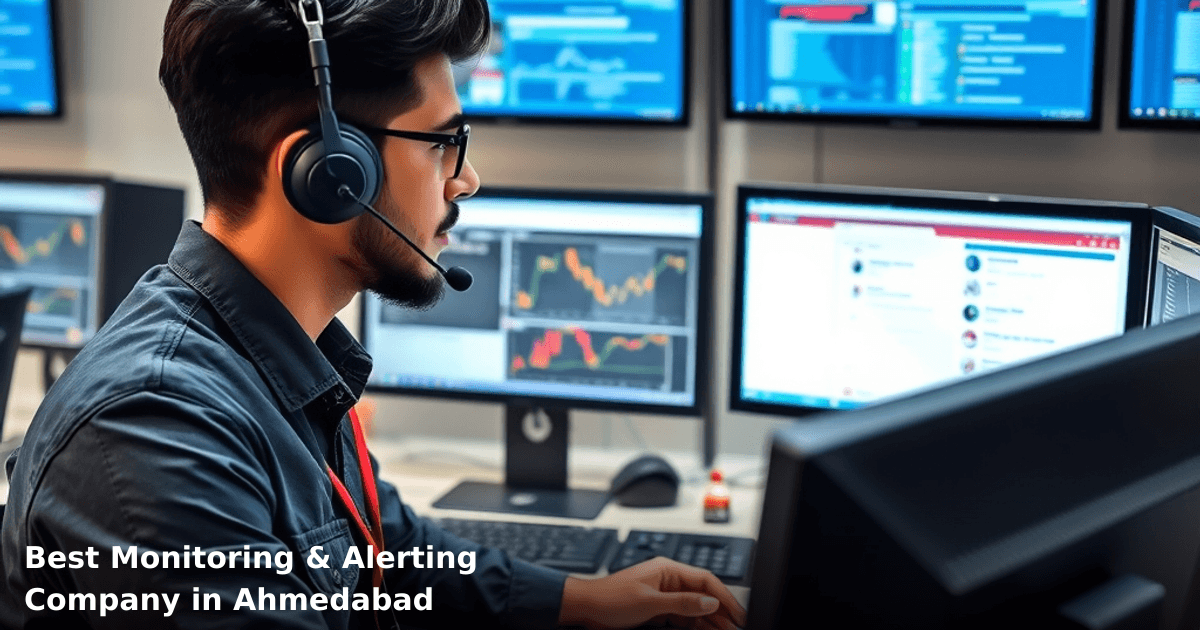
Monitoring watches your systems continuously. Alerting tells you when something's wrong. Together, they give you visibility into what's happening right now—not yesterday, not in a report, but in real-time.
Real-Time System Health Tracking
A monitoring system checks your servers every 30 seconds (or faster). It measures CPU usage, memory, disk space, network traffic, database performance, API response times, and application errors. When a metric crosses a threshold you've set—say, CPU hits 85%—the system logs it and can trigger an alert.
Instant Notifications to Your Team
Alerts go to your phone, email, Slack, or SMS. Your DevOps engineer gets notified immediately. Your manager gets a summary. Critical issues can even trigger automatic actions—restarting a service, scaling up servers, or triggering a failover.
Historical Data and Reporting
You get dashboards showing trends. You can see that your database gets slow every Tuesday at 3 PM (probably a backup job). You can prove to your boss that uptime was 99.7% last month. You can troubleshoot faster because you have data, not guesses.
Monitoring & Alerting Company Options in Ahmedabad: Comparison
| Factor | Cloud-Only (AWS CloudWatch, GCP Monitoring) | Hybrid (Datadog, New Relic) | On-Premise (Prometheus, Grafana) | Local Ahmedabad Partner |
|---|---|---|---|---|
| Setup Time | 3–5 days | 5–7 days | 7–14 days | 5–7 days |
| Monthly Cost | ₹8,000–₹20,000 | ₹15,000–₹40,000 | ₹5,000–₹12,000 (self-hosted) | ₹10,000–₹30,000 |
| Best For | Cloud-native startups | Mixed infrastructure | Large enterprises, sensitive data | SMBs wanting local support |
| Support Response | 24/7 via chat/email | 24/7 via phone | Community + paid support | Same-day response |
| Data Privacy | Data in cloud | Shared SaaS | Your servers only | Your choice |
| Learning Curve | Low | Medium | High | Medium |
Step-by-Step Guide: How to Choose a Monitoring & Alerting Company in Ahmedabad
We set up and manage your cloud infrastructure
From AWS to Azure — we design, deploy, and maintain reliable infrastructure for Indian startups and SMBs.
1. Map Your Infrastructure First
Before you call anyone, write down what you're actually running. Do you have servers in a data center? Cloud VMs on AWS or Azure? Databases? APIs? Load balancers? Microservices? A mix of everything?
A textile export company we worked with had servers in a Mumbai data center, a cloud database in AWS, and APIs running on their own office network. They needed monitoring that handled all three.
2. Define What Matters Most to You
Not every metric is equally important. A payment gateway cares about API response time. An e-commerce store cares about page load speed and database queries. A manufacturing company running an ERP cares about database uptime and user login times.
Write down your top 5 metrics. This becomes your selection criteria.
3. Test the Alert System Before Committing
Ask the company to do a proof-of-concept. They should monitor one non-critical system for 2–3 days. You should see:
- How fast alerts actually reach you (not just "we send alerts"—actually get one)
- How clear the alert message is (can your team understand what's wrong?)
- How easy the dashboard is to navigate
- Whether they can integrate with your existing tools (Slack, email, SMS, PagerDuty)
4. Check Their Local Support and Response Time
"24/7 support" sounds good until you need help at 10 PM on a Sunday and get an auto-reply. Ask a potential monitoring & alerting company in Ahmedabad India:
- Do they have someone in India who can help during IST business hours?
- What's their average response time for critical alerts?
- Can they do on-site troubleshooting if needed?
- Do they speak your language (Hindi, Gujarati, English)?
One pharmaceutical distributor in Vadodara chose a company with no India presence. When their system went down during peak ordering season, support was asleep in the US. They switched within a month.
5. Negotiate Pricing and Scalability
Don't accept the first quote. Ask for:
- Pricing based on the number of servers/services you're monitoring, not per-user seats
- What happens if you add 10 new servers next month (is it automatic or do you renegotiate?)
- A 3-month trial period at a discounted rate
- A cap on how much your bill can increase year-over-year
According to a NASSCOM report, 58% of Indian SMBs overpay for monitoring because they don't negotiate the scaling terms upfront.
Common Mistakes to Avoid When Choosing a Monitoring & Alerting Partner
Mistake 1: Choosing Based on Price Alone
The cheapest monitoring & alerting company in Ahmedabad India isn't always the best. A ₹3,000/month service that misses a critical alert is infinitely more expensive than a ₹15,000/month service that catches it immediately.
Mistake 2: Not Testing the Alert Delivery
We've seen companies sign up for monitoring and discover 6 months later that alerts were going to an email address nobody checks. Test alerts on day 1.
Mistake 3: Monitoring Everything Without Prioritization
If your team gets 200 alerts a day, they'll ignore all of them. Start with 5–10 critical metrics. Add more once you have a good baseline.
Mistake 4: Forgetting About Data Privacy and Compliance
If you handle customer payment data or medical records, your monitoring system can't send that data to a public cloud. Check compliance requirements (GST, HIPAA, RBI guidelines for fintech) before signing up.
Mistake 5: Setting Thresholds Too Low
If you alert on every tiny CPU spike, your team gets alert fatigue. Work with your provider to set realistic thresholds based on your actual traffic patterns.
Key Takeaways
- Monitoring & alerting Ahmedabad India services watch your systems 24/7 and alert you to problems before customers notice them, typically costing ₹5,000–₹25,000/month.
- The right choice depends on your infrastructure (cloud, on-premise, or hybrid), your team's technical skill, and your data privacy needs.
- Always run a proof-of-concept with at least one potential vendor before committing to a long-term contract.
- Local support matters—choose a company that can respond quickly during Indian business hours, not just promise 24/7 support from overseas.
- Start with 5–10 critical metrics, not 200. Alert fatigue makes monitoring useless.
- Integrate your monitoring system with Slack, email, and SMS so alerts reach the right person immediately.
- Budget ₹10,000–₹20,000/month if you want professional support, not just basic tools.
Frequently Asked Questions
Quick answers about monitoring & alerting ahmedabad india
01 How much will a monitoring & alerting system actually cost my Ahmedabad manufacturing business? ›
Most monitoring solutions in Ahmedabad charge between ₹8,000–₹25,000 per month depending on server count and alert complexity, with setup fees ranging ₹15,000–₹40,000. If you're running 10–15 servers, expect ₹12,000–₹18,000/month for a mid-tier provider; larger setups with 50+ servers typically negotiate custom pricing around ₹30,000–₹50,000/month. Many local providers offer 3-month trials at 40–50% discount, so test before committing.
02 How long does it typically take to get monitoring up and running across all my systems? ›
Basic setup takes 3–5 days for small deployments (under 20 servers), but full integration with your existing applications usually requires 2–3 weeks including agent deployment, dashboard customization, and alert rule configuration. Most Ahmedabad-based monitoring companies can have your critical systems monitored within 48 hours if you have clear documentation; the remaining time goes to fine-tuning thresholds and integrating with your ticketing system.
03 Is enterprise-grade monitoring worth it for a 50-person SMB, or am I overpaying? ›
Absolutely yes—at your scale, monitoring prevents ₹2–5 lakh losses from undetected downtime per incident, which ROI-justifies ₹15,000–₹20,000/month in monitoring costs within 6–8 months. Most Ahmedabad SMBs in the 40–100 person range benefit from mid-tier solutions (not full enterprise suites), which give you 99.5% uptime visibility without the ₹1+ lakh/month overhead; companies skipping this stage typically lose 15–20% productivity during outages.
04 What's the biggest mistake SMB owners make when choosing a monitoring company? ›
The most common mistake is picking based on lowest price alone—₹5,000/month solutions often lack proper alert routing, have 30–45 minute detection delays, and provide poor Gujarati/Hindi support, costing you far more in missed alerts than you save. I've seen businesses switch providers after 2 months because their ₹6,000/month vendor couldn't integrate with their custom ERP; always verify integration capabilities and local support responsiveness before signing, even if it costs ₹3,000–₹5,000 more monthly.
05 What's the first step I should take if I've never had monitoring before? ›
Start by auditing your critical systems (database, web server, payment gateway, ERP) and listing which ones cause revenue loss when down—typically 4–6 systems for most SMBs—then request a free assessment from 2–3 local Ahmedabad providers (they usually offer this within 2–3 days). Most will give you a custom quote based on your actual needs rather than selling you a bloated package; this 1-week discovery phase costs nothing and clarifies whether you need ₹8,000 or ₹20,000/month solutions.
Need this built for your business?
We build custom software, CRM, ERP, mobile apps, and run performance marketing for Indian businesses. Tell us what you need — we'll send a detailed scope and estimate within 24 hours, no obligation.
- Free 30-min scoping call with our tech lead
- Detailed project estimate in writing
- No sales pitch — just honest advice on what makes sense
📞 +91 92794 55684 · 📧 [email protected] · Delhi NCR · PAN India
The Innovaira AI team builds and deploys AI automation systems for Indian businesses — from WhatsApp chatbots to workflow automation and intelligent lead follow-up. ISO 42001:2023 certified AI management.