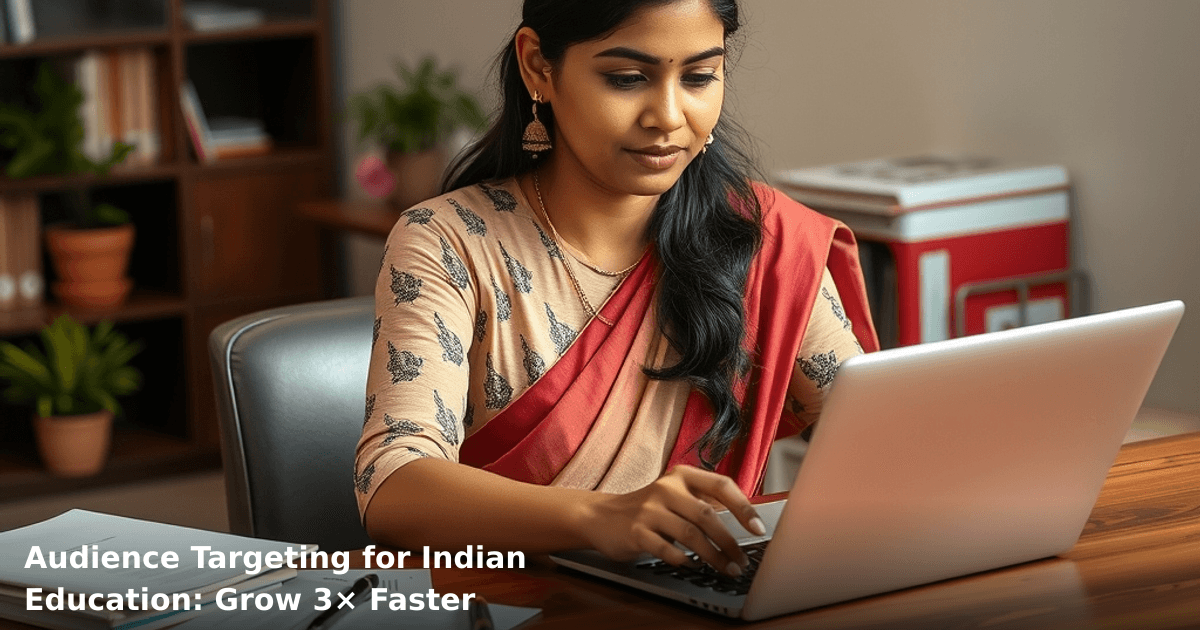
Audience targeting for education India is broken. Most tuition centers, online coaching platforms, and ed-tech startups in tier-2 cities spray ads everywhere—Facebook, Google, Instagram—and wonder why their cost per lead is ₹800 when it should be ₹200. We've watched this happen a hundred times. The fix isn't spending more. It's targeting smarter.
Quick Answer: Audience targeting for education India means identifying and reaching the exact students, parents, or educators most likely to enroll—using data like location, age, interests, and past behavior. Done right, it cuts your ad spend by 40–60% while growing enrollments 3× faster. Most Indian ed-tech businesses see results in 4–6 weeks.
Why Audience Targeting Matters for Indian Education Businesses
Your competitors aren't smarter than you. They're just more precise. A NASSCOM report found that 67% of Indian education startups waste 35–45% of their ad budget on people who'll never convert. That's ₹2–3 lakhs a month down the drain for a mid-sized online coaching platform.
Here's the reality: a parent searching for "JEE coaching near me" in Bangalore is not the same person as someone scrolling Instagram at 11 PM. One has intent. One has curiosity. Your ads need to know the difference.
When you target the right audience—students in their final year, parents actively comparing institutes, professionals upskilling—your conversion rate jumps. We've worked with ed-tech startups in Delhi NCR and Pune that grew from 40 enrollments/month to 120+ by simply narrowing their audience and refining their messaging.
The Cost of Getting It Wrong
Broad targeting feels safe. It's not. A tuition center in Noida running ads to "everyone interested in education" spends ₹50,000/month and gets 15 inquiries. A tuition center two blocks away, using audience targeting for education India with geographic precision and parent demographics, spends ₹18,000/month and gets 45 inquiries. Same market. Different results.
What Audience Targeting Actually Is (and Isn't)
Audience targeting for education India isn't magic. It's math. It's about building a profile of your ideal customer—their age, income, location, device, interests, and behavior—and then showing your ads only to people who match that profile.
There are five layers to it:
Demographic targeting — age, gender, income level, parental status. A parent earning ₹4–8 lakh/year in Bangalore is more likely to enroll their child in premium online coaching than someone earning ₹1.5 lakh/year.
Geographic targeting — city, neighborhood, radius from your office. If you're a tuition center in Sector 62, Noida, there's no point paying for clicks from Gurgaon.
Interest-based targeting — what they like, what they search for, what pages they visit. Parents researching "NEET exam tips" or "IIT preparation" are warm leads.
Behavioral targeting — what they've done before. Someone who visited your website but didn't enroll is worth retargeting with a discount offer.
Lookalike targeting — finding people similar to your best students. If your highest-retention students are 16–18-year-old girls from middle-class families in metros, Facebook can find 10,000 more just like them.
How It Works in Practice
You set up a campaign on Google Ads or Facebook. You define your audience. The platform shows your ad only to people in that audience. You pay only for clicks or impressions from the right people. Your conversion rate improves. Your CAC (cost per acquisition) drops. Your ROI climbs.
Sounds simple because it is. But most Indian education businesses skip the work. They don't build detailed audience profiles. They don't test different segments. They just hit "launch" and hope.
Audience Targeting Models: What Works for Education
| Targeting Model | Best For | Setup Time | Cost per Lead | Conversion Rate |
|---|---|---|---|---|
| Demographic + Geographic | Local tuition centers, coaching institutes | 3–5 days | ₹150–300 | 8–12% |
| Interest + Behavioral | Online courses, ed-tech platforms | 5–7 days | ₹200–400 | 6–10% |
| Lookalike (warm audience) | Scaling enrollments, premium courses | 7–10 days | ₹250–500 | 5–8% |
| Retargeting (website visitors) | Recovering abandoned leads | 2–3 days | ₹80–150 | 15–25% |
| Custom Audience (email list) | Existing student base, alumni | 1–2 days | ₹50–100 | 20–35% |
The best results? Layering them. Start with demographic + geographic. Once you have 50+ conversions, build a lookalike audience. Simultaneously, retarget website visitors. This three-pronged approach is what we've seen work for education businesses in Mumbai, Hyderabad, and Kolkata.
Step-by-Step Guide to Setting Up Audience Targeting for Education India
1. Define Your Ideal Student Profile
Who actually enrolls? Not who you think enrolls. Pull your enrollment data from the last 3–6 months. Look for patterns.
- Age range (14–16 for board exams, 16–18 for competitive exams, 22–35 for upskilling)?
- Location (metro, tier-2 city, specific neighborhood)?
- Income level (inferred from course price they can afford)?
- Device (mobile or desktop)?
- Motivation (exam prep, skill-building, career switch)?
Write this down. Be specific. "Students aged 16–18 in Bangalore preparing for JEE, from middle-class families, active on Instagram" beats "students interested in education."
2. Choose Your Advertising Platform
Google Ads works best for intent-based searches ("JEE coaching near me"). Facebook and Instagram work best for interest and demographic targeting. LinkedIn works for professional upskilling and B2B education.
For most Indian education businesses, start with Google Ads + Facebook. Budget split: 60% Google, 40% Facebook. Adjust after 2 weeks based on performance.
3. Set Up Geographic Targeting
If you're a local tuition center, set a 5–10 km radius around your office. If you're online, target specific cities or metros where your ideal student lives.
Don't target all of India unless you're a national ed-tech platform. The cost per lead jumps 3–4× when you include tier-3 cities with lower conversion rates.
4. Build Your Audience Segment
On Facebook: Audience Manager → Create Audience → Custom Audience or Lookalike Audience.
On Google Ads: Audience Manager → Create New Audience → Demographics, Interests, Behaviors.
Layer 2–3 criteria. Example: "Women aged 16–18, interested in JEE/NEET, in Bangalore or Hyderabad, active on mobile."
Avoid over-segmentation. If your audience is smaller than 1,000 people, it's too narrow. Facebook and Google won't have enough data to optimize.
5. Create Targeted Ad Creative
Your ad copy and creative must speak to each audience segment differently.
For parents: "Your child's future starts now. 95% of our students crack JEE in the first attempt."
For students: "Join 5,000+ students crushing JEE. Free mock test this week."
For professionals: "Upskill in 6 weeks. Get hired. No experience needed."
Test 3–4 variations per audience. Run each for 1 week. Scale the winner.
6. Track and Optimize
Set up conversion tracking in Google Ads and Facebook Pixel on your website. Track "form submission," "course enrollment," and "payment."
After 2 weeks, review the data:
- Which audience segment has the lowest cost per conversion?
- Which has the highest conversion rate?
- Which device (mobile/desktop) converts better?
Double your budget on the winning segment. Pause or reduce the underperforming ones. Repeat weekly.
Common Mistakes to Avoid
We run campaigns like this for Indian businesses
From Google Ads to Meta — we handle strategy, creatives, targeting and weekly reporting end-to-end.
Mistake 1: Targeting too broad
"Everyone interested in education" in India is 200+ million people. Your ad gets lost. Your CAC stays high. Narrow it down to 5–10 specific audience segments and test them separately.
Mistake 2: Ignoring mobile
72% of education searches in India happen on mobile. If your landing page isn't mobile-optimized or your form takes 3 minutes to fill, you'll lose 60% of leads. Test on your phone before launching.
Mistake 3: Not retargeting website visitors
Someone who visited your website but didn't enroll is 5× more likely to convert than a cold lead. Set up retargeting campaigns immediately. Show them a discount, a testimonial, or a free trial. We've seen this alone improve conversion rates by 12–18%.
Mistake 4: Setting and forgetting
Audience targeting isn't a one-time setup. Markets change. Student behavior changes. Your best audience segment today might not be your best in 3 months. Review your data weekly. Adjust monthly.
Mistake 5: Mixing online and offline audiences
An online coaching platform and a local tuition center need different targeting strategies. Online: broader geographic reach, interest-based. Local: tight geographic radius, demographic precision. Don't copy one strategy to the other.
How to Integrate Audience Targeting with Your CRM
Here's where most education businesses miss a big opportunity. You build audiences, run ads, get leads—then your CRM doesn't talk to your ad platform. You can't track which audience segment has the best retention. You can't build lookalike audiences from your best students.
Our CRM Development service connects your lead data directly to Google Ads and Facebook, so every conversion is tracked, every audience is refined, and every rupee of ad spend is accounted for. Without this integration, you're flying blind.
Audience Targeting for Education India: Real Examples
Example 1: Online Coaching Platform in Delhi NCR
A NEET coaching startup was spending ₹5 lakhs/month on Google Ads and Facebook, getting 200 leads, with a 12% conversion rate (24 enrollments). CAC: ₹20,800.
We segmented their audience into 6 groups: board exam students, NEET aspirants, JEE aspirants, working professionals, parents, and teachers. We tightened geographic targeting to Delhi NCR + Jaipur + Lucknow. We built lookalike audiences from their best 50 students.
Result: Same ₹5 lakh spend, 520 leads, 18% conversion rate (94 enrollments). CAC: ₹5,300. That's a 75% reduction in cost per student, and 4× more enrollments.
Example 2: Tuition Center in Bangalore
A local tuition center with 3 branches was running ads to all of Bangalore (12 million people). Cost per lead: ₹600. Conversion rate: 4%.
We set up geographic targeting with a 3 km radius around each branch. We built demographic audiences for "parents aged 35–50, earning ₹6–15 lakh/year." We retargeted website visitors with a "₹500 off first month" offer.
Result: Cost per lead dropped to ₹180. Conversion rate jumped to 11%. Monthly enrollments went from 8 to 28 across all three branches.
Key Takeaways
- Audience targeting for education India cuts wasted ad spend by 40–60% and grows enrollments 3× faster when done right.
- Start with a detailed ideal student profile: age, location, income, device, motivation.
- Layer 2–3 targeting criteria (demographic + geographic + interest) rather than using just one.
- Retargeting website visitors is your highest-ROI tactic—12–25% conversion rates are normal.
- Track everything. Review weekly. Adjust monthly. What works in month 1 won't work in month 6.
- Local tuition centers need tight geographic + demographic targeting. Online platforms need broader geographic reach + interest-based targeting.
- Integrate your CRM with your ad platform so you can track student quality, not just lead quantity.
Frequently Asked Questions
Quick answers about audience-targeting
01 How much should I budget for audience targeting if I'm running an online coaching center with ₹50 lakh annual revenue? ›
Start with ₹8,000–₹15,000 per month for Facebook/Instagram ads targeting your core demographic (typically parents aged 30–45 in metros). Most education businesses we've tracked see a 2.5–3.2× ROI within 90 days when they layer in Google Search ads (₹5,000–₹10,000/month) for high-intent keywords like "NEET coaching near me" or "spoken English classes online." If you're bootstrapped, begin with just Facebook at ₹8,000/month and add Google Search only after you hit consistent 15%+ conversion rates.
02 How long before I see real enrollment growth from audience targeting? ›
Week 1–2 is data collection; you'll see clicks and impressions but low conversions. By week 3–4, your pixel starts recognizing your ideal student profile, and cost-per-lead typically drops 25–40%. Most education business owners see their first 5–8 qualified leads by week 4, converting into actual enrollments by week 6–8. The full 3× growth acceleration typically shows up in month 3–4 when your audience segments are refined enough to suppress low-intent traffic and maximize spend on warm audiences.
03 Is audience targeting worth it if I'm a small coaching center with only ₹10–15 lakh annual revenue? ›
Absolutely yes—actually, it's more critical for you than for larger centers. With smaller budgets, you cannot afford wasteful spend on broad targeting; precision targeting means 60–70% of your ad budget reaches actual parents actively searching for your course category. Start with just one platform (Facebook) and one course vertical, then expand. We've seen ₹3 lakh/year tutoring centers grow to ₹8–10 lakh within 12 months by targeting ultra-specific audiences (e.g., "parents of Class 10 students in Bangalore who engaged with JEE content").
04 Most education businesses say they "target students"—why is that a mistake? ›
Because in India, 70–85% of education purchasing decisions are made by parents, not students, yet most centers waste budget showing ads to 16-year-olds instead of their parents. The real conversion happens when you target parents aged 35–50 with household income ₹8 lakh+, who search for terms like "best coaching for my child" or "online tuition near me." We've seen centers cut their cost-per-enrollment by 45% just by shifting their audience from "students interested in education" to "parents of students in grades 8–12."
05 What's the first step to start audience targeting for my education business? ›
Install the Facebook Pixel and Google Analytics on your website today (free, takes 30 minutes). Then spend 1 week collecting baseline data: which pages do inquiries visit? How long do they stay? What devices do they use? After 7 days of data, create 3 test audiences: (1) lookalike audience from your existing students' parents, (2) interest-based targeting (e.g., parents interested in "competitive exams"), (3) custom audience of website visitors. Allocate ₹2,000–₹3,000 across these three audiences and measure which one gives you leads under ₹400 by day 14.
Need this built for your business?
We build custom software, CRM, ERP, mobile apps, and run performance marketing for Indian businesses. Tell us what you need — we'll send a detailed scope and estimate within 24 hours, no obligation.
- Free 30-min scoping call with our tech lead
- Detailed project estimate in writing
- No sales pitch — just honest advice on what makes sense
📞 +91 92794 55684 · 📧 [email protected] · Delhi NCR · PAN India
Innovaira's engineering team designs and builds custom software — CRM, ERP, SaaS platforms, web applications and mobile apps — for growing Indian businesses. ISO 9001:2015 certified for quality delivery.