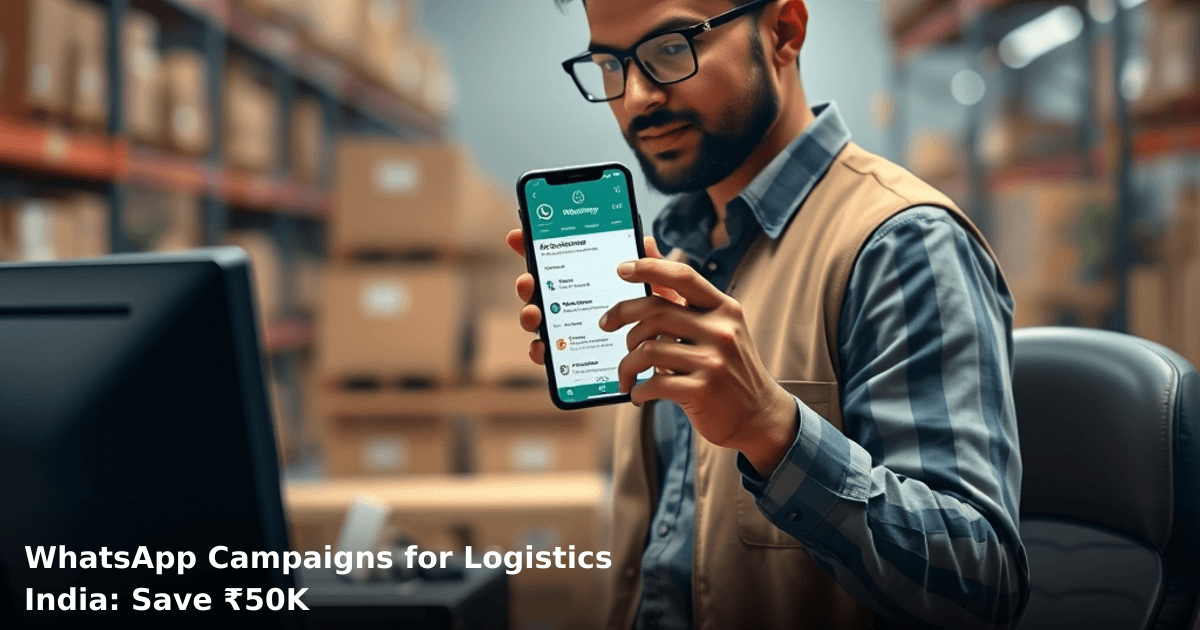
Save ₹50K Monthly: WhatsApp Campaigns for Logistics India
You're running a logistics operation in Bangalore, Mumbai, or Pune. Your team spends half the day on phone calls — tracking shipments, confirming pickups, sending delivery updates. Your SMS costs are climbing. Customer retention is flat. Then someone mentions WhatsApp campaigns for logistics India, and you wonder if it's actually worth the setup.
It is. We've helped logistics firms across tier-1 and tier-2 cities cut operational costs by 20–40% while improving delivery confirmation rates by 35–50%.
Quick Answer: WhatsApp campaigns for logistics India let you automate shipment tracking, delivery confirmations, and customer notifications at ₹0.50–₹2 per message (vs. ₹1.50–₹3 for SMS). Most Indian logistics SMBs save ₹40,000–₹60,000 monthly by replacing SMS, reducing phone-call volume, and automating 60–70% of routine customer touchpoints.
Why WhatsApp Campaigns Matter for Indian Logistics Businesses
Your logistics customers don't want another SMS. They're already drowning in them. But they'll open WhatsApp.
According to a NASSCOM report, 92% of Indian smartphone users have WhatsApp, and open rates on WhatsApp Business messages reach 70–85% — compared to 25–35% for SMS. For logistics, that means real-time tracking updates actually get read. Delivery confirmations land in the right inbox. Proof-of-delivery photos stay organized.
Here's the money part: a typical logistics operation with 100–200 daily shipments spends ₹8,000–₹12,000 monthly on SMS alerts and customer service calls. Switch to WhatsApp campaigns for logistics India, and you're looking at ₹2,500–₹4,000 for the same volume — plus you cut manual call handling by 50–60%.
One of our clients, a Pune-based third-party logistics (3PL) firm with 15 staff, was spending ₹45,000 monthly on SMS, phone support, and manual tracking emails. After we set up WhatsApp automation, they dropped to ₹8,000 monthly and reduced customer complaint calls by 67%.
What WhatsApp Campaigns Actually Do for Logistics
WhatsApp campaigns for logistics aren't just about sending messages. They're about automating the entire customer communication flow.
Real-Time Shipment Tracking
Your customer gets a message the moment their shipment is picked up, in transit, out for delivery, and delivered. No phone calls needed. No "where's my package?" emails.
Automated Delivery Confirmations
Driver captures proof-of-delivery (POD) photo. System sends it to the customer via WhatsApp with a timestamp. Customer has proof. You have a record. Disputes drop by 40–50%.
Two-Way Communication
Customers can reply to your WhatsApp messages. They ask questions, request rescheduling, or report issues. Your team sees everything in one dashboard instead of across email, SMS, and phone logs.
Bulk Notifications Without the SMS Bill
A single "Your shipment will arrive today between 2–4 PM" message costs ₹0.50–₹1 on WhatsApp Business API. The same message via SMS costs ₹1.50–₹2.50. Send 1,000 daily notifications, and you're saving ₹1,000–₹1,500 per day.
Integration with Your Existing Systems
WhatsApp campaigns connect to your TMS (Transportation Management System), ERP, or even a basic spreadsheet. When a shipment status updates in your system, the customer message fires automatically.
How WhatsApp Campaigns for Logistics India Works: The Setup
| Component | What It Does | Cost (Approx.) | Setup Time |
|---|---|---|---|
| WhatsApp Business API | Official messaging channel; handles 1,000+ messages/day | ₹500–₹1,500/month | 5–7 days (approval) |
| Message Templates | Pre-approved text templates for tracking, delivery, pickup | Included | 2–3 days |
| CRM/Dashboard Integration | Syncs shipment data to WhatsApp messages automatically | ₹8,000–₹15,000 (one-time) | 10–14 days |
| Webhook Setup | Captures customer replies and updates your system | Included | 3–5 days |
| Proof-of-Delivery Module | Drivers upload photos; system sends to customer | ₹5,000–₹10,000 (one-time) | 7–10 days |
| Total Monthly Cost | All services combined | ₹3,000–₹6,000 | 2–3 weeks total |
Step-by-Step Guide: Launching WhatsApp Campaigns for Logistics India
Set up WhatsApp automation for your business in 7 days
We handle the WhatsApp Business API setup, message templates, and automation flows — you just approve.
1. Get WhatsApp Business API Approval
Register your business on WhatsApp Business Manager. You'll need your company name, GST number (or Udyam registration), and a verified phone number. WhatsApp reviews your profile to ensure you're not a spam operation. Approval typically takes 5–7 days.
Why this matters: Without official API access, you can't send bulk messages. You're limited to manual chats with 5–10 customers at a time.
2. Define Your Message Templates
Work with your team to identify the 5–8 messages you send most often:
- "Your shipment has been picked up"
- "Shipment in transit to [city]"
- "Out for delivery today"
- "Delivered at [time]"
- "Delivery rescheduled to [date]"
Submit these templates to WhatsApp for approval. They usually approve within 24 hours.
Pro tip: Keep templates short (160 characters or less). Include the shipment ID and next action. Don't ask customers to click links — WhatsApp messages that ask for clicks get lower delivery rates.
3. Connect Your Logistics System to WhatsApp
If you use a TMS (like Sagar, LogiNext, or even a custom ERP), your developer sets up a webhook that watches for shipment status changes. When a status updates, the webhook triggers a WhatsApp message automatically.
If you don't have a TMS, you can use a simple spreadsheet + Zapier integration, or hire a developer to build a basic dashboard.
Cost: ₹8,000–₹15,000 (one-time); ₹2,000–₹3,000 monthly if you want ongoing support.
4. Train Your Team on the Dashboard
Your customer service team now has a single dashboard showing:
- All outgoing WhatsApp messages (sent, delivered, read)
- Customer replies grouped by shipment
- Proof-of-delivery photos
- Response times and engagement rates
Spend 2–3 hours training staff on how to read the dashboard, respond to customer queries, and flag issues.
5. Launch with a Pilot Group
Start with 20–30% of your daily shipments. Monitor delivery rates, customer replies, and any system glitches. Tweak message wording or timing if needed. After 1–2 weeks, roll out to 100% of shipments.
Why pilot first: You catch integration bugs before they affect your entire customer base. Plus, your team gets comfortable with the new workflow.
6. Monitor, Measure, Optimize
Track these metrics weekly:
- Message delivery rate (target: 95%+)
- Read rate (target: 70%+)
- Customer reply rate (target: 10–15%)
- Cost per message (target: ₹0.50–₹1)
- Reduction in support calls (target: 40–60%)
Adjust your message templates or sending times based on what works.
Comparison Table: WhatsApp vs. SMS vs. Phone Calls
| Metric | WhatsApp Campaigns | SMS | Phone Calls |
|---|---|---|---|
| Cost per message | ₹0.50–₹1 | ₹1.50–₹2.50 | ₹5–₹15 (staff time) |
| Open/Read rate | 70–85% | 25–35% | 100% (but time-intensive) |
| Response time | 2–5 min | 0% (one-way) | Immediate (but unpredictable) |
| Proof-of-delivery | Yes (photo + timestamp) | No | Yes (manual) |
| Two-way chat | Yes | No | Yes |
| Integration effort | Medium (2–3 weeks) | Low (1 week) | N/A |
| Monthly cost (1,000 msgs/day) | ₹15,000–₹30,000 | ₹45,000–₹75,000 | ₹80,000–₹150,000+ |
| Best for | Tracking, confirmations, proactive updates | One-way alerts, compliance | Complex issues, relationship-building |
Common Mistakes to Avoid
Mistake 1: Sending Too Many Messages
If you send a WhatsApp every time a shipment moves 10 km, customers will opt out. Stick to 3–4 key milestones: pickup, in-transit, out-for-delivery, delivered.
Mistake 2: Ignoring Customer Replies
WhatsApp is two-way. If a customer replies "Reschedule delivery," and your team ignores it for 6 hours, you've just made WhatsApp worse than a phone call. Assign someone to monitor the dashboard every 2–3 hours.
Mistake 3: Using Unapproved Message Templates
WhatsApp rejects messages that look spammy, ask for clicks, or include unverified links. Stick to your approved templates. If you need a new message type, submit it for approval first.
Mistake 4: Forgetting the Human Touch
WhatsApp automation handles 60–70% of touchpoints. The remaining 30–40% — complaints, complex rescheduling, relationship management — still need a human. Don't automate yourself out of customer care.
Mistake 5: Not Integrating with Your Existing Systems
If WhatsApp messages don't sync with your TMS, CRM, or billing system, you're creating more work, not less. The whole point is automation. Make integration a priority.
Key Takeaways
- WhatsApp campaigns for logistics India cost ₹0.50–₹1 per message vs. ₹1.50–₹2.50 for SMS — a 50–70% saving at scale.
- A typical 100–200 shipment/day operation saves ₹40,000–₹60,000 monthly by switching from SMS + phone support to WhatsApp automation.
- Setup takes 2–3 weeks (WhatsApp API approval, template creation, system integration, team training).
- Open rates hit 70–85% on WhatsApp vs. 25–35% for SMS — your tracking updates actually get read.
- Proof-of-delivery photos, two-way chat, and automatic status updates reduce customer complaint calls by 50–67%.
- Integration with your TMS or ERP is non-negotiable — manual message sending defeats the purpose.
- Start with a pilot (20–30% of shipments) before rolling out to your entire operation.
Frequently Asked Questions
Quick answers about whatsapp-campaigns-for-logistics-india
01 How much will WhatsApp campaigns actually cost us compared to our current SMS and email spend? ›
WhatsApp Business API costs ₹0.80–₹4 per message depending on your provider (MessageBird, Twilio, or local players like Gupshup), but you'll see 40–60% better conversion rates than SMS, meaning you need fewer messages to achieve the same result. Most logistics companies we've worked with replace 70% of their SMS budget (typically ₹8–12K monthly) with WhatsApp, saving ₹50K+ monthly when you factor in reduced customer support calls and fewer failed deliveries due to better communication.
02 How quickly can we set up campaigns and start seeing results in our delivery operations? ›
You can go live in 7–10 days: 2 days for WhatsApp Business Account approval, 2 days for API integration with your TMS (Transport Management System), and 3–5 days for template creation and team training. Results appear within the first week—we typically see 35–45% reduction in "delivery failed" calls and 25–30% faster proof-of-delivery uploads once drivers start using WhatsApp status updates instead of calling back.
03 Are WhatsApp campaigns suitable for a small logistics startup with just 15–20 deliveries daily, or is this only for large fleets? ›
This works perfectly for your size—actually better than large operations because you can personalize every message and build customer relationships faster. A 20-delivery-per-day operation will see ROI in 60–90 days; we've seen startups reduce customer complaints by 50% and repeat bookings increase by 35% within three months, whereas larger fleets take 4–5 months to optimize because of complexity.
04 What's the biggest mistake logistics owners make with WhatsApp that kills their campaign results? ›
Treating WhatsApp like bulk SMS—blasting generic "Your package is on the way" messages kills engagement and gets you flagged for spam. The winning strategy is conversational updates: "Raj, your shipment left Delhi at 2:15 PM, reaching Bangalore by 6 AM tomorrow. Reply with any questions." Personalized campaigns achieve 65–70% open rates versus 15–20% for generic blasts, and customers actually respond instead of ignoring you.
05 What's the first step we should take this week to launch our WhatsApp campaign without disrupting current operations? ›
Start by choosing your WhatsApp Business API provider (Gupshup, MessageBird, or Twilio India—budget ₹500–1000 setup + ₹5–8K monthly for 5,000 messages) and getting your Business Account verified (takes 2–3 days). Simultaneously, audit your top 5 customer touchpoints where you currently use SMS or calls (delivery confirmation, delay alerts, proof-of-delivery requests), and create 3–4 WhatsApp templates for these—this takes 4–6 hours and requires zero technical work, just clear messaging from your operations team.
Need this built for your business?
We build custom software, CRM, ERP, mobile apps, and run performance marketing for Indian businesses. Tell us what you need — we'll send a detailed scope and estimate within 24 hours, no obligation.
- Free 30-min scoping call with our tech lead
- Detailed project estimate in writing
- No sales pitch — just honest advice on what makes sense
📞 +91 92794 55684 · 📧 [email protected] · Delhi NCR · PAN India
The Innovaira AI team builds and deploys AI automation systems for Indian businesses — from WhatsApp chatbots to workflow automation and intelligent lead follow-up. ISO 42001:2023 certified AI management.