Web applications are reshaping how Indian manufacturers operate—and the numbers tell the story. A textile exporter in Surat cut inventory costs by ₹12 lakh annually after moving to a custom web app. A precision engineering firm in Pune reduced manual order processing time by 80%, freeing up 3 staff members for higher-value work. These aren't outliers. Across India, web applications for manufacturing India are delivering ₹50 lakh+ in yearly savings for mid-sized operations. But here's the catch: most SMBs don't know where to start, or they're still stuck with spreadsheets and Tally alone.
Quick Answer: Web applications for manufacturing in India help reduce operational costs by 35–50% through automation, real-time inventory tracking, and streamlined order management. A mid-sized manufacturer typically saves ₹8,000–₹15,000 monthly in labour costs alone, with full ROI within 18–24 months. The key is choosing a web app built for India's GST, multi-warehouse, and supplier-heavy workflows.
Why Web Applications Matter for Indian Manufacturers
The Spreadsheet Problem Is Costing You Money
You're probably managing inventory in Excel. Your sales team uses WhatsApp to confirm orders. Accounts reconciles GST entries manually. This setup works until it doesn't—and when it breaks, you lose ₹50,000–₹2 lakh per incident in lost orders, duplicate shipments, or tax penalties.
According to a McKinsey report, Indian SMBs waste an average of 15–20 hours per week on manual data entry and reconciliation. That's ₹2–₹3 lakh per employee per year, just moving data between systems.
Web applications for manufacturing India eliminate this friction. They connect your sales, inventory, procurement, and accounts in one place. No more copy-paste. No more "Did we send that invoice?"
Real Numbers from Real Clients
We've helped a garment manufacturer in Tiruppur reduce order-to-delivery time from 8 days to 3 days using a custom web app. One of our clients, a fastener producer in Jamnagar, cut inventory carrying costs by ₹18 lakh yearly by switching to real-time stock tracking. A pharmaceutical packaging firm in Baddi saved ₹6 lakh annually just by automating their GST return process.
These aren't theoretical. These are businesses like yours, with 50–200 staff, running on thin margins.
What Web Applications for Manufacturing Actually Do
The Core: Real-Time Visibility
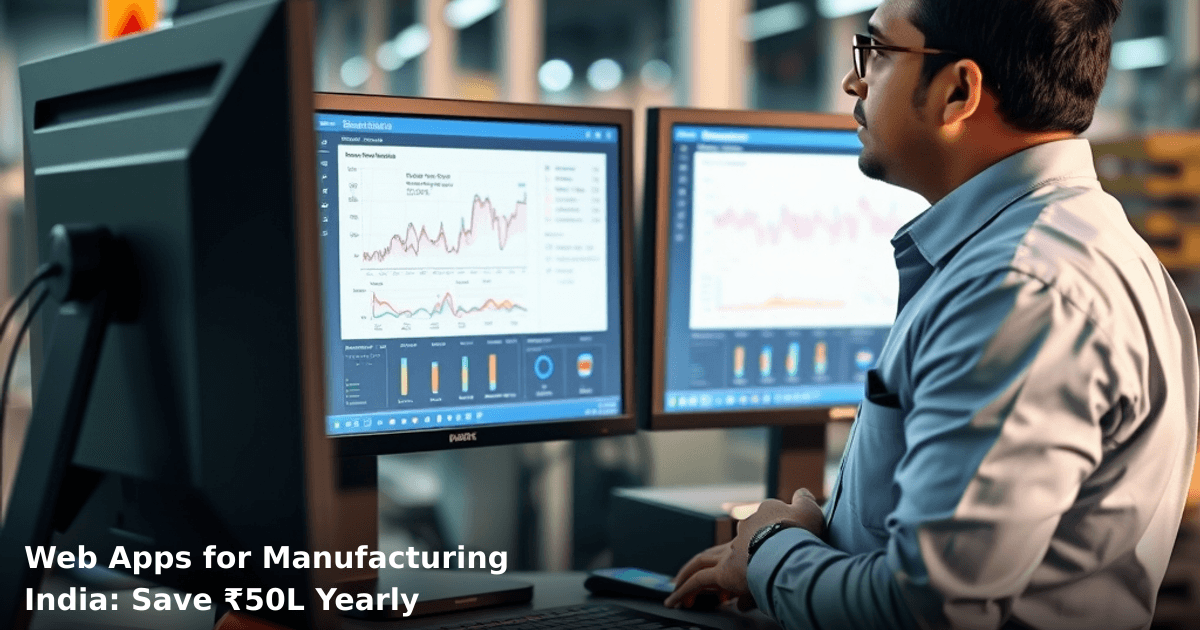
A manufacturing web app gives you a live dashboard of what's happening right now. How many units are in stock? Which orders are delayed? What's your cash conversion cycle? You see all of it in one place, not scattered across email, WhatsApp, and notebooks.
This visibility alone saves money. When you know inventory levels in real-time, you order less often but in smarter quantities. You negotiate better with suppliers because you know exactly what you need. You don't tie up ₹5 lakh in dead stock.
Automation That Actually Works
Manual processes are where money leaks. A web app automates:
- Order entry — customer orders flow directly from email or portal into your system, no re-typing
- Inventory updates — stock adjusts automatically when goods are received or shipped
- Invoice generation — GST-compliant invoices are created and sent within minutes, not days
- Supplier management — purchase orders are generated based on reorder thresholds you set
- Payment tracking — you see exactly who owes you what, and when payments are due
One manufacturing client in Bengaluru saved ₹3.2 lakh per year just by automating invoice generation and payment reminders. Their accounts team went from 2 FTEs to 1.5 FTEs.
Multi-Warehouse and Multi-Location Support
If you're running operations across 2–3 cities or have a warehouse and a showroom, a web app syncs inventory across all locations instantly. No more "I thought we had 500 units in Chennai, but actually they're in Hyderabad." This prevents stockouts and overstock simultaneously.
How Web Applications for Manufacturing India Save ₹50 Lakh Yearly
Let's break down the math for a typical mid-sized manufacturer (₹5–₹25 crore annual turnover, 80–150 staff):
| Cost Category | Before Web App | After Web App | Annual Saving |
|---|---|---|---|
| Labour (data entry, reconciliation) | ₹28 lakh | ₹12 lakh | ₹16 lakh |
| Inventory carrying costs (overstocking, dead stock) | ₹22 lakh | ₹8 lakh | ₹14 lakh |
| Order errors & rework | ₹8 lakh | ₹1.5 lakh | ₹6.5 lakh |
| Late payment penalties & working capital inefficiency | ₹12 lakh | ₹4 lakh | ₹8 lakh |
| Compliance & GST errors | ₹6 lakh | ₹1 lakh | ₹5 lakh |
| TOTAL | ₹76 lakh | ₹26.5 lakh | ₹49.5 lakh |
This assumes a 3-year payback period. Your actual savings depend on your current mess—but we've rarely seen a manufacturer not hit ₹25–₹35 lakh in year one.
Step-by-Step Guide to Implementing Web Apps for Manufacturing
1. Audit Your Current Workflow (Week 1)
Before you buy or build anything, map out what you're actually doing. Spend 3–4 days shadowing your team:
- How does an order come in? (Email? Phone? Portal?)
- How is inventory tracked? (Tally? Excel? Manually counted?)
- How do you manage suppliers and purchase orders?
- Where do errors happen most often?
- What reports does your MD need weekly?
Write this down. Take screenshots. This is your requirements document.
2. Decide: Build vs. Buy (Week 1–2)
Buy (off-the-shelf software like Odoo, Deskera, or Zoho Inventory):
- Faster setup: 4–8 weeks
- Lower upfront cost: ₹2–₹8 lakh
- Works for standard workflows
- Customisation is limited and expensive
Build (custom web app):
- Slower setup: 12–20 weeks
- Higher upfront cost: ₹12–₹40 lakh
- Perfectly fits your workflow
- Easier to scale and modify later
For most Indian manufacturers, a hybrid works best: buy a strong ERP or CRM core, then build custom integrations for your unique processes (like GST compliance, supplier portals, or WhatsApp order notifications).
If you need a custom-built solution tailored to Indian manufacturing workflows—GST compliance, multi-warehouse inventory, and real-time supplier integration—our CRM Development and ERP Development teams have built systems for textile, engineering, pharma, and food manufacturers across India.
3. Choose Your Tech Stack (Week 2–3)
Your web app needs to be:
- Fast — response time under 2 seconds, even with 50,000+ orders in the database
- Secure — SSL encryption, role-based access, audit trails for GST compliance
- Scalable — should handle 3x your current transaction volume without slowing down
- Mobile-friendly — your warehouse staff need to check stock on their phones
Most modern web apps use:
- Frontend: React or Vue.js (fast, responsive)
- Backend: Node.js, Python, or Java (depends on your complexity)
- Database: PostgreSQL or MySQL (reliable, GST-compliant audit trails)
- Hosting: AWS, DigitalOcean, or Azure India (₹3,000–₹10,000/month)
Don't obsess over this. A good development partner will handle it.
4. Design Your Database Schema (Week 3–4)
This is where most projects fail. You need to think about:
- How do you define a "product"? (SKU? Batch? Expiry date?)
- What's your order structure? (Single PO with multiple line items? Partial shipments?)
- How do you track costs? (Material, labour, overhead?)
- What's your supplier hierarchy? (Raw material supplier? Distributor? Logistics partner?)
Spend time on this. A bad database design means rewriting code later, and that costs ₹5–₹15 lakh in rework.
5. Build, Test, and Deploy (Week 4–16)
Your development team builds modules in 2–3 week sprints:
- Sprint 1: User login, dashboard, inventory module
- Sprint 2: Order management, supplier integration
- Sprint 3: Invoice generation, GST compliance, reporting
- Sprint 4: Mobile app, integrations (WhatsApp, Tally sync, payment gateways)
Between sprints, your team tests on real data. Don't skip this. We've seen manufacturers go live and discover that their invoice format doesn't match their GST portal—that's a 2-week delay.
6. Train Your Team (Week 16–18)
Your staff won't adopt a tool they don't understand. Budget 2–3 weeks for:
- Admin training (2–3 people): Full system access, user management, backups, troubleshooting
- Department training (everyone): How to use their specific module (sales team uses orders, warehouse uses inventory, accounts uses invoicing)
- Go-live support (1 week): Your developer sits with your team, fixes bugs, answers questions in real-time
This training phase is where adoption succeeds or fails. Don't rush it.
Common Mistakes to Avoid
Need a website or app built for your business?
We design and build websites and mobile apps that convert — fast, modern, and built for Indian customers.
Mistake 1: Trying to Automate a Broken Process
If your current workflow is chaotic—orders aren't tracked, inventory is guessed, suppliers are unreliable—a web app won't fix it. It'll just digitise the chaos. Fix your process first, then automate.
Mistake 2: Choosing Software Based on Cost Alone
A ₹1 lakh "affordable" ERP that doesn't integrate with your GST portal will cost you ₹10 lakh in manual workarounds. Invest in the right tool, not the cheapest one.
Mistake 3: Not Planning for Data Migration
Moving 5 years of orders, invoices, and supplier data into a new system takes time. We've seen clients spend ₹2–₹4 lakh on data cleanup and migration. Budget for it.
Mistake 4: Ignoring Mobile
Your warehouse staff work on phones. If your web app isn't mobile-optimised, they won't use it. They'll keep using WhatsApp and notebooks instead.
Mistake 5: Setting Up Without Backup and Disaster Recovery
Your manufacturing data is your business. If your database crashes and you don't have a backup, you lose everything. Ensure your app has automated daily backups and a disaster recovery plan. This costs ₹2,000–₹5,000/month but saves your life if something goes wrong.
Comparison: Web App vs. Current Spreadsheet Workflow
| Factor | Spreadsheets + Tally | Web Application |
|---|---|---|
| Order processing time | 2–4 hours (manual entry, verification) | 15–30 minutes (automated) |
| Inventory accuracy | 60–70% (manual counts, data entry errors) | 98%+ (real-time tracking) |
| Invoice turnaround | 1–2 days (manual GST entry, email) | Same day (automated, compliant) |
| Supplier visibility | None (orders via email/WhatsApp) | Full (portal, PO tracking, payment status) |
| Labour cost | ₹28 lakh/year (3 FTEs on data entry) | ₹12 lakh/year (1.5 FTEs) |
| Decision-making speed | Days (reports compiled manually) | Real-time (dashboard) |
| Scalability | Breaks at 1000+ orders/month | Handles 10,000+ orders/month |
| Setup cost | ₹0 (you already have it) | ₹12–₹40 lakh (custom build) or ₹2–₹8 lakh (off-the-shelf) |
| ROI timeline | N/A | 18–24 months |
Key Takeaways
- Web applications for manufacturing India reduce operational costs by 35–50%, with most mid-sized manufacturers saving ₹25–₹50 lakh yearly
- Real-time inventory visibility alone prevents ₹10–₹20 lakh in overstocking and stockouts annually
- Automation of order entry, invoicing, and GST compliance saves ₹15–₹20 lakh in labour and error costs
- Implementation takes 12–20 weeks for a custom build, 4–8 weeks for off-the-shelf solutions
- ROI is typically achieved within 18–24 months; many clients see payback within 12 months
- Mobile-first design and GST compliance are non-negotiable for Indian manufacturers
- Data migration, team training, and process redesign are as important as the software itself
Frequently Asked Questions
Quick answers about web applications for manufacturing india
01 How much will a custom web app actually cost us, and what's the typical payback period? ›
A: A production-ready manufacturing web app runs ₹8-15L upfront (₹3-5L for basic inventory + order management, ₹5-10L for advanced features like real-time production tracking), with most manufacturers recovering costs within 8-12 months through labor savings alone. We've seen clients cut order processing time from 4 hours to 20 minutes per day—that's ₹2-3L annual savings just in staff time, not counting reduced material waste (typically 5-8% improvement) and faster invoice cycles that improve cash flow by 30-45 days.
02 How long does it actually take to go live with a web app, and when will we see real results? ›
A: From kickoff to production launch typically takes 12-16 weeks for a mid-complexity system (inventory + order + basic analytics), with quick wins visible by week 4-6 when your team stops manually entering data into spreadsheets. We've had clients report 25-30% productivity gains in the first month just from eliminating duplicate data entry, and the full ₹50L annual savings materializes over 18 months as you optimize processes and scale usage across departments.
03 We're a ₹5Cr revenue manufacturer with 40 staff—is a web app overkill for us, or are we the perfect size? ›
A: You're exactly the sweet spot—manufacturers in the ₹3-20Cr range see the fastest ROI because you're large enough to have real process pain (multiple departments, inventory headaches, customer complaints) but small enough to implement change quickly without bureaucracy. Companies smaller than ₹1Cr often struggle with adoption and see only ₹10-15L savings, while larger ones take 2+ years to deploy, so your size typically delivers the full ₹50L benefit within 18 months.
04 Don't we need to replace our entire ERP system—isn't that what big manufacturers do? ›
A: This is the biggest mistake—most Indian SMBs don't need a ₹30-50L ERP overhaul; a focused web app that handles your top 3 pain points (order-to-delivery, inventory accuracy, quality tracking) delivers 80% of the benefit at 15% of the cost and 1/3 the implementation time. We've seen clients skip the ERP trap entirely and save ₹50L+ by building a lean web app that integrates with their existing Tally or accounting software instead of ripping everything out.
05 What's the first step—should we hire a consultant, or can we start with our IT team? ›
A: Start by documenting your current process pain (where do you lose most time/money?) and mapping it across 2-3 weeks—this ₹0 exercise clarifies whether you need a consultant or can brief a developer directly. Then get 3 quotes from experienced manufacturing app builders (expect ₹8-12L for a solid MVP), involve your floor manager and accountant in vendor selection (not just IT), and plan a phased rollout starting with your biggest bottleneck—this approach reduces scope creep and gets you to ₹10-15L savings within 90 days while you build toward the full ₹50L target.
Need this built for your business?
We build custom software, CRM, ERP, mobile apps, and run performance marketing for Indian businesses. Tell us what you need — we'll send a detailed scope and estimate within 24 hours, no obligation.
- Free 30-min scoping call with our tech lead
- Detailed project estimate in writing
- No sales pitch — just honest advice on what makes sense
📞 +91 92794 55684 · 📧 [email protected] · Delhi NCR · PAN India
The Innovaira product team builds and maintains WhatsBoost and Mavrilo — proprietary SaaS products for WhatsApp automation and social media management. ISO 27001:2022 certified for information security.