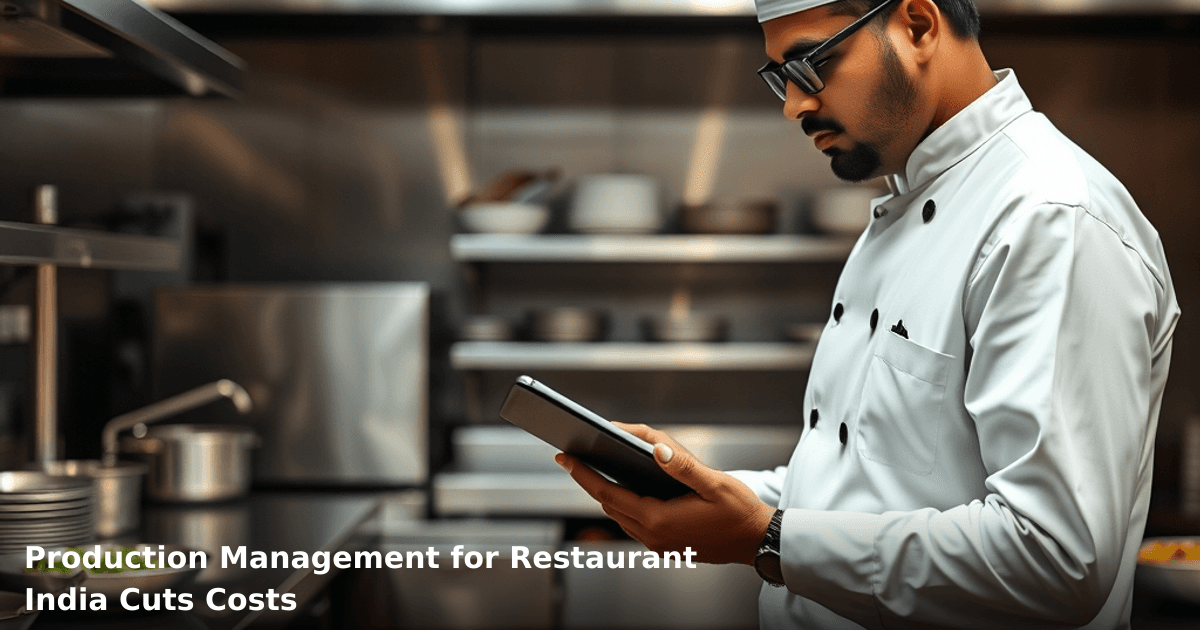
7 Ways Production Management for Restaurant India Cuts Costs
Production management for restaurant India isn't just about keeping the kitchen running—it's about keeping your margins alive. We've watched too many restaurant owners in Bangalore, Delhi, and Mumbai bleed money on wastage, overstaffing, and poor inventory tracking. A McKinsey report on Indian hospitality found that restaurants waste 15–20% of their raw materials annually, which translates to ₹2–3 lakh per month for a mid-sized operation. The good news? Structured production management fixes this.
Quick Answer: Production management for restaurants in India reduces food waste by 25–40%, cuts labour costs by 12–18%, and improves table turnover by 20% through better inventory tracking, staff scheduling, and kitchen workflow optimization. Most restaurants see ROI within 3–4 months.
Why Production Management Matters for Indian Restaurants
The Cost Crisis in Indian Kitchens
Your kitchen is a cost centre that most restaurant owners treat like a black box. You order ingredients, staff shows up (sometimes), food comes out, customers eat, money comes in. But somewhere between ordering and plating, ₹1–2 lakh disappears every month—and you can't explain why.
According to Statista data on the Indian food service industry, restaurants operating without structured production management systems lose 18–22% of revenue to operational inefficiencies. For a restaurant doing ₹20 lakh monthly turnover, that's ₹3.6–4.4 lakh in preventable losses.
The problem isn't your team. It's the system (or lack of one).
What Production Management Actually Does
Production management for restaurant India means controlling four things:
- What you buy — inventory planning that matches demand
- How you store it — proper rotation, temperature control, shelf life tracking
- How you prepare it — standardized recipes, portion control, batch cooking
- How you deploy staff — scheduling based on covers, not guesswork
When these four are aligned, your cost structure changes. Dramatically.
The Real Numbers: Before and After
Here's what we've seen in restaurants we've worked with across tier-2 and tier-3 cities:
| Metric | Before Production Management | After (3–6 months) | Monthly Savings |
|---|---|---|---|
| Food waste % | 18–22% | 8–12% | ₹1.2–1.8 lakh |
| Labour cost % of revenue | 32–38% | 24–28% | ₹80,000–1.2 lakh |
| Inventory turnover (days) | 12–15 days | 7–9 days | ₹60,000 (cash freed up) |
| Table covers per shift | 35–42 | 48–55 | ₹40,000–60,000 |
| Stockouts (monthly) | 8–12 incidents | 1–2 incidents | ₹20,000–30,000 |
A 150-seat restaurant in Pune we worked with cut food costs from ₹8.5 lakh to ₹6.2 lakh monthly—without changing the menu or raising prices.
7 Ways Production Management for Restaurant India Cuts Costs
1. Eliminate Food Waste Through Demand Forecasting
You're cooking for yesterday's customers, not today's.
Most restaurants order based on "gut feel" or last week's usage. Then Monday's chicken sits in the cooler until Wednesday, when it goes in the bin. Production management starts with data: Which dishes sell on which days? What's your average cover count? What's your wastage pattern by ingredient?
How to implement:
- Track sales by dish for 8–12 weeks (use your POS system—you already have the data)
- Plot demand by day of week and time of year
- Adjust your purchase orders to match actual demand, not historical guesses
- Set par levels for each ingredient (minimum and maximum quantities)
A restaurant in Hyderabad reduced chicken waste from 12% to 4% by forecasting demand 3 days ahead. That alone saved them ₹35,000 monthly.
2. Standardize Recipes and Portion Sizes
Every chef has "their way" of making butter chicken. Problem: your way uses 180g of cream, your sous chef's uses 220g, and your morning cook uses 150g. Over a month, that's thousands of rupees in uncontrolled cost variance.
Production management means one recipe card per dish. Not a suggestion. A law.
What this includes:
- Exact ingredient quantities (in grams, not "a handful")
- Cooking times and temperatures
- Plating standards
- Yield percentages (e.g., raw chicken → cooked chicken = 65% yield)
When you standardize, three things happen:
- Customers get consistent quality (they order the same dish again)
- You buy the exact amount needed (no overages)
- Staff works faster (they're not improvising)
A multi-outlet restaurant group in Delhi implemented standardized recipes across 8 locations and cut ingredient costs by 8% within 2 months. That's ₹2.4 lakh monthly savings across the group.
3. Implement FIFO Inventory Rotation
FIFO = First In, First Out. It's not new. But 70% of Indian restaurants don't do it.
Older stock sits in the back. Newer stock gets used first. Six weeks later, you're throwing out ₹8,000 of expired paneer because nobody checked the dates.
Production management for restaurants means:
- Dating every item when it arrives
- Storing older stock in front, newer stock behind
- Checking expiry dates during shift handovers
- Tracking what goes bad and why
Monthly impact: Most restaurants recover ₹15,000–25,000 just by implementing FIFO properly.
4. Right-Size Your Kitchen Staff Schedule
You're paying for 8 kitchen staff members because lunch is busy. But dinner is slower, and breakfast is dead. So for 2 hours you're overstaffed and for 14 hours you're either overstaffed or understaffed.
Production management means scheduling staff based on actual covers, not tradition.
The process:
- Track covers by hour for 4 weeks
- Calculate labour needed per 10 covers (e.g., 1 chef per 15 covers)
- Build a schedule that matches demand
- Adjust for seasonal patterns (weekends, festivals, holidays)
A 120-seat restaurant in Bangalore reduced kitchen staff from 7 full-time to 5 full-time + 4 part-time, and actually improved service speed. Monthly savings: ₹1.1 lakh.
5. Reduce Stockouts and Last-Minute Emergency Orders
Your bestselling paneer tikka runs out at 8:45 PM. You call your supplier at 9:15 PM. He charges you 40% premium for emergency delivery. You pay it because customers are waiting.
This happens 6–8 times a month. Cost: ₹12,000–18,000 in unnecessary premiums.
Production management prevents this through par-level inventory management:
- Par level = the quantity that should always be in stock
- When inventory hits 30% of par, you reorder (planned, not panicked)
- You never run out, and you never over-order
Set par levels based on:
- Average daily usage
- Supplier lead time (how long delivery takes)
- Storage capacity
- Shelf life
Result: Planned ordering, predictable costs, zero emergency premiums.
6. Batch Cook High-Volume Dishes
Instead of cooking butter chicken to order every time (which ties up your stove and delays service), batch cook it in the afternoon and hold it hot.
This works for curries, gravies, rice, and dal—basically anything that reheats well.
Benefits:
- Kitchen operates faster during peak hours (fewer active cooking stations needed)
- Consistent product (batch is mixed once, not 20 times)
- Staff can focus on plating and finishing, not base prep
- You use equipment more efficiently
A restaurant in Mumbai implemented batch cooking for 5 core curries and reduced kitchen labour by 1.5 FTE (full-time equivalent), saving ₹45,000 monthly.
7. Track and Optimize Your Food Cost Percentage
Most restaurant owners know their food cost percentage. But they don't know why it is what it is.
Production management means breaking it down by:
- Dish-level profitability (which items are money-makers, which are margin-killers)
- Ingredient-level usage (which suppliers are reliable, which ingredients have high waste)
- Seasonal variance (why does your cost % spike in monsoon?)
How to track it: Use your POS system + a simple spreadsheet. Record:
- Total ingredient cost (what you paid)
- Total revenue (what you sold)
- Food cost % = (ingredient cost / revenue) × 100
Industry benchmark for India: 28–32% for casual dining, 24–28% for QSR.
If you're at 38%, something's broken. Production management helps you find it.
One restaurant in Jaipur discovered that their chicken biryani had a 42% food cost (way too high). They standardized the rice-to-chicken ratio, negotiated better chicken pricing, and brought it down to 31% within 6 weeks. That dish alone went from a margin-killer to profitable.
Comparison: Manual vs. Structured Production Management
| Aspect | Manual (Guesswork) | Structured Production Management |
|---|---|---|
| Inventory tracking | Rough estimates, memory | Data-driven par levels, FIFO |
| Staff scheduling | Based on "busy days" | Based on actual covers and demand |
| Recipe consistency | Varies by chef | Standardized, documented |
| Waste % | 18–22% | 8–12% |
| Stockouts/month | 8–12 | 1–2 |
| Food cost % | 36–42% | 28–32% |
| Setup time | None (existing chaos) | 2–3 weeks |
| Monthly savings | ₹0 | ₹2–3.5 lakh |
Step-by-Step Guide for Indian SMBs
Ready to scale your business systematically?
We combine software, automation, and marketing to build growth systems that work while you sleep.
Step 1: Audit Your Current State (Week 1)
You can't improve what you don't measure. Spend one week documenting:
- Daily sales by dish — Use your POS data if you have it. If not, manually track for 7 days.
- Daily inventory — Count what you have on Day 1 and Day 7.
- What gets thrown away — Track waste by item and reason (expired, spoiled, plate waste, trim waste).
- Staff schedule — Who works when, and how many covers you serve per shift.
- Current food cost % — Add up all ingredient purchases for one month, divide by total revenue.
This audit takes 4–6 hours and costs nothing. It's your baseline.
Step 2: Set Par Levels for Key Ingredients (Week 1–2)
Par level = the quantity you should always have in stock.
Formula: Par level = (Average daily usage × Lead time in days) + Safety stock
Example: You use 5 kg of chicken daily. Your supplier delivers every 3 days. Safety stock = 3 kg (for unexpected demand or supplier delays).
Par level = (5 × 3) + 3 = 18 kg
When your chicken inventory hits 6 kg (33% of par), you reorder.
Do this for your top 15–20 ingredients. That covers 80% of your cost.
Step 3: Document Standardized Recipes (Week 2–3)
For each dish, create a recipe card with:
- Ingredients — with exact quantities in grams
- Yield — how much finished product you get (e.g., "Yields 4 portions")
- Cost per portion — calculate this once, use it forever
- Method — step-by-step cooking instructions
- Plating standard — what the finished dish looks like
Print these. Laminate them. Post them in the kitchen.
A 60-dish menu takes 6–8 hours to document. Do your top 20 dishes first.
Step 4: Implement FIFO Inventory Rotation (Week 2)
- Label everything — Write the date received on every container, bottle, and pack.
- Arrange storage — Older items in front, newer items behind.
- Check dates daily — During shift handover, spend 5 minutes scanning for expiries.
- Log what goes bad — Track waste by item and reason.
This takes 30 minutes daily. It saves ₹15,000+ monthly.
Step 5: Build a Demand-Based Staff Schedule (Week 3)
- Plot your covers — For each hour of the day, how many customers do you serve?
- Calculate labour needed — Typically 1 chef per 12–15 covers, 1 helper per 20 covers.
- Schedule accordingly — More staff during peak hours, minimal staff during slow hours.
- Test it for 2 weeks — Adjust based on real feedback.
A sample schedule for a 120-seat restaurant:
- 11 AM–1 PM (lunch rush): 5 kitchen staff + 2 helpers
- 1 PM–5 PM (slow): 2 kitchen staff + 1 helper
- 6 PM–10 PM (dinner rush): 5 kitchen staff + 2 helpers
- 10 PM–11 PM (close): 2 kitchen staff
Step 6: Set Up Weekly Inventory Reviews (Week 4)
Every Monday morning (or your slowest day):
- Count inventory — Physical count of all items.
- Compare to par levels — Are you above or below target?
- Place orders — Reorder anything below par.
- Review waste log — What went bad? Why? How to prevent it?
- Calculate food cost % — For the previous week.
30 minutes per week. It keeps everything on track.
Step 7: Monitor and Adjust (Ongoing)
After 4 weeks, review your numbers:
- Food waste % (target: 8–12%)
- Food cost % (target: 28–32%)
- Stockouts (target: 0–2 per month)
- Labour cost % (target: 24–28%)
If you're not hitting targets, adjust. Maybe your par levels are wrong. Maybe a dish is being prepped inefficiently. Maybe you're over-ordering from one supplier.
Production management isn't set-it-and-forget-it. It's a cycle of measure, adjust, improve.
Common Mistakes to Avoid
Mistake 1: Not tracking waste by reason
You know you waste 20% of chicken. But is it because it's spoiling? Because your chef is trimming too much? Because customers are leaving it on plates?
Track the reason. Different reasons need different solutions.
Mistake 2: Setting par levels once and never updating them
Par levels should change with the seasons. Winter demand is different from summer. Festival season is different from regular season.
Review par levels quarterly.
Mistake 3: Standardizing recipes but not training staff
You create a beautiful recipe card. Nobody reads it. Everyone cooks the way they've always cooked.
Training takes 1–2 hours per person. Do it. Make it mandatory.
Mistake 4: Implementing everything at once
You can't overhaul your entire operation in one week. You'll confuse your staff and create chaos.
Start with inventory management (Week 1–2). Then standardize recipes (Week 3). Then fix scheduling (Week 4).
Mistake 5: Not involving your kitchen team
Your sous chef knows where the waste is happening. Your head chef knows which recipes are inefficient. Your dishwasher knows which equipment breaks down.
Ask them. Listen. They'll give you the best ideas.
Key Takeaways
- Production management for restaurant India reduces food waste by 25–40% and cuts labour costs by 12–18% within 3–6 months
- Implement FIFO inventory rotation, standardized recipes, and demand-based staff scheduling as your foundation
- Track your food cost % weekly and break it down by dish and ingredient to find profit leaks
- Par-level inventory management eliminates emergency orders and their 40% premiums
- Batch cooking high-volume dishes frees up kitchen capacity and improves consistency
- A typical mid-sized restaurant (120 seats) saves ₹2–3.5 lakh monthly through structured production management
- Setup takes 2–4 weeks; ROI typically comes within 3–4 months
Frequently Asked Questions
Quick answers about production-management-for-restaurant-india
01 How much can I actually save on food costs by implementing proper production management in my restaurant? ›
Most Indian restaurant owners see 12-18% reduction in food costs within the first 3 months—that's typically ₹40,000-₹80,000 monthly savings for a mid-sized restaurant doing ₹5-7 lakh monthly turnover. The biggest wins come from reducing plate waste (we've seen restaurants cut this from 8-10% to 2-3%), better inventory tracking that prevents spoilage, and accurate portion control—one restaurant in Bangalore reduced their chicken biryani portion variance from 50g difference to just 5g, cutting COGS by ₹2.50 per plate.
02 How long will it take before I see actual cost savings after implementing production management systems? ›
You'll notice measurable improvements within 2-3 weeks if you start with inventory tracking and portion standardization, but significant ₹ savings typically show up in your P&L by week 6-8. The timeline depends on your baseline—restaurants with zero systems see faster results (15-20% savings by month 2), while those already doing basic tracking might take 8-10 weeks to hit that 12% mark because the gains are incremental. Most owners I've worked with see their first ₹10,000-₹15,000 monthly savings by week 5.
03 Is production management worth implementing if I'm running a small 30-seater restaurant with just 2-3 kitchen staff? ›
Absolutely—in fact, small restaurants benefit MORE because every ₹100 saved matters proportionally. A 30-seater doing ₹2-3 lakh monthly turnover can save ₹25,000-₹35,000 monthly through production management, which is 12-15% of revenue versus 8-10% for larger restaurants. Start simple: just implement a daily prep checklist, standardized recipes on laminated cards, and basic FIFO inventory—this takes 30 minutes daily with 2 staff and eliminates 60% of typical small restaurant waste.
04 What's the biggest mistake restaurant owners make when trying to cut costs through production management? ›
They assume portion cutting is the answer and slash portions by 20-30%, which destroys customer satisfaction and repeat business—I've seen restaurants lose ₹50,000+ monthly revenue from this backfiring. The real mistake is not tracking where waste actually happens; most owners guess instead of measuring. Spend 1 week documenting actual waste (spoilage, plate waste, prep loss) before changing anything—we typically find 40% of waste comes from just 2-3 dishes or 1 vendor, so fixing those specific issues cuts costs without touching portions.
05 What's the simplest way to start implementing production management if I've never done this before? ›
Start with just 3 things this week: (1) create a standardized recipe card for your top 5 dishes with exact portions in grams, (2) implement a simple daily inventory checklist for your 10 highest-cost items using a ₹200 notebook, and (3) assign one staff member 15 minutes daily to note what gets thrown away. This costs you ₹0 and takes 2 hours total setup time, yet typically reveals ₹8,000-₹12,000 monthly savings just from reducing spoilage—then you can invest in a billing software or RFID system (₹15,000-₹30,000) once you've proven the concept works in your kitchen.
Need this built for your business?
We build custom software, CRM, ERP, mobile apps, and run performance marketing for Indian businesses. Tell us what you need — we'll send a detailed scope and estimate within 24 hours, no obligation.
- Free 30-min scoping call with our tech lead
- Detailed project estimate in writing
- No sales pitch — just honest advice on what makes sense
📞 +91 92794 55684 · 📧 [email protected] · Delhi NCR · PAN India
Innovaira's engineering team designs and builds custom software — CRM, ERP, SaaS platforms, web applications and mobile apps — for growing Indian businesses. ISO 9001:2015 certified for quality delivery.