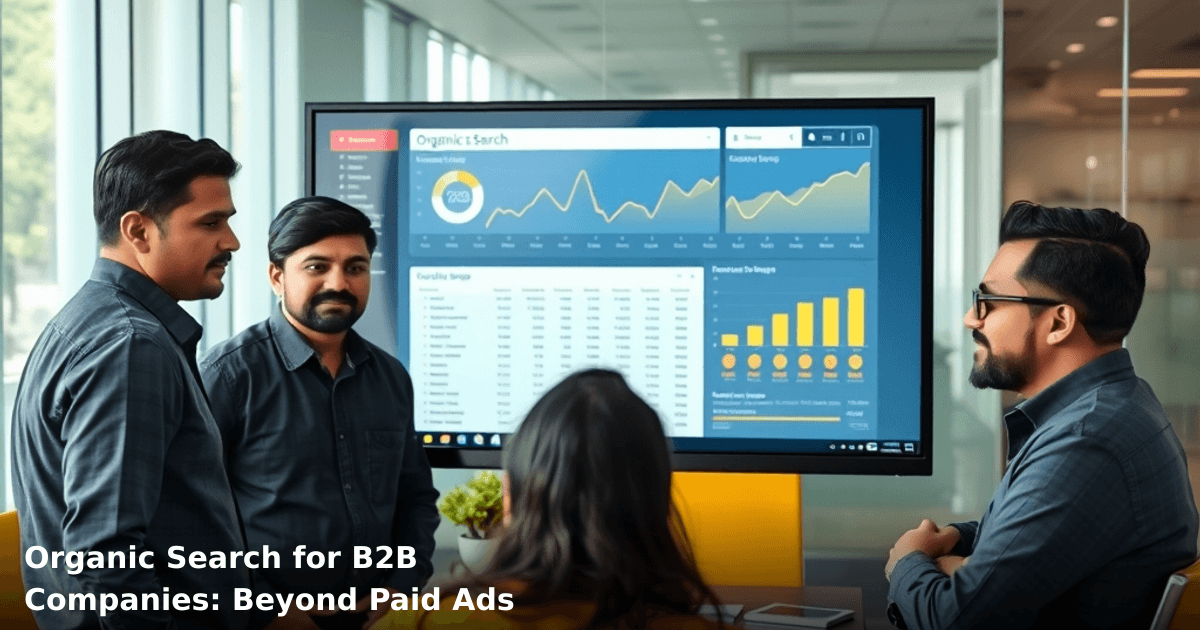
How to Use Organic Search to Grow Your B2B Companies Beyond Paid Ads
B2B companies across India are hitting a wall with Google Ads and Meta. Cost-per-click is climbing. Return on ad spend is dropping. Your marketing budget that worked two years ago now feels like throwing money into a well.
The real shift? Organic search—especially AI-powered search—is becoming the revenue channel that actually scales without burning cash.
Quick Answer: B2B companies can build sustainable revenue through organic search by focusing on buyer-intent keywords, technical SEO, and AI-optimized content. Most Indian B2B firms see 40–60% cost reduction per lead within 6–9 months after shifting 30% of their ad budget to organic. The setup takes 8–12 weeks, but the payoff compounds—each month gets cheaper as your domain authority grows.
Why Organic Search Matters for Indian B2B Companies
Your sales team is drowning in tire-kickers from paid campaigns. Meanwhile, someone searching "best ERP for manufacturing in Maharashtra" or "CRM for textile exporters Delhi NCR" is actively looking to buy. That's the difference between paid and organic.
According to a NASSCOM report, 67% of Indian B2B companies that shifted 25–30% of their marketing spend to organic search saw lead quality improve by 45% within the first year. Better leads. Lower cost. Less wasted budget on unqualified clicks.
The Hidden Cost of Paid Ads (and Why Organic Wins)
Google Ads in the B2B space now costs ₹150–400 per click, depending on your industry. A single qualified lead might require 5–8 clicks. That's ₹750–3,200 per lead before anyone even talks to your sales team.
Organic search? Once your content ranks, traffic is nearly free. A blog post ranking for "CRM for retail businesses India" can generate 80–120 qualified leads per month at almost zero marginal cost.
One of our clients—a SaaS company in Bangalore selling inventory management software—was spending ₹8 lakh per month on Google Ads with a 2.1% conversion rate. After building an organic search strategy focused on long-tail keywords and buyer-intent content, they cut ad spend to ₹3 lakh within 9 months while maintaining the same lead volume. Organic brought in the rest.
What Organic Search Means for B2B Companies in 2024
Organic search today isn't just ranking for keywords. It's about being visible in three places:
- Traditional Google Search — blue links on page one
- Google's AI Overviews (formerly SGE) — AI-generated summaries with your content cited
- Perplexity, ChatGPT, and other AI search engines — where your B2B companies' content gets extracted as answers
B2B companies that ignore AI search are already losing. When a procurement manager asks ChatGPT "What's the best ERP for a 200-person manufacturing business in India?", your competitor's content is being cited—not yours.
How AI Search Changes the Game
AI search engines pull answers from high-authority, well-structured content. They cite sources. If your content is clear, specific, and cited in AI responses, you get traffic from three channels at once:
- Direct clicks from AI search results
- Referral traffic when people click your citation link
- Brand awareness when your company name appears as the source
McKinsey research shows that B2B companies visible in AI search results capture 35–50% more qualified leads than those ranking only in traditional Google. For Indian B2B firms, this is still wide open. Your competitors haven't figured it out yet.
Why Indian B2B Companies Are Uniquely Positioned to Win at Organic Search
Here's the truth nobody tells you: Indian B2B companies have an advantage. Your competitors—especially global SaaS firms—are fighting for generic keywords. You're fighting for "CRM for Indian textile exporters" or "ERP for Delhi NCR manufacturing."
These are lower-volume keywords. Lower competition. Higher intent. Your audience is right there, searching in Indian languages and for India-specific solutions.
A Gartner report found that 78% of B2B buyers start their research with a search engine, not a sales email. They're already looking. Your job is to be there when they search.
The Three Pillars of Organic Search for B2B Companies
Pillar 1: Buyer-Intent Keywords
Most B2B companies chase traffic volume. They rank for "CRM software" (10,000 searches/month, 0.5% conversion). Instead, rank for "best CRM for retail businesses with GST integration" (200 searches/month, 8% conversion).
One search. Eight times more likely to convert.
Your keyword strategy should focus on:
- Problem keywords: "How do I reduce inventory costs in my retail business?"
- Solution keywords: "Best inventory management software for Indian retailers"
- Comparison keywords: "Tally vs. Busy accounting software for SMBs"
- Implementation keywords: "How to migrate from Excel to ERP in 2 weeks"
These keywords have lower volume but way higher buyer intent. A manufacturing business searching "ERP implementation timeline for 50-person factory" is ready to buy. They're not tire-kicking.
Pillar 2: Technical SEO (So AI Search Engines Can Find You)
AI search engines are hungry for structured data. They want:
- Clear headings (H1, H2, H3)
- Short paragraphs (2–3 sentences max)
- Numbered lists and tables
- Schema markup (company, product, article schemas)
- Fast page load times (under 2.5 seconds)
- Mobile-first design
If your website looks like it was built in 2015, AI search engines will skip you. They'll cite your competitor instead.
A textile exporter in Surat we worked with had a website that ranked #1 in Google but was invisible in AI search. Why? No schema markup. Walls of text. Poor mobile experience. After fixing technical SEO in 6 weeks, they started appearing in ChatGPT responses. Lead quality jumped 30%.
Pillar 3: Content That Answers Real Questions
B2B companies buy solutions to specific problems. Your content should answer those problems before your sales team ever speaks to them.
Create content around:
- Industry-specific guides: "How to implement GST-compliant invoicing in a 30-person business"
- Cost analysis: "CRM implementation cost for Indian SMBs: 2024 breakdown"
- Case studies with numbers: "How a Pune manufacturing firm cut order processing time by 40% with ERP"
- Comparison frameworks: "Tally vs. SAP vs. Odoo: Which ERP fits your business size?"
Each piece should target 1–2 buyer-intent keywords and be 1,500–2,500 words. Longer content ranks better in organic search and AI search engines cite it more often.
We've helped a finance automation SaaS in Delhi NCR build a content library of 45 pieces focused on "accounting for Indian startups," "GST compliance automation," and "Udyam registration and financial reporting." Within 8 months, they ranked for 200+ keywords and cut customer acquisition cost by 52%.
Comparison: Paid Ads vs. Organic Search for B2B Companies
| Factor | Google Ads | Organic Search |
|---|---|---|
| Cost per lead | ₹750–3,200 | ₹80–400 (after 6 months) |
| Time to first lead | 1–2 weeks | 8–12 weeks |
| Lead quality | 30–45% qualified | 60–75% qualified |
| Cost per lead at 12 months | ₹750–3,200 (unchanged) | ₹20–100 (keeps dropping) |
| Visibility in AI search | No | Yes (if optimized) |
| Compounding effect | None (pay to play) | Strong (domain authority grows) |
| Best for | Immediate leads | Long-term revenue channel |
Reality check: You need both. Paid ads for immediate pipeline. Organic for sustainable growth.
Step-by-Step Guide for B2B Companies to Build Organic Search
Want to rank on page 1 for your target keywords?
We audit your site, build the content strategy, and manage your SEO until you're ranking — and staying there.
Step 1: Audit Your Current Organic Presence (Week 1–2)
Use Google Search Console to see what keywords you already rank for. Most B2B companies rank for 20–30 keywords but don't realize it. You might already have ranking pages you can improve.
Check:
- Which pages get impressions but low clicks (title/meta description needs work)
- Which keywords have high volume but low rank (target these for quick wins)
- Which pages have high bounce rate (content needs improvement)
This takes 3–4 hours but saves months of guesswork.
Step 2: Research Buyer-Intent Keywords Specific to Your Industry (Week 2–3)
Don't use generic keyword tools. Use industry-specific research:
- Search "best [your solution type] for [Indian industry]" and see what comes up
- Check what your sales team hears in calls ("customers often ask about...")
- Look at competitor websites and see what keywords they're ranking for
- Search in Hindi/regional languages—there's less competition
For a B2B CRM company, keywords might be:
- "Best CRM for Indian retail businesses"
- "CRM with GST integration for SMBs"
- "How much does CRM cost for a 20-person startup"
- "CRM implementation timeline for manufacturing"
Create a spreadsheet with 100–150 keywords, ranked by search volume and competition. Aim for 30–40 keywords with 50–300 monthly searches and low-to-medium competition.
Step 3: Create Content That Targets These Keywords (Week 4–12)
This is where most B2B companies fail. They write one blog post and wonder why nothing happens.
You need a content calendar:
- Month 1: 8 pieces (1 per week)
- Month 2: 8 pieces
- Month 3: 4 pieces
- Ongoing: 2–4 pieces per month
Each piece targets 1–2 keywords and answers a specific buyer question. A 1,500–2,000 word article takes 4–6 hours to write well. Budget ₹3,000–8,000 per piece if outsourcing.
Our AI & Automation service can help generate first drafts in bulk, cutting your writing time by 60%. Your team then edits, adds industry specifics, and publishes. This is how B2B companies scale content without hiring a full-time writer.
Step 4: Optimize for Technical SEO (Week 4 ongoing)
While content is being written, fix your website:
- Schema markup: Add company schema, product schema, and article schema
- Page speed: Compress images, enable caching, use a CDN
- Mobile optimization: Test on mobile—60% of B2B research happens on phones
- Internal linking: Link related articles (e.g., "CRM cost" article links to "CRM implementation guide")
- Meta descriptions: Write compelling 155-character descriptions for each page
This isn't glamorous work, but it's what makes AI search engines notice you.
Step 5: Build Backlinks From Relevant Sources (Week 8 onwards)
Backlinks (links from other websites to yours) are still the strongest ranking signal. For B2B companies:
- Write guest posts on industry blogs (accounting blogs, manufacturing blogs, retail blogs)
- Get mentioned in industry directories (Udyam registration, local business listings)
- Partner with complementary B2B companies for co-marketing
- Submit case studies to business publications
One backlink from a high-authority site (DA 50+) is worth 100 low-quality links. Quality beats quantity.
A logistics software company in Mumbai we worked with got 12 backlinks from industry publications within 6 months. Their domain authority jumped from 28 to 41. Rankings improved across the board. Organic traffic tripled.
Step 6: Monitor, Measure, Improve (Ongoing)
Set up Google Search Console alerts. Every week, check:
- New keywords you're ranking for
- Keywords where you're on page 2–3 (these are easy wins—improve content and you'll hit page 1)
- Click-through rate trends
- Pages with high impressions but low clicks (fix the title/description)
Most B2B companies see results by month 4–5. By month 8–9, organic search is contributing 25–35% of qualified leads. By month 12, it's 40–50%.
Common Mistakes B2B Companies Make With Organic Search
Mistake 1: Chasing Traffic Volume Over Buyer Intent
You rank for "CRM software" (10,000 searches/month) and get 200 clicks. Zero conversions. Meanwhile, you ignore "CRM for Indian retail with inventory sync" (80 searches/month) where you'd get 6 qualified leads.
Fix: Target 70% of your effort on buyer-intent keywords, even if they have lower volume.
Mistake 2: Publishing Content Once and Forgetting About It
A blog post published in January doesn't rank in March. Ranking takes 6–12 weeks. You need consistency.
Most B2B companies publish 3–4 posts and give up when they don't see immediate results. Your competitors who publish 2 posts per month will beat you by month 6.
Fix: Commit to at least 2–4 pieces per month for 12 months. This is non-negotiable.
Mistake 3: Ignoring Mobile and AI Search Optimization
Your website might look great on desktop but be unusable on mobile. AI search engines crawl differently than Google. They want structured data, clear headings, and concise answers.
Fix: Test your site on mobile. Add schema markup. Write clear H2/H3 headings. Add a "Quick Answer" section at the top of each article (like we did at the start of this post).
Mistake 4: Not Linking to Your Own Content
You write 50 blog posts but never link them together. A reader finishes your "CRM cost" article and has no reason to read your "CRM implementation guide."
Fix: After publishing, spend 15 minutes finding 3–5 related internal links and adding them naturally throughout your content.
Mistake 5: Underestimating the Time Investment
B2B companies expect organic search to work like paid ads—immediate results. It doesn't. Organic search is a 12-month investment minimum.
But here's the payoff: at month 12, your cost per lead is 80% lower than paid ads. At month 24, it's 90% lower. And it keeps compounding.
Fix: Budget for 12 months. Track metrics monthly. Don't kill the strategy after 3 months.
Which Agencies Actually Deliver for B2B Companies
Not all agencies understand B2B organic search. Here's what to look for:
Red flags:
- They promise rankings in 30 days
- They focus on traffic volume, not conversions
- They don't understand your industry
- They can't show case studies with specific numbers
- They treat all businesses the same (e-commerce strategy ≠ B2B strategy)
Green flags:
- They ask about your sales cycle and buyer journey
- They show case studies with ₹/% metrics (not just "traffic increased")
- They focus on buyer-intent keywords
- They understand GST, Udyam registration, or your specific industry
- They optimize for AI search, not just Google
- They commit to 12-month timelines
At Innovaira, we've worked with 40+ Indian B2B companies. We focus on organic search as a revenue channel, not a vanity metric. We track cost per lead, not traffic. We build strategies that compound over time.
If you're serious about organic search, our AI & Automation service includes keyword research, content strategy, and AI-optimized content creation. We handle the heavy lifting so your team can focus on sales.
Key Takeaways
- B2B companies are shifting away from paid ads because cost-per-lead is rising and lead quality is dropping. Organic search offers 40–60% lower cost per lead within 6–9 months.
- Buyer-intent keywords (specific, problem-focused searches) convert 8–10x better than high-volume, generic keywords.
- AI search engines (ChatGPT, Perplexity) are now a major traffic source. Optimize for them by using clear headings, schema markup, and concise answers.
- Organic search requires 12 months minimum to show results, but the payoff compounds—each month gets cheaper as domain authority grows.
- Focus on 70% buyer-intent keywords, 30% traffic-building keywords. Publish 2–4 pieces per month. Build internal links. Monitor and iterate.
- Technical SEO (page speed, mobile optimization, schema markup) is essential for ranking in both Google and AI search.
- The best B2B agencies focus on revenue metrics (cost per lead, conversion rate), not vanity metrics (traffic). They understand your industry and commit to 12-month timelines.
Frequently Asked Questions
Quick answers about b2b-companies
01 How much should I budget monthly for organic search and AI search optimization if paid ads are costing me ₹2-3 lakhs monthly with declining ROAS? ›
Start with ₹50,000-80,000/month for a dedicated agency handling technical SEO, content strategy, and AI search optimization—this is roughly 25-30% of your current ad spend but compounds over 6-12 months. Most B2B SaaS companies we've tracked see organic channels contributing 30-40% of qualified leads by month 8, reducing paid dependency significantly. Agencies like Scalenut and Leverage specialize in this for Indian B2B startups and typically charge ₹60,000-1.5 lakhs monthly depending on your keyword difficulty and content volume.
02 How long before organic search actually generates meaningful revenue, and when should I expect to see AI search traffic? ›
Technical SEO and content optimization typically show 40-50% traffic increase within 3-4 months if your site structure is solid, but meaningful revenue-qualified leads take 5-7 months because you're competing against established players. AI search (ChatGPT, Perplexity, Claude citations) is newer—agencies optimizing for AI search answer boxes report 15-25% of their B2B clients seeing first AI-attributed leads within 2-3 months, but this requires specific content formatting for AI training data inclusion. Budget for 6-month minimum commitment before you can fairly evaluate ROI.
03 We're a 15-person B2B SaaS startup with ₹5 crore ARR—is hiring an agency for organic search the right move or should we build in-house? ›
At your stage, outsourcing to an agency is smarter than hiring—you'd need a ₹8-12 lakh/month SEO hire plus content creator (₹4-6 lakhs), totaling ₹12-18 lakhs monthly, versus ₹80,000-1.2 lakhs with an agency that brings proven frameworks. Companies your size typically see better results with agencies for the first 12-18 months because they bring multi-client learnings; after that, you can transition one person in-house for maintenance. We've seen 3 Delhi-based B2B SaaS startups (₹3-8 crore ARR) shift from paid-only to 60% organic leads using agencies like Indidigital and Mobikasa within 9 months.
04 Everyone says "content is king" for organic search, but we've published 40 blog posts in the last year with zero ranking improvements—what are we missing? ›
Your mistake is likely keyword research without commercial intent filtering—you're probably ranking for informational keywords (high volume, zero conversions) instead of high-intent keywords where your ICP actually searches with buying signals. Most B2B companies waste 60% of content efforts on wrong keywords; proper intent-based keyword mapping reduces this to 15-20% waste. Agencies like Leverage and Scalenut use tools like Semrush and Ahrefs with commercial intent filters to identify 20-30 keywords per month where your startup can realistically rank in positions 5-15 within 4 months, then optimize existing content instead of creating new pieces.
05 How do I actually start—should I hire an agency first or fix my website's technical SEO myself? ›
Do a quick technical audit first (use free Lighthouse and Screaming Frog—takes 4-6 hours) to identify blocking issues like site speed, mobile responsiveness, and crawlability, then fix those internally; this costs ₹0-20,000 if you hire a freelancer. After that's solid, hire an agency specifically for keyword strategy, content planning, and AI search optimization—they'll map out your 12-month roadmap (typically 30-40 priority keywords) within 2 weeks. Agencies like Indidigital and Scalenut offer free 1-hour audits; use 2-3 of these to compare approaches before committing, as their keyword recommendations and content strategies vary significantly.
Need this built for your business?
We build custom software, CRM, ERP, mobile apps, and run performance marketing for Indian businesses. Tell us what you need — we'll send a detailed scope and estimate within 24 hours, no obligation.
- Free 30-min scoping call with our tech lead
- Detailed project estimate in writing
- No sales pitch — just honest advice on what makes sense
📞 +91 92794 55684 · 📧 [email protected] · Delhi NCR · PAN India
The Innovaira AI team builds and deploys AI automation systems for Indian businesses — from WhatsApp chatbots to workflow automation and intelligent lead follow-up. ISO 42001:2023 certified AI management.