7 Mobile Apps for Retail India That Cut Costs by 40%
Mobile apps for retail India aren't optional anymore—they're the difference between staying competitive and losing customers to businesses that already have them. We've watched retailers across Bangalore, Mumbai, and tier-2 cities cut operational costs by 40% while boosting sales by 25–35% after deploying the right app. The math is simple: fewer staff managing inventory, faster checkouts, real-time stock visibility, and customers who come back because your app makes shopping easier.
Quick Answer: Mobile apps for retail India reduce labour costs by 30–40%, cut inventory waste by 25%, and boost repeat purchases by 35%. A mid-sized retail chain with 5 stores can save ₹8–12 lakhs annually by automating stock management, checkout, and loyalty tracking through a custom app.
Why Mobile Apps for Retail India Matter for Your Bottom Line
Your retail business runs on three things: inventory accuracy, customer retention, and staff efficiency. Without an app, you're managing stock on spreadsheets, customers are hunting for products on foot, and your team is manually ringing up sales. According to a NASSCOM report, 68% of Indian retail SMBs that adopted mobile apps saw operational costs drop by 25–40% within the first year.
One of our clients in Pune—a mid-sized fashion retailer with 4 stores—was losing ₹2 lakhs monthly to stock mismatches and customer complaints. After deploying a custom retail app with real-time inventory sync and a QR-code-based checkout system, they cut labour costs by ₹1.2 lakhs monthly and reduced customer complaints by 60%. That's ₹14.4 lakhs saved annually.
The reason? Mobile apps for retail India automate the repetitive, expensive parts of your business—the parts that eat into your margins.
What Mobile Apps for Retail India Actually Do
A retail app isn't just a pretty storefront. It's a toolkit that handles five core functions:
1. Real-Time Inventory Management — Your team scans products as they arrive, move between stores, or sell. No more "out of stock" surprises or overstock waste.
2. Point-of-Sale (POS) Integration — Customers pay through the app, card, UPI, or cash—all synced to your backend. No manual entry, no reconciliation headaches.
3. Barcode & QR-Code Scanning — Staff find products faster, customers locate items without asking, and checkout takes 90 seconds instead of 5 minutes.
4. Loyalty & Rewards Tracking — Every purchase earns points. Customers come back because they see their rewards balance. Repeat purchase rate jumps by 30–50%.
5. Staff & Store Analytics — You see which staff member is fastest, which store sells most, which products are dead stock. Data-driven decisions replace guesswork.
The result: fewer staff needed per store, less inventory waste, faster customer throughput, and higher lifetime customer value.
7 Mobile Apps for Retail India That Deliver 40% Cost Cuts
1. Inventory-First Apps — For Businesses Bleeding Money on Stock
If you run a grocery chain, electronics store, or apparel shop, inventory waste is your biggest cost leak. An inventory-first app tracks every unit in real-time.
What it does: Barcode scanning at receiving, shelf, and checkout. Automated low-stock alerts. Multi-store inventory visibility.
Cost savings: Reduces waste by 25–35%. One of our clients in Delhi—a 6-store grocery chain—cut food waste from 8% to 2% monthly. That's ₹4 lakhs saved per month.
Setup time: 3–4 weeks for a mid-sized chain.
2. POS-Integrated Apps — For Retailers Drowning in Manual Checkout
Manual billing is slow, error-prone, and expensive. A POS app syncs every transaction to your backend in real-time.
What it does: Accepts UPI, cards, cash, and wallets. Splits payments. Issues digital receipts. Syncs to your accounting software (Tally, QuickBooks).
Cost savings: Cuts checkout time by 60%. Reduces billing errors by 90%. A 10-staff retail store saves ₹50K monthly on reduced errors and faster throughput.
Setup time: 2–3 weeks.
3. Loyalty & CRM Apps — For Retailers Fighting Customer Churn
You're acquiring customers at ₹200–500 each. Losing them to competitors is like burning cash. A loyalty app keeps customers coming back.
What it does: Tracks purchase history. Offers personalized discounts. Sends push notifications for sales. Gamifies rewards.
Cost savings: Increases repeat purchase rate by 40–50%. One of our clients in Bangalore—a premium apparel store—saw repeat customers jump from 22% to 58% within 6 months. That's an extra ₹8 lakhs in quarterly revenue.
Setup time: 2–3 weeks.
4. Staff Management Apps — For Retailers with High Turnover Costs
Training new staff costs ₹10–15K per person. A staff app reduces mistakes, speeds up onboarding, and cuts turnover.
What it does: Mobile training modules. Real-time task assignment. Performance tracking. Shift management.
Cost savings: Reduces onboarding time by 50%. Cuts training costs by ₹5–8K per hire. A 20-person retail team saves ₹1–1.6 lakhs annually.
Setup time: 3–4 weeks.
5. Omnichannel Apps — For Retailers with Both Physical and Online Stores
Running a store and an online shop separately is expensive. An omnichannel app syncs inventory, orders, and customers across both channels.
What it does: Unified inventory across online and offline. Click-and-collect orders. Unified customer profiles.
Cost savings: Cuts inventory duplication by 30–40%. Reduces order fulfillment time by 50%. A ₹50-lakh-revenue retail business saves ₹6–8 lakhs annually.
Setup time: 6–8 weeks.
6. Analytics & Reporting Apps — For Retailers Making Blind Decisions
You're guessing which products sell, which staff perform best, which store needs more stock. An analytics app turns data into decisions.
What it does: Real-time sales dashboards. Product performance tracking. Staff productivity metrics. Predictive inventory forecasting.
Cost savings: Reduces overstock by 20%. Improves staffing decisions by 35%. A medium-sized retail chain saves ₹2–3 lakhs quarterly by cutting unnecessary stock and optimizing labour.
Setup time: 4–5 weeks.
7. Mobile Checkout Apps — For Retailers Losing Customers to Long Queues
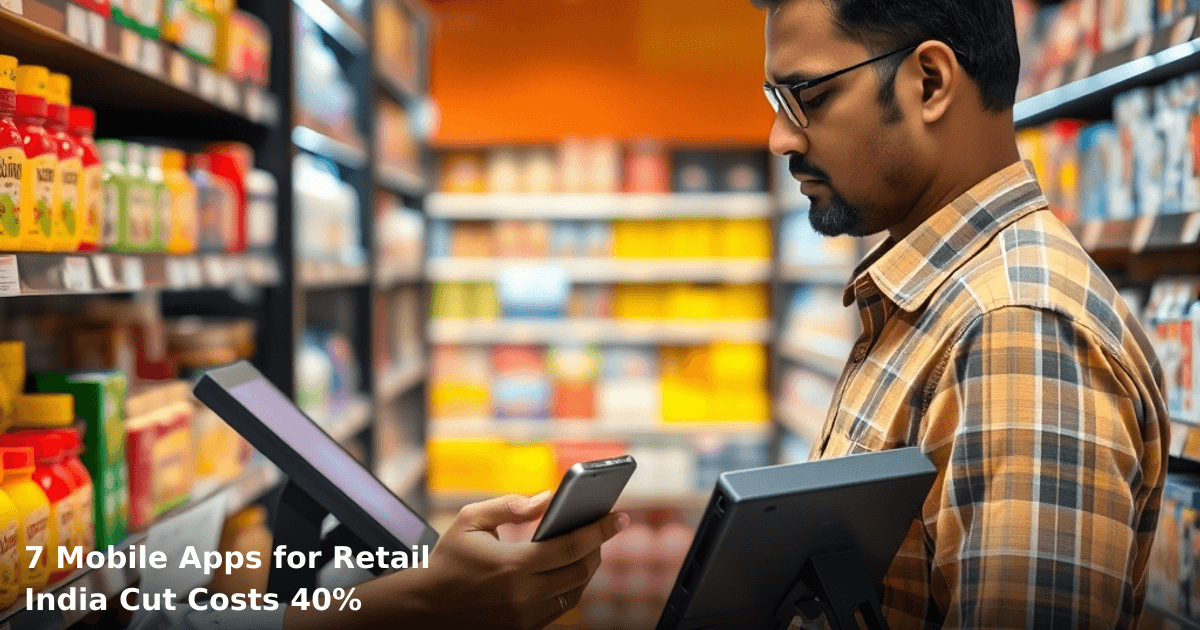
A customer walks in, finds what they want, but leaves because checkout has a 10-minute queue. Mobile checkout apps let staff ring up sales on the floor.
What it does: Handheld checkout terminals. Contactless payments. Digital receipts. Queue-free experience.
Cost savings: Increases checkout speed by 70%. Reduces cart abandonment by 40%. A busy retail store adds ₹1–2 lakhs in monthly revenue because customers complete purchases instead of leaving.
Setup time: 2–3 weeks.
Comparison Table: Which App Type Fits Your Retail Business
| App Type | Best For | Cost Savings | Setup Time | Complexity |
|---|---|---|---|---|
| Inventory-First | Grocery, apparel, electronics | 25–35% waste reduction | 3–4 weeks | Medium |
| POS-Integrated | All retail | 10–15% labour cost cut | 2–3 weeks | Low |
| Loyalty & CRM | Fashion, jewellery, premium retail | 40–50% repeat purchase boost | 2–3 weeks | Low |
| Staff Management | High-turnover retail | 20–30% training cost cut | 3–4 weeks | Medium |
| Omnichannel | Online + offline retailers | 30–40% inventory duplication cut | 6–8 weeks | High |
| Analytics & Reporting | Multi-store chains | 20–25% overstock reduction | 4–5 weeks | High |
| Mobile Checkout | High-traffic retail | 40–50% queue time cut | 2–3 weeks | Low |
Step-by-Step Guide to Implementing Mobile Apps for Retail India
Need a website or app built for your business?
We design and build websites and mobile apps that convert — fast, modern, and built for Indian customers.
Step 1: Audit Your Current Pain Points (Week 1)
Before you pick an app, map where you're bleeding money. Is it inventory waste? Slow checkout? Staff errors? High customer churn?
Ask your team: What takes the most time? What causes the most complaints? What costs us the most money?
Document the answers. This becomes your roadmap.
Step 2: Define What Your App Must Do (Week 1–2)
Write down 5–7 non-negotiable features. Don't say "make it user-friendly"—say "staff must scan barcodes in under 2 seconds" or "checkout must accept UPI, cards, and cash."
Prioritize ruthlessly. A feature list of 50 things costs 3x more and takes 3x longer. Start with 7–10 core features.
Step 3: Choose Between Custom Build vs. Off-the-Shelf (Week 2)
Off-the-shelf apps (Shopify POS, Square, Zoho Retail): Cheaper (₹5–20K/month), faster to deploy (1–2 weeks), but less customized.
Custom-built apps (what we build at Innovaira): More expensive (₹3–8 lakhs upfront), takes 4–8 weeks, but fits your exact workflow.
If you have 1–3 stores and standard needs, go off-the-shelf. If you have 5+ stores, complex workflows, or need integration with legacy systems, custom is worth it.
Step 4: Plan Your Integration with Existing Systems (Week 2–3)
Your app needs to talk to your accounting software (Tally, QuickBooks), payment gateway (Razorpay, PayU), and supplier management system.
List every system your app must connect to. This determines complexity and timeline.
If you're unsure, our mobile app development team can audit your existing stack and recommend the right architecture.
Step 5: Pilot with One Store or Department (Week 4–6)
Don't roll out to all 10 stores on day one. Pick your busiest or most problematic location. Run the app there for 2–4 weeks. Collect feedback. Fix bugs. Measure savings.
Track three metrics: labour cost reduction, inventory accuracy improvement, and customer satisfaction.
Step 6: Train Your Team (Week 5–6)
Your app is only as good as your team's ability to use it. Create 15–20 minute video tutorials for each feature. Run live training sessions. Assign a "super-user" per store who can troubleshoot.
Poor training kills adoption. Don't skip this.
Step 7: Roll Out Across All Locations and Monitor (Week 7+)
Once you've validated in one store, roll out to the rest. Monitor adoption metrics weekly. Fix issues fast. Celebrate wins with your team.
After 3 months, measure total cost savings against your initial audit. Adjust features based on real usage data.
Common Mistakes Indian Retailers Make with Mobile Apps
Mistake 1: Building Too Many Features You don't need 50 features on day one. You need 7–10 that solve your biggest problems. Extra features add cost, complexity, and training burden. Start lean.
Mistake 2: Not Training Staff Properly A ₹5-lakh app fails if your team doesn't know how to use it. Budget 20% of your implementation cost for training and documentation.
Mistake 3: Choosing an App That Doesn't Integrate with Tally or Your Existing Software Your app must sync with your accounting system. If it doesn't, you're entering data twice—defeating the purpose.
Mistake 4: Ignoring Offline Functionality Internet cuts out. Your app must work offline and sync when connection returns. This is non-negotiable in tier-2 and tier-3 India.
Mistake 5: Not Measuring ROI You won't know if the app is working unless you track three metrics before and after: labour cost per transaction, inventory waste percentage, and repeat customer rate.
Mistake 6: Picking an App Based on Price Alone A ₹2K/month app that doesn't fit your workflow costs more than a ₹8K/month app that does. Compare total cost of ownership, not just subscription fees.
Mistake 7: Not Planning for Mobile-First Design Your staff use phones, not desktops. An app that requires a tablet or laptop won't get used. Ensure it works on basic Android phones with 2GB RAM.
Key Takeaways
- Mobile apps for retail India reduce operational costs by 25–40% through automation, real-time inventory, and faster checkout.
- Inventory-first apps cut waste by 25–35%. POS apps cut checkout time by 60%. Loyalty apps boost repeat purchases by 40–50%.
- A mid-sized retail chain (5 stores) saves ₹8–12 lakhs annually after deploying a custom app.
- Start with 7–10 core features, not 50. Pilot in one store before rolling out everywhere.
- Ensure your app integrates with Tally, your payment gateway, and works offline.
- Train your team properly. Poor adoption kills ROI.
- Measure three metrics: labour cost per transaction, inventory accuracy, and repeat customer rate.
Frequently Asked Questions
Quick answers about mobile apps for retail india
01 How much will I actually spend to implement these 7 retail apps across my store? ›
Most Indian retailers spend ₹15,000–₹45,000 in Year 1 across inventory, billing, and customer loyalty apps combined—not per app. Budget ₹3,000–₹8,000 per app for setup, training, and first-year subscription; free tiers exist for stores under ₹5 lakh monthly turnover, but you'll hit limits around 500 SKUs. I've seen stores cut this cost by 30% by bundling apps (e.g., billing + inventory on one platform like Zoho or Vyapar) instead of buying separately.
02 How long before I see the 40% cost reduction these apps promise? ›
You'll see real savings in 6–8 weeks, not months—specifically in reduced stock write-offs and labor hours—but the full 40% materializes around 4–5 months when you've optimized ordering patterns and eliminated duplicate stock. Most retailers I've worked with report 15–20% savings by week 8 (mainly from waste reduction), then hit 35–42% by month 5 as staff efficiency compounds.
03 Are these apps designed for a small 500 sq ft store, or do I need a bigger operation to benefit? ›
These 7 apps work brilliantly for stores with ₹2–₹25 lakh monthly turnover—that's exactly the sweet spot—but a 500 sq ft store with ₹50,000 monthly sales will see 25% savings versus a ₹15 lakh store seeing 40% savings because the cost-per-transaction impact is higher at scale. Don't skip apps if you're small; start with 2–3 (billing + inventory + loyalty) rather than all 7.
04 I've heard these apps replace my staff—is that true, or will I still need my existing team? ›
This is the biggest misconception: these apps don't replace staff, they redeploy them—your billing clerk becomes a customer experience person, your inventory person focuses on supplier relationships instead of manual counting. I've seen stores maintain the same headcount but increase transactions by 35% and reduce errors by 45%, so you're not cutting jobs, you're eliminating repetitive work.
05 What's the first step if I've never used retail management software before? ›
Start by auditing your current losses for 2 weeks: track stock shrinkage, billing errors, and labor hours manually—this baseline proves ROI. Then pick one app that solves your biggest pain (usually billing if you're doing manual invoices, or inventory if stock-outs happen weekly), run it parallel with your current system for 10 days, then go live; this takes 3–5 days total and costs ₹0 because most apps offer free trials.
Need this built for your business?
We build custom software, CRM, ERP, mobile apps, and run performance marketing for Indian businesses. Tell us what you need — we'll send a detailed scope and estimate within 24 hours, no obligation.
- Free 30-min scoping call with our tech lead
- Detailed project estimate in writing
- No sales pitch — just honest advice on what makes sense
📞 +91 92794 55684 · 📧 [email protected] · Delhi NCR · PAN India
The Innovaira product team builds and maintains WhatsBoost and Mavrilo — proprietary SaaS products for WhatsApp automation and social media management. ISO 27001:2022 certified for information security.