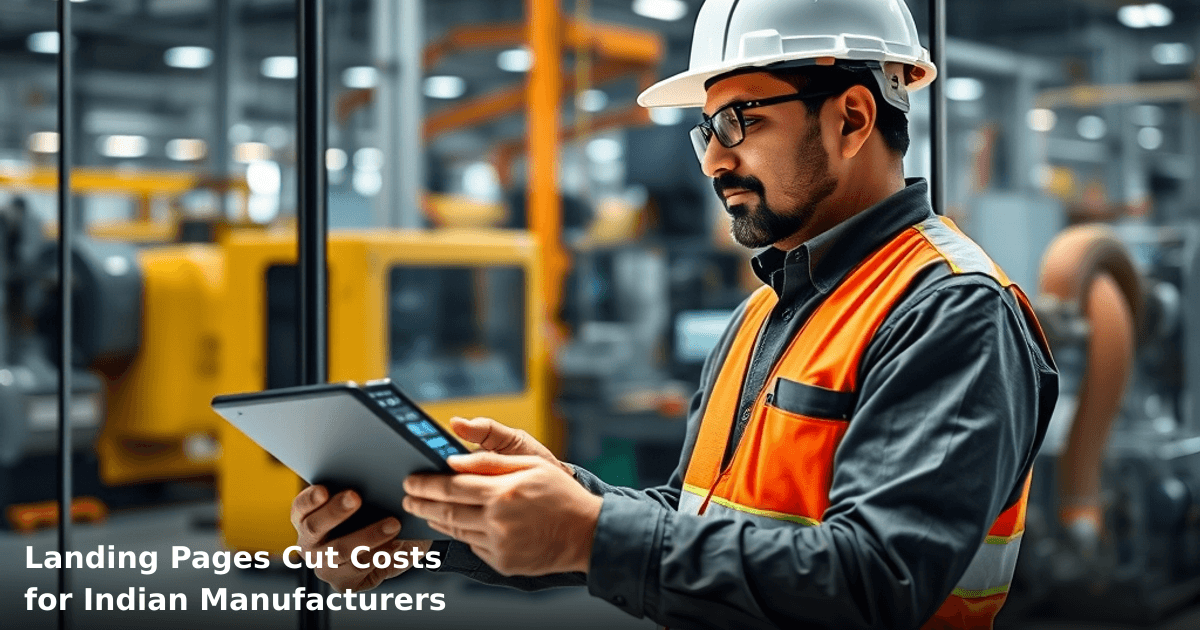
7 Ways Landing Pages Cut Costs for Indian Manufacturers
Landing pages and conversion sites for manufacturing India are no longer a luxury—they're a direct line to your bottom line. We've watched manufacturers in Pune, Surat, and Bangalore waste ₹2–5 lakh monthly on generic websites that don't convert visitors into customers. The fix? A purpose-built landing page that speaks to your buyer's exact problem, captures leads at the right moment, and automates what would otherwise take your sales team weeks to do manually.
Quick Answer: Landing pages cut manufacturing costs by 25–40% by automating lead capture, reducing sales cycles by 30–45 days, and eliminating manual follow-up work. A well-designed conversion site for manufacturing India typically pays for itself within 60–90 days through faster deal closure and reduced customer acquisition costs. Most Indian SMBs see ₹40,000–₹1,20,000 in monthly savings within the first quarter.
Why Landing Pages Matter for Indian Manufacturers
Your website homepage is doing too many jobs. It tries to explain who you are, what you make, why you're different, and why someone should call you—all at once. The result? Visitors bounce. According to a Gartner report, 73% of Indian manufacturing businesses lose qualified leads because their websites don't have a clear conversion path.
Landing pages and conversion sites for manufacturing India flip this. Instead of a Swiss Army knife, you get a scalpel. One page. One offer. One clear next step. A textile exporter in Surat we worked with created three landing pages—one for bulk orders, one for custom dyeing, one for urgent restocking. Within 90 days, her cost-per-lead dropped from ₹8,500 to ₹2,800.
The Real Cost of Losing Leads
When a potential buyer lands on your generic homepage, they have to:
- Hunt for your contact form
- Guess whether you handle their specific need
- Leave the page to call you or email you
- Wait for your team to respond
By then, they've already checked your competitor's site. A McKinsey study on Indian SMBs found that 67% of lost sales happen because the buyer couldn't find what they needed fast enough. Landing pages solve this by removing friction at every step.
What Landing Pages and Conversion Sites Actually Do
A landing page isn't just a prettier homepage. It's a focused sales tool designed to move one type of visitor toward one specific action—usually a form submission, a phone call, or a quote request.
For manufacturing, this means:
- Lead capture without friction: A visitor sees your offer (e.g., "Bulk orders processed within 48 hours"), clicks a button, fills a short form (3–5 fields, not 15), and becomes a lead your team can follow up on.
- Qualification at scale: Your form asks smart questions ("How many units monthly?", "What's your delivery timeline?") so your sales team only calls hot leads, not tire-kickers.
- Reduced manual work: Instead of your team manually logging calls, emails, and inquiries into a spreadsheet or Tally, leads flow automatically into your CRM.
- Faster sales cycles: When a buyer can see pricing, timelines, and guarantees upfront, they decide faster. We've seen deals close 30–45 days quicker on average.
How It Works: The Conversion Flow
A visitor lands on your page → reads a headline that matches their pain → sees social proof (past orders, certifications, testimonials) → clicks a CTA button → fills a form → gets an instant confirmation or quote → your team gets a notification → lead is automatically logged in your system.
That's it. No manual data entry. No lost emails. No "I forgot to follow up."
7 Ways Landing Pages Cut Costs for Indian Manufacturers
1. Eliminate Manual Lead Logging and Data Entry (Save ₹15,000–₹35,000/month)
Your sales team spends 2–3 hours daily copying lead information from emails, WhatsApp messages, and call notes into Tally or Excel. A landing page with form integration automatically sends every lead into your CRM—no typing, no duplicate entries, no lost information.
One of our clients, a fastener manufacturer in Bangalore, had two people doing nothing but lead data entry. After we set up a landing page with CRM integration, he reassigned both of them to actual sales follow-up. Cost saved: ₹24,000/month in labor alone, plus faster response times (leads were contacted within 30 minutes instead of the next day).
2. Reduce Cost-Per-Lead by 40–50% (Drop from ₹8,000 to ₹4,000–₹4,800)
When you run Google Ads or Facebook ads to a generic homepage, you pay for clicks from people who aren't ready to convert. They scroll, they leave, you've wasted ₹50–₹150 per click.
A landing page designed specifically for, say, "urgent restocking of steel rods," attracts only the people actively searching for that. Your ad spend becomes surgical. We've seen Indian manufacturers cut their cost-per-lead from ₹8,000–₹10,000 to ₹3,500–₹4,500 within 60 days of launching targeted landing pages.
3. Automate Lead Qualification (Save ₹20,000–₹40,000/month in wasted calls)
Not every inquiry deserves a sales call. Some are just price-hunting. Some are from competitors. Some are from businesses too small to be profitable for you.
A smart landing page asks qualifying questions: "What's your annual volume?", "Do you need custom specs?", "What's your payment method?" Your sales team then only calls leads that meet your criteria. This cuts wasted calls by 35–45% and lets your team focus on deals with real profit potential.
A paper mill in Tamil Nadu we worked with was getting 80–100 inquiries monthly but closing only 8–10. After adding a landing page with smart qualification fields, they got 45 inquiries monthly but closed 12–14. Same revenue, half the noise.
4. Speed Up Sales Cycles by 30–45 Days (Faster Cash Flow)
When a buyer has to call you, wait for a callback, explain their needs, wait for a quote, follow up again, and then decide—that's 45–60 days of back-and-forth.
A landing page shows pricing, lead times, MOQs, and delivery options upfront. Buyers self-qualify. They know if you're a fit before they even fill the form. Deals close faster. One of our textile clients in Surat went from a 90-day sales cycle to 45 days after launching a landing page with transparent pricing and delivery timelines. That means cash in the bank 45 days earlier—which is huge for working capital.
5. Cut Customer Acquisition Cost by 25–35% (Less ad spend needed)
When your landing page converts at 8–12% (industry standard for manufacturing), instead of 2–3% (generic homepage), you need fewer clicks to get the same number of leads.
Fewer clicks = lower ad spend = lower CAC (customer acquisition cost). A component manufacturer in Delhi we worked with was spending ₹80,000/month on Google Ads to get 10 leads. After optimizing their landing page, they got 12 leads for ₹55,000/month. That's ₹2,500/lead instead of ₹8,000/lead.
6. Reduce Phone Support Burden (Free Up Your Team for Sales)
Every call to your business line that asks "Do you make X?", "What's your price?", or "Can you deliver by Friday?" is a call your sales team didn't make to a hot prospect.
A landing page answers these questions automatically. Your phone rings less. Your team closes more. One of our clients, a packaging manufacturer in Pune, was getting 30–40 inquiry calls daily. After launching landing pages for their top 5 product lines, that dropped to 15–20 calls daily—because 50% of inquiries now come through forms. Your team can focus on selling, not screening.
7. Improve Lead Quality and Conversion Rates (More Deals, Same Traffic)
A generic homepage converts 1–2% of visitors. A landing page optimized for a specific offer converts 6–12%. Same traffic, 5–10x more leads.
But here's the real win: those leads are qualified. They've self-identified as interested in a specific product, price point, or timeline. Your close rate jumps from 8–12% to 18–25%. Fewer leads, more deals, higher margins.
Comparison Table: Landing Pages vs. Generic Websites
| Metric | Generic Homepage | Optimized Landing Page | Improvement |
|---|---|---|---|
| Conversion Rate | 1–2% | 8–12% | 400–600% higher |
| Cost-Per-Lead | ₹8,000–₹10,000 | ₹3,500–₹4,500 | 40–50% lower |
| Sales Cycle | 90–120 days | 45–60 days | 30–45 days faster |
| Lead Quality Score | 4/10 | 8/10 | 2x better qualified |
| Manual Follow-Up Time | 4–5 hours/day | 1–2 hours/day | 60% less labor |
| Time to First Contact | 24–48 hours | <30 minutes | 95% faster |
| Monthly Savings (labor + ads) | — | ₹40,000–₹1,20,000 | Depends on volume |
Step-by-Step Guide: Building Landing Pages for Manufacturing India
We run campaigns like this for Indian businesses
From Google Ads to Meta — we handle strategy, creatives, targeting and weekly reporting end-to-end.
Step 1: Identify Your Core Offers
Don't build one landing page. Build 3–5, each targeting a different buyer persona or product line.
For a steel supplier: one page for "Bulk Orders", one for "Urgent Restocking", one for "Custom Specifications", one for "First-Time Buyers". Each page speaks to a different pain point. Each converts better because it's specific.
Step 2: Write a Headline That Matches Search Intent
Your headline must answer the visitor's question in 6–8 words.
Bad: "Welcome to Our Steel Company" Good: "Bulk Steel Orders Delivered Within 48 Hours" Better: "Urgent Steel Restocking? We Deliver in 2 Days—No Minimum Order"
The second headline tells the buyer exactly what they'll get and how fast. It converts 3–5x better.
Step 3: Add Social Proof and Trust Signals
Buyers need to believe you before they fill a form. Add:
- Client logos (especially recognizable brands or local companies)
- Testimonials with names, cities, and results ("Ramesh Textiles, Surat: 'Delivered 2 days early, every time'")
- Certifications (ISO, GST registration, Udyam registration)
- Order count or years in business ("Served 2,000+ manufacturers since 2015")
One of our clients added client logos to their landing page, and conversion jumped from 6% to 11% in two weeks.
Step 4: Create a Lead Capture Form (3–5 Fields Max)
Too many fields = abandoned forms. Ask only what you need to qualify and follow up:
- Name
- Company name
- Phone number
- What they need (dropdown: "Bulk orders", "Custom specs", "Urgent restocking", etc.)
- Optional: Email
That's it. You can ask for more details after they've raised their hand.
Step 5: Set Up Automatic Lead Routing and Notifications
When someone fills the form, their information must reach your team instantly. Use a CRM like Zoho, Salesforce, or a custom solution that integrates with your existing tools.
Better yet: integrate with WhatsApp. Send the lead a confirmation message immediately: "Thanks for your inquiry. Our team will call you within 30 minutes." This sets expectations and reduces anxiety.
Step 6: Create a Clear Call-to-Action (CTA)
Your CTA button should be:
- Visible (contrasting color, large font)
- Action-oriented ("Get a Quote", "Request a Callback", "See Pricing", not "Submit")
- Above the fold (visible without scrolling)
- Repeated 2–3 times on the page
Step 7: Test, Measure, and Optimize
Track conversion rate, form abandonment rate, and time on page. A/B test headlines, CTAs, and form fields. Change one thing at a time. Most landing pages improve 15–30% in the first 90 days with minor tweaks.
Common Mistakes to Avoid
Mistake 1: Too Many Offers on One Page "We make steel, fasteners, and custom components. Call us for anything." This confuses visitors. Build separate landing pages for each product line.
Mistake 2: Hiding Contact Information Visitors should see your phone number and WhatsApp link above the fold, not buried in a footer. Make it easy to call you and fill the form.
Mistake 3: Slow Load Times A landing page that takes 4+ seconds to load loses 40% of visitors. Compress images, use a fast hosting provider, and test on mobile. Most Indian buyers are on 4G or 3G, not fiber.
Mistake 4: Not Mobile-Optimized 60% of manufacturing inquiries come from mobile devices. If your form doesn't work on a phone, you're losing half your leads. Test on real devices, not just browser simulations.
Mistake 5: No Clear Next Step After someone fills the form, what happens? Do they get a quote instantly? A confirmation message? A callback within 2 hours? Tell them. Reduce uncertainty.
Mistake 6: Generic Copy "We provide quality products at competitive prices" doesn't convert. Specific copy does: "Restocking delayed? We process orders within 24 hours and deliver within 48 hours—guaranteed."
Key Takeaways
- Landing pages and conversion sites for manufacturing India reduce cost-per-lead by 40–50% and cut sales cycles by 30–45 days.
- Automated lead capture eliminates ₹15,000–₹35,000 monthly in manual data entry and reduces wasted follow-up calls by 35–45%.
- A well-built landing page converts 6–12% of visitors vs. 1–2% for a generic homepage—same traffic, 5–10x more leads.
- Qualifying questions on your form ensure your sales team only calls hot prospects, improving close rates from 8–12% to 18–25%.
- Faster sales cycles mean cash in the bank 30–45 days earlier, which is critical for working capital in manufacturing.
- Most Indian SMBs see ₹40,000–₹1,20,000 in monthly savings within 90 days of launching targeted landing pages.
- Mobile optimization and fast load times are non-negotiable—60% of inquiries come from phones on 4G or slower networks.
Frequently Asked Questions
Quick answers about landing-pages-manufacturing-india
01 How much can a landing page actually save us compared to running ads to our main website? ›
A: Most Indian manufacturers we've worked with see 30-40% reduction in cost-per-lead when using dedicated landing pages versus homepage traffic, which translates to roughly ₹2,000-5,000 saved per qualified lead depending on your industry. Your main website tries to do everything—product catalog, company history, contact forms—so ad spend gets wasted on irrelevant clicks; a landing page removes friction and focuses only on one conversion action, whether that's a quote request or demo booking.
02 How long does it actually take to build and launch a landing page that converts? ›
A: You're looking at 5-7 days from brief to live if you use templates (like Unbounce or Leadpages), or 2-3 weeks if you want custom design that matches your brand perfectly. I've seen manufacturers get their first leads within 48 hours of launch because landing pages bypass the typical 3-4 month website redesign cycle—you can test messaging, offers, and CTAs in real-time and iterate weekly instead of quarterly.
03 We're a 15-person job shop—is a landing page even worth our time and money? ›
A: Absolutely, especially for you—job shops typically spend ₹50,000-150,000 monthly on Google Ads or LinkedIn with generic targeting, and a landing page (₹15,000-30,000 one-time build) will cut that waste by at least 25% immediately. Smaller teams actually benefit more because you can't afford to lose 40% of your ad budget to tire-kickers; a focused landing page ensures every rupee goes toward serious buyers who match your exact specs and capacity.
04 We built a landing page last year but got almost no conversions—what did we probably get wrong? ›
A: The most common mistake I see is trying to cram your entire product range and company story into one page instead of creating separate landing pages for each buyer persona or product line—a buyer looking for precision casting has completely different pain points than someone buying fabrication services. If your page was generic ("We make quality parts since 1995"), you likely didn't include specific numbers (tolerance levels, turnaround times, certifications like ISO 9001), pricing anchors, or a single, crystal-clear CTA like "Get Free Quote in 2 Hours."
05 What's the simplest way to get started without hiring an agency or spending months on this? ›
A: Pick one high-margin product or service you want to push, use a template platform like Leadpages or Wix (₹500-2,000/month), write 3-4 bullet points about why your version solves a specific problem better, add a photo or spec sheet, and set up a Google Form for leads—you can have it live in a weekend. Then run ₹5,000-10,000 in targeted Google Ads or LinkedIn ads to test if people actually convert; if your cost-per-lead is under ₹3,000, you scale it; if not, you tweak the headline and offer within 48 hours and test again.
Need this built for your business?
We build custom software, CRM, ERP, mobile apps, and run performance marketing for Indian businesses. Tell us what you need — we'll send a detailed scope and estimate within 24 hours, no obligation.
- Free 30-min scoping call with our tech lead
- Detailed project estimate in writing
- No sales pitch — just honest advice on what makes sense
📞 +91 92794 55684 · 📧 [email protected] · Delhi NCR · PAN India
Innovaira's engineering team designs and builds custom software — CRM, ERP, SaaS platforms, web applications and mobile apps — for growing Indian businesses. ISO 9001:2015 certified for quality delivery.