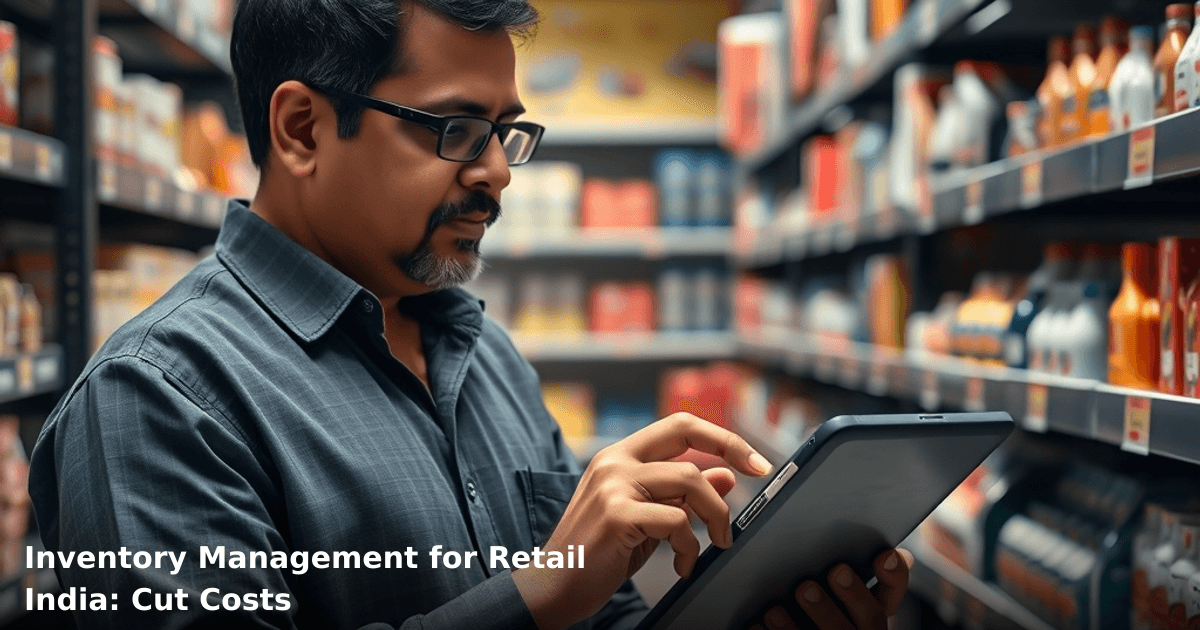
7 Ways Inventory Management for Retail India Cuts Costs — And How You're Losing Money Right Now
Your retail store in Mumbai, Bangalore, or any tier-2 city is bleeding money through inventory gaps. Dead stock gathering dust. Fast-moving items running out mid-week. Staff manually counting boxes instead of selling. Inventory management for retail India isn't just about tracking SKUs—it's about reclaiming ₹40,000 to ₹2,00,000 every month that your business is currently hemorrhaging.
We've watched retail owners waste entire profit margins on inventory chaos. One apparel chain in Pune was holding ₹18 lakhs in dead stock. Another quick-service restaurant in Delhi had to throw away ₹12,000 worth of perishables monthly because no one knew what was already in the back. Both fixed it with proper inventory systems.
Quick Answer: Inventory management for retail India reduces costs by automating stock tracking, cutting dead stock by 35–50%, minimizing wastage by 20–30%, and freeing up 10–15 hours of manual work weekly. Most retail SMBs save ₹50,000–₹1,50,000 monthly within 3–4 months of implementation.
Why Inventory Management Matters for Indian Retail Businesses
Your retail inventory is your second-largest expense after payroll. According to a McKinsey study, 23% of Indian retail SMBs lose 15–25% of annual profit to inventory mismanagement alone. That's not a small leak—that's a pipe burst.
Here's what happens without proper retail inventory management:
- Overstocking: You tie up cash in products no one's buying. In seasonal retail (think winter wear in August), this can lock up ₹3–5 lakhs for months.
- Stockouts: Customers walk to your competitor. One missed sale might seem small, but multiply it across a month: ₹50,000–₹1,00,000 in lost revenue.
- Shrinkage: Theft, damage, and expiry waste 2–8% of inventory value in Indian retail. For a ₹5 lakh monthly stock, that's ₹10,000–₹40,000 gone.
- Manual tracking errors: Your staff is counting inventory on paper or Excel. Mistakes happen. You order too much of one item, miss reordering another. Both kill margins.
Inventory management for retail in India solves all four problems. Let's see how.
What Inventory Management for Retail India Actually Does
Before we get into the 7 ways it cuts costs, let's be clear: we're not talking about spreadsheets and clipboards.
Real inventory management means:
- Real-time stock visibility — You know exactly how many units of each SKU are in store, in transit, or in the warehouse. No guessing. No counting.
- Automated reordering — The system flags low-stock items and suggests purchase orders based on sales velocity. Your supplier gets the order before you even think about it.
- Demand forecasting — The system learns your sales patterns and predicts what you'll need next week, next month. Seasonal items? Handled.
- Multi-location sync — If you run 2–3 retail outlets, inventory syncs across all of them. A customer can reserve an item from another branch.
- Shrinkage tracking — Every item that leaves the shelf is logged. Theft, damage, expiry—you see it all.
Most Indian retail owners think this sounds complex. It's not. Systems like Tally, Zoho Inventory, or custom ERPs handle this automatically once set up.
7 Ways Inventory Management for Retail India Cuts Costs
1. Eliminate Dead Stock (Save ₹30,000–₹1,20,000/month)
Dead stock is inventory that hasn't sold in 90+ days. It's occupying shelf space, tying up cash, and eating into your profit margin.
A textile retailer in Surat had ₹22 lakhs in dead stock—mostly unsold winter collection from the previous year. They were paying rent on that space. They were paying GST on that value. They were paying staff to manage it. The real cost wasn't ₹22 lakhs; it was ₹22 lakhs + 18% GST + 12 months of rent and labor.
With inventory management for retail India, you:
- Identify slow-moving items in real-time. The system flags anything that hasn't moved in 60 days.
- Automate clearance pricing. Reduce prices gradually to move stock before it becomes completely dead.
- Prevent future dead stock by analyzing sales velocity before ordering. You order based on actual demand, not hunches.
A quick-service restaurant in Bangalore cut dead stock by 42% in 4 months. They saved ₹38,000/month in freed-up cash and reduced spoilage.
Cost saved: ₹30,000–₹1,20,000/month depending on your current dead stock levels.
2. Cut Shrinkage and Theft (Save ₹8,000–₹50,000/month)
Shrinkage in Indian retail averages 2–4% of inventory value. For a store with ₹10 lakhs in stock, that's ₹20,000–₹40,000 disappearing annually. Some of it's theft. Some is damage. Some is expired stock that wasn't tracked.
Inventory management systems reduce shrinkage by:
- Logging every movement. When a product leaves the shelf, it's scanned. When it's damaged, it's flagged. When it expires, the system alerts you.
- Identifying patterns. If 3 units of a high-value item go missing every week, you know there's a problem. You can add CCTV, tighten protocols, or investigate staff.
- Automating expiry alerts. For perishables or dated goods (cosmetics, medicines, packaged food), the system reminds you before expiry. You can mark down or donate instead of throwing away.
One apparel store in Delhi reduced shrinkage from 3.2% to 1.1% in 6 months using barcode-based inventory tracking. That's ₹26,000/month saved on a ₹10 lakh inventory.
Cost saved: ₹8,000–₹50,000/month depending on current shrinkage rate.
3. Reduce Carrying Costs (Save ₹12,000–₹60,000/month)
Carrying cost is what it costs to hold inventory: rent, insurance, utilities, handling labor, and opportunity cost (the cash tied up in stock that could be invested elsewhere).
For Indian retail SMBs, carrying cost runs 20–30% of inventory value annually. If you're holding ₹5 lakhs in stock, you're paying ₹1,00,000–₹1,50,000/year just to keep it on shelves.
Inventory management for retail India reduces carrying costs by:
- Optimizing stock levels. You hold just enough inventory to meet demand—not more. This frees up 20–40% of your current stock value.
- Faster inventory turnover. If your current turnover is 8x/year (every 45 days), proper management pushes it to 12–15x/year (every 25–30 days). Faster turnover = lower carrying costs.
- Reducing safety stock. You don't need to overstock "just in case" anymore. The system predicts demand accurately.
A fashion retailer in Hyderabad reduced inventory holding by ₹8 lakhs while maintaining the same sales. That freed up ₹8 lakhs in cash and cut carrying costs by ₹24,000/month.
Cost saved: ₹12,000–₹60,000/month depending on inventory size.
4. Minimize Wastage and Expiry Losses (Save ₹5,000–₹40,000/month)
For retail segments like F&B, pharmacy, cosmetics, or fashion (seasonal expiry), wastage is brutal.
Quick-service restaurants waste 15–20% of perishable inventory. A restaurant in Pune was throwing away ₹15,000/month in expired or spoiled food. They had no system to track what was in the fridge or when it arrived.
Inventory management for retail India prevents this by:
- Tracking expiry dates automatically. The system knows when each batch expires and flags items nearing expiry.
- FIFO enforcement (First In, First Out). Staff is reminded to use older stock first, reducing waste.
- Real-time alerts. A notification goes to your phone when stock is 5 days from expiry. You can sell at discount, donate, or process returns.
- Waste analytics. You see patterns: Which suppliers send items that expire quickly? Which menu items have high waste? You adjust ordering accordingly.
After implementing inventory management, that Pune restaurant cut food waste to 7%. That's ₹9,000/month saved—on a single line item.
Cost saved: ₹5,000–₹40,000/month for perishable-heavy retail.
5. Reduce Manual Labor and Counting Time (Save ₹15,000–₹50,000/month)
Your staff is spending 8–15 hours/week on manual inventory tasks:
- Physical stock counts (monthly or quarterly)
- Manual reordering calls to suppliers
- Chasing delivery confirmations
- Updating Excel sheets
- Tracking damaged or expired items
That's 1–2 staff members' time, partially or fully. At ₹300–₹400/hour (including overhead), that's ₹12,000–₹24,000/month in pure labor waste.
Inventory management for retail India automates all of this:
- Cycle counting replaces physical counts. Instead of closing the store for a full inventory count, you count 5–10% of items daily. Faster, more accurate, no disruption.
- Automated reordering sends purchase orders to suppliers with one click. No phone calls needed.
- Supplier integration pulls delivery confirmations automatically from emails or APIs.
- Mobile app for staff. Damage, expiry, or stock movement is logged from the shop floor in seconds.
One retail chain in Bengaluru cut inventory labor by 70% after going digital. That freed up 1.5 staff members to focus on sales and customer service instead of counting boxes.
Cost saved: ₹15,000–₹50,000/month in labor.
6. Improve Cash Flow and Reduce Working Capital (Save ₹20,000–₹1,50,000/month)
This is the big one. Better inventory management means faster cash conversion.
Here's the math:
- Before: You order ₹5 lakhs of stock. It sits for 45 days before selling. Your supplier wants payment in 30 days. You're short ₹5 lakhs for 15 days. You take a loan at 18% interest. That's ₹13,500 in interest for those 15 days alone.
- After: With demand forecasting and optimized stock levels, inventory sits for only 25 days. You sell faster. Your cash converts quicker. You don't need that loan.
Inventory management for retail India improves cash flow by:
- Reducing inventory holding period from 45 days to 25–30 days.
- Matching supply to demand so you're not forced to take loans to cover overstocking.
- Enabling better supplier negotiations. When you have data on exact demand, you can negotiate better terms.
A multi-store retail chain in Chennai freed up ₹35 lakhs in working capital by optimizing inventory. They didn't need to take a ₹50 lakh loan that quarter. Interest saved: ₹2,25,000 (at 18% for 6 months).
Cash flow improvement: ₹20,000–₹1,50,000/month depending on inventory size and current turnover.
7. Prevent Stockouts and Capture Lost Sales (Save ₹25,000–₹2,00,000/month)
The flip side of overstocking is stockouts. You run out of a popular item mid-week. A customer wants to buy but can't. They go to your competitor. That's a lost sale and a lost customer.
For Indian retail, stockouts are common because:
- Manual reordering is slow and unreliable.
- Demand forecasting is based on guesses, not data.
- You don't know your sales velocity by item.
Inventory management for retail India prevents stockouts by:
- Demand forecasting. The system predicts which items will sell and how many. You reorder before running out.
- Automated low-stock alerts. When inventory dips below a threshold, a purchase order is auto-generated.
- Sales velocity tracking. You know that branded t-shirts sell 5 units/day on weekdays and 8 units/day on weekends. The system adjusts stock accordingly.
- Multi-location visibility. If one store runs out, you can pull from another or offer to order for the customer.
A fashion retailer in Kolkata cut stockouts by 80% after implementing inventory management. They captured an extra ₹45,000/month in sales that they were previously losing to stockouts.
Cost saved (or revenue captured): ₹25,000–₹2,00,000/month depending on lost sales rate.
Comparison Table: Inventory Management Approaches for Indian Retail
Ready to scale your business systematically?
We combine software, automation, and marketing to build growth systems that work while you sleep.
| Approach | Manual (Excel/Paper) | Basic POS System | Full Inventory Management |
|---|---|---|---|
| Stock visibility | Updated weekly, errors common | Real-time at one location | Real-time across all locations |
| Reordering | Manual calls, guesswork | Semi-automated, limited | Fully automated, demand-based |
| Expiry tracking | Not tracked | Partial | Full, with alerts |
| Shrinkage visibility | Unknown | Partial | Complete tracking |
| Labor time/week | 10–15 hours | 4–6 hours | 1–2 hours |
| Stockout rate | 8–12% | 4–6% | 1–2% |
| Dead stock | 20–30% of inventory | 10–15% | 3–5% |
| Setup time | None (but errors multiply) | 2–3 weeks | 3–6 weeks |
| Cost (monthly) | ₹0 (hidden costs: ₹40K–₹1.5L in waste) | ₹2,000–₹5,000 | ₹5,000–₹15,000 |
| ROI timeline | Negative (losses continue) | 6–8 months | 2–3 months |
Step-by-Step Guide: Implementing Inventory Management for Retail India
Step 1: Audit Your Current Inventory
Before you buy any system, understand what you're working with.
- Count your current stock (physical count or from your records).
- Identify dead stock — Items that haven't sold in 60+ days.
- Track shrinkage — Compare your physical count to your records. The gap is shrinkage.
- List your SKUs — How many unique products do you sell? (Most retail SMBs have 200–2,000 SKUs.)
- Map your suppliers — How many suppliers do you order from? What are their lead times?
This audit takes 2–3 days. You'll uncover ₹20,000–₹1,00,000 in hidden losses immediately.
Step 2: Define Your Inventory Metrics
You need to measure what matters.
- Inventory turnover ratio = Cost of Goods Sold / Average Inventory Value. For retail, 8–12x/year is healthy. Yours might be 4–6x/year (meaning inventory sits 60–90 days). That's your baseline.
- Days Inventory Outstanding (DIO) = 365 / Turnover Ratio. If you turn 6x/year, your DIO is 60 days. Good inventory management brings this to 25–35 days.
- Shrinkage rate = (Expected Inventory – Actual Inventory) / Expected Inventory. Track this monthly.
- Stockout rate = (Number of times item was out of stock) / (Total selling days). Even 2% is costing you money.
Set targets: Improve turnover by 30%, reduce DIO by 25 days, cut shrinkage by 50%, eliminate stockouts.
Step 3: Choose an Inventory Management System
You have options:
- Tally with inventory module — ₹5,000–₹10,000 one-time, works for small retail. Limited forecasting.
- Zoho Inventory — ₹3,000–₹8,000/month, cloud-based, good for 1–3 locations. Integrates with Zoho CRM.
- Custom ERP — ₹8,000–₹20,000/month, built for your business. Best for multi-location retail or complex needs.
- POS + Inventory combo — Many modern POS systems (Square, Razorpay, Billdesk) include inventory. ₹2,000–₹5,000/month.
For most Indian retail SMBs, we recommend Zoho Inventory or a lightweight custom ERP. The setup is 3–6 weeks, not months.
If setting this up sounds complex, our CRM Development and ERP Development teams at Innovaira handle the entire implementation—data migration, staff training, supplier integration, and ongoing support—for businesses across Delhi NCR and beyond.
Step 4: Migrate Your Data
This is the tedious part, but it's critical.
- Import your product catalog — SKU, name, category, cost, selling price, supplier, lead time.
- Input current stock levels — Physical count or your best record.
- Add supplier details — Name, contact, lead time, payment terms, MOQ (Minimum Order Quantity).
- Set reorder points — The system will reorder when stock drops below this level. Formula: (Daily Sales × Lead Time) + Safety Stock.
Data migration takes 1–2 weeks depending on your catalog size. Most systems have templates; you fill in Excel and upload.
Step 5: Train Your Staff
Your system is only as good as your team's discipline.
- Teach barcode scanning — Every item in, every item out is scanned. No exceptions.
- Explain the alerts — When the system flags low stock or expiry, staff needs to act immediately.
- Set protocols — Damaged items are marked as such. Returns are logged. Theft suspicions are reported.
- Run a 2-week pilot — Use the system in parallel with your old method. Catch errors before going live.
Training takes 2–3 days. Most staff gets it within a week of daily use.
Step 6: Go Live and Monitor Weekly
- Monitor key metrics — Turnover, DIO, shrinkage, stockout rate. Weekly reports.
- Adjust reorder points — The system's first guesses won't be perfect. Tweak based on actual sales.
- Fix data issues — If counts are off, investigate. Is staff not scanning? Is there theft? Is the system miscalculating?
- Celebrate wins — When you hit a target (e.g., shrinkage down to 1.5%), recognize it.
The first month is rough. By month 3, you'll see 20–30% improvements in key metrics.
Step 7: Optimize and Scale
After 3 months, you'll have data. Use it.
- Demand forecasting — The system now knows your sales patterns. Use forecasts to plan stock.
- Seasonal planning — You know which items spike in summer, winter, festival season. Stock accordingly.
- Supplier negotiations — With data on exact demand and lead times, negotiate better terms.
- Multi-location expansion — If you want to open a second store, the system makes it easy to replicate inventory practices.
Common Mistakes to Avoid
Mistake 1: Buying a System and Not Training Staff
You implement a ₹10,000/month ERP, but your staff still counts inventory manually and doesn't scan items. The system becomes expensive shelf-ware. Fix: Allocate 20% of your implementation budget to training and 4 weeks to staff adoption.
Mistake 2: Setting Wrong Reorder Points
You set the reorder point too high, and you're overstocked. You set it too low, and you stockout. Fix: Start with the formula (Daily Sales × Lead Time) + Safety Stock, then adjust weekly based on actual data.
Mistake 3: Ignoring Data Quality
Your system is only as good as your data. If you import wrong prices or stock levels, everything downstream is wrong. Fix: Spend time cleaning data before migration. Do a physical count.
Mistake 4: Not Integrating with Suppliers
Your system reorders, but suppliers don't receive orders automatically. You still have to call them. Fix: Use supplier APIs or email integrations. Most modern suppliers support this.
Mistake 5: Expecting Instant Results
Inventory management takes 3–4 months to show full ROI. You won't save ₹50,000/month in week 1. Fix: Set realistic timelines. Celebrate small wins (e.g., "We reduced dead stock by 10% this month").
Mistake 6: Not Tracking Shrinkage Actively
You implement inventory management but don't investigate shrinkage. You just accept it. Fix: When shrinkage is flagged, investigate immediately. Is it theft? Damage? Data entry error? Fix the root cause.
Mistake 7: Forgetting Seasonal Adjustments
You set reorder points in January. Summer hits, demand doubles, and you're out of stock. Fix: Review reorder points quarterly. Adjust for seasonal patterns.
Key Takeaways
- Inventory management for retail India cuts costs by 25–40%, primarily through reduced dead stock, shrinkage, and labor.
- Seven main cost-saving levers: eliminating dead stock (₹30K–₹1.2L/month), cutting shrinkage (₹8K–₹50K/month), reducing carrying costs (₹12K–₹60K/month), minimizing wastage (₹5K–₹40K/month), reducing labor (₹15K–₹50K/month), improving cash flow (₹20K–₹1.5L/month), and preventing stockouts (₹25K–₹2L/month).
- Most Indian retail SMBs save ₹50,000–₹1,50,000/month within 3–4 months of implementing proper inventory management.
- ROI timeline is 2–3 months, not 12 months. Your investment pays back quickly.
- Setup is not complex. Systems like Zoho Inventory or lightweight ERPs are 3–6 weeks to go live.
- Staff training is critical. The best system fails if your team doesn't use it.
- Data quality matters. Garbage in, garbage out. Spend time cleaning data before migration.
- Seasonal adjustments are essential. Your reorder points in January won't work in July.
Frequently Asked Questions
Quick answers about inventory management for retail india
01 How much can I actually save on inventory costs by implementing better management systems? ›
Most Indian retail stores waste 15-25% of their inventory budget on dead stock, overstocking, and shrinkage — that's ₹2-4 lakhs annually for a mid-sized store doing ₹20 lakh monthly revenue. By switching to proper inventory tracking (even basic spreadsheets with ABC analysis), retailers typically recover ₹30,000-₹80,000 in the first year alone through reduced markdowns and better reorder timing.
02 How long does it take to see results after setting up inventory management? ›
You'll spot quick wins in 30 days — reduced stockouts and fewer emergency restocks — but real cost savings show up in 60-90 days when you have enough data to optimize reorder points and identify your actual slow-moving items. The first 45 days are messy; expect staff resistance and data entry chaos, but by month 3, most retailers see 8-12% improvement in inventory turnover.
03 Is inventory management software worth it for a small store with just 2-3 staff members? ›
Yes, but not expensive software — a ₹500-2,000/month cloud-based solution (like Zoho or even advanced Excel templates) works perfectly for stores with under 1,000 SKUs and ₹10-30 lakh monthly turnover. Manual systems fail at your scale because one person leaving takes all the knowledge; even basic software creates accountability and catches mistakes that cost you 3-5% of revenue.
04 Isn't inventory management just about counting stock and preventing theft? ›
That's the biggest trap — most retailers focus only on shrinkage prevention (which matters, but is only 5-10% of the problem), while the real money bleeds through overstocking slow items (₹50,000+ tied up in dead stock), stockouts that lose sales, and poor reorder timing that forces expensive rush deliveries. Proper management is about demand forecasting and cash flow optimization, not just security.
05 What's the simplest first step to start managing inventory better without buying software? ›
Categorize your products using ABC analysis — spend 2-3 days sorting items by monthly revenue contribution, then manually track only your top 20% (A items) weekly and middle 30% (B items) fortnightly; the rest monthly; this 80/20 approach takes 4-5 hours per week but catches 90% of your problems without any software investment and shows you exactly where to focus first.
Need this built for your business?
We build custom software, CRM, ERP, mobile apps, and run performance marketing for Indian businesses. Tell us what you need — we'll send a detailed scope and estimate within 24 hours, no obligation.
- Free 30-min scoping call with our tech lead
- Detailed project estimate in writing
- No sales pitch — just honest advice on what makes sense
📞 +91 92794 55684 · 📧 [email protected] · Delhi NCR · PAN India
Innovaira's engineering team designs and builds custom software — CRM, ERP, SaaS platforms, web applications and mobile apps — for growing Indian businesses. ISO 9001:2015 certified for quality delivery.