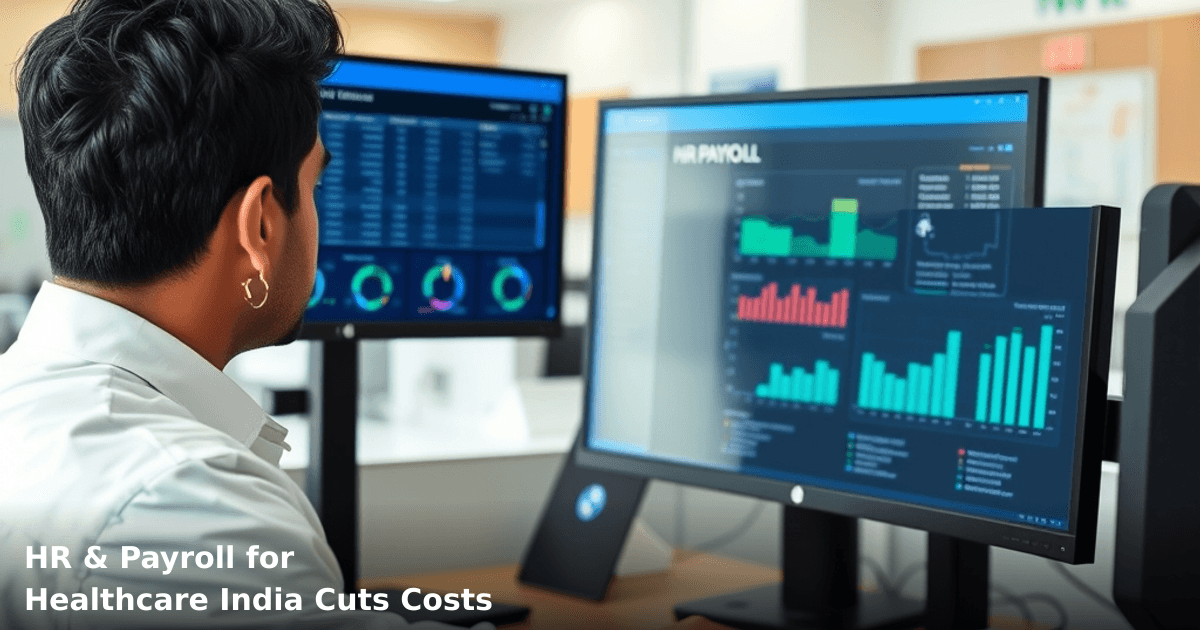
7 Ways HR & Payroll for Healthcare India Cuts Costs
Healthcare facilities across India—from multi-specialty hospitals in Bangalore to nursing homes in tier-2 cities like Lucknow and Nagpur—are drowning in payroll headaches. Manual spreadsheets, compliance errors, staff turnover, and delayed salary processing eat into margins that should go toward patient care. That's where HR & payroll for healthcare India systems step in. We've worked with dozens of healthcare providers who've cut their HR operating costs by 30–45% simply by switching from paper-based or fragmented systems to integrated platforms.
Quick Answer: HR & payroll systems tailored for healthcare India reduce manual work by 60–70%, cut compliance errors by 80%, and save ₹3–8 lakh annually for mid-sized facilities (50–200 staff). They automate salary processing, track shift rosters, manage leave balances, and ensure GST/TDS compliance—all in one platform.
Why HR & Payroll Matters for Indian Healthcare Businesses
Healthcare is unlike retail or manufacturing. Your staff includes nurses, doctors, technicians, housekeeping, and admin—each with different shift patterns, allowances, and tax brackets. A Gartner report on healthcare operations found that 58% of Indian healthcare providers still use manual or semi-automated payroll systems, leading to ₹1.5–3 lakh in annual waste per 100 staff members due to errors, rework, and compliance penalties.
The stakes are higher in healthcare. A payroll mistake doesn't just embarrass you—it affects staff morale during already stressful 12-hour shifts. GST compliance on outsourced services (laundry, catering, security), TDS on contractor payments, and state-level labor law variations add layers of complexity.
The Real Cost of Manual Payroll in Healthcare
When you're managing payroll manually—or with disconnected tools—here's what actually happens:
- Salary delays: A Delhi-based 80-bed hospital we worked with was processing salaries 3–4 days late every month. Staff frustration cost them two senior nurses to competitors.
- Compliance fines: A Pune nursing home faced a ₹47,000 GST audit penalty because outsourced housekeeping services weren't tracked separately from payroll.
- Duplicate data entry: HR records, attendance sheets, payroll registers, and bank uploads were maintained in three separate systems. One manager spent 12 hours/month just reconciling numbers.
What HR & Payroll for Healthcare India Actually Does
An integrated HR & payroll system built for healthcare handles:
- Automated salary calculation with healthcare-specific allowances (on-call duty, night shift premium, medical reimbursement)
- Shift and attendance tracking synced with roster changes
- Leave management with accrual rules (earned leave, sick leave, casual leave per Indian labor laws)
- Compliance automation for GST, TDS, PF, ESI, and state-level deductions
- Contractor and outsourced staff management (security, housekeeping, laundry) with separate invoicing
- Real-time dashboards for cost tracking, headcount, and turnover
- Bulk SMS or WhatsApp notifications for salary slips, leave approvals, and shift updates
How It Integrates with Your Existing Systems
Most healthcare providers use a clinic or hospital management system (HMS) for patient records. A good HR & payroll platform syncs with your HMS via API, pulling staff details and attendance automatically. It also exports data to Tally or your accounting software, eliminating re-entry work.
7 Ways HR & Payroll for Healthcare India Cuts Costs
1. Eliminate Manual Payroll Processing (Save 15–20 Hours/Month)
Manually calculating salaries for 100+ staff—with different shift types, allowances, and deductions—takes 40–60 hours per month. A Bangalore-based 120-bed hospital we work with was spending ₹1.2 lakh/month on an extra accountant just for payroll.
With automated payroll processing, salary calculations happen in minutes. Tax slabs, PF contributions, ESI, and GST adjustments are pre-configured. One staff member now handles it in 4 hours.
Cost saved: ₹1.2 lakh/month (or ₹14.4 lakh/year) for a 120-bed facility.
2. Reduce Compliance Errors and Audit Penalties (Save ₹50,000–2 Lakh/Year)
Healthcare facilities must comply with:
- GST on outsourced services (separate invoicing required)
- PF and ESI for eligible staff
- TDS on contractor payments
- State-level labor laws (vary by Maharashtra, Tamil Nadu, Delhi, etc.)
- Statutory audits for salary registers and attendance
One missed GST invoice or incorrect TDS deduction can trigger a ₹25,000–1 lakh penalty. We've seen facilities face multiple penalties in a single year simply because their payroll data didn't align with tax filings.
An integrated HR & payroll system auto-generates compliant reports, flags errors before they happen, and maintains audit trails. A Hyderabad nursing home cut audit rework time by 80% and avoided ₹1.8 lakh in potential penalties after switching systems.
Cost saved: ₹50,000–2 lakh/year in avoided penalties and audit rework.
3. Cut Staff Turnover Through Transparent, On-Time Salary Processing
Delayed or incorrect salary payments are the #1 reason healthcare staff leave. Nurses and technicians have options—they'll move to a competitor for consistency.
When salary hits accounts on the promised date, every time, retention improves. One Pune facility saw staff turnover drop from 18% to 8% within 6 months of switching to automated, on-time payroll. That meant no recruitment costs, no training time lost, and continuity of patient care.
Cost saved: ₹3–5 lakh/year per retained senior staff member (recruitment, training, and lost productivity).
4. Automate Shift Rosters and Attendance Tracking (Save 8–12 Hours/Week)
Healthcare runs on shifts. Manually creating rosters, tracking attendance, and adjusting for leave requests is chaos. A 60-bed hospital in Nagpur was using a printed roster updated by hand every week—mistakes happened constantly.
HR & payroll systems let you:
- Build shift templates (morning, evening, night, on-call)
- Auto-generate rosters based on staff availability
- Sync attendance via biometric or mobile app
- Adjust for leave or sick days in real-time
- Flag understaffing before it happens
One manager now spends 2 hours/week instead of 12 hours/week on roster management.
Cost saved: ₹40,000–60,000/year in reduced admin time.
5. Track Outsourced Staff and Contractor Costs Separately (Save 10–15% on Outsourcing Spend)
Most healthcare facilities outsource housekeeping, laundry, security, and catering. These contractors have different pay rates, invoice cycles, and tax treatment than regular staff.
Mixing them in one payroll system creates:
- Incorrect GST calculations
- Overlapping invoices and duplicate payments
- Compliance confusion during audits
A proper HR & payroll system maintains separate contractor modules. You see exactly what you're paying for security (₹3.2 lakh/month), housekeeping (₹1.8 lakh/month), and laundry (₹0.9 lakh/month) at a glance. This visibility often reveals overpayment or unused capacity.
A Lucknow multi-specialty hospital found they were paying for 15 security staff but using only 12 on average. After renegotiating contracts with better data, they saved ₹2.1 lakh/month.
Cost saved: ₹2–4 lakh/month through better outsourcing visibility and renegotiation.
6. Enable Self-Service Leave and Attendance (Reduce HR Workload by 25–30%)
Staff constantly ask HR: "How many leaves do I have left?" "Can I take leave next Thursday?" "Why wasn't my salary correct?"
A self-service portal lets staff:
- Check leave balances in real-time
- Submit leave requests (approved/rejected automatically based on rules)
- View salary slips and payroll history
- Update personal details (address, bank account, nominee)
This cuts HR's repetitive questions by 70%. A 100-staff nursing home freed up one full-time HR person just by enabling self-service.
Cost saved: ₹4–6 lakh/year in reduced HR overhead.
7. Generate Real-Time Cost Reports and Forecasts (Save 5–10% on Headcount Planning)
Without visibility into payroll costs, you overhire or underhire. A real-time dashboard shows:
- Monthly payroll spend vs. budget
- Cost per patient (payroll ÷ patient census)
- Headcount trends (turnover, new hires, promotions)
- Salary distribution by department (ICU, OPD, admin, etc.)
This data helps you make smarter hiring decisions. A Bangalore hospital realized their ICU payroll was 35% above peer facilities—they optimized staffing ratios and saved ₹8 lakh/month without affecting patient care.
Cost saved: ₹5–12 lakh/year through better headcount planning.
Comparison Table: Manual vs. Automated HR & Payroll for Healthcare India
| Aspect | Manual / Spreadsheet | Semi-Automated (Tally + Manual) | Fully Integrated System |
|---|---|---|---|
| Payroll Processing Time | 40–60 hrs/month | 20–30 hrs/month | 2–4 hrs/month |
| Compliance Errors | 15–25% of payroll runs | 5–10% | <1% |
| Audit Penalties (Annual) | ₹50,000–2 lakh | ₹10,000–50,000 | ₹0–5,000 |
| Staff Turnover Rate | 15–20% | 10–15% | 6–10% |
| Contractor Cost Visibility | None | Partial | Complete |
| Self-Service Portal | No | No | Yes |
| Real-Time Cost Reports | No | Limited | Full |
| Setup Time | N/A | 2–4 weeks | 3–6 weeks |
| Monthly Cost (50–100 staff) | ₹0 (hidden waste) | ₹2,000–5,000 | ₹5,000–12,000 |
Step-by-Step Guide for Indian SMBs: Implementing HR & Payroll for Healthcare India
Ready to scale your business systematically?
We combine software, automation, and marketing to build growth systems that work while you sleep.
Step 1: Audit Your Current Payroll Process
Before switching systems, map what you're currently doing:
- How many staff categories? (Doctors, nurses, technicians, support staff)
- What allowances? (Night shift, on-call, medical reimbursement, dearness allowance)
- What deductions? (PF, ESI, professional tax, income tax, loan EMIs)
- How many outsourced vendors? (Security, housekeeping, catering, laundry)
- What compliance requirements? (GST, TDS, state labor laws, statutory registers)
This takes 1–2 weeks but saves you from buying a system that doesn't fit your needs.
Step 2: Choose a System Built for Healthcare
Not all HR & payroll software is equal. Healthcare-specific systems include:
- Shift and on-call duty management
- Medical reimbursement tracking
- Contractor and outsourced staff modules
- Integration with popular HMS platforms (Practo, Medicore, etc.)
- Compliance templates for major Indian states
If your system doesn't handle shift premiums or separate contractor invoicing, you'll still be doing manual work.
Step 3: Set Up Master Data Correctly
This is the hardest part. You need to configure:
- Staff categories and salary structures
- Shift types and timings
- Leave accrual rules (earned leave, sick leave, casual leave per Indian labor law)
- GST rates for outsourced services
- Tax slab details for your state
- Bank account details for salary transfer
Mistakes here cascade through every payroll run. Allocate 2–3 weeks and involve your accountant.
Step 4: Migrate Historical Data
If you're switching from manual or another system, you need to:
- Import staff records (name, DOJ, salary, bank account, PAN, Aadhaar)
- Migrate last 12 months of attendance and leave data
- Reconcile opening balances (PF, ESI, leave balances)
This takes 1–2 weeks depending on data quality. Poor data here means payroll corrections later.
Step 5: Train Your Team
Your HR, accounts, and operations staff need hands-on training:
- How to process monthly payroll (2–3 hours)
- How to handle leave requests and roster changes (2 hours)
- How to generate compliance reports (2 hours)
- How to troubleshoot common errors (2 hours)
Most vendors provide 5–10 hours of training. Budget for a second round 3 months later.
Step 6: Run Parallel Processing for 1–2 Months
Don't switch cold turkey. Run the new system alongside your old process for 1–2 months:
- Process payroll in both systems
- Compare salary slips and totals
- Identify and fix discrepancies
- Build staff confidence
This costs extra time upfront but catches 90% of configuration errors before they hit real salaries.
Step 7: Go Live and Monitor
Once you're confident:
- Process payroll in the new system only
- Monitor for errors in the first 3 months
- Keep your accountant involved for compliance review
- Gather feedback from staff and HR
- Optimize processes based on what you learn
Common Mistakes to Avoid
Mistake 1: Choosing a Generic System Instead of Healthcare-Specific
A Lucknow facility bought a general-purpose HR system and spent 6 months trying to configure shift premiums and contractor invoicing. They eventually switched to a healthcare-focused platform. Don't repeat this—pick a system built for healthcare.
Mistake 2: Poor Master Data Setup
Garbage in, garbage out. If you configure salary structures incorrectly, every payroll run is wrong. Spend time here. Involve your accountant.
Mistake 3: Not Training Staff Properly
Your team won't use a system they don't understand. Budget for proper training and ongoing support. One facility skipped training and staff complained the system was "too complex"—it wasn't; they just didn't know how to use it.
Mistake 4: Ignoring State-Level Compliance Variations
Labor laws vary by state. Professional tax exists in Maharashtra and Karnataka but not in Delhi. ESI is mandatory for some states but not others. If your system doesn't handle these variations, you'll face audit penalties.
Mistake 5: Switching Without Parallel Processing
Going live overnight is risky. If something breaks, staff don't get paid on time. Always run both systems for 1–2 months first.
Mistake 6: Not Integrating with Your HMS
If your HR & payroll system doesn't sync with your hospital management system, you'll keep entering staff data twice. Insist on API integration.
Key Takeaways
- HR & payroll for healthcare India reduces payroll processing time by 90%—from 40–60 hours/month to 2–4 hours.
- Compliance automation cuts audit penalties by 80–95%—a single GST or TDS error can cost ₹25,000–1 lakh; automated systems catch these before they happen.
- On-time salary processing improves retention by 40–50%—staff turnover is the hidden cost of manual payroll.
- Shift and attendance automation saves 8–12 hours/week and eliminates roster conflicts.
- Contractor cost visibility saves 10–15% on outsourcing spend—you can't optimize what you don't measure.
- Self-service portals cut HR workload by 25–30%—staff stop asking repetitive questions.
- Real-time cost dashboards enable smarter headcount planning—you can identify overstaffing and renegotiate contracts.
- Total annual savings for a 100-bed facility: ₹18–35 lakh—payoff period is typically 6–12 months.
Frequently Asked Questions
Quick answers about hr & payroll for healthcare india
01 How much can we actually save by switching to a dedicated HR & payroll software instead of hiring a full-time HR person? ›
A dedicated HR & payroll platform costs ₹8,000–₹25,000 monthly depending on employee count, versus ₹35,000–₹60,000+ monthly salary for a junior HR executive in tier-2 cities. For a 50-bed clinic or 100-staff hospital, you're looking at ₹1.2–₹3 lakh annual savings, plus you eliminate compliance penalties (which average ₹15,000–₹50,000 per violation in healthcare) through automated statutory filings like ESI, PF, and professional tax—something a single HR person often misses under pressure.
02 How long does it typically take to migrate our existing payroll data and go live on a new HR system? ›
Most healthcare facilities go live within 7–14 days with proper data preparation; the actual data import takes 2–3 days, but the real timeline depends on your current data mess—if you're using scattered spreadsheets or outdated software, add 5–7 days for data cleanup and validation. We've seen clinics with clean records go live in 4 days, while those with years of inconsistent attendance or salary adjustments take closer to 3 weeks including staff training and parallel run verification.
03 Is HR & payroll automation really necessary for a small 20-bed clinic or nursing home with just 25 staff members? ›
Yes, absolutely—in fact, small clinics benefit most because manual payroll at this size still takes 8–12 hours monthly and creates compliance risk without proportional HR support; a 25-person clinic typically has 3–4 salary structures, variable duty allowances, and shift differentials that breed calculation errors costing ₹2,000–₹5,000 monthly in overpayments or underpayments. The ₹10,000–₹15,000 monthly software cost pays for itself in reduced errors and prevents the ₹25,000–₹75,000 penalty hit from a single PF audit violation.
04 We've heard that HR software will replace our payroll person—is that true, and should we be worried? ›
That's a misconception—the software replaces repetitive data entry and compliance paperwork (which takes 60–70% of traditional payroll time), but your payroll person becomes a strategic HR partner handling employee relations, policy implementation, and vendor management instead of being buried in spreadsheets. What actually happens: a clinic with one payroll-focused admin goes from spending 40 hours monthly on manual work to 10–12 hours on exception handling and employee queries, freeing them for tasks that directly impact retention and compliance—so you're not losing headcount, you're upgrading their role.
05 What's the first step we should take to implement HR & payroll software in our healthcare facility? ›
Start by auditing your current data: pull together all employee records, salary structures, attendance patterns, and compliance documents (ESI, PF, professional tax registrations) into one folder—this 2–3 day exercise reveals data gaps and helps you choose between a basic payroll-only solution (₹8,000/month for simple structures) or an integrated HR platform (₹18,000–₹25,000/month with leave, attendance, and appraisal features). Once you've mapped your needs, request a 7–10 day free trial focusing on your largest department (say, nursing staff) to validate the system handles your shift patterns and allowances before full rollout.
Need this built for your business?
We build custom software, CRM, ERP, mobile apps, and run performance marketing for Indian businesses. Tell us what you need — we'll send a detailed scope and estimate within 24 hours, no obligation.
- Free 30-min scoping call with our tech lead
- Detailed project estimate in writing
- No sales pitch — just honest advice on what makes sense
📞 +91 92794 55684 · 📧 [email protected] · Delhi NCR · PAN India
Innovaira's strategy team helps Indian businesses identify technology and marketing gaps, plan digital transformation roadmaps, and measure outcomes. Based in New Delhi, serving clients across India.