7 Ways Customer Portals for Manufacturing India Cut Costs
Customer portals for manufacturing India are no longer a luxury — they're a necessity if you want your customers to stop calling you every time they need an order update. We've watched manufacturers lose ₹2–5 lakh annually just managing customer inquiries manually. A portal fixes that, but the real win is what happens after: 40% fewer support tickets, faster cash collection, and customers who actually feel looked after.
Quick Answer: Customer portals for manufacturing India reduce operational costs by automating order tracking, invoicing, and payment collection — saving manufacturers ₹1.5–3 lakh annually while cutting customer service workload by 60%. Implementation typically takes 4–6 weeks and pays for itself within 3–4 months.
Why Customer Portals Matter for Indian Businesses
Your customers today expect what they get from Amazon: real-time tracking, instant invoicing, and self-service order management. If you're still sending WhatsApp messages or emails for order status, you're burning money and losing credibility.
According to a McKinsey report, Indian manufacturers that adopted customer self-service tools saw a 35% reduction in support costs within the first year. That's not theoretical — we've seen it with a textile exporter in Surat who went from 4 people handling customer queries to 1.5.
The Real Cost of Manual Order Management
When your team manually updates customers on order status, invoice queries, or payment schedules, you're paying for:
- Staff time spent on repetitive emails and calls (₹15,000–25,000/month per person)
- Delayed payments because invoices reach customers late
- Angry customers who feel ignored (leading to order cancellations)
- Duplicate data entry across spreadsheets and WhatsApp
A portal automates all of this. Your customer logs in, sees their order status, downloads their invoice, and pays online — no human intervention needed.
What a Customer Portal Actually Does
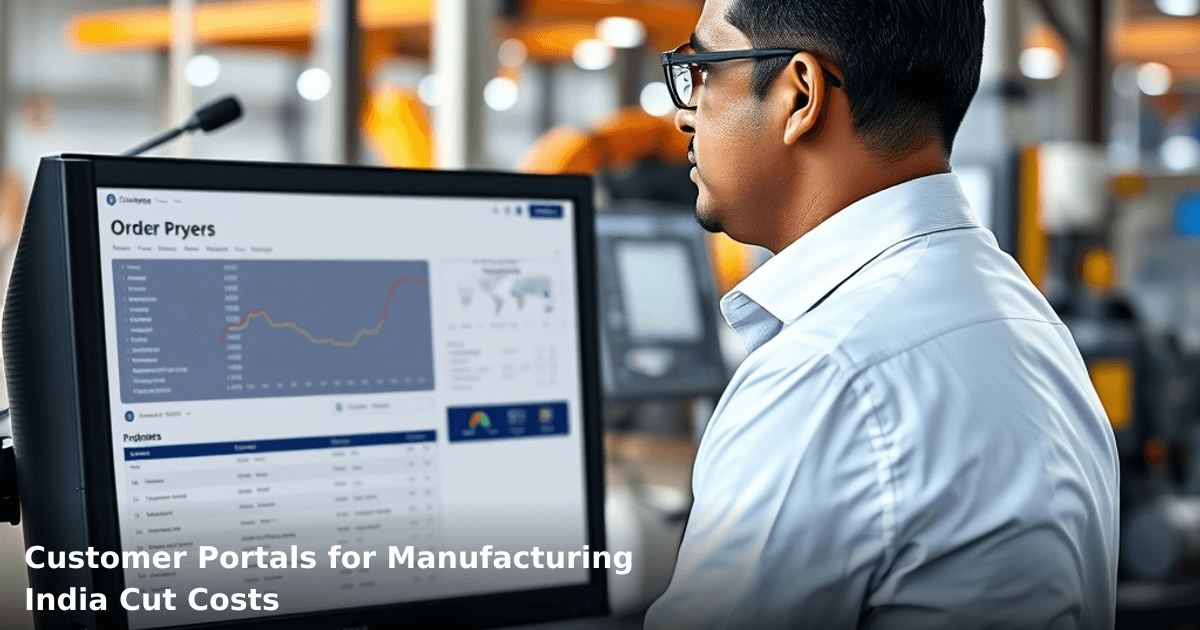
A manufacturing customer portal is a private, web-based dashboard where your customers can:
- Track orders in real-time (from confirmation to dispatch to delivery)
- Access and download invoices and purchase history
- Raise support tickets and track their resolution
- Make online payments (UPI, card, NEFT, or bank transfer)
- View pricing, stock availability, and delivery timelines
- Manage their billing and delivery addresses
Think of it as your own mini-marketplace, built specifically for your customers' needs.
The best part? It's not just convenience for them — it's a cost-cutting machine for you.
7 Ways Customer Portals for Manufacturing India Cut Costs
1. Reduce Customer Support Workload by 60%
Your phone rings 50 times a day with the same question: "Where's my order?" A portal answers that question automatically.
One of our clients, a fastener manufacturer in Bangalore, had 3 people answering customer calls and emails full-time. After implementing a portal, they reduced that to 1 person handling only complex issues. Annual savings: ₹4.8 lakh in salaries alone.
The math:
- Average support staff cost: ₹16,000/month
- Reduction from 3 FTE to 1 FTE: 2 people freed up
- Annual savings: ₹3.84 lakh (before benefits)
Plus, your team now has time to actually sell, not just answer "where's my order?"
2. Accelerate Cash Collection by 15–25 Days
Late payments are a manufacturing killer. A portal with integrated online payments fixes this faster than anything else.
When your customer sees their invoice instantly (instead of waiting for email), and can pay with one click (UPI, card, or NEFT), they pay faster. We've seen cash collection cycles drop from 45 days to 30 days — that's an extra ₹5–10 lakh in working capital freed up for a ₹50 lakh annual revenue business.
Why it works:
- Invoices appear automatically the moment goods are dispatched
- Payment options are right there (no "how do I pay you?" emails)
- Automated reminders for overdue invoices (polite, not aggressive)
- Payment confirmation is instant
A pharmaceutical packaging supplier in Pune cut their DSO (Days Sales Outstanding) from 42 to 28 days within 2 months. That ₹1.8 lakh in freed-up capital went straight into buying more raw materials.
3. Eliminate Duplicate Data Entry and Spreadsheet Hell
Your team probably maintains customer data in 3 places: Tally, a spreadsheet, and WhatsApp. Every time something changes, you update all three. It's chaos, and it costs time.
A portal syncs with your ERP or CRM automatically. Order data, customer info, payment status — it all flows in one direction. No re-entering, no mistakes, no ₹2,000 orders marked as ₹20,000.
Time saved per week: 4–6 hours of data reconciliation Annual cost of that time: ₹1.2–1.8 lakh (at ₹500/hour)
4. Reduce Returns and Disputes by 40%
When customers can see exactly what they ordered, when it's being delivered, and what they owe, disputes drop dramatically.
A steel trading company in Jamshedpur implemented a portal with detailed order confirmations and delivery proof. Returns and quality disputes fell from 8% of orders to 3%. That's not just goodwill — that's ₹2.4 lakh saved annually on handling returns, restocking, and credit notes.
Why? Because there's a clear audit trail. The customer can't say "I never ordered that size" when they've got a timestamped order confirmation in their portal.
5. Cut Logistics and Delivery Coordination Costs
A portal can integrate with your logistics partner's API (or at minimum, pull tracking data manually once a day). Your customers see real-time delivery status. Your team stops fielding "where is my shipment?" calls.
One of our clients, a chemical distributor in Vadodara, saved ₹80,000/year just by eliminating the need for a dedicated person to coordinate between logistics and customer inquiries.
Added benefit: Customers can reschedule deliveries themselves through the portal, reducing failed delivery attempts (which cost ₹200–500 per attempt).
6. Improve Customer Retention by 25–30%
Customers who feel informed and in control are customers who stick around. A portal gives them both.
According to a Gartner report, businesses that provide self-service customer portals see a 25% improvement in customer retention. For a manufacturer with ₹1 crore annual revenue and 15% annual churn, that's 2–3 extra customers staying on board. At ₹15–20 lakh per customer's annual value, that's ₹30–60 lakh in retained revenue.
Plus, a portal makes your business look professional. A small customer sees your branded portal and thinks "this company has their act together."
7. Enable Data-Driven Decisions
A portal generates data. Which customers order most frequently? Which products have the highest return rates? What's your average payment delay by customer?
This data lets you:
- Offer volume discounts to top customers (increasing loyalty)
- Identify problem products before they become bigger issues
- Forecast demand more accurately
- Target upsell opportunities
One of our clients, a plastic injection molding company in Indore, used portal data to identify that 3 customers were consistently ordering small quantities at irregular intervals. They offered those customers a subscription model with 10% discounts. Result: ₹12 lakh in new recurring revenue within 6 months.
Comparison Table: Portal Types and Their Cost Impact
| Portal Type | Setup Cost | Monthly Maintenance | Best For | Annual ROI |
|---|---|---|---|---|
| Basic (Order tracking + invoices) | ₹50,000–1,00,000 | ₹3,000–5,000 | Small manufacturers, <50 customers | 150–200% |
| Standard (+ payments + support tickets) | ₹1,50,000–2,50,000 | ₹8,000–12,000 | Mid-size (50–200 customers) | 180–250% |
| Advanced (+ custom workflows + analytics) | ₹3,00,000–5,00,000 | ₹15,000–20,000 | Large manufacturers, complex supply chains | 200–300% |
| DIY / Low-code (Shopify, WooCommerce) | ₹20,000–40,000 | ₹2,000–4,000 | Retail-focused, simple orders | 100–150% |
Note: ROI assumes 40–60% reduction in support costs + 15% faster cash collection. Actual results vary by industry and customer base size.
If you're running a B2B manufacturing operation with 50+ customers, the Standard tier pays for itself within 4–5 months. If you're smaller, start with Basic.
Step-by-Step Guide for Indian SMBs
Tired of scattered spreadsheets and manual follow-ups?
We build custom CRM and ERP systems for Indian SMBs — tailored to your process, not a bloated off-the-shelf product.
Step 1: Audit Your Current Customer Communication Process
Before building anything, map out what your customers actually need.
- How many customer inquiries do you get per day? (Call, email, WhatsApp)
- What are the top 5 questions?
- How long does it take to answer each?
- What data do customers need access to?
Spend 1–2 weeks collecting this. Talk to your sales team and customer service staff. You'll find that 70% of inquiries are about order status, invoices, or payment options.
Step 2: Choose Your Portal Platform
You have three options:
Option A: Custom-built portal (₹1.5–5 lakh + ₹8–20k/month)
- Fully tailored to your business
- Integrates directly with your ERP/CRM
- Takes 6–12 weeks to build
- Best if you have complex workflows or 100+ customers
Option B: No-code/Low-code platform (₹30–60k setup + ₹3–8k/month)
- Faster to launch (2–4 weeks)
- Limited customization
- Works with most ERPs via API or manual sync
- Best for straightforward order tracking and invoicing
Option C: Marketplace integration (₹0–50k one-time)
- Use existing platforms like IndiaMart or JioMart's B2B tools
- Limited branding and control
- Best if you're already selling on these platforms
For most Indian SMBs, Option B (no-code) is the sweet spot: fast, affordable, and flexible enough.
If you need deep integration with your Tally or custom ERP, our CRM Development team can build a tailored portal that syncs automatically with your existing systems.
Step 3: Design Your Core Features
Start with the essentials. Don't build everything at once.
MVP (Minimum Viable Product) — Month 1:
- Customer login (with GST number or customer ID)
- Order history and status tracking
- Invoice download
- Basic support ticket form
Phase 2 — Month 2–3:
- Online payment integration (UPI, card, NEFT)
- Automated payment reminders
- Delivery tracking (if you use logistics APIs)
Phase 3 — Month 4+:
- Subscription/repeat order management
- Product recommendations
- Advanced analytics dashboard
Most manufacturers see ROI by Phase 2. Phase 3 is optimization.
Step 4: Integrate with Your ERP or CRM
This is where most projects stall. Your portal needs real-time data from your backend system.
If you use Tally:
- Export order data daily (via CSV or API if Tally Plus)
- Upload to portal daily
- Takes 30 minutes to set up, then runs automatically
If you use a custom ERP:
- Build an API integration (1–2 weeks)
- Data syncs every 2 hours
- More expensive but seamless
If you use cloud-based systems (Zoho, SAP, Oracle):
- Most have built-in API integrations
- Setup takes 2–3 days
The key: your portal data must be fresh. A 24-hour delay defeats the purpose.
Step 5: Train Your Team and Launch
Your team needs to know:
- How to resolve customer issues that arise
- How to update order status in the backend (which flows to the portal)
- How to handle payment issues or refunds
- How to monitor portal analytics
Budget 1–2 days for training. Then soft-launch to 10–20 customers first. Fix bugs and feedback before going live to everyone.
Step 6: Monitor, Measure, and Optimize
Track these metrics from day one:
- Support ticket volume: Should drop 40–60% within 2 months
- Average payment delay: Should improve by 10–20 days
- Customer login frequency: Should be 30–50% of your customer base per month
- Portal uptime: Aim for 99.5%+
If support tickets aren't dropping, it means customers aren't using the portal. This usually means poor communication during launch or unclear navigation.
Common Mistakes to Avoid
Mistake 1: Building Too Much, Too Soon
You don't need a portal with AI recommendations, predictive analytics, and 50 features on day one. Start with order tracking and invoicing. Add payments next. Everything else is optimization.
A textile exporter in Tiruppur spent ₹4.5 lakh building a "full-featured" portal. After 3 months, customers used only 20% of the features. The other 80% was waste.
Mistake 2: Not Integrating with Your Backend System
A portal that shows outdated order data is worse than no portal. If your customer sees "order shipped 5 days ago" when it's actually been delivered, they lose trust.
Always integrate with your ERP or CRM. If that's not possible, commit to updating data at least daily.
Mistake 3: Launching Without Customer Communication
You build a portal. You send one email: "Here's your new portal." And then... crickets. 30% adoption.
Instead:
- Call your top 20 customers personally and walk them through it
- Send video tutorials (2–3 minutes each)
- Offer a small incentive (1% discount) for first payment via portal
- Follow up with email reminders for 4 weeks
Adoption jumps to 70%+ within 30 days.
Mistake 4: Ignoring Mobile Users
60% of your customers will access the portal on mobile. If it's not mobile-friendly, they won't use it.
Ensure the portal works on phones. Period.
Mistake 5: Forgetting About Data Security
Your customer portal holds sensitive data: invoices, payment info, delivery addresses. If it gets hacked, you lose customers and face compliance issues (GST, data protection).
Invest in:
- SSL encryption (HTTPS)
- Regular security audits
- Automated backups
- Role-based access control
This adds ₹10–20k to your setup but is non-negotiable.
Key Takeaways
- Customer portals for manufacturing India cut support costs by 40–60% — that's ₹3–5 lakh annually for most SMBs.
- Cash collection improves by 15–25 days — freeing up ₹5–15 lakh in working capital.
- ROI hits within 4–6 months — setup costs (₹50k–2.5 lakh) pay for themselves through cost savings and faster payments.
- Start simple: Order tracking + invoicing + payments. Everything else is Phase 2.
- Integration is non-negotiable: A portal with stale data is worse than no portal.
- Communication drives adoption: Call customers, send videos, offer incentives. Don't just launch and hope.
- Mobile-first design is essential: 60% of your customers access on phones.
- Data security is not optional: Invest in SSL, backups, and access controls.
Frequently Asked Questions
Quick answers about customer-portals-manufacturing-india
01 How much will a customer portal actually cost my manufacturing business, and what's the typical payback period? ›
A: Most cloud-based portals for Indian manufacturers run ₹15,000–₹50,000 monthly depending on users and features, but you'll see 40–60% reduction in order-related support calls within 3–4 months, recovering costs in 5–7 months. If you're currently spending ₹8,000–₹12,000 monthly on customer service staff just handling order queries, a ₹25,000 portal investment pays for itself quickly through labor reallocation alone.
02 How long does it actually take to get a customer portal live and working with our existing systems? ›
A: Most SaaS portals for manufacturing integrate with your ERP in 4–6 weeks if your data is clean; the real timeline killer is usually getting your customers to adopt it (another 6–8 weeks of training and reminders). I've seen businesses go live in 3 weeks with basic order tracking, then add invoicing and shipment visibility over the next quarter—start small, expand fast.
03 Is a customer portal worth it if we only have 50–100 active customers? ›
A: Yes, absolutely—this is actually the sweet spot for ROI. With 50–100 customers, you'll eliminate 60–70% of repetitive "where's my order" calls, and your team can focus on problem-solving instead; larger businesses see only 30–40% call reduction because their support load is more complex. Even one person spending 15 hours weekly on order status queries justifies a ₹20,000 portal investment immediately.
04 We're worried a portal will confuse our older customers—is this a real problem or just a misconception? ›
A: It's a real adoption challenge, not a misconception, but it's solvable: 70–80% of resisters adopt within 2–3 months once they see it saves them time; the key is offering phone/email support alongside the portal for 90 days, not replacing it. I've seen businesses lose 2–3 customers by forcing portals too hard, but zero losses when they kept parallel support channels and showed ROI (faster invoices, real-time tracking) to early adopters first.
05 What's the first step to implement this without disrupting our current operations? ›
A: Start with a pilot: pick your 10–15 most tech-comfortable customers and give them portal access for order tracking and invoice download only—takes 2 weeks to set up, zero disruption to your backend. Once they're comfortable (usually 4 weeks), roll out to your next 30–40 customers and add features like shipment visibility; most Indian manufacturers go full deployment in 12–16 weeks using this phased approach instead of a risky big-bang launch.
Need this built for your business?
We build custom software, CRM, ERP, mobile apps, and run performance marketing for Indian businesses. Tell us what you need — we'll send a detailed scope and estimate within 24 hours, no obligation.
- Free 30-min scoping call with our tech lead
- Detailed project estimate in writing
- No sales pitch — just honest advice on what makes sense
📞 +91 92794 55684 · 📧 [email protected] · Delhi NCR · PAN India
Innovaira's engineering team designs and builds custom software — CRM, ERP, SaaS platforms, web applications and mobile apps — for growing Indian businesses. ISO 9001:2015 certified for quality delivery.