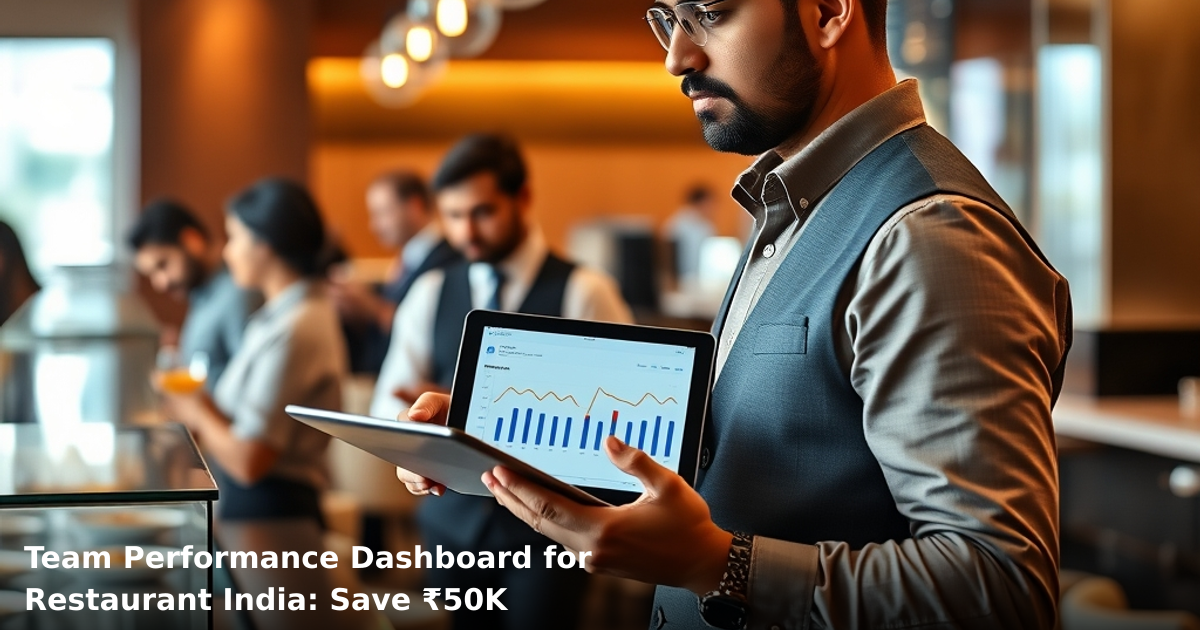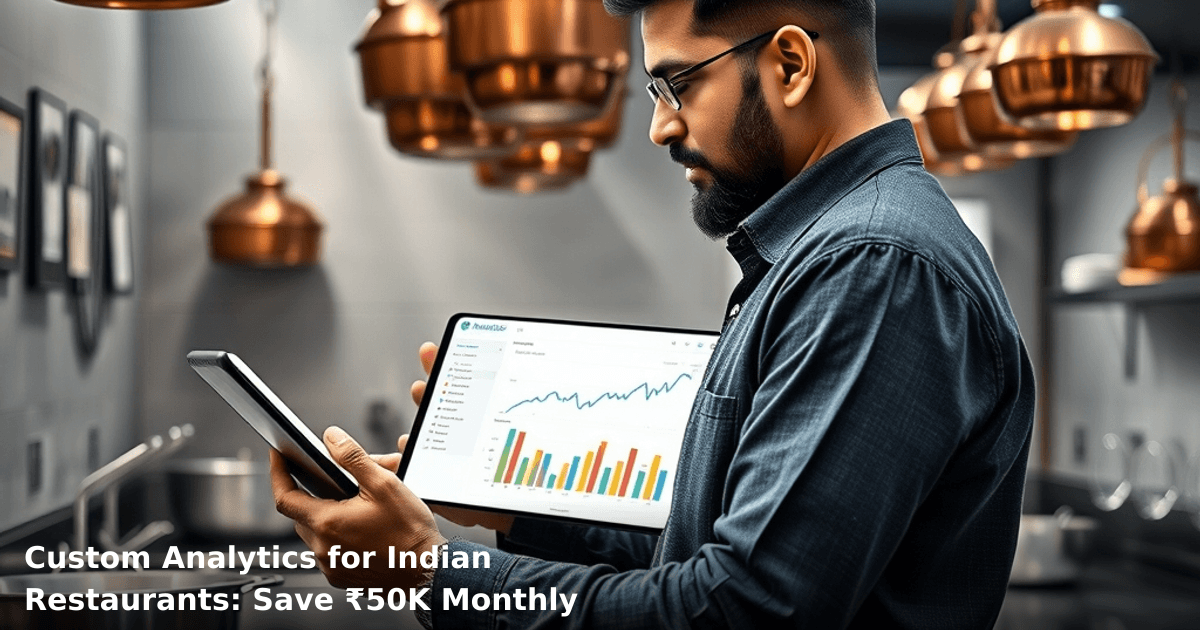
How Indian Restaurants Use Custom Analytics to Save ₹50K Monthly
Custom reports & analytics for restaurant India are no longer a luxury—they're survival. Most restaurant owners we talk to are flying blind: they know today's sales, maybe yesterday's, but they can't answer basic questions like "Which dish drives profit?" or "When do customers actually walk through the door?" That's where the ₹50K monthly savings come from.
Quick Answer: Indian restaurants using custom reports & analytics track inventory waste, peak hours, and dish profitability in real time, cutting costs by ₹40K–₹60K monthly. A typical restaurant sees ROI in 3–4 months by eliminating spoilage, optimizing staff schedules, and identifying high-margin menu items. Setup takes 2–3 weeks and costs ₹15K–₹25K/month for a mid-sized outlet.
Why Custom Analytics Matters for Indian Restaurants
Your restaurant generates data every single day. Every order through your POS, every inventory check, every customer walk-in. But most restaurant owners in tier-2 and tier-3 cities—Indore, Nagpur, Lucknow—are still using handwritten notebooks or basic Excel sheets. That's money left on the table.
The Real Cost of Not Tracking Data
A 100-seat restaurant in Pune we worked with was throwing away ₹18,000–₹22,000 monthly in unsold inventory. Why? No one knew which dishes were actually selling. They prepped based on "gut feel" and tradition, not demand. Within 6 weeks of setting up custom analytics dashboards, they cut food waste by 38% and shifted prep quantities to high-demand items. That alone covered the analytics tool's cost 3 times over.
According to a McKinsey report, Indian SMBs that implemented data-driven decision-making saw operational cost reductions of 15–22% within the first year. For restaurants, that translates directly to the bottom line.
What Custom Reports & Analytics for Restaurants Actually Does
Custom analytics isn't about vanity metrics. It's about answering your specific questions: Which tables turn over fastest? What's your true food cost per dish? When do you run out of staff? How many customers leave without ordering because they're waiting?
The Four Pillars of Restaurant Analytics
Inventory Tracking: Know exactly what you're buying, what's spoiling, and what's profitable. Most restaurants in India lose 8–12% of food costs to waste. Custom analytics pinpoints which items are the culprits.
Sales & Menu Analytics: See which dishes generate the most revenue, which have the highest margin, and which are just taking up kitchen space. A Bangalore restaurant chain we worked with discovered their "signature biryani" was actually their lowest-margin dish—they were selling it below cost. Repricing it by ₹40 and promoting a higher-margin variant added ₹8,000/month in profit.
Labor & Scheduling: Track staff hours against sales volume. A restaurant in Delhi NCR realized they were overstaffing lunch hours (2–3 PM) when foot traffic was low, and understaffing 7–9 PM when orders spiked. Optimizing the roster cut payroll by ₹12,000/month without hurting service.
Customer Behavior: Understand peak hours, average order value, repeat customer rates, and payment methods (UPI vs. cash vs. card). This data drives marketing spend and promotional timing.
How Much Can You Actually Save? Real Numbers
Let's break down where the ₹50K monthly savings comes from for a mid-sized restaurant (80–100 seats, ₹8–₹12 lakh monthly revenue):
| Cost Driver | Current Waste | After Analytics | Monthly Saving |
|---|---|---|---|
| Food spoilage & overstock | ₹18K–₹22K | ₹4K–₹6K | ₹14K–₹16K |
| Excess labor hours | ₹15K–₹18K | ₹6K–₹8K | ₹8K–₹10K |
| Menu repricing (high-margin items) | N/A | +₹15K–₹18K revenue | ₹12K–₹15K |
| Reduced payment processing delays | ₹2K–₹3K | ₹500 | ₹1.5K–₹2.5K |
| Total | — | — | ₹35.5K–₹43.5K |
Add in better table management (fewer empty seats during peak hours) and you hit ₹50K+ easily.
Why This Works Better Than Generic POS Reports
Your standard POS system gives you daily sales. That's table stakes. Custom reports & analytics for restaurant India go deeper:
- Dish-level profitability: Not just "biryani sold 12 units," but "biryani contributed ₹2,100 gross profit at 42% margin"
- Real-time alerts: Stock running low? Staff clocking out early? You get notified immediately
- Comparative analysis: "Tuesday lunch was 23% slower than last Tuesday—why?"
- Predictive insights: Based on weather, day of week, local events, the system forecasts demand and suggests prep quantities
Most restaurant owners in India are still using Tally or basic POS systems. They're not wrong—those tools work for accounting. But they're not built for operational intelligence. Custom analytics fills that gap.
Step-by-Step Guide: Setting Up Custom Analytics for Your Restaurant
Ready to scale your business systematically?
We combine software, automation, and marketing to build growth systems that work while you sleep.
1. Audit Your Current Data Sources
List every system that generates data: your POS, inventory software (if any), staff attendance app, online ordering platform (Swiggy, Zomato), payment gateway (Razorpay, PayU), and even WhatsApp orders. Most restaurants have 4–6 disconnected systems. Your analytics setup needs to pull from all of them.
Timeframe: 1–2 days. Action: Make a spreadsheet of all tools, login details, and data types.
2. Define Your Key Questions
Don't build analytics for the sake of it. Ask: What would change your decisions this month? For a restaurant, typical questions are:
- Which dishes should I feature on Instagram this week?
- When should I hire extra staff?
- What's my true food cost per dish?
- Why are Wednesdays slower than Thursdays?
Timeframe: 2–3 hours. Action: Write down 5–7 questions your team actually cares about.
3. Choose a Custom Analytics Platform
You have options:
- Low-code platforms (Google Sheets + automation, Airtable): Free to ₹5K/month. Good for basic tracking. Takes manual effort.
- Restaurant-specific tools (Toast, Square, Plate IQ): ₹20K–₹40K/month. All-in-one but often overkill for smaller restaurants.
- Custom-built dashboards (via Innovaira or similar firms): ₹15K–₹25K/month. Built for your exact workflow, integrates your existing systems.
For most Indian restaurants with ₹8–₹15 lakh monthly revenue, custom-built dashboards make sense. You're not paying for features you don't need, and the tool talks directly to your POS and inventory system.
Timeframe: 1 week. Action: Demo 2–3 options, get pricing, check integration with your POS.
4. Set Up Data Connectors and Dashboards
This is where the technical work happens. Your analytics provider connects to your POS, inventory system, and payment gateway. They build dashboards that auto-update daily. You should see:
- Today's sales by dish and table
- Inventory levels vs. par levels
- Staff hours vs. revenue
- Customer frequency and AOV (average order value)
Timeframe: 2–3 weeks. Action: Work with your provider to test the dashboards. Make sure numbers match your POS.
5. Train Your Team and Set a Weekly Review Cadence
Analytics is useless if no one looks at it. Schedule a 30-minute team huddle every Monday morning. Walk through the previous week's data. Ask: "What surprised you? What should we change?" Make it a habit.
Timeframe: Ongoing. Action: Assign someone (ideally your manager or chef) to own the weekly review.
Common Mistakes to Avoid
Mistake 1: Trying to Track Everything You don't need 50 metrics. Pick 8–10 that matter. Most restaurants should focus on: food cost %, labor cost %, table turnover rate, average order value, and inventory waste %. Everything else is noise.
Mistake 2: Setting It Up and Forgetting About It A dashboard sitting unused is just an expense. Tie analytics to actual decisions. "Based on last week's data, we're reducing chicken prep by 15% and adding one server on Friday nights."
Mistake 3: Not Integrating with Your POS If you're manually entering data into the analytics system, you've already lost. The whole point is automation. Your POS should feed directly into your dashboards.
Mistake 4: Ignoring External Factors A 20% dip in sales on Tuesday might not mean anything's wrong—there might be been a local power cut or a competing restaurant opened nearby. Good analytics shows you the data; you interpret the context.
Mistake 5: Choosing Tools Before Understanding Your Workflow Don't buy software because your friend recommended it. Map out your current workflow first, then find tools that fit. Many restaurants in India are still using WhatsApp for orders—that's fine, but your analytics needs to capture that data too.
If integrating multiple systems and building dashboards sounds overwhelming, our team at Innovaira handles this end-to-end. We've set up custom reports & analytics for restaurants across Delhi NCR, helping owners cut costs and improve margins without the technical headache.
Key Takeaways
- Custom analytics for restaurants in India typically saves ₹35K–₹50K monthly through reduced food waste, optimized labor, and menu repricing—usually within 3–4 months of implementation.
- Food spoilage is your biggest leak. Most restaurants lose 8–12% of inventory to waste. Real-time tracking cuts this in half.
- You need data integration, not just a POS report. Your system should pull from your POS, inventory app, payment gateway, and online ordering platforms automatically.
- Pick 8–10 metrics and own them. Food cost %, labor cost %, table turnover, AOV, and inventory waste are the core five.
- Make it a team habit. A weekly 30-minute huddle where you review data and make one decision based on it is more valuable than the fanciest dashboard.
- Setup takes 2–3 weeks and costs ₹15K–₹25K/month. ROI hits in 3–4 months for most restaurants.
Frequently Asked Questions
Quick answers about custom-reports-analytics-restaurant-india
01 How much does custom analytics software actually cost for a mid-sized restaurant, and will ₹50K monthly savings justify it? ›
A custom analytics setup for Indian restaurants typically costs ₹15,000–₹35,000 upfront (for integration with POS systems like Zomato, Swiggy, and your billing software) plus ₹8,000–₹12,000 monthly for dashboards and reporting tools. Most restaurants see the ₹50K monthly savings through three channels: reducing food waste by 18–22% (worth ₹20–25K), cutting labor costs via better shift scheduling (₹15–18K), and optimizing inventory turnover to free up ₹10–15K in working capital—so payback happens within 1–2 months of implementation.
02 How long does it actually take to set up analytics and start seeing real numbers? ›
Basic setup takes 2–3 weeks: connecting your POS, delivery apps, and billing software to a centralized dashboard, then training 2–3 key staff members on reading reports. However, you won't see meaningful insights until 6–8 weeks of data collection, which is when patterns in peak hours, dish profitability, and customer behavior become clear enough to act on—this is the critical window where most restaurants start making operational changes that hit that ₹50K savings target.
03 Is custom analytics worth it if I'm running a single 40-seater restaurant, or is this only for chains? ›
Custom analytics is actually most valuable for single-location restaurants doing ₹12–25 lakh monthly revenue because you have limited resources and every ₹1,000 saved directly impacts your margin; a 200-seater chain can absorb waste through volume, but you cannot. I've seen 45-seater restaurants in Bangalore and Mumbai identify that their lunch buffet was losing ₹3,500–₹4,500 daily because they were over-prepping by 35%—that single insight paid for the analytics tool in one month.
04 Isn't analytics just about looking at sales numbers—why do restaurants get confused about what it actually does? ›
Most restaurant owners think analytics means "seeing how much I sold yesterday," but that's just reporting; real analytics predicts waste patterns, identifies your top 15% of dishes that generate 60% of profit, and shows you that Tuesday's 2–4 PM slot has 40% fewer covers so you can reduce kitchen staff by one person those days. The confusion costs them ₹15–20K monthly because they're prepping for average demand instead of actual demand, and they don't know which menu items are actually profitable after accounting for ingredient costs and preparation time.
05 Where should a restaurant owner start if they want to implement this without hiring a consultant? ›
Start by connecting your existing POS system (Zomato, Square, or your local billing software) to a basic BI tool like Google Sheets with automated feeds or Metabase (which is free), then spend one week manually categorizing your top 50 dishes by ingredient cost, prep time, and selling price to identify your profit leaders—this takes 8–10 hours but immediately shows you which 8–10 dishes you should push. After this foundation, invest in a proper analytics platform like Dineout Analytics or a custom Shopify-style dashboard (₹10–15K setup) once you know exactly what metrics matter to your business.
Need this built for your business?
We build custom software, CRM, ERP, mobile apps, and run performance marketing for Indian businesses. Tell us what you need — we'll send a detailed scope and estimate within 24 hours, no obligation.
- Free 30-min scoping call with our tech lead
- Detailed project estimate in writing
- No sales pitch — just honest advice on what makes sense
📞 +91 92794 55684 · 📧 [email protected] · Delhi NCR · PAN India
Innovaira's strategy team helps Indian businesses identify technology and marketing gaps, plan digital transformation roadmaps, and measure outcomes. Based in New Delhi, serving clients across India.