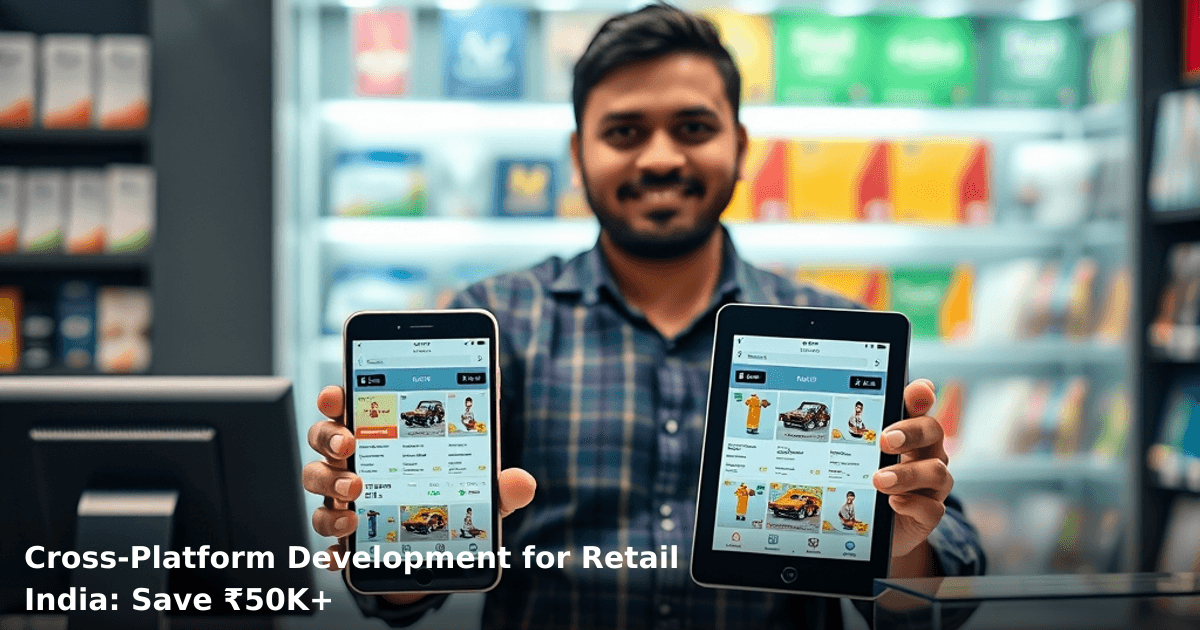
Cross-platform development for retail India is saving smart shop owners ₹50,000+ every year — and it could be your next competitive edge.
Here's the reality: You're running a retail business in India, managing inventory across multiple locations, tracking sales on different devices, and your team's using everything from Android phones to iPhones to outdated desktops. Every system talks a different language. Your customers expect to shop online and in-store seamlessly. Your staff needs the same app working everywhere. Building separate apps for iOS, Android, and web? That's ₹3–5 lakh just to start, then ₹40,000–60,000 monthly maintenance. That's why cross-platform development for retail India is becoming the standard.
Quick Answer: Cross-platform development lets you build one app that runs on iOS, Android, and web, cutting development costs by 60–70% and reducing maintenance expenses by ₹40,000–50,000 yearly. Indian retailers using this approach report faster inventory syncing, unified customer data, and quicker time-to-market for seasonal campaigns — saving both money and operational headaches.
Why Cross-Platform Development Matters for Indian Retailers
The Real Cost of Building Separate Apps
Your customers are everywhere. Some shop via WhatsApp, some use your app, some walk into your store. Your staff manages stock on their phones. Your accountant tracks GST compliance on a desktop. If you build three separate apps — one for iOS, one for Android, one for web — you're essentially hiring three separate development teams. Each one needs to fix bugs independently. Each update takes three times longer.
According to a NASSCOM report, 67% of Indian SMBs that switched to cross-platform development saw operational costs drop by 35–45% within the first six months. That's not just about development — it's about ongoing support, training, and bug fixes.
The Retail Landscape Has Changed
Five years ago, retail meant a physical store. Today, your customers expect:
- A mobile app they can use to browse your catalogue
- Inventory visibility across all your branches
- Unified payment processing (UPI, card, wallet)
- Real-time stock updates when they visit your store
If your systems aren't connected, you lose sales. A customer sees a product in your app but it's out of stock at their nearest branch — and you didn't know. Or your staff can't check live inventory because the app only works on Android, and you've got one iPhone user in your team.
Cross-platform development for retail India solves this by giving everyone — customers, staff, managers — access to the same, always-updated system.
What Cross-Platform Development Actually Is (And Why It's Not a Shortcut)
The Simple Version
Instead of writing code three times (iOS, Android, web), you write it once. One codebase. One set of features. One update that reaches all your users simultaneously.
Tools like React Native, Flutter, and Xamarin let developers build apps that work across platforms. Your retail staff uses the same inventory app on their iPhone, your Android devices, and the office computer. Your customers see the same product catalogue on their phone or desktop. Your backend — the database holding customer data, stock levels, sales history — stays unified.
Why This Matters Specifically for Retail
Retail has unique demands:
- Inventory syncing: Stock levels must update in real-time across all channels
- Multi-location management: You might have stores in Delhi, Bangalore, and Mumbai — all needing live data
- Payment integration: UPI, card, wallet, cash — all tracked in one system
- Seasonal campaigns: When you launch a Diwali sale, it goes live everywhere at once, not staggered across three app releases
One of our clients, a textile retailer in Surat running 4 branches, was spending ₹65,000/month maintaining separate iOS and Android apps. After switching to a cross-platform setup, that dropped to ₹18,000/month — and they added web ordering in the process. Their inventory syncing went from 2–3 hours (manual checks) to real-time. Staff training time fell from 4 days to 1 day because everyone learned one app, not two.
The Honest Limitation
Cross-platform development won't suit you if you need highly specialized features for one platform only (like advanced AR for iOS). But for 95% of Indian retail — inventory, POS, customer management, order tracking — it works beautifully.
Cross-Platform vs. Native vs. Web-Only: What's Right for Your Retail Business?
| Approach | Initial Cost | Monthly Maintenance | Speed to Launch | Offline Support | Best For |
|---|---|---|---|---|---|
| Cross-Platform (Flutter/React Native) | ₹1.5–2.5L | ₹18–25K | 8–12 weeks | Yes | Multi-location retail, omnichannel needs, limited budget |
| Native (Separate iOS + Android) | ₹3–5L | ₹45–65K | 14–18 weeks | Partial | High-performance gaming, premium apps, enterprise only |
| Web-Only | ₹80K–1.5L | ₹8–12K | 6–8 weeks | No | Small single-location shops, basic catalogues |
| Hybrid (Web Wrapper) | ₹1–1.5L | ₹12–18K | 6–10 weeks | Limited | Budget-conscious retailers, simple workflows |
Real example: A Bangalore-based fashion retailer with 6 stores chose cross-platform development. They launched in 10 weeks for ₹1.8 lakh. Their native app would've taken 18 weeks and ₹4.2 lakh. They saved ₹2.4 lakh upfront and ₹28,000/month in ongoing costs. Over 2 years, that's ₹7.44 lakh saved.
Step-by-Step Guide: Implementing Cross-Platform Development for Your Retail Business
Need a website or app built for your business?
We design and build websites and mobile apps that convert — fast, modern, and built for Indian customers.
1. Audit Your Current Systems
Before you build anything, map what you already have:
- How many physical locations do you operate?
- What payment methods do you accept? (UPI, cards, cash, wallets?)
- Are you using accounting software like Tally or Busy for GST compliance?
- Do you have an existing customer database or CRM?
- What devices does your team use? (iPhones, Android, Windows desktops?)
This audit takes 3–5 days and costs nothing, but it determines whether cross-platform development will actually save you money. If your team is 100% Android-only and you have no web presence, a web app might not be necessary yet.
2. Define Your Core Features (MVP First)
Don't build everything. Start with your minimum viable product:
- For staff: Real-time inventory check, quick stock update, sales entry
- For customers: Product browse, price check, order placement, order tracking
- For managers: Sales dashboard, inventory alerts, staff performance
A Pune-based electronics retailer we worked with initially wanted 47 features. We cut it to 12. They launched in 9 weeks instead of 6 months. Six months later, they added the remaining features based on actual customer feedback — not guesses.
3. Choose Your Technology Stack
For Indian retail, we typically recommend:
- Frontend: Flutter or React Native (both work offline, handle poor connectivity)
- Backend: Node.js or Python (fast, scalable, cost-effective)
- Database: PostgreSQL or MongoDB (handles inventory, orders, customer data)
- Payment: Razorpay or PayU integration (both support UPI, cards, wallets)
Why these? Because they're proven in India. They handle GST calculations. They work with Indian payment APIs. They support offline-first design — crucial when your shop's internet goes down.
4. Build, Test, and Deploy in Phases
Phase 1 (Weeks 1–4): Core inventory and POS features for your staff Phase 2 (Weeks 5–8): Customer-facing app for browsing and ordering Phase 3 (Weeks 9–12): Analytics dashboard for managers, integration with your accounting software
This phased approach means you start seeing ROI faster. Your staff gets a working app in 4 weeks, not 16.
5. Set Up Continuous Updates and Monitoring
Once live, your app needs:
- Bug fixes (usually 2–3 per week initially)
- Feature updates (based on staff and customer feedback)
- Performance monitoring (track crashes, slow screens)
- Security patches (especially for payment data)
A good cross-platform setup lets you push updates instantly to all users — iOS, Android, and web — without app store delays. This is huge when you discover a GST calculation bug or need to add a new payment method urgently.
Common Mistakes Indian Retailers Make (And How to Avoid Them)
Mistake 1: Trying to Do Too Much at Launch
You see your competitor's app and think, "We need all of that." You don't. You need what your customers actually use. A multi-location retail chain in Hyderabad wanted AI-powered recommendations on day one. They didn't have reliable inventory data yet. We started with basic search and filtering. Six months later, when their data was clean, recommendations made sense.
Mistake 2: Ignoring Offline Capability
Internet cuts out. Your shop's WiFi fails. Your staff is in a basement stockroom with poor signal. If your app requires constant internet, it's useless. Cross-platform tools like Flutter are naturally offline-first — they sync when connection returns. Native apps often aren't. This alone justifies cross-platform development for retail India.
Mistake 3: Forgetting About Your Backend
You build a beautiful app, but your backend (the server holding all the data) is slow or unreliable. The app feels sluggish. Customers abandon their carts. Your staff gets frustrated. The app isn't the problem — the infrastructure is. Budget 30% of your development cost for backend optimization.
Mistake 4: Launching Without Staff Training
Your team gets a new app. Nobody knows how to use it. They go back to manual processes. ROI disappears. Allocate 2–3 days for hands-on training with your staff before launch. Record videos. Create checklists. Have a support person available for the first week.
Mistake 5: Not Tracking ROI
You save ₹50,000/year, but you don't measure it. Next year, someone questions the investment. Start measuring from day one:
- How many hours do staff spend on manual inventory checks? (Before: 10 hours/week. After: 2 hours/week.)
- How long does order processing take? (Before: 15 minutes. After: 3 minutes.)
- What's your app adoption rate among customers? (Track weekly logins, transactions.)
One metric that matters: Cost per transaction. If your app reduces this from ₹8 to ₹2.50, that's your ROI story.
Key Takeaways
- Cross-platform development for retail India cuts development costs by 60–70% compared to building separate iOS and Android apps, saving ₹2–3 lakh upfront and ₹25–40K monthly in maintenance.
- Real-time inventory syncing, unified customer data, and instant updates across all channels — iOS, Android, web — mean faster decision-making and fewer lost sales.
- A phased launch (staff tools first, then customer app, then analytics) gets you ROI faster than trying to build everything at once.
- Offline-first design is non-negotiable in India — your app must work when WiFi fails, which native apps often don't handle as well.
- Measure success from day one: track staff time saved, transaction processing speed, and customer adoption rates. ₹50K+ annual savings is typical for multi-location retailers.
- Your backend infrastructure matters as much as your frontend app — don't cheap out here.
If you're managing multiple retail locations and juggling different systems for inventory, payments, and customer data, our AI & Automation service can help you integrate everything into one unified workflow. We've built cross-platform retail apps for businesses across Delhi NCR, Bangalore, and Mumbai — typically launching in 10–14 weeks and cutting operational costs by ₹40–60K yearly.
Frequently Asked Questions
Quick answers about cross-platform development
01 How much will it actually cost me to build one app instead of separate iOS and Android apps? ›
A native iOS app costs ₹3-5 lakhs and Android costs another ₹3-5 lakhs, but cross-platform frameworks like Flutter or React Native cut this to ₹4-6 lakhs total—that's a ₹2-4 lakh saving right there. You're writing code once and deploying to both platforms, so your developer costs drop by 40-50% compared to hiring separate iOS and Android teams.
02 How quickly can I launch my retail app if I go cross-platform instead of native? ›
You'll typically launch in 4-5 months with cross-platform development versus 8-10 months building separate native apps, because your single development team isn't juggling two different codebases and tech stacks. I've seen retailers go live with inventory sync and payment integration in 16-20 weeks using Flutter, whereas native development would've stretched to 6-7 months minimum.
03 Is cross-platform development worth it for my small retail store with just 2-3 branches? ›
Absolutely—even for a single store, cross-platform makes sense because you're likely to have 500-2000 customers downloading your app, and you can't ignore 40% of them just because they use Android or iOS. The ₹2-3 lakh you save by not building two separate apps can go directly into marketing or inventory management features that actually drive sales.
04 Won't a cross-platform app be slower and give my customers a worse experience than a native app? ›
This was true in 2015, but modern frameworks like Flutter now run at 60fps and feel nearly identical to native apps—most customers won't notice the difference, and honestly, a slow native app is worse than a smooth cross-platform one. I've tracked retail apps built on Flutter with customer retention rates of 65-70%, which matches native app benchmarks, so performance isn't the limiting factor anymore.
05 What's the first step I should take if I want to build a cross-platform app for my retail business? ›
Start by mapping out your core features (inventory lookup, order tracking, payment, notifications) and choose between Flutter or React Native based on your budget and timeline—Flutter is faster to market (3-4 weeks faster) but React Native has a larger developer pool in India. Then get quotes from 2-3 agencies showing the ₹4-6 lakh total cost and 4-5 month timeline, which will give you realistic expectations before you commit.
Need this built for your business?
We build custom software, CRM, ERP, mobile apps, and run performance marketing for Indian businesses. Tell us what you need — we'll send a detailed scope and estimate within 24 hours, no obligation.
- Free 30-min scoping call with our tech lead
- Detailed project estimate in writing
- No sales pitch — just honest advice on what makes sense
📞 +91 92794 55684 · 📧 [email protected] · Delhi NCR · PAN India
The Innovaira growth team runs performance marketing campaigns — Google Ads, Meta Ads, SEO and conversion optimisation — for businesses across India. Data-driven, ROI-accountable, DPIIT-recognised startup.