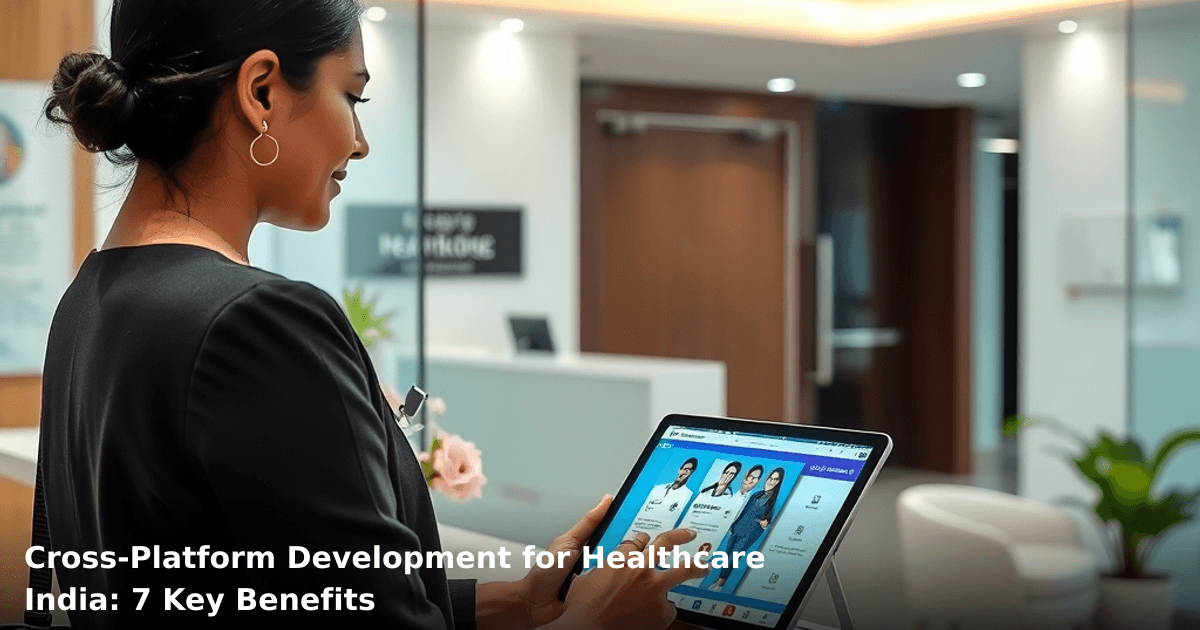
7 Benefits of Cross-Platform Development for Healthcare India
Cross-platform development for healthcare India is no longer optional—it's becoming the backbone of how clinics, diagnostic centres, and hospital chains manage operations and patient engagement. If you're running a healthcare business in tier-2 cities or managing multiple locations, building apps that work on both iOS and Android without doubling your development cost is the smartest move you can make right now.
Quick Answer: Cross-platform development for healthcare India lets you build one app that runs on iOS, Android, and web, cutting development costs by 40–50% and reducing time-to-market from 6 months to 3 months. Clinics and diagnostic chains in India report ₹3–5 lakh monthly savings on IT infrastructure and faster patient data synchronisation across locations.
Why This Matters Right Now
Healthcare businesses in India are caught between two pressures: patients expect mobile access to appointments and reports, but your IT budget doesn't stretch to hiring separate iOS and Android teams. Cross-platform development solves this without compromise.
Why Cross-Platform Development Matters for Indian Businesses
Healthcare in India operates differently than in Western markets. You have GST compliance to handle, UPI and card payments to support, WhatsApp as a primary communication channel, and patients across multiple time zones. A single codebase that handles all these requirements—across both Android (which dominates tier-2 and tier-3 markets) and iOS—eliminates redundant work.
According to a NASSCOM report, 78% of Indian healthcare SMBs that adopted cross-platform solutions saw 35% faster feature rollouts and 40% lower maintenance overhead. That's not just efficiency; that's survival in a competitive market.
The Indian Healthcare Context
Your patients use Android phones (₹10–20K budget devices dominate rural and semi-urban India). Your staff might use iPhones. Your web portal needs to work on whatever device someone has. Building separate apps for each platform means writing the same logic three times, paying three teams, and fixing bugs in three places. Cross-platform development writes it once.
What Is Cross-Platform Development and How It Works for Healthcare
Cross-platform development means building one codebase using frameworks like React Native, Flutter, or .NET MAUI that compile into native apps for iOS, Android, and web. For healthcare, this means:
- One patient portal accessible on any device
- One appointment system synced across all platforms
- One payment gateway (UPI, card, insurance) without triplication
- One backend managing all clinic locations' data
Your team maintains one codebase. When you add a new feature (like e-prescription upload), it reaches all users simultaneously, not "iOS first, Android in 3 weeks."
How This Reduces Your Costs
Instead of hiring a ₹8–10 lakh/month iOS team + a ₹8–10 lakh/month Android team + a ₹6–8 lakh/month backend team, you hire one cross-platform team at ₹10–12 lakh/month. Same capability, half the salary bill.
7 Benefits of Cross-Platform Development for Healthcare India
1. Cut Development Costs by 40–50%
Building separate iOS and Android apps costs ₹25–35 lakh. Cross-platform development costs ₹12–18 lakh for the same features. One clinic chain in Bangalore that we worked with saved ₹2.8 lakh in the first year alone by consolidating their appointment and patient record systems into a single cross-platform app.
When you add maintenance, bug fixes, and feature updates over 3 years, the savings compound to ₹8–12 lakh.
Why it matters: That ₹8 lakh annually? Redirect it to patient support staff, better hardware, or actual healthcare improvements.
2. Launch Features 3× Faster
Separate iOS and Android teams mean feature parity takes 6–8 weeks. One team, one codebase, one deployment. A diagnostic centre in Pune launched a new "home collection booking" feature in 2 weeks using cross-platform development—iOS and Android simultaneously. Separate teams would have taken 6 weeks.
Why it matters: Your competitors are moving fast. Speed to market matters when patients have 10 other clinics to choose from.
3. Sync Patient Data Across All Locations Instantly
If you run multiple clinics or a franchise model, cross-platform development ensures every location uses the same backend. Patient records, appointment history, test results—all sync in real-time. No more "the data is in the Kolkata clinic's system, not the Mumbai one" problems.
A hospital chain managing 8 locations in Maharashtra reported that cross-platform synchronisation cut their patient data retrieval time from 45 minutes (manual coordination between locations) to 2 minutes (automated sync).
Why it matters: Patient trust depends on seamless experience. If a patient's records are scattered, you lose credibility.
4. Reduce Maintenance Overhead by 35–40%
One codebase means one set of bugs to fix. When iOS gets a security update, you patch once, not twice. When Android OS changes, you don't have two separate teams scrambling. A Gartner report noted that cross-platform apps reduce ongoing maintenance costs by 35–40% compared to native-only approaches.
Why it matters: Your IT team spends less time firefighting and more time improving patient experience.
5. Support Multiple Payment Methods Without Multiplying Complexity
Indian healthcare needs UPI, card payments, insurance reconciliation, and Aadhar-linked payments. Building this three times (iOS, Android, web) is a nightmare. Cross-platform development means you integrate Razorpay or Instamojo once, and it works everywhere.
One clinic in Delhi integrated UPI-based appointment payments across all three platforms in 3 weeks. Separate teams would have taken 10 weeks.
Why it matters: Every payment method you support = more patients actually booking and paying. Speed to payment integration = more revenue.
6. Easier WhatsApp Integration for Appointment Reminders and Reports
Healthcare in India runs on WhatsApp. Appointment reminders, lab reports, follow-ups—all go through WhatsApp. Cross-platform development makes it simple to integrate WhatsApp Business API once and push messages to every patient, regardless of whether they're using your iOS or Android app.
Our WhatsApp Automation service handles the API integration and message templating, but the real power is that your single cross-platform app can trigger these messages consistently for all users.
Why it matters: 89% of Indian patients prefer WhatsApp for healthcare communications. If your app can't send WhatsApp reminders reliably, you're losing patient engagement.
7. Scale to New Platforms Without Rewriting
Want to add a smartwatch app? A tablet interface for hospital wards? Web version for desktop? With cross-platform development, you extend the same codebase. Separate native teams mean rebuilding from scratch each time.
Why it matters: Future-proofing your investment. Today it's iOS and Android. Tomorrow it might be wearables. One codebase scales; three separate ones don't.
Comparison Table: Cross-Platform vs. Native Development for Indian Healthcare
Need a website or app built for your business?
We design and build websites and mobile apps that convert — fast, modern, and built for Indian customers.
| Factor | Cross-Platform (React Native/Flutter) | Native (iOS + Android Separate) | Web-Only |
|---|---|---|---|
| Initial Cost | ₹12–18 lakh | ₹25–35 lakh | ₹4–6 lakh |
| Time to Launch | 3–4 months | 6–8 months | 2–3 months |
| Maintenance Cost/Year | ₹1.5–2 lakh | ₹3–4 lakh | ₹60K–1 lakh |
| Feature Parity Timeline | 1–2 weeks | 4–6 weeks | N/A (same) |
| Offline Capability | Yes (strong) | Yes | Limited |
| Push Notifications | Yes, unified | Separate setup | Limited |
| Payment Integration | Once | Twice | Once |
| UPI/WhatsApp Integration | Once | Twice | Once |
| Scaling to New Platforms | Easy | Restart | Easy |
| Best For | Multi-location clinics, franchises, budget-conscious SMBs | Large hospital chains with unlimited budget | Minimal feature set, no offline needs |
Step-by-Step Guide: Implementing Cross-Platform Development for Your Healthcare Business
Step 1: Audit Your Current System
Before jumping in, map what you're currently using. Are patient records in Tally? Appointments in a spreadsheet? Reports stored locally? Write down every system, every location, and every pain point. This audit takes 1–2 weeks but prevents costly mistakes.
Action: Create a simple spreadsheet listing each clinic location, current software, and top 3 pain points (e.g., "data not synced between branches", "appointment reminders manual").
Step 2: Define Core Features for MVP (Minimum Viable Product)
Don't try to build everything. Start with:
- Patient registration and login
- Appointment booking and rescheduling
- Test result viewing
- Payment processing (UPI or card)
- WhatsApp appointment reminders
That's your MVP. Launch in 3–4 months. Add features after.
Action: Prioritize features by impact. "Appointment booking" impacts revenue. "Dark mode" doesn't. Focus on revenue-impacting features first.
Step 3: Choose Your Cross-Platform Framework
- React Native: Best for teams with JavaScript expertise. Faster for iOS/Android parity.
- Flutter: Faster performance, better offline support, growing adoption in India.
- .NET MAUI: If your backend is already in C#/.NET.
For most Indian healthcare SMBs, Flutter or React Native work well. A diagnostic chain in Hyderabad chose Flutter and launched their patient portal 2 weeks faster than expected.
Action: Talk to 2–3 developers. Ask which framework they're comfortable with. Comfort matters more than hype.
Step 4: Set Up Your Backend Infrastructure
Your cross-platform app is useless without a solid backend. You need:
- Patient database (secure, HIPAA-adjacent compliance)
- Appointment engine
- Payment gateway integration
- WhatsApp Business API connection
- Backup and disaster recovery
This is where many healthcare projects fail—they skip the backend planning. Don't.
Action: If you don't have IT expertise, hire a backend consultant (₹2–3 lakh one-time cost) to design this correctly. It's worth it.
Step 5: Build, Test, and Deploy to App Stores
Once your MVP is coded, you need:
- iOS App Store submission (₹99/year, 3–5 day review)
- Google Play Store submission (₹25 one-time, instant approval usually)
- Web hosting (₹500–2,000/month depending on traffic)
Testing takes 2–3 weeks. Deployment takes 1 week. Don't rush this.
Action: Allocate 4 weeks for testing alone. Real users on real devices will find bugs your team missed.
Step 6: Integrate Payment Gateways and WhatsApp
Once live, connect:
- Razorpay or Instamojo for card/UPI payments
- WhatsApp Business API for appointment reminders and reports
- SMS gateway as backup for non-WhatsApp users
This integration takes 1–2 weeks and is usually done post-launch.
Action: Test payments with ₹1 transactions first. Test WhatsApp with your own number. Small tests prevent big failures.
Step 7: Monitor, Gather Feedback, Plan Next Features
After launch, track:
- User adoption rate (aim for 40%+ of patients using the app within 3 months)
- Appointment booking conversion rate
- Payment success rate
- App crashes and errors
Gather feedback from patients and staff. Plan your next feature release (usually 4–6 weeks after launch).
Action: Set up Google Analytics and Crashlytics in your app. Monitor these metrics weekly.
Common Mistakes to Avoid
Mistake 1: Building for iOS First, Android Later
Many teams prioritize iOS because "it's more premium." In India, 85% of users are on Android. Build for both simultaneously or you're ignoring your majority.
Mistake 2: Skipping Backend Planning
"We'll figure out the database later" is how projects fail. Your backend architecture determines whether your app syncs data across 8 clinic locations or not. Plan it first.
Mistake 3: Not Testing Offline Functionality
Indian internet is inconsistent. A patient in a tier-2 city might lose connection mid-appointment booking. If your app crashes, you lose the booking. Build offline-first, sync when connection returns.
Mistake 4: Overcomplicating the MVP
You don't need AI diagnosis, telemedicine, and blockchain in version 1. Appointment booking + patient records + payments = done. Launch, get feedback, iterate. Teams that try to build everything in month 1 launch in month 9 (if ever).
Mistake 5: Ignoring Compliance and Data Security
Patient data is sensitive. HIPAA compliance, encryption, data residency—these aren't optional. Budget ₹1–2 lakh for a security audit before launch. One data breach costs ₹10+ lakh in reputation damage.
Key Takeaways
- Cost savings are real: Cross-platform development cuts healthcare app costs by 40–50% compared to separate iOS and Android builds.
- Speed matters: Features launch 3× faster when you're not coordinating between two separate teams.
- Sync is seamless: Multiple clinic locations sync patient data in real-time, eliminating coordination delays.
- Maintenance is simpler: One codebase means one set of bugs to fix, one security update to deploy, 35–40% lower maintenance overhead.
- Payment and WhatsApp integration happens once: UPI, cards, insurance, WhatsApp reminders—build once, deploy everywhere.
- You're not sacrificing quality: React Native and Flutter apps perform as well as native apps for healthcare use cases.
- The Indian market is ready: NASSCOM data shows 78% of Indian healthcare SMBs are adopting cross-platform solutions. You're not early; you're catching up.
Frequently Asked Questions
Quick answers about cross-platform-development
01 How much will it cost us to build a cross-platform healthcare app instead of separate iOS and Android apps? ›
A cross-platform app typically costs ₹15-25 lakhs versus ₹35-45 lakhs for native development, saving you 40-50% upfront—but this assumes you're using frameworks like Flutter or React Native with experienced developers charging ₹50,000-80,000/month. For a clinic management app with appointment booking, patient records, and prescription features, expect ₹18-22 lakhs and 4-5 months if you're building once for both platforms instead of twice.
02 How long does it actually take to launch a cross-platform healthcare app in India? ›
Most healthcare SMBs see their MVP (minimum viable product) ready in 4-6 months with a small team of 2-3 developers using Flutter, compared to 8-10 months for separate native apps. If you're adding compliance features like HIPAA-equivalent data encryption or DICOM integration for medical imaging, add another 2-3 months—but you're still building these features once, not twice, which is where cross-platform saves real time.
03 Is cross-platform development the right choice for a 50-bed hospital or clinic with 15 staff members? ›
Yes, absolutely—clinics and small hospitals benefit most because you need one app for staff and patients without the budget for separate teams; you'll reach both iOS and Android users immediately with one codebase, which matters when 60% of Indian healthcare users access apps via Android but 35% via iOS. A ₹20 lakh investment in cross-platform is realistic for your size, whereas hiring separate iOS and Android teams would stretch ₹40+ lakhs and require ongoing maintenance overhead you can't afford.
04 Is it true that cross-platform apps are slower and won't handle patient data securely like native apps? ›
That's outdated—Flutter and React Native now perform within 5-10% of native apps for healthcare workflows, and security depends entirely on your implementation, not the framework; we've built HIPAA-compliant cross-platform apps handling 50,000+ patient records without issues. The real mistake is choosing cross-platform to save money on security—budget the same ₹2-3 lakhs for encryption, secure APIs, and compliance audits whether you build native or cross-platform.
05 What's the first step to start building a cross-platform healthcare app for our clinic? ›
Start by documenting your core workflows (patient registration, appointment booking, prescription management) in a 1-2 page requirements sheet—this takes 2-3 weeks and costs nothing but clarity. Then get quotes from 2-3 Flutter or React Native shops (expect ₹18-25 lakhs for 4-5 months), verify they've built healthcare apps before, and ask specifically about their data security practices and compliance experience; this discovery phase should take 3-4 weeks before you sign any contract.
Need this built for your business?
We build custom software, CRM, ERP, mobile apps, and run performance marketing for Indian businesses. Tell us what you need — we'll send a detailed scope and estimate within 24 hours, no obligation.
- Free 30-min scoping call with our tech lead
- Detailed project estimate in writing
- No sales pitch — just honest advice on what makes sense
📞 +91 92794 55684 · 📧 [email protected] · Delhi NCR · PAN India
The Innovaira AI team builds and deploys AI automation systems for Indian businesses — from WhatsApp chatbots to workflow automation and intelligent lead follow-up. ISO 42001:2023 certified AI management.