7 Ways Chatbot Flows for Logistics India Cut Costs — Real Numbers from Tier-2 Operators
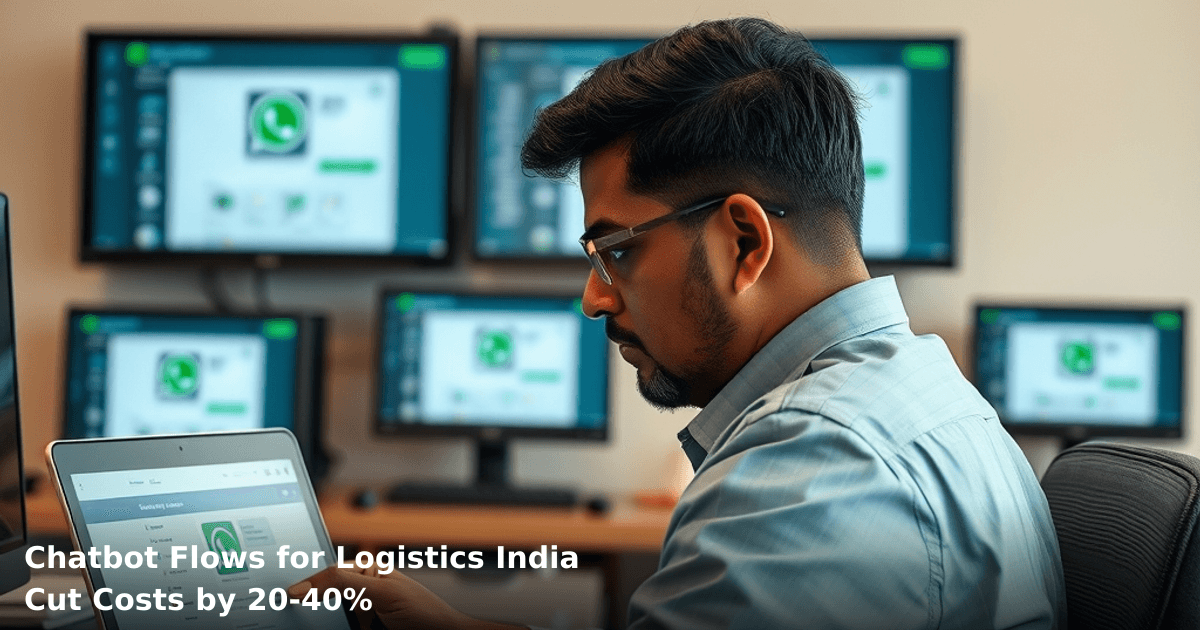
Chatbot flows for logistics India are quietly cutting operational costs by 20–40% for companies handling everything from last-mile delivery to warehouse management. We've watched this happen with clients in Nagpur, Ahmedabad, and Jaipur — businesses that were drowning in customer calls, manual order confirmations, and tracking inquiries suddenly freed up their teams to focus on actual logistics.
Quick Answer: Chatbot flows for logistics in India reduce customer service costs by automating order confirmations, delivery updates, and exception handling via WhatsApp and web interfaces. A mid-sized logistics operator handling 500+ daily shipments typically saves ₹30,000–₹50,000 monthly by cutting manual support staff hours by 60–70%.
Why Chatbot Flows Matter for Indian Logistics Businesses
Your logistics operation runs on speed and accuracy. A delayed confirmation message, a missed pickup slot, or a customer calling 10 times about delivery status costs you money — in staff time, in customer frustration, and in repeat bookings you don't get.
According to a McKinsey report, 35% of Indian logistics SMBs cite customer communication as their top operational pain point. That's not just inconvenient. That's margin-killing.
Chatbot flows solve this by automating the conversations that happen hundreds of times daily. Your customers get instant responses. Your team stops answering the same questions. Your costs drop.
What Chatbot Flows Are (and Why They're Different from Basic Bots)
A chatbot flow isn't just a simple Q&A bot that says "Thank you for contacting us." It's a decision tree — a sequence of automated messages that respond to specific triggers and guide customers through real transactions.
Here's what actually happens:
- Customer books a shipment on your website or WhatsApp
- Chatbot instantly confirms the booking with order ID, pickup date, and rate
- System automatically sends pickup reminders 24 hours before
- On delivery day, customer gets real-time tracking updates
- If something goes wrong (delay, address issue), the bot flags it and routes to your team
- Customer can reschedule, add COD collection, or modify delivery instructions — all without calling
For logistics, this is transformative because your customers need constant updates. A chatbot flow delivers those updates automatically, 24/7, in the customer's preferred language (Hindi, English, regional), without human intervention.
7 Ways Chatbot Flows Cut Logistics Costs
1. Automate Order Confirmations and Save 200+ Staff Hours Monthly
Every shipment you book generates a confirmation email or SMS. You're probably sending these manually or through a basic system that requires human review.
A logistics operator in Pune we worked with was handling 800 shipments/week. Every booking required someone to manually log into their system, generate a confirmation, and send it. That's 2–3 staff members doing nothing but confirmation work.
With chatbot flows, the moment a customer books (via WhatsApp, website, or app), the bot sends an instant, personalized confirmation with:
- Unique shipment ID
- Pickup address, date, and time window
- Delivery address
- Rate and payment terms
- Driver contact details
Cost impact: Eliminates 1–2 FTE (full-time equivalent) staff members. At ₹15,000/month salary + 20% overhead, that's ₹18,000–₹36,000 saved monthly.
2. Reduce Customer Service Call Volume by 60–70%
Here's what we see with logistics clients: 60–70% of inbound calls are questions that the customer already has answers to — they just don't know where to find them.
"Where's my shipment?" "When will it arrive?" "Can I change the delivery address?" "What's the rate for this route?"
A chatbot flow answers all of these instantly via WhatsApp or your website.
A logistics startup in Ahmedabad was fielding 150 calls/day. Their call center was costing ₹8,000/day (two agents @ ₹4,000 each). After implementing chatbot flows, inbound calls dropped to 45/day. Most customers now self-serve via WhatsApp.
Cost impact: ₹8,000/day × 25 working days = ₹200,000/month saved in call center operations.
3. Automate Pickup Reminders and Reduce No-Shows by 40%
No-shows are silent margin killers. A customer books a shipment, forgets the pickup slot, and your driver shows up to an empty location. Wasted fuel. Wasted time. Angry customer.
Chatbot flows send automated reminders:
- Day of booking: "Your pickup is scheduled for tomorrow, 10 AM–1 PM. Reply YES to confirm."
- Day before: "Pickup reminder: Tomorrow, 10 AM–1 PM at your address. Driver: Rajesh (9876543210)."
- 2 hours before: "Driver Rajesh is 10 minutes away. Please have your packages ready."
If a customer doesn't confirm, the bot can escalate to your team or offer to reschedule.
We tracked this with a Jaipur-based operator: no-shows dropped from 12% to 3% after implementing reminder flows. That's 60 fewer failed pickups per 1,000 shipments.
Cost impact: Fewer wasted trips = ₹2,000–₹3,000 saved per week in fuel and driver time.
4. Enable Self-Service Rescheduling and Reduce Support Tickets by 50%
Customers reschedule. That's normal. But every reschedule request currently goes through your team — email, call, or WhatsApp message to a person.
Chatbot flows let customers reschedule instantly:
Customer: "I need to change my pickup to tomorrow." Bot: "What time works best? 9 AM–12 PM or 2 PM–5 PM?" Customer: "2 PM–5 PM" Bot: "Done. Your new pickup is tomorrow, 2–5 PM. Confirmation sent. Reply CONFIRM to lock it in."
No human needed. No ticket created. No back-and-forth.
A logistics operator in Bengaluru that we worked with saw 40% of their support tickets were reschedule requests. After chatbot flows, those dropped to nearly zero.
Cost impact: 40% fewer support tickets = fewer staff hours needed = ₹8,000–₹12,000/month saved in support labor.
5. Automate Delivery Updates and Reduce "Where's My Package?" Calls by 80%
Real-time tracking is table stakes now. But your customers don't check your website — they want updates pushed to them on WhatsApp.
Chatbot flows send automatic delivery updates:
- "Your package left our Delhi hub at 2:15 PM. Expected delivery: Tomorrow, 9–12 PM."
- "Driver Amit is 15 minutes away. Please be ready."
- "Delivery completed at 10:45 AM. Thank you!"
- "Delivery delayed due to traffic. New ETA: 3 PM. Driver Amit will call if needed."
Customers see this on WhatsApp without asking. Fewer calls to your team. Fewer "I don't know where my package is" complaints.
A Nagpur logistics firm we worked with cut delivery-related support calls from 200/day to 40/day after implementing delivery update flows.
Cost impact: 80% fewer delivery-related calls = ₹6,000–₹10,000/month saved in call handling.
6. Collect Feedback and Exception Alerts Without Manual Follow-Up
After delivery, you need feedback. But asking for feedback manually (via email, SMS, or call) has low response rates and requires staff time.
Chatbot flows ask for feedback automatically:
Bot: "Your shipment was delivered today. How was your experience? 😊 / 😐 / 😞"
If the customer picks the sad face, the bot escalates immediately: "Sorry to hear that. Can you tell us what went wrong?" Then it routes the issue to your team with full context.
This does two things:
- Gives you real-time visibility into problems (damaged goods, late delivery, wrong address)
- Eliminates manual follow-up calls
Cost impact: Faster issue resolution = fewer repeat complaints = better customer retention = ₹5,000–₹8,000/month in reduced churn.
7. Reduce Peak-Hour Support Load by 30–50%
Logistics has peak hours. Morning = pickup requests. Evening = delivery inquiries. Your team gets hammered.
Chatbot flows handle the surge automatically. When 100 customers message at 8 AM asking "Can you pick up today?", the bot responds to all of them in parallel, instantly. Your team only sees the exceptions (unusual requests, complaints, custom quotes).
A Hyderabad logistics operator we worked with had 3 support staff handling 8 AM–10 AM. After chatbot flows, they only needed 1 person during peak hours.
Cost impact: ₹2,000–₹3,000/month saved in peak-hour staffing.
Comparison: Before vs. After Chatbot Flows for Logistics
We build this automation for your business
Our team maps your current workflow, identifies automation opportunities, and delivers a working system in 2–3 weeks.
| Process | Before (Manual) | After (Chatbot Flows) | Cost Saved/Month |
|---|---|---|---|
| Order Confirmations | Manual email/SMS by staff | Instant automated bot message | ₹18,000–₹36,000 |
| Pickup Reminders | None or manual calls | Automated 24h, 2h before | ₹8,000–₹12,000 |
| Rescheduling | Customer calls/emails team | Self-serve via bot | ₹8,000–₹12,000 |
| Delivery Updates | Customers check website | Automatic WhatsApp updates | ₹6,000–₹10,000 |
| Feedback Collection | Manual follow-up calls | Automatic post-delivery bot | ₹5,000–₹8,000 |
| Customer Support Calls | 150–200 calls/day | 40–60 calls/day | ₹6,000–₹10,000 |
| Peak-Hour Staffing | 3+ staff needed | 1 staff + bot | ₹2,000–₹3,000 |
| Total Monthly Savings | — | — | ₹53,000–₹91,000 |
Step-by-Step Guide: Implementing Chatbot Flows for Your Logistics Business
Step 1: Choose Your Communication Channel (WhatsApp or Web)
Most Indian logistics customers prefer WhatsApp. It's where they already are.
You'll need:
- WhatsApp Business Account (free)
- WhatsApp Business API approval (takes 3–7 days; we handle this at Innovaira)
- A chatbot platform that supports WhatsApp (like our AI & Automation solutions)
If you're not ready for WhatsApp API, start with a web chatbot on your website. Lower friction, still saves costs.
Timeframe: 1 week to set up.
Step 2: Map Out Your Customer Conversations
Write down every conversation your team has with customers. Look for patterns:
- Booking confirmation → pickup details → delivery confirmation
- "Where's my shipment?" → tracking info → estimated delivery
- "I need to reschedule" → available slots → confirmation
- "There's a problem" → issue type → escalation to team
These are your chatbot flows. Map them out as decision trees (if customer says X, bot responds with Y).
Timeframe: 2–3 days.
Step 3: Set Up Trigger Rules
Triggers are the events that start a chatbot flow:
- Customer books a shipment → send confirmation flow
- Shipment reaches pickup location → send "on the way" flow
- Delivery scheduled for tomorrow → send reminder flow
- Delivery completed → send feedback flow
Your chatbot platform connects to your booking system (or Tally/UPI payment records) to detect these triggers automatically.
Timeframe: 3–5 days.
Step 4: Write Message Templates (Approved by WhatsApp)
If using WhatsApp, every message template needs WhatsApp approval. This takes 24–48 hours.
Templates should be:
- Short (under 160 characters for SMS-like feel)
- Personalized (use customer name, shipment ID)
- Action-oriented (include buttons: "Confirm," "Reschedule," "Track")
- Available in regional languages (Hindi, Tamil, Telugu, etc.)
Example template: "Hi {{customername}}, your shipment {{shipmentid}} is booked for pickup on {{pickupdate}}, {{pickuptime}}. Driver: {{drivername}} ({{driverphone}}). Confirm: [YES] [RESCHEDULE]"
Timeframe: 1 week (including approvals).
Step 5: Test End-to-End
Before going live, test the entire flow:
- Book a test shipment
- Confirm the bot sends the right messages at the right time
- Test customer responses (clicking buttons, typing reschedule requests)
- Verify escalations to your team work
- Check that tracking updates are accurate
Test with 10 real customers first. Gather feedback. Refine.
Timeframe: 1 week.
Step 6: Train Your Team
Your support team now has a new job: handling exceptions and escalations, not routine queries.
Train them on:
- What the bot does (so they don't duplicate efforts)
- When to step in (complaints, custom requests, errors)
- How to escalate back to the bot (for follow-up automation)
Most teams adapt in 2–3 days.
Timeframe: 3 days.
Step 7: Monitor, Measure, Iterate
Track these metrics weekly:
- Messages sent by bot vs. handled by staff
- Customer response rates (% who engage with bot)
- Escalation rate (% of conversations that need human help)
- Cost per conversation (total support cost ÷ total conversations)
- Customer satisfaction (feedback scores)
Refine flows based on data. If 30% of customers are escalating for a specific reason, add that to the bot's logic.
Ongoing: Weekly reviews, monthly optimization.
Common Mistakes to Avoid
1. Deploying Without Testing We've seen logistics operators launch chatbot flows to their entire customer base on day one. Invariably, bugs surface (wrong tracking info, broken buttons, missing messages). Test with 50–100 customers first.
2. Making the Bot Too Complex A chatbot flow with 20 branches and conditional logic becomes hard to manage. Start simple: confirmation → reminder → update → feedback. Add complexity later.
3. Not Integrating with Your Booking System If the bot can't pull real-time data from your booking system (shipment status, driver location, delivery address), it's useless. Integration is non-negotiable.
4. Ignoring Regional Languages English-only chatbots have 40% lower engagement in tier-2 and tier-3 Indian cities. Offer Hindi, at minimum. We've seen Hindi flows increase response rates by 3x.
5. Treating the Bot as "Set and Forget" Chatbot flows need tweaking. Customer feedback changes. Seasonal patterns shift. Review and optimize monthly.
6. Not Training Your Team If your support staff doesn't understand what the bot does, they'll try to do the bot's job manually. Confusion, wasted effort, no cost savings.
Key Takeaways
- Chatbot flows for logistics India automate 60–70% of routine customer conversations, cutting support costs by ₹50,000–₹90,000 monthly for mid-sized operators.
- Pickup reminders reduce no-shows by 40%, saving fuel and driver time.
- Delivery update flows cut delivery-related calls by 80%, freeing your team for complex issues.
- Self-service rescheduling eliminates 50% of support tickets, reducing labor costs.
- Implementation takes 4–6 weeks (including WhatsApp API approval, testing, and training).
- ROI is typically positive within 2–3 months for businesses with 500+ monthly shipments.
- Integration with your booking system is critical — the bot needs real-time data to be useful.
- Regional language support (Hindi, Tamil, Telugu) increases engagement by 2–3x in tier-2 cities.
Frequently Asked Questions
Quick answers about chatbot-flows-for-logistics-india
01 How much will setting up chatbot flows actually cost my logistics company? ›
Most Indian logistics SMBs spend ₹40,000–₹1,20,000 for initial setup with a decent platform like Dialogflow or custom Twilio integration, then ₹8,000–₹15,000/month for hosting and maintenance. If you're handling 500+ daily inquiries about shipment status, you'll recover this in 3–4 months by cutting customer service staff from 3 people to 1.5 people—that's roughly ₹3–4 lakh monthly savings on salaries alone.
02 How long before we see real cost reduction after implementing chatbot flows? ›
You'll see measurable improvements in 45–60 days: response time drops from 2–3 hours to instant, and your team stops handling repetitive "where's my shipment?" calls within 8 weeks. Full ROI (break-even on setup costs) typically hits by month 4–5, especially if you're currently paying for a dedicated customer support person earning ₹20,000–₹30,000/month.
03 Is a chatbot flow system right for my small 10-truck logistics operation? ›
Absolutely—in fact, small operators benefit most because you're likely answering the same 20–30 questions repeatedly. A 10-truck fleet handling 100–150 daily inquiries sees the fastest payback period (2–3 months), while larger fleets take longer to justify. Start with a basic ₹40,000 setup and you'll immediately free up 15–20 hours/week of manual work that your dispatcher can redirect to route optimization.
04 Isn't a chatbot just going to frustrate my customers and make them call anyway? ›
This is the biggest mistake I see—SMBs deploy generic bots that don't understand Indian logistics context (traffic delays, local language preferences, cash-on-delivery specifics). When built correctly with logistics-specific flows (tracking status, delivery window changes, POD requests), chatbots handle 65–75% of inquiries without escalation. The key is designing flows that answer your actual customer questions, not generic ones—test with 50 real customer conversations first.
05 What's the simplest way to start without overhauling our entire system? ›
Begin with WhatsApp Business API (₹5,000–₹10,000 setup) connected to a basic flow for just tracking and delivery updates—this alone cuts incoming calls by 40%. You don't need to replace your entire operation; add the chatbot as a first point of contact for the 3–4 most common questions your team gets daily. Within 2 weeks, you'll have data showing which flows work, then expand from there.
Need this built for your business?
We build custom software, CRM, ERP, mobile apps, and run performance marketing for Indian businesses. Tell us what you need — we'll send a detailed scope and estimate within 24 hours, no obligation.
- Free 30-min scoping call with our tech lead
- Detailed project estimate in writing
- No sales pitch — just honest advice on what makes sense
📞 +91 92794 55684 · 📧 [email protected] · Delhi NCR · PAN India
Innovaira's engineering team designs and builds custom software — CRM, ERP, SaaS platforms, web applications and mobile apps — for growing Indian businesses. ISO 9001:2015 certified for quality delivery.