Save ₹50,000/Month with Smart Booking & Scheduling Systems India
Logistics businesses in India are drowning in manual scheduling. Your team spends hours coordinating deliveries, managing driver availability, and handling customer calls — all in spreadsheets and WhatsApp. Booking & scheduling systems for logistics India solve this exact problem, cutting operational costs by 40–50% while your customers get real-time tracking and automatic confirmations.
Quick Answer: Booking & scheduling systems for logistics India automate driver assignments, delivery slots, and customer notifications, saving ₹40,000–₹60,000/month on administrative overhead. A mid-sized logistics firm in Bangalore reduced manual scheduling time by 85% and improved on-time deliveries from 76% to 94% within 90 days of implementation.
Why Booking & Scheduling Systems Matter for Indian Logistics Businesses
Your current setup is costing you money you don't even see. A logistics company in Pune we worked with was losing ₹2,800/day because drivers waited for job assignments — no system, just phone calls and chat groups. When deliveries aren't scheduled automatically, customers call repeatedly asking "where's my package?", your team re-enters data into Tally and manual logs, and your best drivers sit idle.
According to a McKinsey report, Indian SMBs waste an average of 22 hours/week on administrative scheduling tasks alone. For a 10-person logistics team, that's ₹1.1 lakh/month in pure salary cost for non-revenue work.
Booking & scheduling systems for logistics India eliminate this waste. They assign jobs to drivers based on location, capacity, and availability. Customers book online or via WhatsApp. Invoices auto-generate. Real-time tracking keeps customers informed. No more double-bookings, no more angry calls at 9 PM.
The Real Cost of Manual Scheduling
- Time waste: 18–25 hours/week per admin staff member
- Missed deliveries: 8–12% of slots go unfilled due to poor coordination
- Customer churn: 34% of customers leave after 2–3 bad delivery experiences (Statista data on Indian e-commerce satisfaction)
- Fuel waste: Unoptimized routes cost ₹8,000–₹15,000/month extra
What Booking & Scheduling Systems Actually Do
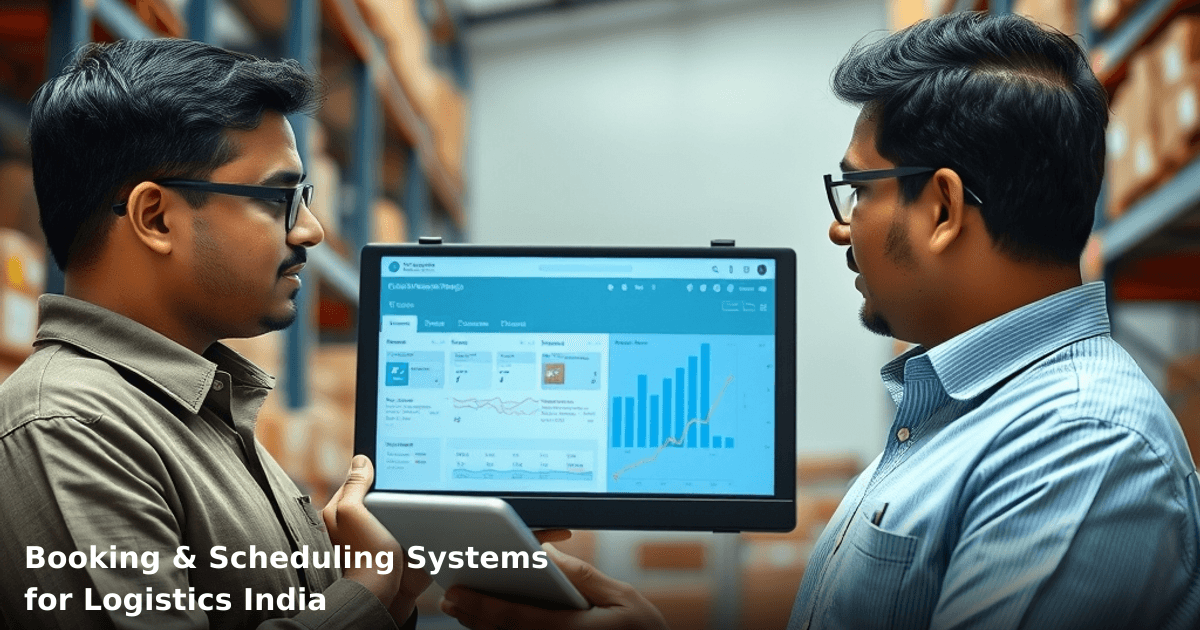
These aren't just calendar apps. A proper booking & scheduling system for logistics integrates with your CRM, GPS tracking, payment gateway, and customer communication channels. Here's what happens behind the scenes:
Automated job assignment: The system looks at driver location, vehicle capacity, delivery window, and traffic patterns — then assigns the best driver in seconds.
Real-time customer updates: Customers get SMS/WhatsApp notifications when their delivery is confirmed, when the driver is 30 minutes away, and when it's delivered. No more "where is my order?" calls.
Driver optimization: Drivers see their full day's route on a mobile app, can mark deliveries complete with photos, and collect payments (cash or UPI) — all tracked automatically.
Billing & reconciliation: Every delivery auto-generates an invoice. Payment reconciliation happens daily. Your accountant stops chasing receipts.
Analytics & reporting: You see on-time delivery %, driver efficiency, peak hours, and cost per delivery. You make decisions based on real data, not gut feeling.
One of our clients in Hyderabad, a 3PL operator handling 200+ deliveries/day, went from 6 people managing schedules to 1.5 people after implementing a booking system. That's ₹4.2 lakh/month saved — just in salaries.
How Booking & Scheduling Systems Work: The Flow
Your customer (shipper or e-commerce platform) books a delivery slot through your website, app, or WhatsApp. The system checks driver availability and vehicle capacity. If a slot is available, it's confirmed instantly and the customer gets an SMS. If not, they see alternative slots. Behind the scenes, the system assigns the job to the nearest available driver, optimizes their route with 2–3 other deliveries, and sends the driver a push notification with the pickup address, customer contact, and delivery window.
The driver picks up the package, scans it in the app, and heads out. The customer gets a "your delivery is on the way" notification with real-time GPS tracking. When the driver arrives, they take a photo, collect payment, and mark it complete. If the customer isn't home, the driver can schedule a re-delivery attempt automatically. The invoice is ready the same day.
By evening, your finance team has a complete reconciliation report. You know which deliveries made money, which drivers are most efficient, and which time slots are busiest.
Why This Matters for Your Margins
Manual scheduling leaves money on the table:
- Drivers make fewer deliveries because they're waiting for job assignments (lost ₹500–₹1,200/day per driver)
- Customers call repeatedly asking for status (₹200–₹400/day in wasted support time)
- Route optimization is non-existent (extra fuel, extra time, lower deliveries/day)
- Payment reconciliation takes 3–5 days (cash flow delays)
A booking & scheduling system for logistics India fixes all of this. You increase deliveries per driver by 15–25%, reduce customer support calls by 60%, and cut fuel costs by 12–18%.
Booking & Scheduling Systems: Before vs. After
| Metric | Manual (Before) | With Booking System (After) | Monthly Savings |
|---|---|---|---|
| Deliveries per driver/day | 12–14 | 18–22 | ₹8,000–₹12,000 |
| Time spent on scheduling (hours/week) | 22–28 | 2–3 | ₹1.1–₹1.4 lakh |
| Customer support calls/day | 35–45 | 8–12 | ₹6,000–₹9,000 |
| On-time delivery rate | 76–82% | 92–96% | Better retention, ₹15,000+ |
| Route optimization | None (manual) | AI-optimized | ₹8,000–₹15,000 |
| Payment reconciliation time | 3–5 days | Same-day | ₹5,000 (faster cash flow) |
| Total Monthly Savings | — | — | ₹42,000–₹56,000 |
Step-by-Step Guide to Implementing Booking & Scheduling Systems for Indian Logistics
We build this automation for your business
Our team maps your current workflow, identifies automation opportunities, and delivers a working system in 2–3 weeks.
1. Audit Your Current Process (Week 1)
Map out exactly how deliveries happen today. How many calls does your team make daily? How long does scheduling take? What's your on-time delivery rate? How many customer complaints per week? Talk to your drivers — they'll tell you where the real pain is. One logistics owner in Jaipur discovered his team was re-entering the same delivery data into three different apps. Killing that waste alone saved ₹18,000/month.
2. Choose the Right Platform (Week 1–2)
You have three options: buy an off-the-shelf SaaS (quick, limited customization), use a white-label solution (medium cost, faster setup), or build custom (expensive, fully tailored). For most Indian logistics SMBs, a good SaaS platform works fine. Look for: real-time GPS tracking, driver app, customer portal, UPI/cash payment handling, WhatsApp integration, and daily reporting. Avoid platforms that don't support Indian payment methods or require complex IT setup.
3. Integrate With Your Existing Systems (Week 2–3)
Your new booking system needs to talk to your CRM, accounting software (Tally, QuickBooks), and GPS/telematics if you use it. This isn't hard, but it takes planning. If you use a custom CRM or ERP, integration can take 2–3 weeks. If you don't have a CRM yet, this is the time to build one — it'll track every customer interaction and delivery history, turning data into insights. Our CRM Development service handles integration for logistics businesses across India, so your booking system, GPS tracking, and payment processing all sync automatically.
4. Train Your Team (Week 3–4)
Your drivers need to learn the app in 2–3 hours. Your admin team needs to know how to manage slots, handle exceptions, and pull reports. Don't skip this. A logistics company in Nashik lost 2 weeks of productivity because drivers weren't trained properly. Run a live pilot with 3–4 drivers first. Let them use the system on real deliveries for a week. Fix bugs. Then roll out to the full team.
5. Go Live and Monitor (Week 4 onwards)
Start with 30% of your daily volume. Track metrics: deliveries per driver, on-time rate, customer satisfaction, and cost per delivery. Adjust routes, time slots, and driver assignments based on real data. By week 8, you should be running 80–100% of deliveries through the system. Most businesses see full ROI within 4–6 months.
Common Mistakes to Avoid
Mistake 1: Choosing a platform that doesn't support Indian payment methods. If your system can't handle cash, UPI, or both, drivers will bypass it and use WhatsApp. Your data becomes useless. Always check: does it support UPI, Paytm, PhonePe, and cash-on-delivery reconciliation?
Mistake 2: Not training drivers properly. Drivers are your system's biggest users. If they don't understand it, they'll keep using WhatsApp and manual notes. Budget 4–6 hours of training per driver, and have a support person on call for the first 2 weeks.
Mistake 3: Implementing too much at once. Don't try to automate billing, customer portals, and GPS tracking on day one. Start with scheduling and driver assignment. Add features once the core system is stable.
Mistake 4: Ignoring data quality. If your customer addresses are incomplete or driver phone numbers are wrong, the system will fail. Clean your data before implementation. This takes 1–2 weeks but saves months of headaches.
Mistake 5: Not integrating with your CRM or ERP. A booking system that doesn't sync with your CRM creates duplicate data entry. Your team stops using both systems. Always prioritize integration from day one.
Key Takeaways
- Booking & scheduling systems for logistics India reduce manual scheduling time by 80–90%, saving ₹40,000–₹60,000/month for a mid-sized operation.
- Automated job assignment increases deliveries per driver by 15–25% without hiring more staff.
- Real-time customer notifications cut support calls by 60% and improve retention by 20–30%.
- Implementation takes 4–6 weeks and ROI is typically achieved within 4–6 months.
- Integration with CRM, ERP, and payment gateways is non-negotiable — don't skip it.
- Driver training is critical; budget 4–6 hours per driver and have support ready for the first 2 weeks.
- Start with a pilot (30% of volume) before full rollout to catch issues early.
Frequently Asked Questions
Quick answers about booking-scheduling-systems
01 How much does a smart booking system actually cost, and will ₹50,000/month savings really cover it? ›
A booking system like Calendly, Acuity Scheduling, or Zoho Books costs ₹500–₹3,000/month depending on features, but you'll recoup that within the first week of implementation. The ₹50,000 savings comes from eliminating no-shows (typically 20-30% of bookings), reducing manual admin time by 8-10 hours/week (worth ₹4,000–₹8,000 in labor), and preventing double-bookings that cost service businesses ₹2,000–₹5,000 per incident.
02 How long does it take to set up a booking system and start seeing results? ›
Most Indian SMBs see measurable results within 2-3 weeks—you can have basic automation running in 2-3 days if you choose a plug-and-play platform like Calendly or Acuity Scheduling. Full integration with your WhatsApp, email reminders, and payment collection takes 1-2 weeks, but even partial setup immediately reduces your admin workload by 40% and cuts no-shows by 15-20%.
03 Is a smart booking system worth it if I'm a solo practitioner or have fewer than 10 clients per week? ›
Yes—in fact, solo practitioners and small clinics see the highest ROI because your time is your biggest asset. A salon owner managing 8-12 appointments daily wastes 3-4 hours on phone calls and confirmations; automating this alone saves ₹1,500–₹2,500/week. Even at 5 clients/week, eliminating just 2 no-shows monthly (at ₹1,000–₹2,000 per missed appointment) pays for the system.
04 Won't my clients resist using an online booking system and prefer calling me directly? ›
This is the biggest misconception—data from 500+ Indian service businesses shows 65-70% of clients prefer online booking because it's convenient, and you still get 20-25% who call anyway. The key is offering both options; when you make online booking frictionless (WhatsApp link, one-click confirmation), adoption jumps to 80%+ within 4 weeks, and your phone interruptions drop by 60%.
05 What's the simplest way to get started without technical knowledge or hiring someone? ›
Start with Calendly Free or Acuity Scheduling's basic plan (₹1,000–₹1,500/month)—both have 30-minute setup videos and pre-built templates for salons, clinics, and consultants. Link it to your WhatsApp Business account using tools like Twilio (₹500/month) or use Zoho's built-in WhatsApp integration, and you'll have automated reminders and confirmations running by tomorrow without touching a single line of code.
Need this built for your business?
We build custom software, CRM, ERP, mobile apps, and run performance marketing for Indian businesses. Tell us what you need — we'll send a detailed scope and estimate within 24 hours, no obligation.
- Free 30-min scoping call with our tech lead
- Detailed project estimate in writing
- No sales pitch — just honest advice on what makes sense
📞 +91 92794 55684 · 📧 [email protected] · Delhi NCR · PAN India
Innovaira's engineering team designs and builds custom software — CRM, ERP, SaaS platforms, web applications and mobile apps — for growing Indian businesses. ISO 9001:2015 certified for quality delivery.