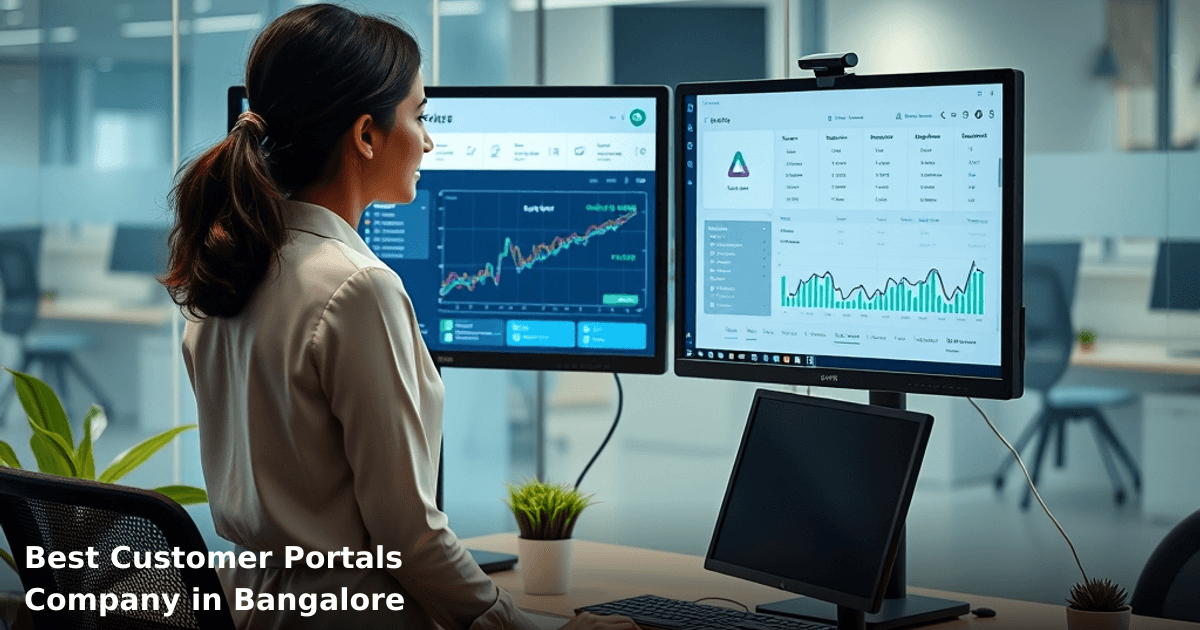
Best Customer Portals Company in Bangalore: How to Choose
Your customers want to check order status at 11 PM. Your team wants to stop fielding the same "where's my delivery?" calls every day. A customer portal in Bangalore, India solves both — but only if you pick the right vendor and build it right.
Quick Answer: A customer portal is a self-service platform where your customers log in to track orders, view invoices, download documents, and resolve issues without contacting your team. Bangalore has 15+ vendors offering this; the best ones integrate with your existing CRM or ERP, cost ₹15,000–₹50,000/month, and reduce support tickets by 40–60%. Choose based on your industry (e-commerce, SaaS, services), integration needs, and whether you need WhatsApp or email notifications built in.
Why Customer Portals Matter for Indian Businesses
Your customers expect instant access. Not because they're demanding — because Amazon, Flipkart, and even Zomato have trained them to expect it.
A NASSCOM report showed that 68% of Indian SMBs that implemented customer self-service portals saw a 45% drop in support costs within 6 months. That's not just about saving money on support staff. It's about freeing your team to focus on selling, not explaining.
Here's the real situation in Bangalore: You've got a booming tech and logistics ecosystem. Your customers are scattered across India. Your support team is drowning. A proper customer portal isn't a luxury — it's operational survival.
We've worked with a textile exporter in Surat who was handling 200+ customer inquiries daily via email and WhatsApp. After implementing a customer portal with order tracking and invoice downloads, their support queries dropped to 60 per day. That's not magic. That's automation doing what it's supposed to do.
What a Good Portal Does (and What It Doesn't)
A good customer portal lets your customers:
- Track orders in real-time
- Download invoices and receipts
- Update their profile and payment details
- Submit support tickets and see status
- Access past transaction history
- Receive automated notifications
What it doesn't do: It doesn't replace your sales team or customer service entirely. It handles repetitive, predictable queries. Your team still handles complaints, upsells, and relationship-building.
What Is a Customer Portal? How It Works
A customer portal is a web or mobile interface where your customers log in with credentials (email + password, or UPI ID for Indian businesses) and access their data without your involvement.
Here's the flow:
- Customer logs in → 2. System verifies identity → 3. Portal pulls their data from your database → 4. Customer sees their orders, invoices, tickets → 5. Customer takes action (downloads, requests, updates) → 6. Your system logs the action and notifies your team if needed
The technical part: Your portal connects to your backend database (or CRM/ERP system) via APIs. When a customer views their order, the portal queries your database and displays real-time information.
For Indian SMBs, the most common setup is:
- Web-based portal (desktop + mobile-responsive)
- Integrated with CRM or ERP (so data syncs automatically)
- WhatsApp or email notifications (because Indians prefer WhatsApp)
- UPI payment integration (for businesses collecting payments)
Why Bangalore Vendors Are Different
Bangalore has a massive pool of developers and SaaS companies. That's both good and bad.
Good: Competition means better pricing and faster innovation. Bad: It's easy to pick the wrong vendor because there are so many.
Bangalore-based vendors typically understand:
- GST compliance for invoicing
- Integration with Indian payment gateways (Razorpay, PayU, Instamojo)
- WhatsApp Business API for notifications
- Tally or Busy integration for accounting
Comparison: Top Customer Portal Approaches in Bangalore
| Feature | Build Custom (In-House) | Use SaaS Platform | Hire Bangalore Vendor | White-Label Solution |
|---|---|---|---|---|
| Setup Time | 4–6 months | 2–4 weeks | 3–8 weeks | 1–2 weeks |
| Cost (First Year) | ₹8–15 lakh | ₹1.5–3 lakh | ₹2–4 lakh | ₹50k–1.5 lakh |
| Monthly Maintenance | ₹30k–50k | ₹10k–20k | ₹15k–30k | ₹5k–15k |
| Customization | 100% | 20–40% | 60–80% | 30–50% |
| Integration Flexibility | Full | Limited | High | Medium |
| Best For | Large enterprises | Startups, SaaS | Growing SMBs | Very small businesses |
| India Tax/Payment Support | Yes (if coded right) | Sometimes | Yes | Sometimes |
Our recommendation for most Bangalore SMBs: Hire a Bangalore vendor for custom development. You get faster setup than building in-house, more customization than SaaS, and someone local who understands Indian compliance.
Step-by-Step Guide: Choosing a Customer Portal Company in Bangalore
Step 1: Define Your Use Case and Industry
Different industries need different portals. A B2B SaaS company needs different features than an e-commerce business or a coaching institute.
Ask yourself:
- What do your customers need to do most often? (Check order status? Download invoices? Submit support tickets?)
- Are you B2B or B2C? (B2B portals need role-based access and bulk operations; B2C needs simplicity)
- What's your transaction volume? (100 orders/month or 10,000?)
Example: A property developer in Bangalore needs a portal where buyers track construction progress, download documents, and submit maintenance requests. That's different from a logistics company where customers just need real-time tracking.
Step 2: List Your Integration Requirements
This is where most SMBs go wrong. They pick a portal company, then realize it doesn't talk to their ERP.
Write down:
- What systems does this portal need to connect to? (Your CRM? ERP? Accounting software? Payment gateway?)
- Do you need WhatsApp notifications? (Most Indian businesses do)
- Do you need SMS or email, or is WhatsApp enough?
- Do you need to sync data in real-time or is daily sync okay?
Example: We helped a textile exporter in Bangalore who was using Tally for accounting and a custom CRM for orders. Their portal needed to pull order data from the CRM and invoice data from Tally. Not every vendor can do this. We did.
Step 3: Check Their Portfolio and Ask for Bangalore References
Any vendor worth hiring has case studies or references. Specifically ask for:
- 2–3 Bangalore-based clients (so you can call them)
- Clients in your industry (or similar)
- How long their portals have been running (avoid vendors whose oldest project is 6 months old)
Call those references. Ask:
- How long was setup?
- Did they hit the timeline and budget?
- What broke after launch? (Honest vendors will admit something did)
- How's the support? (This matters more than you think)
Step 4: Evaluate Their Technical Stack and Scalability
Ask them:
- What tech stack do they use? (React, Vue, Node.js, Python, etc. — the specific names matter less than whether they're modern)
- Can the portal handle your projected growth? (If you're growing 50% year-on-year, can it scale?)
- Do they use cloud hosting (AWS, Azure, GCP)? (Cheaper and more reliable than on-premise servers)
- What's their uptime guarantee? (Should be 99.5% or better)
- How do they handle security? (SSL certificate, data encryption, regular backups, compliance with GDPR/DPDP Act)
Real scenario: A Bangalore e-commerce startup launched their portal on a vendor's shared server. When they got 5,000 concurrent users during a sale, the portal crashed. They switched vendors. Don't be them.
Step 5: Compare Pricing and Hidden Costs
Ask for a detailed quote that includes:
- Development cost (fixed or hourly?)
- Monthly hosting and maintenance
- Cost per user or transaction (if applicable)
- What's included vs. what costs extra? (e.g., SMS notifications, API integrations, custom reports)
Real pricing from Bangalore vendors (2024):
- Simple portal (order tracking + basic support): ₹1.5–2.5 lakh setup + ₹10k/month
- Mid-range portal (with CRM integration, WhatsApp, reports): ₹3–5 lakh setup + ₹20k/month
- Enterprise portal (full ERP integration, multi-tenant, advanced analytics): ₹8–15 lakh setup + ₹40k/month
Don't pick based on price alone. A ₹50k portal that crashes is more expensive than a ₹2 lakh portal that works for 3 years.
Common Mistakes to Avoid
Tired of scattered spreadsheets and manual follow-ups?
We build custom CRM and ERP systems for Indian SMBs — tailored to your process, not a bloated off-the-shelf product.
Mistake 1: Picking a Vendor Without Testing Integration
You like their portfolio. Their price is good. You sign the contract. Then, 3 weeks in, you realize their API doesn't work with your ERP.
Fix: Ask for a technical integration audit before signing. Have your developer (or hire one for a day) review their API documentation and test a connection.
Mistake 2: Ignoring WhatsApp and Notifications
You build a beautiful portal. Your customers never use it because they don't know it exists.
A portal without notifications is like a shop with no signboard. Set up automatic WhatsApp or email notifications: "Your order is ready" → Customer logs in → Problem solved.
If the vendor doesn't offer WhatsApp integration, our WhatsApp Automation service can layer it on top. Many of our clients in Bangalore do exactly this.
Mistake 3: Not Planning for Mobile
70% of Indian internet users access the web primarily via mobile. If your portal isn't mobile-responsive, you're blocking 7 out of 10 customers.
Test on actual phones (iPhone, Samsung, Redmi) before launch. Not just browser DevTools.
Mistake 4: Underestimating Support Costs
A portal needs ongoing support: bug fixes, feature requests, security updates, hosting management. Budget ₹10k–30k/month for this, even if the vendor says it's "included."
Mistake 5: Launching Without User Training
Your team doesn't know how to use the portal. Your customers don't know it exists. Launch day is chaos.
Fix: Plan for 2–4 weeks of training and soft launch. Start with 10% of your customers, gather feedback, then roll out to everyone.
Comparison: Top Vendors for Customer Portals in Bangalore (2024)
Here's what we see in the market:
| Vendor Type | Pros | Cons | Best For |
|---|---|---|---|
| Large IT Firms (TCS, Infosys, HCL) | Scalable, enterprise support, security | Expensive (₹15L+), slow, overkill for SMBs | Large enterprises, complex requirements |
| Bangalore SaaS Startups | Fast, affordable, modern tech | Limited customization, may shut down | Startups, simple use cases |
| Boutique Dev Shops | Customizable, local, responsive | Can be inconsistent, may lack depth | Growing SMBs, custom needs |
| Freelance Developers | Cheapest (₹30k–50k) | High risk, poor support, hard to scale | Very small businesses, low stakes |
Our take: For most Bangalore SMBs, a boutique dev shop or mid-sized agency is the sweet spot. You get customization without enterprise pricing.
If setting up a customer portal sounds complex, our CRM Development and ERP Development teams in Delhi NCR have built 50+ portals for Indian businesses. We handle the full integration — database design, API connections, WhatsApp notifications, and mobile optimization.
Key Takeaways
- A customer portal reduces support costs by 40–60% and improves customer satisfaction. For Bangalore businesses, this means real money saved and happier customers.
- Choose based on your industry and integrations, not price alone. A ₹1 lakh portal that doesn't sync with your ERP is worthless.
- Bangalore has excellent vendors, but do your homework. Check references, test integrations, and ask about scalability before signing.
- Budget ₹2–5 lakh for setup and ₹15k–30k/month for maintenance and hosting. This is the realistic range for a solid portal.
- Don't forget WhatsApp notifications. A portal without notifications is invisible to your customers.
- Plan for mobile-first design. 70% of your users are on phones.
- Start with a soft launch. Test with 10% of customers, gather feedback, then scale.
Frequently Asked Questions
Quick answers about customer-portals-bangalore-india
01 What's the actual monthly cost of a customer portal in Bangalore, and why do prices vary so much? ›
Most Bangalore portal vendors charge ₹15,000–₹50,000/month for SMBs, depending on user seats and features—basic portals start at ₹8,000/month but lack automation. The variation exists because enterprise-grade vendors bundle CRM integration, API access, and dedicated support (₹40,000+), while lightweight SaaS options skip these and cost ₹12,000–₹20,000; we typically see SMBs overpay by 30–40% by not auditing feature usage before signing annual contracts.
02 How long does it actually take to go live with a customer portal after signing up? ›
A cloud-based portal can go live in 2–4 weeks for basic setup (login, document access, ticket tracking), but if you need custom workflows, payment gateway integration, or data migration from legacy systems, add 6–8 weeks and ₹1–2 lakhs in implementation costs. Most vendors quote 3 weeks but hit delays because SMB owners take 10–15 days just to finalize requirements and get stakeholder sign-off.
03 Is a customer portal even worth it for my 50-person business, or is it overkill? ›
A portal is absolutely worth it at 50 people if you're handling 200+ customer interactions monthly—you'll see 35–45% reduction in support tickets and ₹80,000–₹1.2 lakh annual savings in staff time; however, if you're doing under 100 transactions/month or your customers are mostly walk-ins, stick with WhatsApp and email for another year and revisit when you hit 100+ employees.
04 Why do most customer portals fail in the first 6 months, and what's the real reason? ›
The biggest mistake isn't choosing the wrong vendor—it's poor adoption: 60–70% of portal implementations fail because SMB owners don't train staff to use it or fail to migrate customer data properly, so customers see empty portals and revert to calling support. Success requires 2–3 weeks of internal training, a phased rollout to 20% of customers first, and assigning one person to monitor adoption metrics weekly.
05 What's the first step I should take before even talking to portal vendors in Bangalore? ›
Map out your current customer touchpoints for one month (how many support calls, emails, document requests, payment follow-ups), then calculate the time your team spends on repetitive tasks—this number (usually 15–25 hours/week for a 50-person SMB) becomes your ROI baseline and helps you avoid overselling vendors who'll promise 80% automation when you only need 40%. Once you know this, you'll negotiate better pricing and pick features that actually solve your bottleneck.
Need this built for your business?
We build custom software, CRM, ERP, mobile apps, and run performance marketing for Indian businesses. Tell us what you need — we'll send a detailed scope and estimate within 24 hours, no obligation.
- Free 30-min scoping call with our tech lead
- Detailed project estimate in writing
- No sales pitch — just honest advice on what makes sense
📞 +91 92794 55684 · 📧 [email protected] · Delhi NCR · PAN India
Innovaira's engineering team designs and builds custom software — CRM, ERP, SaaS platforms, web applications and mobile apps — for growing Indian businesses. ISO 9001:2015 certified for quality delivery.