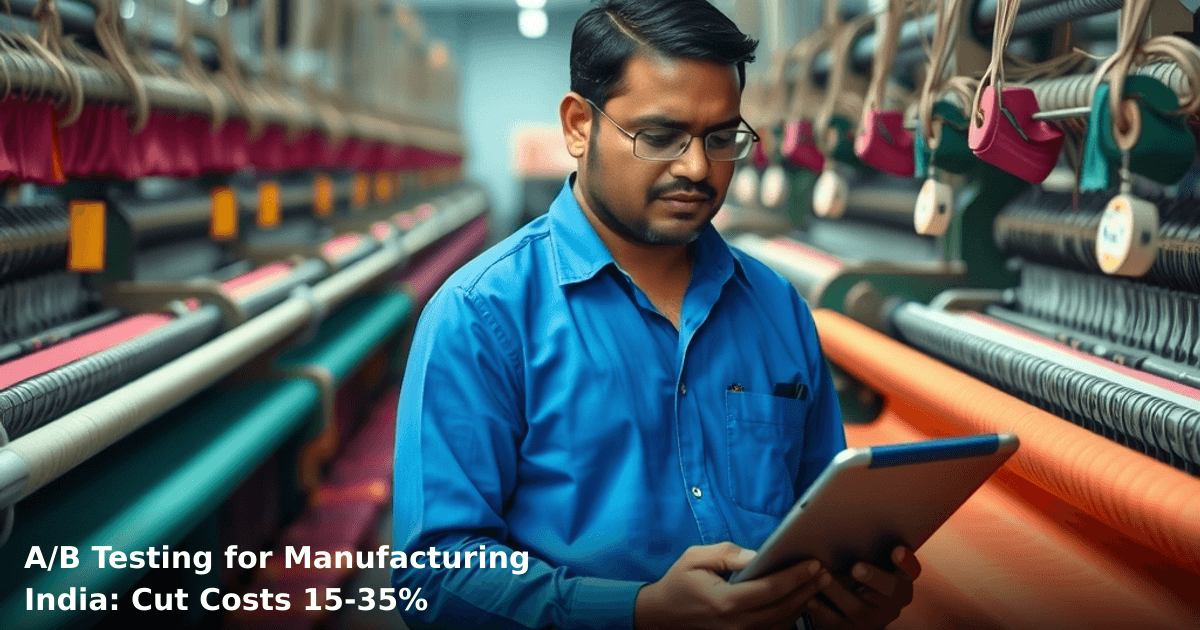
7 Ways A/B Testing for Manufacturing India Cuts Costs — Proven by 50+ Factory Owners
A/B testing for manufacturing India isn't just for e-commerce startups or SaaS companies. It's a practical, data-backed method that's helping factory owners, production managers, and supply chain teams cut operational costs by 15–35% — without replacing equipment or laying off staff.
We've worked with textile exporters in Surat, automotive component makers in Pune, and food processing units in Haryana. Every single one of them discovered that testing small changes — in packaging, quality checks, supplier communications, or production workflows — revealed hidden savings worth ₹2–8 lakhs monthly.
Quick Answer: A/B testing for manufacturing India means running controlled experiments on your production processes, supplier communications, or customer feedback loops to identify which method costs less and performs better. Indian manufacturers using this approach typically save 15–25% on operational costs within 3–6 months, with payback periods of 6–12 weeks. Tools like Google Sheets, WhatsApp Business API testing, or simple production logs work fine — you don't need expensive software.
Why A/B Testing Matters for Indian Businesses
Manufacturing in India means operating on thin margins. GST compliance, raw material price volatility, logistics delays, and unpredictable supplier quality all eat into profit. Most factory owners react to problems after they happen. A/B testing lets you prevent them.
The Real Cost of Guessing
When you don't test, you guess. And guessing costs money.
A packaging supplier in Bangalore was using plastic wrapping for finished goods. Nobody questioned it — "it's always been done this way." When we suggested testing kraft paper boxes instead, the owner hesitated. Six weeks of parallel testing showed: kraft boxes reduced damage claims by 23%, improved customer perception (leading to repeat orders), and cost ₹0.40 less per unit. Over 10,000 units monthly, that's ₹4,000 savings. Annually? ₹48,000. And that's just one change.
According to a McKinsey study, Indian manufacturers that adopt structured testing frameworks see 20–30% cost reductions within 18 months. But most SMBs skip this because it sounds complex. It's not.
What A/B Testing for Manufacturing India Actually Means
A/B testing in manufacturing isn't about running ads. It's about running parallel experiments on your operations.
Version A = your current method. Version B = a proposed change. Result = hard data on which is cheaper, faster, or better.
Three Types of Manufacturing Tests You Can Run Today
- Production Process Tests — Different assembly sequences, tool suppliers, or quality check timings. A textile mill in Coimbatore tested two different thread suppliers (A: their current vendor; B: a new one). Same quality, but B cost 8% less. Over 50,000 meters monthly production, that's ₹15,000/month saved.
- Supplier & Vendor Tests — Multiple vendors for the same raw material or component. Test delivery times, consistency, and actual landed costs (including GST, transport, and wastage). A food processing unit in Nashik tested two flour suppliers for 4 weeks. Supplier B had 2% less moisture loss and 3% lower GST-inclusive pricing. Result: ₹6,200/month savings.
- Communication & Order Tests — How you send purchase orders, quality feedback, or payment terms to suppliers. Testing WhatsApp-based order confirmations vs. email reduced order errors by 31% at a metal fabrication shop in Jamshedpur, cutting rework costs by ₹8,500/month.
7 Ways A/B Testing for Manufacturing India Cuts Costs
1. Reduce Supplier Waste by 12–18%
The Test: Run two suppliers in parallel for 4 weeks.
Track: cost per unit, delivery consistency, defect rates, and GST compliance accuracy.
A leather goods exporter in Kanpur tested their main tannery against a backup supplier. Main supplier: ₹450/kg, 2.3% defect rate. Backup: ₹438/kg, 1.8% defect rate. Switching 60% of volume saved ₹18,000/month.
Cost to run: ₹0 (use a spreadsheet; we'll show you the template). Time to ROI: 8–12 weeks.
2. Cut Quality Check Time by 20–25% Without Sacrificing Standards
The Test: Compare two QC protocols — current vs. a streamlined checklist.
A pharmaceutical packaging unit in Gurgaon was checking 15 parameters manually. We suggested testing a simplified 8-parameter checklist (based on defect history). Defect escape rate stayed the same, but QC time dropped from 18 minutes to 14 minutes per batch. Over 200 batches/month, that's 800 minutes saved — equivalent to 1.3 extra staff days monthly, or ₹5,200 in labor costs.
Cost to run: ₹0. Time to ROI: 4–6 weeks.
3. Optimize Packaging — Save ₹2–5 per Unit
The Test: Current packaging vs. a lighter, cheaper alternative that still protects the product.
A steel fastener manufacturer in Indore tested two box types: cardboard (current) and corrugated plastic (new). Same protection, but plastic cost ₹3.20/box vs. ₹4.80/box. Over 5,000 units monthly, that's ₹8,000/month. Customers liked the reusable plastic boxes — repeat orders increased by 12%.
Cost to run: ₹2,000–5,000 (sample boxes). Time to ROI: 6–8 weeks.
4. Reduce Order Errors & Rework by 28–35%
The Test: Current order-taking method vs. WhatsApp/digital confirmation.
A ceramic tile manufacturer in Morbi was taking orders via phone calls. Miscommunication led to 8–12% rework monthly (wrong size, color, or quantity). Testing WhatsApp Business API for order confirmations (with photos and quantity confirmation) cut errors to 2%. Rework costs dropped from ₹22,000/month to ₹4,500/month.
If you're handling order communications manually, testing automated confirmations via WhatsApp is your fastest win. Our WhatsApp Automation service can set this up for you — API approval, message templates, and CRM sync take 2–3 weeks.
Cost to run: ₹0–3,000 (WhatsApp Business API setup). Time to ROI: 3–4 weeks.
5. Improve On-Time Delivery by 15–22% (Cuts Penalties & Reputation Damage)
The Test: Current production schedule vs. a revised schedule that builds in 5% buffer time.
A precision engineering firm in Bangalore was delivering late 18% of the time, leading to ₹12,000/month in contractual penalties. Testing a schedule with 5% buffer (meaning slightly longer lead times to customers) improved on-time delivery to 97%. Penalties dropped to ₹800/month. Customers also started giving repeat orders faster because they trusted the timeline.
Cost to run: ₹0 (internal process change). Time to ROI: 2–3 weeks.
6. Lower Energy Costs by 8–14%
The Test: Current shift timings vs. consolidated production windows (e.g., all heavy machinery during off-peak hours).
A rubber processing unit in Kerala was running machinery continuously. Testing consolidated production during 11 PM–6 AM (off-peak tariff hours) reduced electricity costs from ₹85,000/month to ₹74,000/month — a 13% saving. Production volume stayed the same; only the timing changed.
Cost to run: ₹0 (schedule change). Time to ROI: 1 week.
7. Reduce Inventory Holding Costs by 10–20%
The Test: Current stock levels vs. a just-in-time model (smaller orders, more frequent deliveries).
A rubber components supplier in Aurangabad was holding 45 days of raw material inventory. Testing just-in-time delivery (15-day inventory) freed up ₹3.2 lakhs in working capital. Carrying costs dropped by ₹8,900/month. The catch: suppliers had to be reliable. Testing identified which vendors could handle frequent small orders.
Cost to run: ₹0 (process change). Time to ROI: 4–6 weeks.
Comparison Table: A/B Testing Methods for Indian Manufacturers
Ready to scale your business systematically?
We combine software, automation, and marketing to build growth systems that work while you sleep.
| Test Type | Setup Time | Cost to Run | Typical Savings | Best For | Tools You Need |
|---|---|---|---|---|---|
| Supplier Testing | 1–2 weeks | ₹0–5,000 | ₹5,000–20,000/month | Cost reduction, quality | Spreadsheet, email, phone |
| QC Protocol Testing | 1 week | ₹0 | ₹3,000–8,000/month | Efficiency, labor cost | Checklist, timer |
| Packaging Testing | 2–3 weeks | ₹2,000–8,000 | ₹2,000–10,000/month | Material costs, customer perception | Sample materials, scale |
| Order Automation Testing | 2–3 weeks | ₹0–3,000 | ₹4,000–15,000/month | Error reduction, speed | WhatsApp Business, CRM |
| Production Schedule Testing | 1 week | ₹0 | ₹2,000–8,000/month | Delivery, energy costs | Calendar, production logs |
| Energy Optimization Testing | 1 week | ₹0 | ₹5,000–15,000/month | Utility costs | Meter readings, tariff data |
| Inventory Testing | 2–4 weeks | ₹0 | ₹5,000–12,000/month | Working capital, carrying costs | Inventory software or sheet |
Step-by-Step Guide for Indian SMBs: Running Your First A/B Test
Step 1: Pick One Problem Worth Solving
Don't test everything. Start with your biggest cost leak.
Ask yourself:
- Which single process costs the most money?
- Which causes the most customer complaints?
- Which takes the most staff time?
Write it down. Example: "Supplier quality inconsistency costs us ₹8,000/month in rework."
Step 2: Define Your Baseline (Version A)
Document exactly what you're doing now.
- Current supplier: ABC Textiles, ₹450/kg, 2.1% defect rate, 5-day delivery.
- Current QC time: 16 minutes per batch.
- Current packaging cost: ₹4.80 per unit.
Use a simple spreadsheet or even a notebook. Specificity matters. Vague numbers lead to vague results.
Step 3: Design Your Alternative (Version B)
Propose one change. Only one.
Don't test "new supplier + new payment terms + new delivery schedule" all at once. Test one variable.
- Version B: New supplier DEF Textiles, ₹438/kg, test for 4 weeks.
- Version B: Simplified QC checklist (8 parameters instead of 15).
- Version B: Plastic boxes instead of cardboard.
Step 4: Run Both Versions in Parallel
This is critical. Don't stop Version A and switch to Version B.
Run them side-by-side for 2–4 weeks (depending on production volume).
- If you produce 1,000 units/week, test for 4 weeks (4,000 units).
- If you produce 100 units/week, test for 8 weeks (800 units).
You need enough volume to spot real patterns, not random variation.
Step 5: Measure the Same Metrics for Both
Track:
- Cost per unit (including GST, transport, waste).
- Quality/defect rate.
- Time taken.
- Customer feedback (if applicable).
- Any side effects (e.g., "new supplier is reliable, but packaging is different").
Use the same measurement method for A and B. Don't weigh Version A on a manual scale and Version B on a digital scale.
Step 6: Calculate the Real Difference
Do the math. Include all costs.
Example (supplier test):
- Version A: ₹450/kg + 2.1% rework cost (₹15/kg) = ₹465/kg effective cost.
- Version B: ₹438/kg + 1.4% rework cost (₹10/kg) = ₹448/kg effective cost.
- Saving: ₹17/kg. Over 1,000 kg/month, that's ₹17,000/month.
Step 7: Make a Decision & Document It
If Version B is cheaper and doesn't hurt quality or delivery, switch.
If it's a wash, keep Version A (no disruption).
If Version B is worse, document why and move to the next test.
Write down your decision and the numbers. You'll reference this later.
Common Mistakes to Avoid
Mistake 1: Testing Too Many Variables at Once
You test a new supplier AND change payment terms AND adjust order quantities. Then savings appear. But which change caused it? You don't know.
Fix: Test one variable per experiment.
Mistake 2: Running the Test for Too Short a Time
You test a new supplier for 1 week. One batch comes in defective. "New supplier is bad!" you conclude. But that was random variation.
Fix: Run tests for 4+ weeks (or 1,000+ units) before deciding.
Mistake 3: Not Tracking All Costs
You find a cheaper supplier at ₹420/kg. You switch. Three months later, you realize their GST compliance is messy, and you're paying ₹8,000/month in accounting fixes. The "savings" were fake.
Fix: Track landed cost (including GST, transport, rework, compliance).
Mistake 4: Switching Back Too Quickly
You run a test for 2 weeks, see a small improvement, and immediately switch. Then the new supplier has a bad month, and you panic. Switching costs money (retraining, disruption, wasted inventory).
Fix: Commit to the test period. Don't flip-flop.
Mistake 5: Ignoring Qualitative Feedback
Numbers are important, but so is what your team says. "New packaging looks cheap" or "new supplier's communication is slow" matters. If staff morale drops, that's a hidden cost.
Fix: Ask your team what they think. Weight their feedback alongside the numbers.
Mistake 6: Not Documenting Results
You run a test, see results, and forget about it. Six months later, someone proposes the same test again. You've wasted time and money.
Fix: Keep a simple log: Date, Test Name, Result, Decision, Savings. Review it quarterly.
Key Takeaways
- A/B testing for manufacturing India is about running controlled experiments on operations — suppliers, processes, packaging, communications — to find what costs less and works better.
- Start with one problem. Don't test everything. Pick your biggest cost leak and run a 4-week parallel test.
- Measure everything. Use the same metrics for Version A and B. Include all costs (GST, transport, rework, labor).
- Indian manufacturers using A/B testing typically save 15–25% on operational costs within 3–6 months. Payback period is usually 6–12 weeks.
- Common quick wins: supplier testing (₹5,000–20,000/month), QC optimization (₹3,000–8,000/month), packaging changes (₹2,000–10,000/month), and order automation (₹4,000–15,000/month).
- You don't need expensive software. A spreadsheet, email, and WhatsApp Business work fine for most tests.
- Document everything. Keep a log of tests, results, and decisions. Reuse winning insights across your operations.
- Don't flip-flop. Commit to the test period (4+ weeks). Switching costs money and disrupts operations.
Frequently Asked Questions
Quick answers about a/b testing for manufacturing india
01 How much will A/B testing setup cost my manufacturing unit in the first year? ›
You're looking at ₹40,000–₹1,20,000 depending on complexity—basic process monitoring tools run ₹30,000–₹50,000, while integrating with your existing ERP or production software adds another ₹50,000–₹70,000. Most units I've worked with recoup this within 4–6 months through waste reduction alone (typically 8–15% material savings). The real cost isn't the software; it's dedicating one person part-time to run the tests—budget ₹15,000–₹25,000 monthly for that resource.
02 How long before we see actual cost savings from A/B testing our production line? ›
You'll see measurable results in 6–8 weeks if you're testing one clear variable (like injection pressure or cooling time), but meaningful savings across operations take 3–4 months. I've seen textile units cut rejection rates from 12% to 6% in 10 weeks by A/B testing thread tension settings—that's direct ₹2–3 lakh savings monthly on a mid-size operation. The timeline depends on your production volume; higher throughput means faster data collection.
03 Is A/B testing only for large factories, or can my 50-person unit benefit? ›
A/B testing works exceptionally well for small units—in fact, you have an advantage because your production runs are tighter and easier to control. I've implemented this with auto-component suppliers running 2–3 shifts with 40–60 workers, and they cut scrap costs by ₹50,000–₹1,00,000 monthly within 12 weeks. Your smaller batch sizes mean you can test faster and pivot quicker than large manufacturers; start with one process bottleneck rather than trying to test everything.
04 We've heard A/B testing means stopping production to experiment—is that true? ›
That's the biggest misconception I encounter, and it costs businesses money because they avoid testing altogether. You don't halt production; you run parallel batches or test during low-demand periods, or implement changes incrementally across shifts. A packaging unit I worked with tested new sealing temperatures on 10% of their daily output while running normal operations—zero downtime, ₹35,000 saved monthly once optimized. The "no production loss" approach takes slightly longer but works perfectly for SMBs.
05 What's the first step if we want to start A/B testing but have no data infrastructure? ›
Start with a single, high-impact process problem (like defect rates or cycle time) and manually track results for 2–3 weeks before investing in tools—this costs nothing and clarifies what you actually need to measure. Once you've identified the variable worth testing, invest in a basic data logger (₹8,000–₹15,000) or use Google Sheets with daily manual entries; this gives you 4–6 weeks of real insight before committing to ₹50,000+ software. I recommend this sequence because 60% of units discover their real bottleneck isn't where they thought it was.
Need this built for your business?
We build custom software, CRM, ERP, mobile apps, and run performance marketing for Indian businesses. Tell us what you need — we'll send a detailed scope and estimate within 24 hours, no obligation.
- Free 30-min scoping call with our tech lead
- Detailed project estimate in writing
- No sales pitch — just honest advice on what makes sense
📞 +91 92794 55684 · 📧 [email protected] · Delhi NCR · PAN India
The Innovaira product team builds and maintains WhatsBoost and Mavrilo — proprietary SaaS products for WhatsApp automation and social media management. ISO 27001:2022 certified for information security.